Search This Blog

Friday, December 23, 2022

DL8: Der Lutheraner, Walther Years: redone (downloads)

[2025-06-14: updated links to DOCX files that are zipped to retain formatting.]
      This continues from Part 7d (Table of Contents in Part 1) in a series presenting Der Lutheraner, 1888-1934, in English. — Due to the success I had with the multi-column formatting of the post-Walther volumes of Der Lutheraner, in getting them in the same multi-column format as the original printed page, I decided to apply the same process to the volumes for the Walther Years. This will update, but not necessarily replace, the single-column format previously provided.  Below is a comparison of the original German with the 2 English versions:

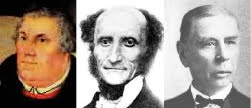
German original                                            *** English-multi-column ***                                 English, single column
(Der Lutheraner, volume 20 (1874), page 1)
The reader will notice that the (middle) formatted output is much closer to the German original, making it easier to compare and cross-reference to the source German page for any obvious OCR and translation errors. — The following table presents download links for the newer multi-column formatted translation of the Walther years, both as DOCX files and PDF files (in Internet Archive):
****  Der Lutheraner (Walther Years), in English, in original format  ****
Vol.YearDOCX (EN)PDF (EN)Vol.YearDOCX (EN)PDF (EN)Vol.YearDOCX (EN)PDF (EN)
11844-1845**161859-1860**311875**
21845-1846**171860-1861**321876**
31846-1847**181861-1862**331877**
41847-1848**191862-1863**341878**
51848-1849**201863-1864**351879**
61849-1850**211864-1865**361880**
71850-1851**221865-1866**371881**
81851-1852**231866-1867**381882**
91852-1853**241867-1868**391883**
101853-1854**251868-1869**401884**
111854-1855**261869-1870**411885**
121855-1856**271870-1871**421886**
131856-1857**281871-1872**431887**
141857-1858**291872-1873**
151858-1859**301874**
The benefit of this new version is not only the updated formatting, but also a slightly better translation due to minor improvements in proofing. Of course many errors still remain as discussed originally. — The PDF uploads to Internet Archive did not replace the unformatted (single column) version and so the the previous uploads were left intact because the Archive's OCR engine will not always work properly with a multi-column format, which renders the "FULL TEXT" mostly useless.
      This is the blog I am bookmarking for my future, and past, references to Der Lutheraner articles. — Now here is a table showing all the major download blogs for Der Lutheraner, Lehre und Wehre, and the St. Louis Edition of Luther's Works:
Publication / Format, file typeDOCX (EN) single columnDOCX (EN) multi-columnDOCX (DE) multi-columnPDF (EN)PDF (DE)Table of Contents (EN)Table of Contents (DE)
Der Lutheraner, Walther Years**coming**
Der Lutheraner, post-Walther Years*****
Lehre und Wehre, all years******
St. Louis Edition (Luther's Works)*coming**comingcoming

Monday, December 19, 2022

StL12f: Index vol. 23: Luther's powerful sayings, “a floral selection", "a kind of encyclopedia"

      This concludes from Part 12e (Table of Contents in Part 1) in a series on the St. Louis Edition (StL) of Luther's complete writings in English. —  Stoeckhardt concludes his essay with a review of the final volume, the Index volume 23.  It is a massive work, but we are given a wonderful sampling to encourage the readers to delve into this to read the sayings of Luther on the chief subjects of Christianity.  I added hyperlinks to all of the examples so that readers of this blog may instantly access the source of each example.  
- - - - - - - - - - - - - - - - - - - - - - - - - - - - - - - - - 

Luther's Works.

 [essay by Prof. George Stoeckhardt; concluded from Part 12e]

An excellent addition to Luther's writings is the index volume that has just appeared in print. It is a short extract of the previous volumes. It is a kind of encyclopedia, in which one can easily find any passage from Luther that one has in mind. It contains, as it were, a floral selection, a collection of Luther's powerful sayings strung together in factual order, given in Luther's own words. Whoever wants to find out in a nutshell what Luther taught, for example, about faith, righteousness, etc., only needs to read the passages listed under these titles. Prof. Hoppe remarks in the preface: “The editor of this index must confess with praise and thanksgiving that he has had rich spiritual blessings in Jesus Christ from his work, and now wishes all who use this index the same blessing of God. For it contains a brief epitome of the precious expositions which the chosen armament of God, Doctor Martin Luther, through the gift of the Holy Spirit, to the praise and glory of God's grace and mercy, has left us on the sacred book of the Bible.” (p. V) We give a sample. Under the heading “Righteousness” [Gerechtigkeit, see “Justice” here] we read column 610

“Christian righteousness is not such as is in us and sticks, but a foreign one, which is altogether apart from us; namely, Christ Himself is our perfect righteousness. 22, 292. Christian righteousness is in Christ alone and in faith in Him. 13, 2609. Christian righteousness is not my work, merit, obedience to the Law, but that I hear of Christ who bore my sin, and firmly believe this. 13, 1840. Christian righteousness does not come from our heart, nor does it stand in our works, but in faith in Christ. 13, 1991. True righteousness is not found in our works, even if they should be holy and unrighteous, but in the forgiveness of sins and in the grace of God. 13, 771. Christians' righteousness is a peculiar piety that no heart can conceive; one must hear and learn from the Holy Spirit. 13, 595.” 

Under the heading “Faith" [Glaube], column 663 reads: 

“Faith is a thing in the heart that has its being for itself, given by God as its own work. 22, 39. True faith is something real in the heart, that is, it is a firm and certain trust in God, who has promised mercy and help. 19, 1475. Man can have no other agreement with God or act in any other way than by faith, that is, that not man by any works, but God is the author of blessedness. 19, 34. Faith is not a work, but the teacher and life of works. 19, 43. True faith joyfully takes hold of the Son of God, who was given for us, with outstretched arms and says: “This is my beloved and I am his. 19, 1439. True faith says: I believe that the Son of God suffered and rose again: he did all this for me, for my sins, I am sure of it. 19, 1439. The 'for me' and 'for us', if one believes it, constitutes the true faith and distinguishes it from every other faith that only hears the histories. 19, 1439.” — 

To the main index of contents is added a rich index of sayings, that is, the evidence where the interpretations of whole biblical books or parts of them, as well as of many individual sayings, are to be found. G. St. [George Stöckhardt].

- - - - - - - - - - - -  End of essay  - - - - - - - - - - - 
Unfortunately, after translating the Index volume, the subjects are no longer in alphabetic order as they were in the original German.  Another shortcoming is when the DeepL translator used an inappropriate translated term, e.g. "Justice" instead of "Righteousness" for "Gerechtigkeit". Fortunately this was not common.
——————————————
      After publishing all these essays that I have translated from Walther, Pieper, Guenther, and Stoeckhardt, it occurs to me that the St. Louis Edition could be named the WSH-Walch Edition or the 
Walther—Stoeckhardt—Hoppe Walch Edition.

Friday, December 16, 2022

StL12e: Melanchthon summarizes Luther’s teaching

      This continues from Part 12d (Table of Contents in Part 1) in a series on the St. Louis Edition (StL) of Luther's complete writings in English. —  Although Philip Melanchthon would later reveal his weakness in doctrine, yet his funeral address for Luther is most uplifting, a wonderful tribute to the legacy of his mentor.
- - - - - - - - - - - - - - - - - - - - - - - - - - - - - - - - - 

Luther's Works.

 [essay by Prof. George Stoeckhardt; continued from Part 12d]

In the funeral oration he delivered at Luther's coffin, Melanchthon enumerates the main doctrines of Scripture that Luther had brought back to light. Luther put down the virtue and pride of the natural man and showed that the free will of man is nothing, that in spiritual, divine things it can do nothing. He brought to light the great difference between the Law and the Gospel. He showed that man is never justified by the work of the Law, nor is he improved by the Law, that the Law only brings knowledge of sin and terror to the conscience, whereby man continues to grumble against God and hate God. He taught that hearts terrified by the wrath of God are then raised up again by the Gospel of Christ, born again and [p. 199] converted to God. Luther has preached of faith and of righteousness that is before God as no other teacher of Christendom before him. He has directed the eye of the poor sinner solely to that which is apart from him, to the perfect righteousness which is present in Christ and is offered in the Word. Luther, as Melanchthon adds, “has shown the true works pleasing to God, and has thus brought to honor and defended the worldly estates, as no other has done in his writings.” 

True church was “not human ceremonies, customs, & statutes,” but the assembly of all God's believing children on earth

He taught what the true church was, that it now instructs a child of seven years of age, “not human ceremonies, customs, and statutes,” but the assembly of all God's believing children on earth. He knew how to speak so comfortingly of God's eternal providence, pointing desponding consciences to the wounds of Christ, in which everyone should seek his election. Luther, as Melanchthon put it, “fought in front against the enemies of pure doctrine” and did not leave them a hair's breadth. And this great, godly teacher of Christianity now stands before our eyes as our leader and speaks to us in his writings. And therefore, dear Lutheran Christians, listen to the voice of this prophet of yours! Search first of all the Holy Scriptures, but then also let Luther explain the Scriptures to you! Luther's writings, such as the House Postils, the interpretation of the first book of Moses [Genesis], the interpretation of the consolations of the Lord, John 14-17, have already become a true bread of life for many Lutheran Christians, refreshment and support for their souls. All Lutheran preachers, however, should always be mindful of the fact that, apart from the Holy Scriptures, no other book is so suitable to introduce them to correct theology, to make them clear, firm and certain in the teaching of the divine Word, to give them courage, strength and joy for their ministry and for the struggle that is assigned to them, as Luther's writings. It will be good for our synod if Luther remains in honor among them and is studied and read a lot.

- - - - - - - - - - - -  Concluded in Part 12f  - - - - - - - - - - - 
      Walther is known for his teaching on "Church and Ministry" but he was only "imitating Luther". Now this doctrine is still under attack, even within today's LCMS. — In the concluding Part 12f, Stoeckhardt gets down to reviewing  the Index volume 23 just published in 1910.

Sunday, December 11, 2022

StL12d: More benefits for pastors, lay people: Why Luther?

      This continues from Part 12c (Table of Contents in Part 1) in a series on the St. Louis Edition (StL) of Luther's complete writings in English. — Stoeckhardt saw a need to renew and expand the interest within the Missouri Synod for acquiring this edition now that it was completed.
- - - - - - - - - - - - - - - - - - - - - - - - - - - - - - - - - 

Luther's Works.

 [essay by Prof. George Stoeckhardt; continued from Part 12c]

Now that the work has been completed, however, it should gain more and more authority in our own synod house, not only in the pastors' study rooms, but also, where it can be made possible, in the families of the members of the congregation. So let us here again point out the main content and the unique value of the same. It is a motto of the Lutheran Church: “God's Word and Luther's Doctrine Pure, shall to eternity endure.” God's Word, the Holy Scriptures, is the greatest treasure of Christianity. The Holy Scriptures alone show us the way to salvation and are a power of God for salvation. But when Luther appeared, this treasure was buried under a mass of human statutes, papal decrees, satanic lies and errors. Luther pulled it out of the rubble and put the eternal Gospel, the Gospel of the grace and glory of God, back on the lampstand so that it shone brightly for miles around.  

Luther is the Reformer of the Church prophesied in Scripture

When Luther began to preach, to teach, to write, find, as a contemporary says, Prophets and Apostles again rose from the dead. In his writings, indeed in all his writings, Luther interpreted the Holy Scriptures and introduced Christianity to the right understanding of the Scriptures like no other teacher of Christianity. Luther is the Reformer of the Church prophesied in the Scriptures [Rev. 14:6-7], the prophet of these last days sent by God. He warned Christendom against the powerful errors of the Pope and the fanatics [or swarming spirits], and these are the errors of these last days by which even now many are deceived. He was not inspired himself. But he was enlightened and seized by the Spirit of God to a very special degree, and so he expounded the salutary teaching of Scripture, whose core and star is Christ, in his writings so simply, plainly and purely, and testified to it with such fervor, power and certainty of victory that every simple-minded Christian can grasp and understand this teaching and is carried away by the spirit of this teacher

- - - - - - - - - - - -  Continued in Part 12e  - - - - - - - - - - - 
In the next Part 12e, Melanchthon wonderfully summarizes Luther’s teaching at his funeral.