Search This Blog

Showing posts with label Germany. Show all posts

Sunday, January 30, 2022

Walther: get non-poisonous reading for youth! (Abendschule) (Der Lutheraner 1855)

      When I ran across the following blurb in an 1855 issue of Der Lutheraner, I was reminded of my blog of 4 years ago of Walther's 1881 comment on "godless newspapers."  We see again how adamant he was for proper reading materials for the youth, from Der Lutheraner, vol. 11 (1855), p 119 [EN]: 
= = = = = = = = = = = = = = = =  
Abendschule or Evening School
mastheads

Illustrated Evening School 

("Illustrirte Abendschule.") 

This paper, dedicated to the instruction and entertainment of the more mature youth, edited by Pastor C. Diehlmann and published by the engraver Mr. H. Tubesing in Buffalo, has already been recommended in the Der Lutheraner (Vol. 10. No. 10.) [sic, No. 13; p. 102-104] to all readers concerned at the time of its publication. It was warmly recommended to all readers concerned. Now, after the completion of the first year of that paper, we not only have no reason to regret our recommendation, but also feel compelled to repeat our warmest recommendation of it. Of course, we do not say this for those who have already received the journal, since there will certainly be few among them for whom the journal has not become indispensable. But we would like to remind those young people who have not yet been made aware of it. Whoever, whatever his profession who, whatever his occupation, desires to be encouraged in all kinds of useful knowledge, and seeks a fruitful entertainment for hours of recreation, will not find in the United States a journal equal to the "Evening School," much less one more suitable for the purpose. Parents, teachers, preachers, and instructors should be careful to bring the paper to their younger charges, and young people to their friends of youth. Through the overviews of the political and other important events of the present that have been included in the journal for some time, it has made every other political journal dispensable for most readers and thus, to a great blessing, has partly displaced many bad newspapers written in the spirit of irreligion and immorality, and partly blocked their entrance. It is true that the paper can no longer be delivered for fifty cents per issue, but from now on costs seventy-five cents; however, this is also such a low price that it can be considered by only very few. In addition, the journal has not only been embellished in that it now appears in four sheets each, of which one volume makes a beautiful book, but in its new form it also contains considerably more teaching material than before. As we have heard, the publisher has had to increase the number of subscribers considerably, since the pictures, as simple as they are, increase the costs of the journal not a little. Whoever is concerned that the dear youth, which is more willing to read here than elsewhere, is not deprived of a means to satisfy this desire not by poisoning the heart, but with true benefit, should also make it his business to distribute the Evening School.

- - - - - - - - - - - - - - - - - - - - - - - - -
      It was always the goal of the Old German Missouri Synod to have their children and youth brought up in congregational schools with religion included, with educational materials that are not soul-destroying as in the state-supported schools. Today the LCMS leaders and pastors rarely promote this, saying "I went to public high school, didn't hurt me." One prominent LCMS pastor shockingly even scoffs at homeschooling over public schools (CN Editor, July 5, 2021, p. 20).
      For those interested in a truly German American Lutheran perspective on education, one may read the earlier 1854 "Prospectus" and Walther's initial recommendation for this publication in the issue Walther mentioned above here (English).  The American general population, myself included, has lost sight of Germany's top position in education and learning in the 19th century (over England, etc.), so the "Prospectus" for this periodical gives an extensive narrative of the background for us today.

Monday, August 26, 2019

Missourian! 6: Avid German response to America… and a mediator; Germany today?

      This continues from Part 5 and concludes the series "Missourian!" (Table of Contents in Part 1) — Walther's stirring 1872 series on the label "Missourian" sparked an enthusiastic response from Germany.  It was written by a contributor to one of the church newspapers that was less inclined to go along with the rationalism and unionism in that country.  He was "Licentiate" K. Stroebel, carrying a title that followed the ecclesiastical system in Germany at that time.  Stroebel has been quoted before on this blog regarding science and religion, but his short essay here calls out to his German countrymen to open their eyes to the pure Lutheranism growing in the New World.  But an editor of the journal, H.F.A. Guericke, could not leave Stroebel's fervent remarks for the "Missourians" without a mediating note.
= = = = = = = = = = = = = = = = =
Stroebel’s original review in Zeitschrift für die gesammte lutherische Theologie und Kirche vol. 34 (1873), p. 688-690 here (DigiZeitschriften.de) and here (Google Books). Translation by BTL.

Miscellaneous.
[by Licentiate K. Stroebel]
I. “Galileans!” “Nazarene!” “Athanasians!” “Lutherans!” “Missourians! What a content-rich, fruitful topic is tied to these names of abuse and honour! Recently Prof. Walther of St. Louis treated it in detail in a foreword to Der Lutheraner (No. 1. and 2., 1. and 15. October 1 and 15, 1872), and we may draw attention to the statements in question, because in any case they are respectable. If the “Missourians” have recently been turned into an odious keyword and cover, the last reason for this is by no means to be found in any particular peculiarity, but rather in something worthy of praise. … [[Stroebel quotes Walther’s entire final footnote on p. 10, column 3, see Part 5]] … The Missourians at least know with reliable precision what the fight against atheism, papism and unionism are about and what they are not about. This is already attested by the other contents of those two Foreword numbers: we mean especially the report about "the free, i.e. unbelieving, and God-denying congregation in Milwaukee”, — then the “Submission on Father Brockhagen's Schutt und Gerölle”, etc. — But above all this is attested by the careful and essentially ironic presentation about “the United-Evangelical Synod of the West” [see United Church of Christ article here] and the pastor belonging to it. Riedel, a gifted, serious and sincere man, who in his recent synodical sermon (characteristically titled: “Silent Voices of Ezekiel's Bone Field, A Sermon on Ezek. 37:1-14” Louisville, Ky. 1872), rolls out an unflattering picture of the real, American as well as European, state of the Union: in both parts of the world, the union does not appear as a Christian community ruled by the Holy Spirit and living faith, but as a vast field full of dead bones over which no breath of God blows. The accusers of the Missouri Synod could well learn a few things from this synodical sermon.  Most painfully Pastor Riedel misses in the doctrine and life of the entire Union that which the Missourian church possesses and on which it conclusively places the decisive accent. — But would she, out of blind devotion to her galvanized hobbyhorses, be disintegrated?… yet with true confessing fellow believers? — Well, think about it and say what you will; but — where there has been so far a breach between the Missourians and other Lutherans, it has acted in a far higher degree than the “Missourian” quirks.1)    Stroebel.
———————
footnote by
editor Guericke
1) Although the undersigned, as far as he is aware, essentially agrees with the writer of the above in full recognition of the Lutheran Missourians, he cannot identify the Missouri Synod and pure Lutheranism (as little as on the other side for instance also the latter and the Leipzig Allgemeine ev.-lutherische Kirchenzeitung) [ref. C.E. Luthardt]. Anyone who, with regard to the actual driving forces in the church struggles of the present time and their travail, has been struck with blindness in order to reconcile with the Missourians (in Der Lutheraner of 15 Dec. 15, 1872, page 45 [Archive here, German text; Walther against Germans mediating with Pope & Jesuits]) that the "Berliner Neue Evangel. Kirchenzeitung" judgment of “quite right”, i.e. absolute  condemnation, of the actual core of v. Gerlach's writing Kaiser und Papst (Emperor and Pope), which in this point (as little as for instance the Leipziger Kirchenzeitung, when it 1873 No. 2 pp. 19 by citing Gury's moral (as countless other authors would then not have to be banished from the German borders with 100fold rights!] justified the expulsion of the Jesuits, etc.) hardly addresses the fame of the simple clear Lutheran eye. Whether a fighter “dulled by the questions of time” can be found on this or that side should not be as easy to decide as one might think.. G. [Guericke, H. E. F. (editor)]

- - - - - - - - - - - - - - - - - - - - - - - - - - -

      Although editor Prof. Guericke was considered a conservative Lutheran in Germany, yet a tone of apathy shows through his footnote to Stroebel's forthright judgment of true Lutheranism.  Guericke did not like Walther's strong stand against a spirit in Germany that would mediate with the Pope and the Jesuits, sworn enemies of the Gospel.

Germany today; America?
      So how are things today in Germany?  I asked a private correspondent in Germany (a layman) a question about that some time ago.  I had read a writing of Prof. Martin Scharlemann (~1970s?) in which he stated that he thought that German book publishers were pushing their writers of theology to not write things "distinctively Lutheran".  My German correspondent replied to this (giving me permission to quote him):
“In your e-mail you ask whether it was true of most German book publishers today to restrict the author to not say anything ‘distinctively Lutheran’. I don't know, ...
I would rather think that 
we don't have any distinct Lutheran authors anymore”.
I would add to his point about Germany another point about America, in the form of a question:
Are there any distinctly Missourian authors in America anymore?
As Stroebel would say "Well, think about it and say what you will…", it is amazing to me that Stroebel was even allowed to say what he did about Walther and the "Missourians", from… Germany.

Tuesday, December 27, 2016

Delitzsch 1: A Tale of 2 Men, 2 Countries; missing pages in Dogmatik; “an evil in the Church?”

      Continuing my project of presenting the full text of Franz Pieper's original Christliche Dogmatik.... (all pages cross referenced to English edition pages, and bookmarked; all Hebrew text added)
- - - - - - - - - - - - - - - - - - 
      As I was cross-referencing the German edition to the English edition of Pieper's Dogmatik, I discovered another series of significant omissions made by the English translators/editors.  These omissions exceed those missing on Usury and Life Insurance.  So I decided to study the omitted material in the German edition and oh! I became more and more puzzled, even irritated, on why these sections were omitted for they give tremendous Church History... they explain further why the Church is in such a dilapidated condition... today, here and now.  But they also show to the Church of today the way out of its sorry condition.
Franz Delitzsch
(Germany)
      Pieper took great pains to give an objective presentation for his Dogmatik theology so that everyone could see which way is the right way for the Church.  And he felt compelled to defend the "Missouri Synod" for it had become the object of attacks as "an evil in the Church" by Germany's theologians in general.  But one famous German theologian stood out as a witness against this charge, at least in his early life: Franz Delitzsch.  So Pieper gave several pages of quotes and information on Delitzsch in support of the “evil” of... that “Missouri Synod”.  
C.F.W. Walther
(America)


      And in the midst of Delitzsch's memories, one man in particular stands out...


      Now I begin a series of blog posts bringing Pieper's full uncut account of Church History covered in his Dogmatik pages 195 to 205… of Germany and on Franz Delitzsch [English edition pages 167-171].  All text in green shading was omitted in the English edition – several pages of material – so this is the first time it is being presented in English.

Translation by BackToLuther; all underlined words were emphasized in the original German; red text and/or red bold text are my emphasis; many items hyperlinked for reference, hyperlinked page numbers in square brackets [ ]; all unshaded text was included in the English edition but I re-translated it to avoid copyright complaints by CPH.
——————————  Part 1  ———————————
[195 >]
It would not appear quite fitting that the church situation in our American Lutheran Church should be described in detail in a dogmatic writing. It must, however, first be borne in mind that our Church in modern and most recent  [196] theological literature — and especially also in dogmatic works — is considered more or less in detail.  This, as we have seen, is done in an accusing and condemning manner, as if with our adherence to the Scripture principle we spread dead orthodoxy, and so we are to be seen as an evil in the Christian Church. …
… [197 middle] At the present time [~ 1924], the separation of church and state has been officially declared in also Germany. This has raised the question of how the Church of Germany had to re-establish itself in the changing circumstances in order to secure her life. The episcopal constitution has been thought of, and some have already been introduced. There is no objection to the episcopal constitution in itself; but without a return to the Word of the Apostles and Prophets as God's infallible Word, the basis  on which the Christian Church is built is lacking, and even the “bishops” are only a piece of decoration that obscures the sad state of affairs in the church.  At present Lutheran countries and Lutheran regions are complaining that not only the great Roman sect, but also the different Reformed sects devote themselves especially to propaganda.  Without a return to Scripture, the Church of Germany is not only powerless against the propaganda of Rome, but is also unable to cope with the propaganda of such Reformed sects, which, in addition to errors, still admit Scripture as the Word of God and also teach the satisfactio vicaria.  By surrendering the Scripture as the Word of God and by the associated surrendering of the satisfactio Christi vicaria the modern theologians of Germany have delivered the weapons of the Christian Church to its enemies and are eo ipso just as powerless against Rome and the sects as political Germany [1924, post WW I] is  a pawn of the arbitrariness of its enemies after delivery of its weapons.  The theology of Germany must return to the theology which it rejects in the theology of the “strictly confessional American Lutheran Church” as Repristination Theology. Moreover, we should recall in this connection that this [198  >] theology comes from Germany, from Germany's best period in the previous century.  
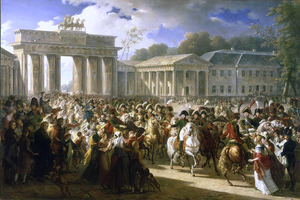
Charles Meynier - Napoleon in Berlin.png
4th Coalition against
Napoleon's French Empire
After the struggles for freedom against the French world domination, a considerable religious awakening went through Germany.  It proceeded primarily from lay circles, but also extended to a part of the student youth. The majority of the fathers of the Missouri Synod belonged to the group of believing students at the University of Leipzig, which is described as follows: “They gathered together on certain days every week for common prayer, for the common reading of the Holy Scriptures, for the purpose of edification and mutual exchange over the One, as was necessary.” 615)  Franz Delitzsch († 1890) [ADB article] also belonged to this student circle.
- - - - - - - - -  continued in next Part 2  - - - - - - - - - -

Pieper gives not only true Church History, but the background of World History for Germany as its faith was floundering.  And there will be more mentions of World History in this continuing series.  But more importantly we see a ray of light beginning to break forth in the gloom of political darkness… in what were termed “lay circles”.
      That's right, if you follow this blog you are following “dead orthodoxy” promoting “an evil in the Christian Church”!  Not just Franz Pieper, but also Franz Delitzsch has a defense for you… (Would some accuser now call me “Franzie baby”...   please?)
   - - - - - - - -  Table of Contents   - - - - - - - -
Part 1 - this introductory blog; “an evil in the Church?”
Part 2 - “no other than the Lutheran faith”; “behind 300 years in matters of faith”
Part 3 - Holy Scriptures & Luther; LC-MS & Luther
Part 4 - Lutheran Confessions; old dogmaticians
Part 5 - “You, my Walther…”; Missouri Synod fathers
Part 6 - German layman, beautiful hymns; “Lutheran Judaism”; “lay circles” - Fundamentalists
Part 7 - later (grieving) Delitzsch; von Hofmann & von Frank
Part 8a - whither is Lutheranism bound?; Missouri's church literature
Part 8b - great chasm — supermen to stragglers
Friday, December 2, 2016

Justification: Objective vs Subjective — Walther in America; Count Erbach (Pieper's Dogmatik)

      Continuing my project of presenting the full text of Franz Pieper's original Christliche Dogmatik.... (adding cross-references for all pages to English edition pages; adding Hebrew text ...)
- - - - - - - - - - - - - - - - - -

      As I was polishing Volume 2, I ran across one of Pieper's many instances where he stressed the teaching of Universal, Objective Justification, or what some abbreviate as "UOJ".  But this one associates this teaching to one man in particular in the history of the Lutheran Church.  I want to present both versions – from the later English edition and my translation of the original German and Latin.  There are only minor differences:
Christian Dogmatics II (1951),  pp. 321
Translated English edition
Christliche Dogmatik, vol. 2 (1917), pp 380
(my translation from German and Latin)
Underlining in original; highlighting is mine.
Now, then, if the Father raised Christ from the dead, He, by this glorious resurrection act, declared that the sins of the whole world are fully expiated, or atoned for, and that all mankind is now regarded as righteous before His divine tribunal. This gracious reconciliation and justification is clearly taught in Rom. 4:25: “Who was delivered for our offenses and was raised again for our justification.” The term δικαίωσις here means the act of divine justification executed through God's act of raising Christ from the dead, and it is for this reason called the objective justification of all mankind. This truth Dr. Wal­ther stressed anew in America. He taught that the resurrection of Christ from the dead is the actual absolution pronounced upon all sinners.55  To refer the words: “Who was raised again for our justifica­tion,” to the so-called subjective justification, which takes place by faith, not only weakens the force of the words, but also violates the context. Calov, following Gerhard, rightly points out the relation of Christ's resurrection to our justification as follows: “Christ's resur­rection took place as an actual absolution from sin. As God punished our sins in Christ, upon whom He laid them and to whom He imputed them, as our Bondsman, so He also, by the very act of raising Him from the dead, absolved Him from our sins imputed to Him, and so He absolved also us in Him.55)
For this reason Scripture also says that justifying and saving faith has that God for its object who raised Christ from the dead. Rom. 4:24: “... if we believe on Him that raised up Jesus, our Lord, from the dead.”  
——————
If then God raised up Christ from the dead, He declared that through the act of resurrection, that by the death of Christ, the sins of man were completely expiated, and that now all mankind is regarded as justified before the divine forum. This situation is sharply expressed in Rom. 4:25: ὃς παρεδόθη διὰ τὰ παραπτώματα ἡμῶν καὶ ἠγέρθη διὰ τὴν δικαίωσιν ἡμῶν. Δικαίωοις referred to the act of divine justification, which took place through the act of Christ's resurrection from the dead, so the so-called objective justification of the whole sinful world. This is the truth to which particularly Walther strongly reminded of again in this country, namely the truth that the resurrection of Christ from the dead is an actual absolution of the whole sinful world. 893) Therefore the Scripture also says that the object of justifying and saving faith has that God who raised up Christ from the dead, Rom. 4:24: τὸν ἐγείραντα Ἰησοῦν τὸν Κύριον ἡμῶν ἐκ νεκρῶν.
——————
893) Evangelienpostille [Gospel Sermons I, p. 226-235, especially p. 236], Easter Day, p. 160 ff. There is a contextual weakening of the words ἠγέρθη διὰ τὴν δικαίωσιν ἡμῶν [“Who was raised again for our justifica­tion”] if one wishes to refer these to the subjective justification which is effected by faith. Calov, after Gerhard, says the right thing about the relation of the resurrection of Christ to our justification: Christ's resurrection is done “with respect to the actual absolution from sin. As God punished our sins in Christ, that is that he was given to us as the surety for this charge, so too He by this very act of raising Him from the dead absolved Him from our sins that were imputed to Him, and hence also in Him we are absolved.”


2 points stand out:
  1. Romans 4:25 is about objective justification, not subjective, and 
  2. It was C.F.W. Walther who was responsible for uncovering the Gospel again.
Pieper identifies Walther as particularly the one man who restored the Gospel again in the world.  And where did he do it?  In America.
      A German nobleman Count Erbach traveled to America in 1869.  (Ernst, Graf zu Erbach-Erbach,  – Travel Letters from America. or Reisebriefe aus Amerika, p. 211 ff.; quoted in E.A.W. Krauß book Lebensbilder aus der Geschichte der christlichen Kirche, pg 727.)  When the Count became acquainted with Walther and with Walther’s theological manner, he wrote:
“This is the man,
God has chosen him for this country”
“Many years of fierce struggle for the truth, ceaseless labor and effort for the extension of the Gospel have developed in this man so adamantine a certainty and such luminous clearness in all matters of faith that I was lost in amazement and finally concluded: This is the man; God has chosen him for this country; He could not have found a better one. And in truth, He has, midst storms and tempests, employed this tool in rebuilding, on the rock of our Confession, His Church in the New World. Through him He founded a new home for the Lutheran Church. . . . America is now the hope of Lutheranism. While elsewhere throughout the world there is heard the crash of the wreck and ruin of things, here the seed of truth undefiled is quietly and unwearyingly sown, cultivated, and watered by men who are undisturbed by the discordant noise of the world, armed with weapons of battle, ready at a moment’s notice to rush to the defense. And the seed visibly brings forth fruit a hundred-fold. ... Not a grain of revealed truth is to be surrendered; rather let everything else perish! Such conditions are a source of comfort to all who are concerned about the future of the Church. With such armament the great, decisive battles may be fought without fear of the issue.” [Requoted by Franz Pieper in Conversion and Election (Zur Einigung) pg 91-92, bolding mine]
Count Erbach spoke many other words about the Lutheran Church in Germany and America which I hope to translate and publish.  Yes, indeed, God did bless America!... and indeed the whole world!… until …
… until the LC-MS allowed the Gospel to be questioned again through especially the unionistic writings of Prof. Theodore Graebner of Concordia Seminary, 70 years later in the American Lutheran magazine in December 1939.