Search This Blog

Showing posts with label Luther on Inspiration. Show all posts

Tuesday, February 5, 2019

Schrift 18: Walther's other 13 Theses- Inspiration, Luther's Doctrine

      This concludes from Part 17 (Table of Contents in Part 1) a series presenting an English translation of C.F.W. Walther's major essay on the Inspiration of Holy Scripture in the Missouri Synod's chief theological journal, Lehre und Wehre. — Walther is noted for his "Thirteen Theses" on the doctrine of Election of Grace, or Predestination.  But the following 13 Theses should be elevated to a similar level of importance in the Lutheran Church today.  To preface this listing, I repeat Walther's statements introducing Luther's own words (see Part 7):
“There is no essential aspect in the doctrine of inspiration of our systematicians that could not be substantiated by Luther's clear statements.  Let  us then, for the following main aspects of the doctrine of inspiration of our dogmatists, obtain the evidence from Luther's writings:”
Walther's Thirteen Theses – Luther's Doctrine of Inspiration

I. All of Holy Scripture is a work of the Holy Spirit. (Parts 8 & 9)

II. There is a specific difference between a prophet in the true sense and a worldly and indirectly enlightened pure teacher. (Part 10)

III. In the Holy Scriptures, nothing is in vain. (Part 10)

IV. The Scripture is free of error. (Part 11)

V. The Scripture is nowhere in contradiction with itself. (Part 12)

VI. At each letter and tittle of Scripture is infinitely much located, and the whole Church is bound to all of them. (Part 12)

VII. The simplistic presentation peculiar to Scripture, and the description therein of minor things, God himself has the Holy Spirit as author. (Part 13)

VIII. Even where the Scriptures report on sexual matters which are offensive to the natural sentiment, the Holy Spirit himself is the correspondent. (Part 13)


IX. Also the lack of proper order, which seems to be found here and there in the Scriptures, has its reason in the wisdom of God the Holy Spirit. (Part 14)

X. Also what the Scriptures say of Natural History is said by God the Holy Spirit Himself. (Part 15)

XI. Also the chronological information in the Holy Scriptures is of divine origin. (Part 15)

XII. The interpretation of the Old Testament given by Christ and the Apostles is the authentic interpretation of the Holy Spirit Himself. (Part 16)

XIII. Even where one cannot understand the Scriptures, one must contemplate and treat them with holy awe and confess one's ignorance. (Part 17)

= = = = = = = = = = = = = = = = = = = = = = = = = = = = = = = = = = = 
      Let no Lutheran teacher of today deceive you – this is Luther's doctrine.  Let no Lutheran teacher deceive you concerning "Lutheran Orthodoxy" or the "dogmaticians", for all their essential teachings on this doctrine were established by Luther. And Walther is to be credited as the leader in presenting Luther's doctrine to our modern age.  Those who purposely avoid (or twist) Walther and claim Luther for their cause are demonstrated to be weak at best, false teachers at worst.
SOLA SCRIPTURA!  Amen! Amen!

Thursday, December 20, 2018

Scripture 6: Luther says: 4 Words, 5 Testimonies (Walther’s short lists of Luther quotes)

      This continues from Part 5 (Table of Contents in Part 1) in a series presenting an English translation of C.F.W. Walther's major essay on  the Inspiration of Holy Scripture in the Missouri Synod's chief theological journal, Lehre und Wehre. —  If there was one segment of this whole series to bookmark, I might pick this one because Walther cuts through all the fog of today's modern theology and presents the real Luther on Holy Scripture.  Luther stood for all of Christianity... on the Bible:
- - - - - - - - - - - - - - - - - - -
Translation by BackToLuther; all highlighted text, text in square brackets [] and in red font are my additions. Underlining follows Walther.
(continued from Part 5)
Lehre und Wehre, vol. 32, February 1886, p. 33-34: "Foreword" by C.F.W. Walther

Under other circumstances than the present, it would be an insult to our readers if our Lehre und Wehre first tried to prove that Luther, too, believed and taught the literal inspiration of all the canonical writings of the Old and New Testaments. This testifies to Luther's appearance and work, which is open to all eyes of the world, right up to his death, and every page of his works left behind. On this doctrine he stood, as on an immovable rock, personally present in Augsburg before Cajetan, in Leipzig opposite Eck, in Worms before Emperor and Empire, in Marburg opposite Zwingli and then the highlanders [Oberländern: Anabaptists? Regensburg?]; from this doctrine he went out on the lectern and in the pulpit; this doctrine shone forth upon him, as in his didactic, as well as his exegetical and polemical writings. On this doctrine he stood against whom ever the latter were directed, be it against the Papists, or against the Enthusiasts or against a rationalist as Erasmus, or against Jews and Turks.
It is precisely in this doctrine that no earlier and later Luther can be distinguished.  In this he has remained completely the same through all periods of his life.

[1] Luther 's words of 1517, with which he concluded his 95 theses against the papal indulgence, and gave the public signal to the great Reformation struggle, without even knowing it: “Also I am not so foolish that I would let the divine word be placed behind the fables, those that human reason invented”;
[2] Luther’s word of 1521, with which he wrote his first personal confession before the whole world: “I can not do otherwise”;
[3] Luther's Word of 1530, which he, as his work hovered in the highest danger, sang joyfully and confidently into the whole of Christendom: “Thy Word they shall let remain”;
[4] Luther's Word of 1546, in which he with his Wittenbergers for (page 34) this life bid farewell: “I am willing to suffer all sorts of invectives, but not a finger’s breadth from the mouth which says: Hear this!” —  
These four words of Luther from various times are four torches which stand on his life's way and will shine and testify to the Last Day that Luther believed that every word of the Holy Scripture was bound to the Word of the living God. If it is necessary to first prove that Luther believed in a God, it seems just as necessary to first prove that Luther believed and taught the divine inspiration of the whole Holy Scripture in the fullest sense of the word.
Unfortunately, dear God! but this proof has become all too necessary. The modern-believing theologians, who not only assert that not a few errors (hay, straw, wood, and stubble) are found in the writings of the Prophets and Apostles, but the learned theologians have also the task to assert the kernel of truth that here too at the same time Luther is their authority.


May Luther even so write  (as Prof. Cremer is not afraid even to cite this passage): “A single letter, yes, a single tittle of Scripture is more and greater than heaven and earth. That is why we cannot suffer that they would be displaced in the least.” (Gr. Commentary on the Letter To the Galatians. VIII 2661.; [StL 9, 650 §126; LW 27, p. 41; WA 402, p. 52])  

May Luther even so write: “It is therefore clear to me that every single passage makes the world too narrow.”  (“That These Words of Christ, 'This is My Body' Still Stand Firm Against the Fanatics”, from the year 1527. XX, 982 [StL 20, p. 788, § 59; LW 37, p. 40 )  

May Luther even so write: “Here stands the love, that you may mock or honor as you wish; but the faith or the Word shall you worship and consider the most Holy.” (Letter to Capito, 1522. XIX, 669 § 26; StL 19, 560-561; LW 48, p. 379; WA Br2, p. 433 ln # 126-129: Latin text.)  

May Luther even so write: “I confess that if Dr. Carlstadt, or anyone else, could have convinced me five years ago that only bread and wine were in the sacrament he would have done me a great service. At that time I suffered such severe conflicts and inner strife and torment that I would gladly have been delivered from them. I realized that at this point I could have given the Papacy over as the greatest whorehouse [Puff]. There were two who then wrote me, with much more skill than Dr. Carlstadt has, and who did not torture the Word with their own preconceived notions.  But I'm trapped, and can not get out; the text is too powerful and will not be torn from its meaning with words.” (Letter to the Christians at Strassburg in Opposition to the Fanatic Spirit, dated 1524. XV, 2448. f., § 10; StL 15, 2050  § 10; LW 40, p. 68)  

Finally, may Luther even so write: “For God’s Word is not to be toyed with. If you cannot understand it, take off your hat to it..” (Exposition of a Passage from the 23rd Chapter of the Prophet Jeremiah, 1526. VI, 1396, § 41; StL 6, 873, § 41; not in LW)  [see also Confessional Lutheran 1960 p 57]
= = = = = = = = = =   continued in Part 7  = = = = = = = = = = =

Walther presents two powerful series of brief quotes.  These are taken from the early Luther to the latest Luther. The Reformer is always the same.  The beauty of Walther's compilations is that they can be easily memorized, or at least this blog post can be bookmarked, for a decisive answer to any wiseacre who would attempt to put Luther with modern theology, a "theology" that cannot quite believe God at His Word, that in various degrees questions Holy Scripture. — In the next Part 7, Walther answers the wiseacre theologians who harp on the lack of any major article on the Inspiration of Scripture in the Lutheran Confessions...

Tuesday, August 13, 2013

Luther's Doctrine of Inspiration – Pieper (in English) Part 2

[2018-05-26: see this later post for letter of request by B. B. Warfield to Pieper; 2018-04-23: appended full text of Pieper's essay at bottom; 2017-11-29: added direct link to Google Doc below text window.]
This concludes from the previous introductory Part 1 and now presents the actual text of Pieper's essay.

Do you read your Bible?  If so, you should now read this masterful essay by Franz Pieper about Martin Luther and the Doctrine of Inspiration.  Here you will know the true Luther.
  • Have you heard someone say that Luther did not believe the entire Bible was Inspired by God?  Then read this essay by Pieper.
  • Have you heard someone say that Luther did not hold certain books of the Bible to be canonical, e.g. of the book of James?  Then read page 265.
  • Have you heard someone say that Luther admitted contradictions in the Bible?  Read pages 263 - 264.
Although the text version below is also available in Google Books, yet my text version has added several hyperlinks that aid in Bible verse lookups, background information on several theologians, and language translations.  Also Scripture references were updated from Roman numerals.  Further work may be done and will be noted by modifications of the date below.
Last text update: August 13, 2013

Highlighting is mine.  Hyperlinks should be opened in new tab/window. Original page headers retained.

 >> Link direct to Google Doc above here. <<

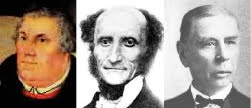
This essay has refreshed my Christian faith.  If you, dear reader, consider yourself to be a Christian, whether you call yourself a Lutheran or not, you would do well to read this essay and recognize the wisdom of 
Prof. Benjamin B. Warfield (a Princeton Presbyterian) who asked
Prof. Franz Pieper (The Twentieth Century Luther) to expound on
Martin Luther and his
Doctrine of the Inspiration of 
The Holy Scriptures

... the Scriptures of which Christ said
Search the scriptures... which testify of me.  John 5:39
= = = = = = = = = = = = = = = = = = = = 
2018-04-23: appended a "Read more »" section below – inline full text of Pieper's essay: