Search This Blog

Showing posts with label LCMS. Show all posts

Sunday, November 5, 2017

Lutheran Church teaches… what? (Part 2a, on Concordia Journal 2017)

      This continues from Part 1, a defense against the assertions and theology promoted in the Summer 2017 issue of Concordia Journal magazine on science and theology.  In Part 1, I addressed a point of science.  In this post, I want to address a point of theology – the Doctrine of Justification.
- - - - - - - - - - - - - - - - - -
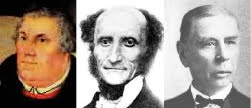
      After defending against the science aspect, it would be misleading to suggest that the Journal does not address theology.  But what about the “article with which the Church stands and falls”, the Doctrine of Justification?  I want the reader to compare the theological teaching promoted in the Concordia Journal with what the true Missouri Synod taught by its founder and his successor.  Then let the reader judge.  And what better source of information can there be than what was “reprinted” by Concordia Seminary's own website ConcordiaTheology.org in 2011 to “celebrate” Walther?  Below are side-by-side excerpts:
Profs. Charles Arand
Joel Okamoto
(Concordia Journal, Summer 2017)
C.F.W. Walther
Franz Pieper
Walther-Pieper composite (from ConcordiaTheology.org Oct 17, 2011).jpg
Arand, p. 18:
I will argue that we begin by working out from the center of our faith. We get our bearings by re-centering ourselves in that which makes us Christians. And that means that we begin where we find Jesus, namely, “in crib and cross—and in the crypt he left behind.” For that reason, I propose Luther’s theology of the cross as a way of helping our people— and ourselves—to think through issues of faith and science.
A View from the Cross
Luther first formulated his theology of the cross in a series of theses that he penned in 1518 as an account of his theology as requested by his Augustinian superiors in Heidelberg. Less than a year earlier, he had posted his ninety-five theses for debate on the question of indulgences. Now Luther sets forth a series of theses on the issue of justification. He does not deal with that topic in isolation, instead, he sees that the position one takes on justification is indicative of a larger methodological approach to all of theology.
In these theses, Luther identifies two approaches to theology, a theology of the cross versus a theology of [human] glory. Luther contrasts a scholastic theology (shaped by philosophy) that glories in human abilities and capacities with a theology of the cross that trusts the crucified and risen Lord. “Luther believed that the best view of all reality was to be had from the foot of the cross on Calvary. The death and resurrection of Christ parted the clouds, and he could see God and himself clearly.” Together, they “disclose in the most decisive way possible what it means for God to be God and what it means for us to be humans.”
The theology of the cross thus provided a way of thinking and a method of practicing theology that Luther continued to draw on for different situations and purposes throughout his life. Indeed, for Luther, “theology is always hermeneutical, an interpretation of God’s dealings in the world by individuals from within the world.” Robert Kolb notes that a theologian of the cross thus “employs the cross of Christ as the focal point and fulcrum for understanding and presenting a wide range of specific topics within the biblical message.”


Okamoto, pp. 54-55:
… In other words, Christian theology must be cosmological. All other topics—sin and grace, incarnation and salvation, justification and sanctification— should be derived from and discussed in this context, rather than be set alongside or above God and his creation.
In an important sense, there is nothing new about doing this. It is simply letting “In the beginning God created the heavens and the earth” stand. It is following through in theological method on the first article of the Creed: I believe in God the Father Almighty, maker of heaven and earth. It is taking seriously that Christ was sent to announce and to establish the reign of God over creation. It is looking for the resurrection of the dead and the life of the world to come. But it is also no longer letting God as Creator and his creation lie in the background or at the margins for theology in favor of an agenda set by certain occasional intramural questions. Instead, theology makes God creating all things the starting point for all reflection. What kind of person is God? The Creator. What is a human being? A creature of God the Creator. What is sin? Not acknowledging God and his rights as Creator. Why is justification by grace? Because God the Creator gets to justify as he pleases. What does it mean to believe in God? To freely let him be the Creator. And so on.
The point is not to teach something different, but rather to teach differently. All theology is occasional in the sense that it arises out of particular occasions. For example, the doctrine of justification as articulated in the Lutheran Confessions arose to deal with questions and confusions raised by medieval teaching and practice over the righteousness of sinners. Roman Catholic theology was not uniform, but it did uniformly maintain that righteousness before God was proper, that is, one’s own. Evangelical theologians maintained that this righteousness was entirely alien, God’s own. And it was this distinction that informed how the Lutheran Confessions formulated their doctrine of justification. As just noted, the “God and his creation” perspective on justification only reinforces that righteousness before God is entirely alien. Nothing changes in the article itself. But how and why it is stated does. Nothing different is taught, but it is taught differently.

When we try to depict Dr. Walther as theologian, we must, above all, discuss his doctrine of justification, for his attitude toward this doctrine supplies the clue to his whole line of action in his life so full of controversy.
Walther recognized the doctrine of justification, or the doctrine that a sinner is justified before God and saved by grace through faith in Christ, as the focal point of all Christian doctrines. All other doctrines serve this doctrine as premises, or they flow from it as conclusions. Uncompromisingly Walther attacked all errors, because he knew that by all of them this central doctrine was endangered.… In our theological seminary he showed his students, above all, how to preach this doctrine rightly, pointing out to them both the right way and in graphic description also the usual aberrations. We believe that it is not saying too much when we declare that after Luther and Chemnitz no other teacher of our church has attested the doctrine of justification so impressively as did Walther. It was particularly in this doctrine that he followed Luther, and he united into one shining beam of light all other bright rays on this doctrine radiating from our later dogmaticians.
According to Walther, the doctrine of justification is the characteristic mark of the Christian religion, by which it distinguishes itself from all other so-called religions. He writes:
When we speak of justification, we speak of the Christian religion, for the doctrine of the Christian religion is none other than God’s revelation concerning the way in which sinners are justified before God and saved through the redemption made by Christ Jesus. All other religions teach other ways which are supposed to lead to heaven; only the Christian religion points out a different way to heaven by its doctrine of justification. This indeed is a way the world has never heard nor known, namely, the counsel of salvation that was hidden in the mind of God before the foundation of the world was laid. (SCR, p. 21.)
To fight for the doctrine of justification and for Holy Scripture and the Christian religion amounts to one and the same thing. Without the doctrine of justification the Christian religion is like a watch without a spring. All other doctrines lose their value if the doctrine of justification is corrupted. When the foundation gives way, the whole building caves in. When the doctrine of justification falls, then the whole Christian doctrine also collapses. In that case the church becomes a mere reform school. Furthermore, as regards the understanding of Scripture let me say: Theologians who err in regard to the doctrine of justification are sitting not in Scripture, but before a closed door, no matter how diligently they may study and quote the Bible. To those who do not understand the doctrine of justification the Bible is merely a book of moral instructions with all manner of strange side issues.
The doctrine of justification is therefore the “chief topic of Christian doctrine” (Ap. IV [(II)] 2).
It is absolutely necessary for everyone rightly to know the doctrine of justification in order that he may be saved. … This doctrine is therefore rightly called the article with which the church stands and falls.
Through the preaching of this doctrine, the Reformation of the church was effected, while all other means that had been tried before to reform the church failed. It was this doctrine which also in other lands and at other times reformed the church.
.… What indeed is all learning, no matter how important it may be in its proper place, compared with the wisdom of God? This becomes apparent already when only the passage is expounded that “God so loved the world that He gave His only-begotten Son,” etc. That message works joy in all penitent sinners; that is something in which the holy angels rejoice, and that is something at which the whole world should prostrate itself and cry out: “Glory, hallelujah!” … In short, let us learn from Luther that we cannot start a Reformation in this country unless we believe this doctrine of justification most firmly, preach it with divine assurance, and faithfully guard and keep it.
A living knowledge of the doctrine of justification therefore is essential to the right preparation for the pastoral ministry. …
We shall now consider some teachings which, according to Walther, are essential today if we are to preserve the doctrine of justification in its purity. Walther writes: “When considering the pure doctrine of justification, as our Lutheran Church has again set it forth on the basis of God’s Word in its full radiant brilliancy, we must keep in mind three doctrines, namely, (1) that of the general and perfect redemption of the world by Christ; (2) that of the power and the efficacy of the means of grace, and (3) that of faith. (SCR, p. 20.)” …
Should, for instance, anyone deny the universality of Christ’s redemption, negating with Calvin the Scripture truth that Christ has redeemed all mankind and that in the Gospel God seriously offers to all men His grace without any discrimination, then he subverts the doctrine of justification. If that error is maintained, then the individual sinner cannot become personally sure of his salvation …To keep the doctrine of justification pure, we must hold the
True Biblical Doctrine of the Perfect Redemption of All Men by Christ
In order to present the perfect redemption of all men by Christ in its full clarity, Walther is concerned to insist that there exists for every person grace, righteousness, and salvation even before faith is engendered, that every sinner is righteous before God, even before he believes, so far as this righteousness has been procured and God has purposed to bestow it
…Walther writes: “Also the heathen believed that they must secure grace and the forgiveness of their sins, but they have never known that forgiveness of sins has already been procured by another and that it already exists.”
Pieper:
To fight for the doctrine of justification and for Holy Scripture and the Christian religion amounts to one and the same thing.

To which pair of theologians will you trust your soul’s salvation to?

      In the left column, although the word "justification" is mentioned, it is not expanded upon.  Instead Prof. Arand immediately switches to a "theology of the cross" and uses this theme (and Robert Kolb dozens of times) to explain the heart of Christianity.  As for Prof. Okamoto, I can only say he speaks as a philosopher who can, in very few places, throw in some Lutheran sounding words… and he is easily dispensed with.
      In the right column, the focus is on the Doctrine of Justification: (1) its basis for the Christian religion, (2) its objective nature, (3) its universal nature, (4) its priority in the Lutheran Confessions as the "chief topic of Christian doctrine", (5) its proof against all heathen religions.

      Why can't today's LC-MS speak plainly about the Doctrine of Justification?  (haven't they lost it?)

      As I blogged earlier, there was a comment made on Walther's/Pieper's Doctrine of Justification by a reader of the above "reprint" on ConcordiaTheology.org.  It was by a certain Mr. Jeff Wild:
  • Jeff Wild says:
  • October 23, 2011 at 1:29 pm
  • This is a wonderful document and I look forward to the second part. For me this is the clearest description of the doctrine of justification that I have ever read.
  • For awhile now I have been considering ordering Francis Pieper’s DOGMATICS, but have been hesitant due to the cost. Would you say that this essay is characteristic of his writing? If so, it sounds like the volumes would be well worth the money.
Mr. Wild testifies indirectly against today's Concordia Seminary.  The theology of today's Concordia Seminary will not get this kind of accolade from a reader because they do not teach like the Old (German) Missouri Synod. Mr. Wild's judgment is one of the clearest public Christian testimonies on the Internet today.  If the reader finds my polemics offensive, then just read the full version of Concordia Seminary's own "reprint" of this essay, and compare Walther's teaching to those who would claim him as their founder. Better yet, read the full un-cut series “Walther as Theologian” in my blog series here.
———————————————————————————
This post became lengthy, but I can not refrain from pointing out where Prof. Arand inadvertently quotes a Bible passage that exposes his error, his mixed theology – in Part 2b.


Friday, May 13, 2016

LC-MS 2016: back door on Inspiration, Infallibility of Holy Scripture; Part 16c

      This continues from Part 16b, a series on Copernicanism and Geocentricity (see Intro & Contents in Part 1) in response to a letter from a young person ("Josh") who asked if I believed Geocentricity ... and did not ridicule me in his question.
= = = = = = = = = = = = = = = = = = = = =
      This an appendix to the previous Part 16b, where the old Missouri Synod defended the divinity of Holy Scripture and against Copernicanism.
      In the LC-MS today, there is the document from 1973 called A Statement of Scriptural and Confessional Principles.  Although it is thought by some to be a full return to the heritage of the old (German) Missouri Synod's teaching, yet it opened a "back door" with the sentence (under heading "The Infallibility of Scripture"):
"We recognize that there are apparent contradictions or discrepancies and problems which arise because of uncertainty over the original text."
The words "contradictions", "discrepancies", "problems", and "uncertainty" are all used in this sentence relating to our Holy Bible.  (How is this different than the phrase "plastic text" used by Prof. Kloha?)  Pastor Martin Noland of the LC-MS writes in the latest issue of Christian News (May 9, 2016, page 3, col. 1) the following regarding this sentence:
"The second part of ... the sentence refers to the problems of biblical text criticism, so LC-MS pastors, theologians, and scholars are free to work on such problems and propose various answers where there is 'uncertainty over the original text' due to variant readings."
It would seem that "All Theology is a Problem" in today's LC-MS.  Their teachers could teach me all day long about the Inspiration or Divinity of Holy Scripture, but all the while I would be questioning their sincerity as they use their "freedom to work on such problems and propose various answers where there is 'uncertainty over the original text' due to variant readings."  Noland then goes on to state that "my professors at Concordia Theological Seminary, Fort Wayne in 1979 to 1986 affirmed and personally practiced textual criticism of the Bible".  He apparently includes also Prof. Robert Preus among these.  How is it that the words used in this 1973 statement, "contradictions, discrepancies, problems, and uncertainty", are to be reconciled to Noland's later statement "that the most significant variant readings do not affect the doctrines of Scripture"?  If they "do not affect the doctrines of Scripture", then how can there be "contradictions, discrepancies, problems, and uncertainty"?
      For antidotes to this ambiguous and confusing wording of today's LC-MS, I suggest two readings:

(1) Franz Pieper's discussion on "variant readings" here, where he concludes:
"So we know a priori, before any investigation, from the promise and the testimony of Christ, that in the Scriptures now at the disposal of the Church we have a reliable text, or, in other words, the authentic doctrine of the Apostles and Prophets, that is, of God, in spite of the variae lectiones in the copies.
     b. We reach the same result also a posteriori, on the basis of scientific investigation. Human scientific investigation establishes the fact that not a single Christian doctrine has been rendered doubtful in any point by the 'legion' of variant readings."
(2)  C.F.W. Walther concluded his charge against Germany's "scientific theologians" in the year before his death in the "Foreword" to the 1886 issue of Lehre und Wehre journal  (Lehre and Wehre, vol. 32, 1886, p. 76 f.) [Christian Dogmatics, vol. 1, pg 306]:
"Sup­pose that Luther actually regarded the Bible as a book containing all manner of error, out of which only the scholars could lift the kernel of divine truth, that position would rob the Bible Christians only of Luther. But it is a most horrible thing that the theologians of the Modernist faith, including the Modernist Lutherans (without exception, it would seem), declare it to be a fact no longer debatable that the Scriptures contain, besides the `good thoughts' of their authors, also `hay, straw, and stubble,' which `the fire consumes.' That stand robs the Bible Christians not only of a man whom they had heretofore regarded as a faithful witness of the truth, but it robs the Bible Chris­tians of the Bible itself, a lamp to their feet and a light on their path forever, their rod and their staff in the dark valley of affliction, in short, of God's Word, their consolation in the terrors of sin, their hope in the darkness of their last hour! ... We must say of this so-called 'divine-human nature of Scripture,' as the term is understood by modern theologians: Beware, beware, I say, of this 'divine-human' Scripture. It is a devil's mask, for at last it manufactures such a Bible according to which I certainly would not care to be a Bible Christian; namely, that henceforth the Bible should be no more than any good book, a book which I would have to read with constant scrutiny in order not to be led into error. For if I believe that the Bible also contains errors, it is to me no longer a touchstone, but itself stands in need of one. In a word, it is unspeakable what the devil seeks with this 'divine­-human' Scripture." (bolding and highlighting are mine)
Later in August of 1886, the Synodical Conference would cement its teaching on the Divinity of Holy Scripture in its doctrinal proceedings, and also call the teaching of Copernicanism... poison.
      We see that in 1973, the LC-MS did not fully return to its heritage and is now adrift in its own teachings... and deceitfully confusing its own people of the Divinity of Holy Scripture... and on Copernicanism. —  In the next Part 17, I touch on what various historians have said about science... and religion.

Friday, December 25, 2015

"Here I Stand!" (4th witness blunder), Part 3 of 3

[2026-05-30: see Part 4 to follow on Pieper's unknown name in LC-MS; 2025-01-12: added link at bottom to Paul McCain/CPH's blog on this subject.]
      This concludes from Part 2 regarding the controversy surrounding the historicity of Luther's famous phrase "Here I Stand...".   But what I had originally planned as a 4th witness for the defense of the phrase turned out to be a blunder on my part.  I had to completely rewrite this post.  But in my error, I take comfort because I realize that my 4th witness is actually a true witness in a perverse way – but who is the culprit?... (Hint: I should have known.)
- - - - - - - - - - - - - - - - - - - -
 Andrew Pettegree for the defense?
Andrew-Pettegree-243x366.jpg
Andrew Pettegree,
author of
Brand Luther
      Andrew Pettegree is the author of the new book Brand Luther (reviewed in this blog post). From Wikipedia: Pettegree is “...one of the leading experts on Europe during the Reformation. ... He is also the founding director of the St Andrews Reformation Studies Institute.” — Andrew Pettegree is hardly a friend of Martin Luther or Lutheranism. After describing the events of Luther’s burning of the papal bull, Pettegree judges Luther (page 131):
“In many respects this was the most unfortunate of the dramatic set-piece events of the Reformation.”
At least Pettegree does not deny that the burning of the papal bull happened! This statement is only one of many examples where Pettegree shows his unfriendliness to Martin Luther’s Reformation.  However Pettegree shows a modicum of ability in judging history when he defends the account (or “myth”) that Luther actually nailed the Ninety-Five Theses to the Wittenberg castle church door on October 31, 1517 (ref. pages 12-13).
But how will Pettegree report the controversial phrase "Here I Stand"? Will he now also take the opportunity to take another shot at Luther’s legacy by mentioning this controversy of the historicity of Luther’s “Here I Stand…” phrase, and so give it credence?  It would be a good opportunity for him to gain added stature as one who can stand over Luther and over Lutheranism, as he does in many other places.  Hmmm, no controversy is even mentioned at this point by Pettegree. (Why doesn't he even mention the controversy?) Rather he quotes Ernest Schwiebert's book Luther and His Times, (pages 504-505) verbatim without comment.  And what does Schwiebert record of Luther at this critical time of the Reformation? He says:
"... I am bound by the Scriptures adduced by me, and my conscience has been take captive by the Word of God, and I am neither able nor willing to recant, since it is neither safe nor right to act against conscience. [omitted "Here I stand" text here] God help me. Amen."
At this point I made an error. In my haste, when I saw "God help me. Amen", I thought that Schwiebert (and Pettegree) had included the "Here I stand..." phrase. But as I was about to publish this blog post, I double checked my sources and discovered my blunder. How stupid! How embarrassing! ... or is it?
  • Who is this Ernest Schwiebert that he should boldly omit the "Here I Stand" phrase? And who published his book that strips one of the best known phrases ever recorded of the sayings of Martin Luther? ... and gives Pettegree free license to do the same and thus embarrass true Lutherans that they should be so encouraged by this actual phrase of Luther? One could say that this historian "Schwiebert" was no friend of Luther or Lutheranism, just like Pettegree who praises papal indulgences and criticizes Luther's burning of the papal bull.
  • Who is it that published "Ernest George Schwiebert"?... it is the great Concordia Publishing House and the LC-MS!! Oh! What? ... Concordia Publishing House? I thought they were supposed to be friends of Luther and his Reformation...? Hmmm, seems that is in question now. (I found my culprit!)
  • And what is this? I notice that the American Lutheran collaborators for the 1953 Martin Luther film were the great theologians Dr. Jaroslav Pelikan and Oswald C.J. Hoffmann of the LC-MS, and Theodore Tappert of the opposing LCA synod, an American synod that was highly liberal. But wait! Did they contradict Schwiebert's judgment and left the controversial phrase in the Luther film? Really? Pelikan, Hoffmann and Tappert opposed Schwiebert? Surely not!
= = = = = = = = = = = = = = = = = = = = = = = = = = = = = = 
Conclusion
In the end, neither Schwiebert or Pettegree or “Diarmaid MacCulloch” or Dr. Scott Hendrix or an editor of the Weimar Ausgabe or any other “church historian” of today could convince me one way or the other if this phrase was actually spoken.  No, it is C.F.W. Walther, it is Pastor Hermann Fick, it is Prof. Franz Pieper who strongly convince me that this possible “myth” substantially happened.  And even if this phrase were a “myth”, no screenwriter could have done a better job of putting words into Luther’s mouth.  I believe that, on this matter, it is C.F.W. Walther, NOT Ernest George Schwiebert, who is the best judge of those other recorders of Luther and the Reformation, of those who recorded that Luther actually spoke these words.  It is C.F.W. Walther who understood Martin Luther better than anyone since the Reformation century.  And it is C.F.W. Walther who will be the best judge of those who recorded the Reformation writings of and about Luther, including George Rörer.
      No, I have to say... would to God! that CPH sold more than just socks with this phrase, but much more, sold framed artwork, screen-printed pencils, embroidered table cloths, whatever... so that Christians are constantly reminded of what they stand on, the same as Martin Luther, whether he said those exact words at the Diet of Worms or not!  That phrase is the perfect summary phrase for the Reformation!
      So to anyone who would be stubborn on this “controversy”, I will point them to Pelikan, Hoffmann and Tappert's allowance for this phrase in their 1953 film, even in the face of Schwiebert's (and CPH's) 1950 attempt to mythologize the phrase. Pettegree’s report even cements Schwiebert's place among "modern historians", surely because Schwiebert was published by CPH  But to true Lutherans, I will say: Walther, Fick, and Franz Pieper report this phrase "Here I Stand..." and much more, as not only “fact” but all the events surrounding it as one of the top defining moments in Reformation history... in true Church History. Let the naysayers chatter and cackle!
      And surely we don’t want to deprive Queen Elsa, Disney Pictures, the Frozen movie, and the songwriters of “Let It Go” their rightful glory in this phrase “Here I Stand!”, do we?
Here I Stand!... with Luther, Walther, and Pieper -- on God's Holy Word! (sola Scriptura) Here I Stand, on God's Grace (sola fidei), by God's Grace Alone! (sola gratia) Amen!

- - - - - - - - - - - - - - - - - - - - - - - - - - - - 
Addendum 2017-12-10:  There is evidence in Luther's own Table Talk (or Tischreden) to corroborate the phrase "Here I stand".  In the Weimar Ausgabe, vol. 5, there are 2 versions of the same "Table Talk" where Luther himself recounts the events at the Diet of Worms: #5342a and #5342b.  In his narrative, he paraphrases the basics of what he said at the Diet before the Emporer, and all the world:
  • #5342a, p. 66, line 20: “und will dabey stehen, es gehe mir druber, wie der liebe Gott wil!”
  • #5342b, p. 71, lines 4-5: “bei den will ich bleiben, es gehe druber, wie der liebe Gotte wolle.”

This Table Talk is not in the American Edition.  I did not check to see if it is in the St. Louis edition.  
If I understand the archaic German wording, the #5342a bold phrase means: 
"and will thereby stand" on my teachings regarding Holy Scripture. – 
Translator Charles Daudert in his book Off the Record With Martin Luther, p. 81 (Amazon), renders #5342b as 
I must stand by them [his writings of Scripture teaching]. I can do no other than what our dear God wills”.
Addendum 2018-02-09: The St. Louis Edition's German text of Luther's last words to the Diet of Worms is in Vol. 15, 1926; American Edition LW 32, p. 113.. [2025-03-19: updated link]

2025-01-12: see also Paul McCain's/CPH's excellent blog published 4 months after this blog confirming this point.

Tuesday, December 8, 2015

A test for unbelief... for today's LC-MS: Michaelis and Noland, Testimony of the Holy Spirit

      Continuing my project of presenting the full text of Franz Pieper's original Christliche Dogmatik.... (Vol. 1a fully proofed, proofing Vol 1b...)
- - - - - - - - - - - - - - - - - -
Johann David Michaelis
      While proofing Vol. 1b, page 378 (English ed. pg 313), I ran across Pieper's discussion of a rather famous German Lutheran theologian from the 1700s (18th century).  His name was Johann David Michaelis (1717-1791).  He was a Hebrew language scholar of highest distinction gaining "nearly a worldwide reputation in theological circles".  He was also noted for having a confession that 
"...he had never felt a witness of the Holy Spirit of the divinity of Scripture in his whole life..."
What struck me when reading of this "famous and eloquent German biblical scholar" was his similarity to the well-known Pastor Martin Noland of the LC-MS.  Pastor Noland essentially professed the same confession when he said:
"Francis Pieper answered the rationalist problem of certainty by appeal­ing to the doctrine of the testimonium Spiritus Sancti and by asserting that "theology is the perfect science, the only reliable science on earth."  Frankly, these answers of Pieper did not solve the problems posed by rationalism." [bolding mine]
But let us go on to the "answers of Pieper" regarding Michaelis.  He said
"But that he [Michaelis] did not have and could not have the testimony of the Holy Spirit later in his life is explained by the fact that he denied the Scripture doctrine of Christ's satisfactio vicaria, and founded the divine forgiveness of sins on the moral improvement of man. The Holy Spirit is not confirmed by a pagan works doctrine but is testified externally in Scripture and inwardly in the heart by the action of faith in the Scripture that Christ died for our sins according to the Scriptures." [ref. 1 Cor. 15:3]
So Pieper judges Michaelis because he not only denied a witness of the Holy Spirit, but also explains this blindness by its root cause – he denied the Scripture doctrine of Christ's vicarious satisfaction, and replaced it with a "moral improvement of man".   That is the HEART of UNBELIEF.  That explains his denial of the divinity of Scripture.  Deny Scripture and you DENY CHRISTIANITY.  Michaelis could not believe the divinity of Scripture because he did not believe his sins were already paid for.

This leaves us with the statements of Pastor Martin Noland, for if he really believes there must be a rational explanation for God as Michaelis did (and many others today!), then one is left with the very unpleasant question of whether he actually believes the Gospel of Christ's vicarious satisfaction for his sins.  One must hope that Pastor Noland is quite inconsistent in his beliefs, or that his teachings exhibit what old Missouri called a "happy inconsistency".

But you and I, dear reader, are not allowed by God to equivocate and demand rationalistic answers as Pastor Martin Noland does and those that question our Bible in today's LC-MS... God says we are to take Him AT HIS WORD AND BELIEVE IT:
Gal. 2:16 – Knowing that a man is not justified by the works of the law, but by the faith of Jesus Christ, even we have believed in Jesus Christ, that we might be justified by the faith of Christ, and not by the works of the law: for by the works of the law shall no flesh be justified.

Tuesday, April 14, 2015

"Just saying"— today's LC-MS on Antichrist

There is a fairly new expression used in everyday conversations today:
"I'm just saying"
This expression has been explained quite well by a noted psychologist Dr. Lynn Margolies on psychcentral.com —
Lately the annoying expression “I’m just saying” — usually tacked to the end of what would be an otherwise thoughtless remark — keeps coming up in everyday conversation. ... we can be onto the hidden dynamics that make this and other such figures of speech so irritating, and we can prepare ourselves for the next time.
...
Brooke used the expression “I’m just saying” after making an off-putting remark, conveniently absolving herself of responsibility for the affront. This tagline is a handy conversational tool: It serves as a free pass for the speaker to say anything and then negate any ill intent.
I find this explanation particularly incisive, at least in a worldly way:
"...a free pass for the speaker to say anything and then negate any ill intent".
Oh, but this expression has a far greater spiritual application!
- - - - - - - - - - - - - - - - - - - - - - -

Officially the LC-MS says the Pope is the Antichrist here:
Concerning the historical identity of the Antichrist, we affirm the Lutheran Confessions' identification of the Antichrist with the office of the papacy whose official claims continue to correspond to the Scriptural marks listed above. It is important, however, that we observe the distinction which the Lutheran Confessors made between the office of the pope (papacy) and the individual men who fill that office. The latter could be Christians themselves. ... [But why say  "it is important that we observe the distinction ... between the ... papacy ... and the individual men"...  Isn't it also important to recognize that the Pope in Rome is the very Antichrist?  Are they declaring the Pope to be the very Antichrist or... are they "Just saying?"]
To the extent that the papacy continues to claim as official dogma the canons and decrees of the Council of Trent which expressly anathematizes, for instance, the doctrine "that justifying faith is nothing else than trust in divine mercy which remits sins for Christ's sake, or that it is that trust alone by which we are justified," the judgment of the Lutheran Confessional writings that the papacy is the Antichrist holds.  At the same time, of course, we must recognize the possibility, under God's guidance, that contemporary discussions and statements (e.g., 1983 U.S. Lutheran-Roman Catholic dialogue statement on "Justification by Faith") could lead to a revision of the Roman Catholic position regarding Tridentine dogma.  [Why always the tone of doubt immediately following each pronouncement of the Papacy as the very Antichrist? – are they "Just saying?"]
But in the CPH book leading up to the 500th Anniversary of the Reformation, The Lutheran Difference (2010 edition), they say this:
page ix-x: List of Comparisons - among the 39 specific areas of "Comparisons" which include "Justification", there is no comparison on the doctrine of the Antichrist between the Lutheran Church and other external church bodies – why? ... "Just saying?"
page 545: Luther ... increasingly saw connections between the prophecies in Revelation, the corrupt world, and the pope as Antichrist. [The editor allows that Luther "saw... the pope as Antichrist", but why is there no clear affirmation of this by the essayist himself?  There is virtually no mention here that the Lutheran Confessions clearly teach that the Pope in Rome is the very Antichrist, only that Luther "saw connections".  Is the LC-MS "Just saying?"]
page 572, Glossary: Antichrist. Based on 1 John 2:18; 4:3, the Antichrist is one who opposes the teachings of Christ. The term is also used to describe "the lawless one" (2 Thessalonians 2:8) or beast of the earth (Revelation 13:11), a deceptive religious leader who will emerge at the end of time. [Again, no mention is made that the Pope in Rome is the very Antichrist...  no mention that the Lutheran Confessions specifically teach this.  There is no mention that the Roman Catholic Church has not struck down its anathemas of the Council of Trent against all Christianity.  Is the LC-MS "Just saying?"]
      Aren't the "hidden dynamics" becoming clear now?  Isn't the LC-MS "just saying" that the Pope in Rome is the very Antichrist?...  that it sees that the world takes offense at this teaching and so, as psychologist Margolies says, it is "conveniently absolving itself of responsibility for the affront?"
      The Roman Catholic Church continues to condemn all Christianity with its Council of Trent anathemas, and its head, The Pope, IS THE VERY ANTICHRIST! 

- - - - - - - - - - - - - - - - 
Psychology 

      There remains a point to be said about my use of a worldly psychologist to unravel today's conversations.  A Christian repudiates whatever "wisdom" that psychology professes, for he already knows the truth: The Truth, The Way, The Life... in Christ Jesus.  The world's psychology is only broken cisterns (Jeremiah 2:13) apart from Christ, which leads one away from his Christian faith.  Dr. Lynn Margolies has no wisdom for the true Christian Church.  
- - - - - - - - - - - - - - - -

      It was Martin Luther, not a psychologist, who unraveled "hidden dynamics" better than anyone!  Perhaps the most forceful example of this is his comments on Erasmus from the book A Life of Luther by Oskar Thulin, Fortress Press,  page 50 [2024-10-08: added link]:
“It is true that he uses refined words, like ‘the dear, holy Christ,’ ‘the saving Word’, ‘the holy sacraments’, but in reality he considers them to be very cold matters.
… Carefully and intentionally he says everything in a tone of doubt; his words are ambiguous and he can interpret them as is expedient to him.
… Erasmus of Rotterdam looks upon the Christian religion and doctrine as if they were a comedy or a tragedy, in which all the events described therein never actually happened or really took place, but were fabricated with the sole purpose of instructing the people in a good external conduct and life and preparing them for worthy obedience and discipline.” (WA, TR 2, 2420; TR 1, 699, 797; TR 2, 2170)
Or translated in our modern vernacular:  Erasmus of Rotterdam was "Just Saying"!
- - - - - - - - - - - - - - - - - - - 
Today's LC-MS
"We're Just Saying!

"We believe, teach and confess..."

Thursday, March 19, 2015

Theses on Justification, 1983 (LC-MS, outcast doc?); good intro to Lutheran Confessions; from Robert Preus?

In my 2 most recent posts (here and here), I wanted to balance the breathtaking errors in today's LC-MS with signs of life from that same body in recent decades.  Alongside Prof. Eugene Klug's testimony, perhaps the best source of some encouragement is a document produced by their CTCR in 1983.  Rolf Preus claimed that his father, Robert Preus, authored this paper, saying:
At any rate, the controversy wasn't entirely harmful to the church inasmuch as it did yield a fine statement from the Commission on Theology and Church Relations [CTCR] of the Lutheran Church – Missouri Synod on the doctrine of justification, authored by none other than Robert Preus
Although this document makes no mention whatsoever of either C.F.W. Walther or Franz Pieper, yet it owes its doctrine not only to Martin Luther, but also largely to these 2 giants of Church History.  I may have some concerns about some aspects of the teaching of Robert Preus, but this paper, whoever authored it, is worthy of study by Lutherans today, here and now.  (I will have more comments of Robert Preus at a later time.)  –  This document is available for download from the official LC-MS CTCR site here.  This document is one of the best official Christian teaching documents since the day Franz Pieper died.  It is so significant, that I want to present it in its entirety on this blog post.  There are dozens (hundreds?) of references to the Lutheran Book of Concord (or Confessions) and I have spent perhaps 15 hours hyperlinking them to the BookOfConcord.org website (Triglotta text) for ease of quick reference.

If you want a better essay on the Doctrine of Justification, go to Walther's essay in 1872 -- here.  Another better treatise would be Franz Pieper's "Lectures on Justification" in the book The Church and Her Treasure.  But if you want one of the best essays in the past 50 years from today's LC-MS, then study the following CTCR essay... of Robert Preus?

Because the automatic tagging of Bible references does not work within the following display window, I have compiled all Bible passages and listed them below this window so they are readily available to the reader by just clicking on the verse reference.
All highlighting is mine.  All hyperlinks must be opened in a new window or new tab!

Scripture references, click and view
Old Testament
New Testament
Genesis 12:3; 15:6;
Matthew 7:1-5; 9:1-8; 9:2; 16:19; 18:18; 18:34; 19:16-22; 26:26-28; 28:18-20;
Deuteronomy 25:1; 27:26;
Mark 10:45; 16:15; 16:16;
1 Kings 8:32;
Luke 7:47-48; 8:11-15; 18:14; 24:46-47; 24:47;
Job 19:25;
John 1:12; 1:14; 1:16-17; 1:29; 3:6; 3:16; 3:36; 5:39; 6:44; 6:65; 8:24; 10:28; 15:1-11; 15:5; 17:20; 20:21-23; 20:23;
Psalms 5:5; 19:7-8; 32:3-5; 32:5; 51:5; 90:7-8; 103:10-12; 110:3; 130:1-8; 130:4;
Acts 1:8; 2:22-24; 2:32-33; 2:38; 4:12; 5:30-32; 8:35; 10:38-43; 10:43; 11:14; 11:20-21; 13:32-33; 13:38-39; 13:39;
Proverbs 17:15;
Romans 1:16-17; 1:18; 1:32; 2:5, 8-9; 3:9-19; 3:12; 3:16-18; 3:19-28; 3:20-28; 3:21-28; 3:23-28;  3:24-26; 3:25-26; 3:28; 4:1-8; 4:1-13; 4:2-8; 4:5; 4:13-15; 4:16; 4:25; 5:1-2; 5:1-11; 5:6, 8; 5:6-18; 5:10; 5:15, 20; 5:18-19; 5:19-24; 6:1-14; 6:23; 8:1; 8:30; 8:32-34; 8:33; 8:37-39; 9:33; 10:5-17; 10:6-8; 10:17; 11:6; 11:32; 12:1; 14:23; 15:13; 16:25; 16:25-27;
Ecclesiastes 7:20;
1 Corinthians 1:21; 1:21-24; 1:29-30; 1:30; 2:1-5; 2:2; 2:12; 3:5; 3:11; 4:1-5; 4:3-5; 4:15; 6:11; 9:16; 12:3; 15:1-2; 15:1-5;
Isaiah 5:23; 45:25; 50:8; 52:3-7; 53; 53:5-7; 55:10-11;
2 Corinthians 1:19-20; 3:5; 3:9; 4:6; 5:15, 21; 5:16-21; 5:17; 5:18-21; 5:18-21; 5:19-21; 5:21; 8:3-4; 8:9; 11:4;
Jeremiah 31:31-34;
Galatians 1:3-10; 1:7; 1:8; 1:11; 2:16; 2:20; 2:21; 3:1; 3:10-14; 3:12; 3:21-26; 3:26-27; 5:4; 3:10; 3:13; 3:22-24; 4:4-5; 4:4-7; 5:4; 5:5; 5:19-21; 5:22-24; 6:14-15;
Habakkuk 2:4;
Ephesians 1:7; 1:19; 2:3; 2:5b; 2:5-8; 2:8-10; 2:13-16; 2:14; 5:2; 5:6;

Philippians 1:6; 1:29; 3:8-9; 3:8-10; 3:9;

Colossians 1:5-6; 1:20-23; 1:21-23; 2:14-15; 3:6; 3:13;

1 Thessalonians 1:10; 2:13; 5:1-10;

2 Thessalonians 2:14;

1 Timothy 1:8-11; 1:15; 2:4; 2:4-6; 2:6; 2:12; 3:16; 4:10;

2 Timothy 1:10; 1:12; 2:8; 2:13; 2:25;

Titus 2:11; 2:14; 3:3-7; 3:5;

Hebrews 2:9; 2:14-18; 7:27; 9:22; 9:26; 9:28; 10:12, 18;

James 1:18-21; 1:21; 4:11;

1 Peter 1:3-5; 1:18-19; 1:23-25; 2:21-24; 3:18; 3:21; 5:10;

1 John 1:7; 1:8; 2:2; 2:12; 3:2; 4:10; 5:9-10; 5:10-13; 5:12;

Revelation 15:4;
= = = = = = = = = = = = = = = = = = = = = = = = = = = = = =
March 23, 2015: Because the LC-MS download file has some minor errors compared to the printed version, I am providing a download link to a PDF file of the scanned copy (text searchable) of the official printed version.  This will clarify any remaining errors in my text copy above.
===>>>  Download print copy here  <<<=== (updated link 2019-01-16)
- - - - - - - - - - - - - - - - - - - - - - - - - -
I may present this same essay in a "piecemeal" fashion and insert comments along the way.  But for now, I want this essay thrown in the face of today's LC-MS.