[2020-08-21: added photo below of Wyneken while a pastor in Baltimore (from CTS-FW Media)]
This continues from Part 7 (Table of Contents in Part 3), a series presenting an English translation of Pastor Christian Hochstetter's 1885 496-page book entitled (abbreviated) The History of the Missouri Synod, 1838-1884. — What follows is one of the more pleasant chapters in Hochstetter, for it tells the story of the colorful life of Missionary/Pastor/President Friedrich Wyneken. And Hochstetter adds another narrative about Wyneken's life to other existing histories. I found Hochstetter's history to be one of the best accounts – who can forget the images portrayed of this fiery, passionate missionary, by his admirer Hochstetter? — We have blogged before about Wyneken. Although there are other writings about this well-known figure in Missouri's history, I invite readers who may have read from modern historians to set them aside, and just read Hochstetter's account which is the only one personally approved by both CHI Director Suelflow and C.F.W. Walther.
This continues from Part 7 (Table of Contents in Part 3), a series presenting an English translation of Pastor Christian Hochstetter's 1885 496-page book entitled (abbreviated) The History of the Missouri Synod, 1838-1884. — What follows is one of the more pleasant chapters in Hochstetter, for it tells the story of the colorful life of Missionary/Pastor/President Friedrich Wyneken. And Hochstetter adds another narrative about Wyneken's life to other existing histories. I found Hochstetter's history to be one of the best accounts – who can forget the images portrayed of this fiery, passionate missionary, by his admirer Hochstetter? — We have blogged before about Wyneken. Although there are other writings about this well-known figure in Missouri's history, I invite readers who may have read from modern historians to set them aside, and just read Hochstetter's account which is the only one personally approved by both CHI Director Suelflow and C.F.W. Walther.
Some quotes from Chapter 4: (p. 91-119)
91: "The Saxon pastors… did not enter this country as missionaries"
92: "When Wyneken read much of the church plight of German Lutherans in the United States… in mission papers at home, the great misery of these people went to his heart"
96: "On October 2 [1838] Wyneken began his first major missionary journey."
98: "A man came up to Wyneken and asked with a self-important air: 'Tell me, Pastor, do you really believe what you preach? I don't believe it.' Wyneken replied immediately, 'And when the devil has you by the throat and is pulling you into hell, you just scream and scream away, 'I don't believe it, I don't believe it, I don't believe it’. With that, Wyneken got on his horse and rode away."
105: "He gave me a sad account of how people everywhere fell to the Methodists and were suddenly inspired by them against our church."
107: "…no one was more severe on himself than Wyneken."
110: "In Columbus, Ohio, [Ohio Synod] there was never to be a permanent place for truly German theologians."
116: "People used to say that in relation to the doctrine for which Prof. Walther brought the right light, Wyneken's word was like thunder following lightning! ‘The Lord had also placed him,’ writes Prof. Walther in a short obituary, ‘as His instrument in these manifold councils to make the Gospel resound loud and clear,’ — for this he was a man of action"
Images of men appearing in Chapter 4:
105: "He gave me a sad account of how people everywhere fell to the Methodists and were suddenly inspired by them against our church."
107: "…no one was more severe on himself than Wyneken."
110: "In Columbus, Ohio, [Ohio Synod] there was never to be a permanent place for truly German theologians."
116: "People used to say that in relation to the doctrine for which Prof. Walther brought the right light, Wyneken's word was like thunder following lightning! ‘The Lord had also placed him,’ writes Prof. Walther in a short obituary, ‘as His instrument in these manifold councils to make the Gospel resound loud and clear,’ — for this he was a man of action"
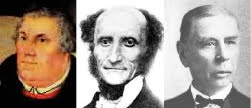
Images of men appearing in Chapter 4:
 |
| Wyneken – Otterbein – Sihler – Craemer – A. Ernst – C.A.T. Selle – Wucherer – Brandt – Loehe – Baierlein – Sievers |
- - - - - - - - - - - - - - - - - - - - - - - - -
The following is an English translation of C. Hochstetter's Geschichte… by BackToLuther utilizing the DeepL Translator with minor assistance from Dr. Fred Kramer's translation. All hyperlinks, highlighting and red text in square brackets [] are mine. All internal hyperlinks are active in this embedded window, external links should be opened in a new tab or window.

