Search This Blog

Showing posts with label Jews. Show all posts

Tuesday, August 25, 2026

BWC2g: Last Judgment; Sin in General; Original Sin

      This continues from Part BWC2f in a series (Table of Contents in Part BWC1) presenting Walther's edition of Baier's Compendium of Positive Theology. —  From pages 250–308.

Notable Quotes: (Italics follow the original. All quotes not from Baier are from Walther's additions.)

Last Judgment and Consummation of the Age:
251: Quenstedt: "Antithesis: 1. Of the Epicureans and mockers, who, upon hearing that Christ would return for judgment, with the Athenians and Stoic philosophers, scoff, Acts 17:32"
251: "there are no lack of signs by which God shows that judgment is drawing near in a certain way"
253: Gerhard: "Papias, bishop of Hierapolis, traced its [millennialism/chiliasm] origin back to the apostolic traditions,…it is by no means probable that the apostles would have handed down some things by word of mouth while committing others to writing."
254: Hollaz: Against millennialism: "…kingdom of Christ at the end of the world, because of the most corrupt morals of the wicked and the most bitter afflictions of the righteous, will be the most turbulent and the most sorrowful." [Today's world: "Corrupt morals" √,  "bitter afflictions of the righteous" √]
Antichrist:
257: "the adversary of Christ (the Antichrist) will be seated in the temple of God, that is, the Christian Church, as its head or monarch, after he has, by the power of Satan, with signs and lying wonders, deceived a great number of people and established his kingdom, so that for some time and by many, the nature or identity of the Antichrist will not be recognized; yet in its own time he will be revealed and acknowledged as the Antichrist. [by Martin Luther] However, even then the day of the Lord will not come immediately; rather, the Antichrist himself, now revealed, will continue on, until he is abolished by the brightness of Christ's coming. The revelation of the Antichrist to the faithful, therefore, should signify, like a sign, the following judgment, by which the Antichrist, now manifested, will finally be abolished."
258: Quenstedt: Lutheran theologians erroneously defending "universal conversion of the Jews": A. Hunnius, Hafenreffer, Menzer, Balduin, Meisner. [Surprising to me. Luther opposed. Also Walther.]
259: Gerhard: "Christ will administer that judgment not only as God, but also as man."
262: "For Christ will judge, so that to each one He will render a clear testimony according to the works of faith or of unbelief (2 Cor. 5:10; cf. Rom. 2:6 ff.; Matt. 25:35, 36, 42, 43; Rev. 20:12, 13)."
263: Scherzer: "The standard of this judgment will be the law and the gospel in one word, but with a different and properly noted respect. The gospel indeed with respect to the elect... The law, however, with respect to the reprobate, but so that it is illuminated by the light of the gospel."
264: "After the judgment is completed, the consummation of the world will immediately follow, in which the heavens and the earth, …by means of fire, will perish.…time will end along with it"

On Sin in General:
268: "concupiscence, being evil by nature; vicious habits contracted by wrongdoing; and all acts that are contrary to the law are customarily and correctly called sins."
269: Balduin: "…synteresis is the faculty of the soul, which always opposes vices and immediately points out committed evils, and thus always desires to keep the soul immaculate from sin. … Synteresis can never err; conscience sometimes errs in its judgment."
270: Kromayer: "A pre-Mosaic Decalogue could easily have been constructed. The first commandment may be found in Gen. 12:1–16:7: 'I am the God who brought you out…' etc.
271: "Christ purged the old law of the corruptions of the Pharisees"
273: Brute animals "are plainly devoid of the faculty to know what the law commands and forbids."
274: Calvinists "nevertheless hold that God is altogether the author and efficient cause of sins."
275: "In the Scriptures, however, sin is taken in a much broader sense, as 1 John 3:4 is content to define sin by ἀνομία (lawlessness), without expressly mentioning the voluntary element."
275: "Zwingli and Calvin, in chap. 3 of Genesis, who deny original sin for the same reason, that it is involuntary."
277: "the paternal chastisements of the pious must be carefully distinguished from what are properly called punishments." [Parental disciplining defended. Likewise God's chastisements of His people.]
278: Luther: "The thief [on the cross] turns around and accuses himself and confesses his sins,…a completely different person is made of him, and his shameful death, which he well deserved, now becomes a service to God, so that from then on he suffers not as a murderer, but as a true saint"

On Original Sin:
282: Gerhard: "Death has passed upon all men, because all have sinned, i.e., because Adam, the parent of the human race, representing the person of all posterity who descend from him by carnal generation, sinned."
282: Zwingli: "'Original sin is not properly a sin, but only a disease and an effect of sin.'"
283: "so, deprived of that original righteousness, man is like a dead man [Eph. 2:1], a being destitute of all the powers necessary to elicit and exercise vital acts and motions within himself"
285: Formula of Concord [Trigl. p. 883]: "the more diligently they labor in this matter to investigate and comprehend these spiritual things with the keenness of their own reason, the less they understand and believe, and they consider all of it to be foolishness and mere nonsense and fables, until they are enlightened and taught by the Holy Spirit."
285: "…Phil. 2:13. For when both of these [to will and to accomplish spiritual things] are attributed to God entirely, and we are therefore commanded to work out our salvation with fear and trembling, it is certain that this is denied to our natural powers"
289: "See Rom. 5:12, where one man, Adam, is declared the cause of sin as the common parent of the entire human race and its root and active principle, since through him sin came into the world."
293: "the woman, seeing that the tree was desirable for understanding, took of the fruit, verse 6 [Gen. 3:6]. Thus, the woman's will more eagerly desired that apparent good, promised by Satan"
297: "we deny that in a man infected with original sin, before he is reborn, there are any powers of the intellect or will such that… the will can determine itself to the good in spiritual matters."
300: Quenstedt: "Antithesis: The Papists, especially the Jesuits. For thus they assert in the Council of Trent, Session VI, Chapter 1: ‘Free will (in unregenerate men) is by no means extinguished’"
300: Quenstedt: "Antithesis:…Lutheran synergists, who posit some synergeia, or cooperation of human forces with grace, in the work of conversion. . . The seeds of this synergistic error were sown quite prolifically by Philip Melanchthon in his various writings and books.…In the Loci Communes of Philipp Melanchthon… inserted into the body of doctrine the definition of free will, which Luther reproved in Erasmus as erroneous" 
304: Luther: "in reality, however, he [Adam] sank his teeth into a thorn, which was the prohibition of God and disobedience to God."
306: Augustine: "When a certain man had fallen into a well… another man came up, and seeing him, said in admiration, 'How did you fall in here?' But he replied, 'Please, think about how to get me out of here, not how I fell in.'…it is enough for us to know the way by which it [an infant] is saved, even if we never know how it fell into that evil."

In the next Part BWC2h we conclude our quotes and provide downloads for Volume 2.

Wednesday, June 4, 2025

EC12: Fundamental, non-fundamental doctrines; Copernicanism; Jews; Adiaphora (Eastern 1868)

     This continues from Part EC11 (Table of Contents in Part EC1), a series restoring availability of English translations of several of Walther's convention essays that have seemingly been abandoned by Concordia Publishing House. — In this seventh of eight essays, Eastern District 1868, elucidating the Theses in Walther's True Visible Church book, he covers XVIII C–D. The following are the subject headings published in the original German at the divisions in the narrative:
Subject headings: 
Meaning of 1 Cor. 3:11-15 ● Fundamental dogma, or what everyone needs to know in order to stand in faith. ● What wood, hay and stubble are. ● Which are fundamentally false doctrines. ● Error of the Methodists. ● False teaching of the Puritans on Sunday. ● Error of the syncretists. ● Primary and secondary fundamental articles of faith and non-fundamental articles. ●Error of the Reformed concerning the Lord's Supper. ● Non-fundamental articles. ● von Rohr's error. ● Flacius’s error. ● Huber's error. ● What secondary fundamental articles are. ● Reformed error about the Lord's Supper. ● Judgment on some recent theologians. ● Kahnis. ● Which is an article of faith. ● A distinction must be made between parts and articles of doctrine. ● Copernican system. ● Four pieces that belong to an article of faith. ● That secondary doctrines should also be accepted with faith. ● Chronology. ● Even under the papacy there is still a church. ● Who is to be considered a heretic. ● An accusation of the Iowa Synod refuted. ● Problems. ● Jewish conversion. ● A Christian, as such, has no master over himself but Christ alone. ● A Christian has to watch over his freedom, but he should not become angry with the weak. ● Should a congregation be allowed to introduce compulsory schooling? ● Paul's example of how one should make oneself a servant of one's neighbor in love.
Notable Quotes:
11: "…some [Scripture doctrines] form the foundation, some rest on this foundation, some form the roof…"
12: "…human ideas, views and opinions for doctrines of faith, wood, hay and stubble" [1 Cor. 3:12-13]
13: Fundamental error: when "the Methodists lead man into a subtle workaholism".
15: "anyone who would deny it [doctrine of Creation] would be a heretic and damned".
16: "where someone… even denies primary fundamental articles, God has revealed his judgment, and we can and should also judge and reject".
18: Copernicanism: "such a person is setting up a dangerous hermeneutical principle".
19: Secondary doctrines: "Even lesser doctrines than these must be precious and valuable to us as revealed by God".
20: "Without this distinction [between primary and secondary fundamental articles, and between the non-fundamental articles] one will always either wrongly condemn or wrongly pronounce as saved."
21: "more is necessary to be believed and known by those with whom one wishes to enter into church fellowship than is required for the attainment of salvation".
21: Jewish conversion: "But if one dreams of a glorious future for the Jews as a special nation, [there are plenty of dreamers today] for example with a return to Palestine and dominion over all peoples, then it already touches on chiliasm and becomes dangerous… As a nation, the Jews will remain Jews until the Last Day".
22: Adiaphora: "our congregations know that we demand no obedience except to God's Word,…they know that we will not make them servants of men, but free children of God".

In the following, underlining follows Walther's emphasis, which is sometimes missing in the 1992 CPH translation. Paragraph breaks follow the 1992 translation; many hyperlinks added:
Web version here; download file >> here <<; the German text >> here <<.

In the next Part EC13…

Saturday, May 17, 2025

EC8: Greatest righteous separation: the Lutheran Church; ceremonies (Central District 1867)

     This continues from Part EC7 (Table of Contents in Part EC1), a series restoring availability of English translations of several of Walther's convention essays that have seemingly been abandoned by Concordia Publishing House. — In this third of eight essays, Central District 1867, elucidating the Theses in Walther's True Visible Church book, he covers Theses VI-X. Walther's explanations of "schism", "sect", "division", "cults", "heretics", "apostates" etc. are most instructive. One learns when to use certain terms and when not. Strangely Prof. Charles Arand, the writer of the 1992 CPH Forewords, called these "seemingly tedious if not hairsplitting dis­tinctions". But I found these highly instructive, not "tedious" or "hairsplitting".
Notable Quotes :
16: "…not every division is a sect, but every sect is a schism"
17: "By a sect we do not mean a bunch of worldly nefarious people, but only people who hold to a fundamental error."
17: "Unitarians, Mormons, etc. etc. are to be counted along with the Turks; they are not heretics in the strict sense of the word, but apostates".
17: "One should depart from heretics and false teachers; one should not separate from preachers who are not right in life, but otherwise teach correctly, otherwise one would create a schism".
18: "dissolute life of a preacher… could well be assumed that there would also be a lack of pure doctrine".
19: "This error [denying Pope is Antichrist] would not be a fundamental error, but a dangerous one."
20: "…one part embraces the pure doctrine, the other rejects it, then the former part, which separated itself from the others, has carried out a just, unrighteous separation. The greatest righteous division that ever took place in the Church is without question the foundation of the Lutheran Church in the Reformation"
21: Ceremonies: "a congregation need not allow itself to be prevented by one or two from introducing a beautiful order"
22: "Unitarians, Socinians, Rationalists are all non-Christian assemblies".
24: "We baptized Christians are now the true Jews in the New Testament — the so-called Jews are the school of Satan, they have left the people of God through their unbelief."
25: "a true visible church… is only that in which God’s Word is proclaimed in its purity and the sacraments are administered according to the Gospel."
28: "…one reserves the right to understand and interpret this [Confessions] one way and that differently".
29: "Lutheran doctrine is everything that is clearly stated in the Bible. In its confessional writings, the Lutheran Church confessed the Holy Scriptures from the very beginning."
29: "our faith is not really a gloss or interpretation of the Bible, but a simple reference to what is clearly written."
30: "Dr. Luther's word was the voice of the Church, because his word agreed with Scripture."
31: "The following was also mentioned about false preachers: that they do not always preach falsehood, but also truth" [i.e. half-truths]
33: "…it has actually happened at times, that in the full sense of the term there was no true visible church".
33-34: "…the general apostasy, where the public preaching ministry will also be completely destroyed. — Word and Sacrament will remain, but there will be no pure public ministry of preaching." [Ref. this blog.]
34: Gerhard: "We say that … all particular churches, and therefore the whole visible church may be darkened by clouds of corruptions, errors, offenses, heresies, persecutions, and the like"
35: "some clear teachings of Holy Scripture are not explicitly discussed and treated in the Symbolical Books. These doctrines are Lutheran because they are Biblical"
38: "…a Lutheran is only he who has come to the certain conviction that in the symbolic books of the Lutheran Church stands the pure truth of the divine Word".

Paragraph breaks have followed the 1992 CPH translation, hyperlinks added:
Web version here; The file may be downloaded >> here <<; the German text >> here <<.

In the next Part EC9…

Thursday, August 29, 2024

Walther: Jews, Mohammedans testify for Jesus’s miracles (Talmud and Koran)

[2024-09-04: added note at bottom about a recent comment of Iran's Mohammedan leader.]
      I blogged 13 years ago about what C. F. W. Walther said to the Eastern District in 1868 about the Jews. Some years before that essay was delivered, he wrote a brief footnote to an Easter sermon from 1851. The sermon was published in Der Lutheraner, vol. 7 (1850-1851), pp. 145 ff. [EN] The footnote is located on p. 148. It reads:
      *) As abominable as the Jews have always spoken and written blasphemies against Jesus, it is nevertheless a tradition perpetuated among them by their Talmud that Jesus has performed many miracles and even raised the dead; they seek to explain this, of course, by saying that Jesus has stolen the Shem Hamphoras, i.e., the mysterious name of God, from the temple. But the more insipid and ridiculous this explanation of the matter is, the more important is this testimony of a whole people, who are filled with the most ardent hatred of Christ. — As is well known, even the Mohammedans do not deny Christ's miracles. In their Koran it says, among other things: God says: "O Jesus, son of Mary, remember My grace towards thee and thy mother; I have equipped thee with the Holy Spirit. With my will thou healest a man born blind, and a leper, and with my will thou broughtest forth the dead from their graves." (See: The Koran, translated by Dr. Ullmann. p. 91. Sura V.)
Walther speaks plainly about the Jews: "a whole people, who are filled with the most ardent hatred of Christ". — Imagine that! The Jews and Mohammedans admit to Jesus's miracles, but some LC–MS theologians have at times caused these miracles to be questioned.
- - - - - - - - - - - - - - - 
2024-09-04
: It has been reported in Christian News recently (August 19, 2024 p. 6; Guardian report?) concerning Iran’s Supreme Leader Ayatollah Ali Khamenei's response to the Paris Olympic's blasphemous opening ceremonies as follows:
Khamenei took to X, stating, “Respect for #JesusChrist (pbuh) is an indisputable, definite matter for Muslims. We condemn these insults directed at the holy figures of divine religions, including Jesus Christ (pbuh).”
Of course the Islamic leader is following the Koran's teaching that Walther reports above.

Tuesday, January 2, 2024

Jewish Mission to NYC: Nathaniel Friedmann (Der Lutheraner 1898) Part 1

"Rabbi", then Pastor, Nathaniel Friedmann
"Rabbi", Pastor Nathaniel Friedmann
(from JewishRoots.net)
      While reviewing the issues of the Der Lutheraner magazine for OCR work, another article caught my eye concerning the Old Missouri Synod's mission to the Jews of New York City (NYC).  And so this post follows the earlier series from 1886 that featured their first "Jewish" Christian missionary, Daniel Landsmann. As remarkable as that account was, the following account of Landsmann's successor, the second "Jewish" Christian missionary, also a former rabbi, Nathaniel Friedmann, further opens the window to reveal the "mystery of Israel's conversion". The background history of Friedmann was provided by the "messianicjudaism.me" website, now only available on the Internet Archive copy:
“Rabbi Nathaniel Friedmann was sent from Russia to win [Daniel] Landsmann (above) back to Judaism in 1889. However his discussions with Landsmann resulted in Friedmann coming to believe in Yeshua’s Messiahship as well. He later was ordained as a Lutheran Pastor and became Landsmann’s successor, and served in NYC until 1941.”
Landmann's powerful message converted the rabbi who was sent to convert him back to Judaism! Friedmann was "ironically becoming Landsmann's successor", as reported by JewishRoots.net.  I had to laugh with joy when I first read this history.  But as startling as this was, so instructive and salutary was Friedmann's report of his work. And along the way, we hear this former rabbi's account of a Jewish fable that vindicates Martin Luther. Now let us take a trip to New York City, of 125 years ago, and hear of this missionary's work among… the Jews of NYC. — The following is from Der Lutheraner, vol. 54 (1898), pp. 205-206 [EN]: 
- - - - - - - - - - - - - - - - - - - - - - - - - - - - - 

On our Mission to the Jews.

[by Pastor Nathaniel Friedmann, Part 1]


From the venerable Jewish Mission Commission, the undersigned has once again been given the task of publishing a report on the Jewish Mission in the “Lutheraner”. God grant that interest in the work among the "lost sheep of the house of Israel" may be promoted by the same for His glory and for the salvation of many souls from Israel.

With thanks to God, the undersigned can once again report that our mission to the Jews has not regressed, but has made some gratifying progress. This does not mean that large numbers of Jews have been received into the Church of God through Holy Baptism, as some Christians might have expected from the Jewish mission. But such progress is not promised to us in God's Word. For the Scriptures of the Old and New Testaments promise us in the conversion of Israel only a "Shear", only a remnant, "according to the election of grace". Thus the evangelist of the old covenant, the prophet Isaiah, prophesies: “In that day the remnant of Israel, and they that are saved of the house of Jacob, shall no more rely upon him that smiteth them; but they shall rely upon the Lord, the Holy One of Israel, in truth. The remnant shall be converted, even the remnant in Jacob, unto God, the strong. For though thy people, O Israel, be as the sand of the sea, yet the remnant of them shall be converted.” Isaiah 10:20-22 [Luther, LED]; cf. Isaiah 3:12-13, Ezek. 6:8. <p. 206> 

Only some will be saved

Therefore the holy Apostle Paul, when he wants to reveal to us the mystery of Israel's conversion (Rom. 11:25), expressly testifies that only those “foreknown” (Rom. 11:2), only the "remnant according to the election of grace" (Rom. 11:5), only “some” of them (Rom. 11:17) will be saved.

If this is the teaching of Holy Scripture, we certainly have no reason to lose interest in the said mission, or even to lose heart, if our mission to the Jews does not show a large number of conversions, but rather we have great cause to thank the Lord of the Church from the heart if only "some" are saved like “a brand out of the fire” through the preaching of the Gospel.

- - - - - - - - - - - - - Continued in Part 2 - - - - - - - - - - - - - -


How vividly Friedmann paints the realities of his mission work, using the Holy Scriptures, that not “all Israel” after the flesh will be saved, but only a “remnant”. In the next Part 2, he shows just how much prejudice the rabbis have implanted in their people against the Christ, and does not hold back about their infamous fable. I was surprised…


- - - - - - - - - - - - - -  Table of Contents  - - - - - - - - - - - - - -
Part 1: this Introduction; "only 'some' of them (Rom. 11:17) will be saved".
Part 2: Jewish “prejudices against Christianity”, “Shemhamforash”
Part 3: “the blinded and fanatical Jews”; "not our work, but God's"
Part 4: Friedmann: Rabbi, apostate Jew, Christian, Lutheran, missionary

Friday, September 29, 2023

“Pious agnostic” Jew, Joseph Epstein: “faith envy”; an honest Jew, like Vitaly Ginzburg

Joseph Epstein — Vitaly Ginzburg
         "faith envy"          ——           "I envy believers"
     A recent issue of the Wall Street Journal (Sept. 8, 2023, p. A13) published a 762-word essay by noted Jewish author Joseph Epstein. The essay was entitled “Pious Agnosticism as a Form of Judaism” under the category “Houses of Worship”. Mr Epstein is in many ways an honest Jew, as his comments about himself reveal. He is an aging man at 86. He says he has “faith envy” when speaking about a “serious Catholic” neighbor woman. This “envy” echoes the statement by the famous aging Russian Jewish scientist Vitaly Ginzburg when he stated "I envy believers".
      Epstein considered his Catholic neighbor to be a Christian believer. Whether she was or not would depend on whether she set aside the Romanist “grace and works” doctrine, also that Mary is a “co-redemptrix” with Christ, and so she only trusted in Christ’s all-atoning sacrifice, not her own works or Mary. — 
      Epstein further reveals what a true Jew is, in his account of a Polish Jew who had “memorized vast stretches of the Talmud” (a product of the Rabbis), yet was “an atheist”. That supports the title of his short essay, as Epstein calls himself a “pious agnostic”.  — 
      He reveals what he thinks of religion, that it “has been the font of morality, instructing humanity in what is right and wrong.” That confirms once again that Judaism is a religion of the Law, and Law alone.  This reminds one of a charge by Luther against not only the Jews, but Erasmus of Rotterdam, when he said [see this blog post] that Erasmus taught religion for “the sole purpose of instructing the people in a good external conduct and life and preparing them for worthy obedience and discipline.” [StL 22, 1082, #126]
      As stated about Mr. Ginzburg, so it holds true for Mr. Epstein: 
"The saddest part is that his unbelief was absolutely unnecessary for he too had a Saviour, a Saviour for whom God so loved the world (John 3:16), a Reconciler for him also (2 Cor. 5:19), even if he would not believe.  Jesus tells us about the likes of these when he answered the Jews who would hold up their heritage of "our father Abraham" before God:
John 8:56 – Your father Abraham rejoiced to see my day: and he saw it, and was glad."

May Mr. Epstein see the light of Day, the Daystar in the Savior from sin — Christ Jesus — and so face eternity with joy. (Num. 24:17, 2 Peter 1:19)

Tuesday, October 25, 2022

StL10b: Polemics strengthen the weak; Lord's chosen armor

      This continues from Part 10a (Table of Contents in Part 1) in a series on the St. Louis Edition (StL) of Luther's complete writings in English. —  Walther explains why Luther's polemics are so great.  While his sermons, catechetics, and expositions are indispensable for new readers, yet his polemics can address issues for which these readers may be weak in faith. 
(From Der Lutheraner, vol. 46 p. 205 (No. 26, Dec. 16, 1890) [EN] (underlining follows Guenther's emphasis):
- - - - - - - - - - - - - - - - - - - - - - - - - - - - - - - - - 
[Review by Martin Guenther; concluded from Part 10a]

Dogmatic - polemical writings.

B. Against the Sacramentarians and other zealots,

as well as against the Jews and Turks.

     [Walther's quote continued]:

Luther's polemical writings make the one who already believes the truths he defends with all his heart rejoice, they strengthen the weak in faith, they make the hitherto doubtful certain, they give full light to the hitherto ignorant of the matter and to the one who out of weakness is caught in error, and they crush the willfully resisting opponent of truth. … The longer one reads these writings and immerses oneself in them, the more undoubted it becomes that here it is not a man who fights against flesh and blood, but that the Lord Himself, through His chosen armor, fights against the prince of darkness, who has deceived poor people into being his instruments. … In addition, like all the writings of this true Reformer, they have the peculiarity of being instructive and attractive to the most simple as well as to the most learned; even the most mischievous sophistries of the opponents are clearly laid before their eyes in all their nakedness, and even the deepest doctrines of divine revelation are presented, substantiated and developed in the brightest and clearest manner.” L. u. W. III, 43 f.

Other important writings contained in this volume could be referred to; among the controversial writings against the Jews we only want to mention the writing against the Sabbaths as important for us here in America, where some want to have keep Sunday as a Jewish Sabbath.

Prof. Hoppe has also taken care in the publication of this volume to provide a correct text; he has added valuable explanations, corrected incorrect time determinations and newly translated some things from Latin. The "Introduction to Luther's controversial writings" etc. is a thorough work and the "Index of some rare or obsolete words in Luther's writings" a most valuable addition.

May this new volume be widely distributed and not only purchased, but also diligently read and studied. Price: $5.00. G. [Martin Guenther]

- - - - - - - - - - - -  End of essay  - - - - - - - - - - - 
      The 3 volumes of Luther's polemics  (18, 19, 20) were the first volumes that I tackled to digitize and translate because Luther's polemics so clearly defended the true Christian faith.  And he stood on the Rock, that is Christ and His Word. — Guenther's short writing only briefly mentions Luther's writings against the Jews, a disappointment for me as I wanted to hear his judgment on this "hot topic" for today. — In the next Part 10c, we add a short review by Franz Pieper from Lehre und Wehre.

Thursday, January 13, 2022

Landsmann, missionary to Jews, debates Rabbi (1/5)

      While processing the Der Lutheraner volumes into digitized text, I ran across an article by a missionary to the Jews in America.  The title alone caused me to take extra time to polish the text so that the best DeepL machine translation into English would come out of it.  And O! was I treated to one of the more remarkable testimonies in Der Lutheraner.  In his article we will walk with Daniel Landsmann, an (Old German) Missouri Synod missionary, into a room full of zealous Jews with a learned "competent" Jewish Rabbi as his opponent in a disputation.  More will be revealed about Landsmann later, but I begin this series with Part 1 of a 5-part series presenting the full English translation, with added hyperlinks and pictures, of his article from Der Lutheraner, vol. 42 (May 1, 1886), pages 65-67 [EN] [German text here]:
Rabbi (later Pastor) Daniel Landsmann
- - - - - - - - - - - - - - - - - - - - - - - - - - - - - - 

(Submitted.)

From our mission to the Jews.

[by Daniel Landsmann] 

Since I had the good fortune, especially on February 8, to be able to testify about Jesus before a crowd of Jews, and to drive them into a corner by their own Talmud, a movement has arisen among them. Some have fallen in with me and respect me, but some are filled with resentment and bitterness toward me, avoid me, and speak all kinds of evil against me. But those who are well-disposed toward me defended me and did not allow any evil to come upon me. — A few days ago there was a wedding; and because many [pg 66] of those Jews with whom I had talked were also invited, the talk also came upon me. Some zealots have said that I myself do not believe what I speak, I rather speak thus because I take salary, or I have been baptized because I want to marry a goy, Christian [Landsmann had been a Jew], and the like.  

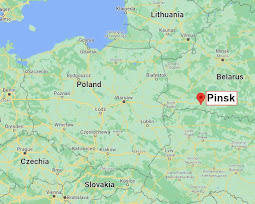
Pinsk, Russia (now in Belarus)
Pinsk - Russian Jewish area

My compatriots from Pinsk [Russia, now in Belarus], however, did not let all this come up against me and defended me to the best of their ability. Those who were hostile to me said: “The Meshumad, the renegade (they did not pronounce my name), had to do with us unlearned people at that time, and he was victorious. But if a competent Rabbi had been present at that time, he would have gone away in disgrace. My compatriots said: “Well, that can be tested. Mr. Landsmann will not refuse an invitation to a disputation.” Others said: “He will beware; he is clever enough and will not come!” My friends replied: “Mr. L. has often assured us: the more learned a Jew is, and the better he knows the Talmud, the easier it is to convince him that Jesus is the Messiah. We are sure that Mr. L. will gladly come. By the way, should he really refuse to come, then woe to him, we would announce it in all the newspapers, and he would have to be ashamed”, etc. — That helped! Now they were discussing who would be the right man to dispute with me. — I knew nothing of all this. Only I noticed that in some families they no longer liked to see me, but gave me short shrift. That hurt me very much.

The day before yesterday (March 18) three friends came to me in the morning, told me what had happened, invited me to a meeting and asked me if I would accept the invitation. I, delighted with the beautiful and rare opportunity to testify of Christ, thanked them for their mediation and said: "It is my duty as a Christian, but especially as a missionary, to give an answer. I showed them Ezk. 3:17—21, where God demanded this of me, and woe to me if I did not want to do it. They went on to say: “Do you also know who the man is with whom you will have to deal?

I answered: “I am coming, and in the name of my God I will cast the net! Do you think we Christians are afraid of your Jewish sophistry? Our faith stands on the Word of God. I promised to be at the appointed place at 2 o'clock in the afternoon.” —

When I got there, the house was full of Jews. They had really got a man who was a good Hebrew, and an even better Talmudist and Kabbalist. Also, as it seems, he was not unversed in the New Testament. It was a pleasure to talk with him. —

The Rabbi took out a Hebrew New Testament and told me to read and translate Heb. 1:3. I did: “Who being the brightness of his glory, and the express image of his person,” etc. —

“Who is that?” the Rabbi asked me triumphantly, “that should be the Messiah? How can you prove that to us?” —

I: “This is the Messiah, and this is exactly how the Messiah of the Bible should and must be; otherwise He could not redeem us apostate people! He must, if He is to redeem us from sin, death and hell, be the reflection of God's glory and the very image of His being!

Before I could explain further, the Rabbi said: ““We do not want to believe you, where is it written among us?” —

I replied: “In your Kabbalah!!!” A silence fell,…  

- - - - - - - - - - - - -  Continued in Part 2  - - - - - - - - - - - 
In the next Part 2 we find out what happened after the "silence fell" among the Jews. There were several periods during this debate where the Jews "fell silent".

- - - - - - - - -  Table of Contents  - - - - - - - - - 
Part 1: This introductory blog
Part 2: Landsmann uses Jewish prayer book against objection; Schem Hamphoras 
Part 3: Landsmann proves Talmud a lie, Schem Hamphoras powerless
Part 4: Jesus and the power to do miracles
Part 5: Jesus's sacrifice does not count? (Scapegoat, red heifer, serpent in wilderness)