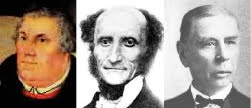
C. F. W. Walther is a master historian of the Reformation and all the theologians connected with it. And in 1876, in the pages of
Lehre und Wehre, Walther tackled one of the most difficult issues a Lutheran theologian has to face: the relationship between
Martin Luther and his associate
Philip Melanchthon. So when I ran across this extensive essay (39 pages in length), I knew that I had to get it translated. Walther digs deep into Reformation history to unearth what the persons involved actually said, then he ties it all together. This is no small task, given the ambiguous language that is used at key points in this history. During the translation of this project, I was greatly interested in the content of Walther’s essay and could hardly wait for each new paragraph in order to get the full story on this important–and controversial–subject. — What did Walther think of Melanchthon and his teaching? He tells us the answer to that question near the end of his essay:
"How much would we have preferred to be able to help that only the memory of Melanchthon should be kept alive from the time of his faithfulness and blessed efficacy, but that the memory of him from the time of his softening and falling should be wiped out and buried forever!"
So
why then did he take the time to go into this thorny topic? We find the answer to that question in both the opening and closing comments. — I have spent
several months working on this essay, its supporting documentation, and on the controversial arguments against it. We begin now the first of many blog posts presenting this masterful essay by… "The American Luther." From
Lehre und Wehre, vol. 22 (Nov., Dec.1876),
pp. 321-338,
353-373 [
EN]
:- - - - - - - - - - - - - - - - - - - - - - - - -
The “Carrying” of Melanchthon on the Part of Luther.
[by C. F. W. Walther, Part 1]
After Luther's death, it has often been pointed out to those Lutherans who did not want to hold fraternal, altar and church fellowship with manifest false teachers within our church, that Luther, as we know, had himself cultivated such fellowship with Melanchthon, even after the latter had no longer agreed with Luther on several important points of doctrine. *) Such Lutherans, it was claimed, obviously wanted to be more strictly Lutheran than Luther himself. A Lutheran in Luther's sense should not break off fellowship with the erring who still professed the faith of our church, but should rather bear and tolerate it, as Luther once did with a Melanchthon.
In recent times this was also reproached to those East Indian missionaries [Zorn, Willkomm, Zucker] who had been dismissed and who declared that they could no longer remain in the service of the Leipzig Missionary Society if the latter did not break away from fellowship with notorious false teachers in which it is known to stand. Missionary Zorn wrote to us from East India that Director Hardeland had said to them, the missionaries troubled in their conscience, “You want to be more orthodox than Luther. — You have to take a man as a Lutheran for as long as he is Lutheran, that is, not to separate from him when he professes to be Lutheran. Here,” it goes on, “Luther's carrying of Melanchthon from 1542-1546 was cited (and cited again and again) as a resounding example of healthy church practice from the fundamental period of the Reformation.”
————
*) This was done by, among others, the crypto-Calvinist Dr. Caspar Peucer, Melanchthon's son-in-law, in his Tractatus historicus de Melanchthonis sententia de controversia Coenae Domini, 1576, and the Philippists at the Altenburg Colloquium in 1568, who went further, claiming that Luther agreed with Melanchthon's deviations from the earlier doctrine.
(LuW 322)
If Melanchthon had really already become apparent in Luther's time as a stubborn false teacher, and if Luther had really let Melanchthon have his way during this time, then one would have to admit that those Lutherans who do not want to cultivate fellowship with false teachers appearing in our church [i.e. theologians claiming to be Lutheran] do not act in Luther's sense, at least not according to Luther's example.
But the matter stands, thank God, quite differently; and the intention of the present article is to prove this.
- - - - - - - - - - Continued in Part 2 - - - - - - - - - -
Walther did not want to write this unhappy essay, he was forced into it — forced because of false charges from Lutheran leaders in Germany in the 19th century. But along with the example of the director of the Leipzig Mission Society, Walther gives examples from the 16th Century who tried to hide behind this same false report of Luther. Unlike his opponents, Walther focuses not on the early years of Melanchthon, but only on the years of the last 10 years of Luther's life. This is exactly the time frame that erring Lutherans want to avoid. — It is a most unsettling history, not only because of Melanchthon's wavering, but also because it is difficult to defend against the misuse of it by erring Lutheran theologians. What a relief it is to have C. F. W. Walther take on this task, the "heavy lifting", of presenting a full analysis.
As I progressed through Walther's essay, another work came to mind that would be a perfect compliment to it, Prof.
F. Bente's 1921
Historical Introduction to the Symbolical Books, his best known work. But as I researched Bente's work
and reactions to it in today's LCMS, a counter concept of Reformation history came to light. There is a
radical shift in thinking being promoted within and without the LC-MS. And so to counter what is being taught in the LC-MS seminaries and institutions, or at least allowed, I decided to take
several months to polish this translation of Walther — adding pictures of many persons, and inserting dozens of links to Walther's source materials so that readers can immediately access them and read them where possible. What makes Bente controversial will certainly make Walther's essay controversial. More will be said about this in upcoming blog posts. — In the next
Part 2, Walther explains the complexity of the problem, then begins to present the matter.
- - - - - - - - - Table of Contents - - - - - - - - -
Part 1: This intro; Leipzig Mission dismisses Missouri leaning missionaries
Part 2: The Melanchthon Conundrum; “Slight doubts [rising from] Church Fathers.”; list of LC-MS opponents
Part 3: M.'s good confessions in Luther's last years; Lowell Green's attacks, Marquart's rebuttal
Part 4: More good confessions by Melanchthon; Green charges Bente on Supper
Part 5: M.'s errors not overlooked; L.'s "guileless, faithful heart"; Rosenbladt's "black hat" charge against Bente
Part 6: Ratzeburger "hits truth" on M.; Scott Keith: Bente's "poorly" covered history
Part 7: M.'s private letters; “objectivity” of modern history?; "Thinking Fellows" "biased" against Bente
Part 8: M.'s “ambiguous behavior”, Calvin: “bread adoration”; "Banned Books" Ban Bente
Part 9: “Beloved Baumgärtner” testifies against M.; praise for Bente's history from
Paul McCain Part 10: M.: gentle or angry nature?; Dr. Green's false judgment
Part 11: M.'s notorious letter; Green avoids recipient's name (Carlowitz)
Part 12: Quenstedt & Calvin tell the truth about M.; do Dingel & Kolb on Melanchthon & Leipzig Interim?
Excursus 1:
Chemnitz on Melanchthon's errors: Philippism, “horrible heresies”
Part 13: Walther summarizes Melanchthon's ups & downs; Langebartels uses Bente
Part 14: Melanchthon: Luther did not carry me; Drs. Keith & Green "
perceived errors" vs. Chemnitz
Part 15:
Cordatus blows whistle; “‘
causa’ must leave”; Walther's
Law & Gospel; Gillespie, Riley against
Unaltered Augsburg Confession?
Part 16: "necessary cause", “What bondage it was”; the many editions of Melanchthon's
Loci Excursus 3:
Löscher: Melanchthon's “all too political, philosophical mind.”; Löscher vs. Rosenbladt
Part 17: “Luther's mildness; The Thinking Fellows: Bente's "bias" of "confessional historiography"
Part 18: Luther too mild?; Bente's
Historical Introductions uploaded 2 ways
Part 19: M.'s "game of hide-and-seek"
Part 20: Transubstantiation, Venetians, Swiss; Kolb against Chemnitz on Church Fathers
Part 21: Luther calmed, but Melanchthon “himself was not calm”
Part 22: The unsuspecting Luther… but only too soon…; Kolb avoids Luther's explosive letter
Part 23: Luther to write against Melanchthon, but…; Dr. Green's false thesis on Melanchthon
Part 24: Elector's letter to spare M.; Kolb whitewashes history, theology; LCMS is not true "Missouri Synod"
Part 25: Luther reproaches Melanchthon, Elector seals record; Dr. Keith's Law-driving
Part 26: Luther to Melanchthon: “do away with some points”; Walther's history of Formula polished, uploaded:
Kern und Stern (another BTL book)
Part 27: Luther: great harm of silence; Pr Riley on Justification (UOJ) — a contradiction
Part 28:
Impossible! (Walther's conclusion); Walther over Drs. Kolb and Green
.jpg)

.jpg "Melanchthon")


.jpg "Walther, Melanchthon, Luther")
,%20Woehling,%20p%2055.jpg "Carl Manthey Zorn, Otto Willkomm, J. F. Zucher (former East Indian missionaries)")
.JPG "Prof. Friedrich Bente, Concordia Seminary")