Search This Blog

Showing posts with label Australia. Show all posts

Sunday, May 31, 2020

History 4a: Hochstetter’s “Foreword” (1 of 2)

      This continues from Part 3 (Table of Contents in Part 3), a series publishing an English translation of Pastor Christian Hochstetter's 1885 496-page book entitled (abbreviated) The History of the Missouri Synod, 1838-1884. — In this installment, we begin with the "Foreword" in which Hochstetter tells us about his background, and why he wrote this book. Why did he join the (Old) Missouri Synod? — Now Hochstetter's History is no longer locked up in the German language, away from English-speaking Lutherans, but is available… in English… for free.
- - - - - - - - - - - - - - - - 
The following is an English translation of C. Hochstetter's Geschichte… by BackToLuther utilizing the DeepL Translator with minor assistance from Dr. Fred Kramer's translation.  All hyperlinkshighlighting and red text in square brackets [] are mine.

[page III]
Foreword.
 
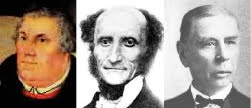
Pastor Christian Hochstetter (image: haseleyfamily.com)
Christian Hochstetter
It has been correctly said: Facta loguuntur [“Facts speak for themselves”]. Also the history of the Missouri Synod needs no long preface. It will, however, be the appropriate place where the author of this writing will have to give an account to his readers of himself and of the cause of writing this book.
The writer of these lines was first inspired to enter into the service of the inner mission in 1850 during a “Kirchentag” meeting held in Stuttgart. Even then he recognized that North America, as the land of immigration, is actually the place for inner mission. But after he had just finished his studies in Tübingen, he entered the vicarial service for a few more years and only in spring 1853 he took a vacation from the Royal Württemberg Consistory, which was only issued for six years. Even before he left for America, he received a call through the mediation of Dr. Barth to a then newly formed congregation in Fort Wayne, Indiana. This congregation had been founded shortly before by a licensed preacher from the Ohio Synod in opposition to the long-standing congregation of Dr. Sihler, which belonged to the Missouri Synod, and the writer of these lines, by accepting this call, came into close association with the Ohio Synod, even before he knew it in detail. Since he did not find in the Ohio Synod what he was looking for, but rather was of the opinion that a strong external church government was needed from the outside in order to be able [page IV] to control the spiritual devastation and the often prevailing disdain for the preaching ministry, he felt drawn to the Buffalo Synod, whose senior was Pastor J. A. A. Grabau († 1879) 
Pastor J. A. A. Grabau († 1879)
In 1857, I was appointed as a deacon next to Pastor Grabau at the Trinity Church in Buffalo, where I served for ten years under very turbulent circumstances. In February 1866, I felt compelled to file a complaint with the Buffalo Synod ministry, and the negotiations that ensued led to a great schism, while Pastor Grabau, along with three other preachers, renounced the Buffalo Synod in the extra session of the Synod held in May of that same year, to which he had appealed. In September of the same year, the writer of these lines, together with the now also deceased Pastor von Rohr, had the first meeting with Prof. Dr. Walther, which took place in Dr. Sihler's home in Fort Wayne. It was there that the Buffalo Colloquium was arranged, which was held in November 1866 between the representatives of the Missouri Synod and those of the Buffalo Synod, as recorded in Chapters VIII and IX of this book. Since the representatives of the Buffalo Synod recognized at this public colloquium that the hitherto contested doctrine of the Missouri Synod, namely the doctrine of church and ministry, is the scriptural and symbolic confession of the Evangelical Lutheran Church, (with only one Buffalo delegate reserving differences), they subsequently joined the Missouri Synod with the largest part of the Buffalo Synod congregations, thus bringing to an end the longstanding dispute between these two synods. In the following year, 1867, the Missouri Synod elected the writer of these lines to represent the Eastern District of the Synod at the colloquium held between the representatives of the Iowa Synod and those of the Missouri Synod in Milwaukee, Wisc., as reported in [page V] Chapter X of this paper. — The author believed that he had to make this preliminary reminder because it is shows that the writer of this is not only in many places an eye- and ear-witness of what he reports in this book, but is also to some extent involved in the doctrinal disputes and struggles that were decided upon by the Missouri Synod. It has not been easy for us, the former members of the Buffalo Synod, to prove right those in whom we once thought were church destroyers; the readers will recognize from what is reported at the end of Chapter VIII that it was only under various tribulations, which had to serve us in the best possible way, and after the temptation which teaches us to remember the Word, that we were set on the path by God's gracious guidance, which we have now walked for 18 years in unity of spirit with the members of the Missouri Synod.
In accordance with the spiritual nature of the kingdom of God, it cannot be otherwise than that only there, in blessing, is building on the walls of our Lutheran Zion, where one builds on the right, old foundation, and where the Holy Spirit himself, who brings the dead to life through his powerful Word, is the master builder, through whom one stone is joined to another. Where the pure preaching of the Gospel as the power of God goes out to the salvation of souls, there the churches will also come to a healthy knowledge and to a proper form from within! This was confirmed by the Evangelical Lutheran Missouri Synod. The founders and leaders of the Synod did not support ecclesiastical political plans, nor did they believe that they had to take into account the circumstances in which they were placed in such a way that they would have pursued a carnal addiction to expansion; when they fought, they fought for the sanctuary of revealed truth, and when they built, they wanted to build the souls through the Word as living stones in the house of God, which is a spiritual temple in the Lord. [page VI] In the Foreword to the Book of the Church and Ministry [p.viii], Dr. Walther exclaims, "We must resolutely reject the accusation that we have bent and modelled the holy pure teaching of our Church in favor of our circumstances — — — We have not modelled the teaching of our Church according to our circumstances, but have ordered it according to the doctrine of our Church. Anyone who doubts this, we confidently call out to him: Come and see!"
The former members of the Buffalo Synod are not the only Lutherans who joined the Missouri Synod for protection and support; entire synods met with it and formed the Lutheran Synodical Conference on the basis of the unadulterated Word of God and under the banner of the Lutheran Confessions rooted in the Word of God; the Lutheran Church in this Occident [Western world] experienced an unprecedented revival through God's gracious visitation, the number of congregations associated with the Missouri Synod increased in an unprecedented way! Why should it be surprising when Satan rumbles about it, when the little ship of our synodical fellowship is threatened and afflicted by heavy storms, especially in recent times? While Satan is leading his own people by the scruff of the neck — and there is no doubt about this — Satan's cunning is also concealed under the fact that in the doctrinal dispute that has now arisen in the midst of our Synodical Conference we are dealing here with the doctrine of predestination, that is to say the eternal election of the children of God. First of all, this was a doctrine that was less well known and less mentioned in comparison with other doctrines that are even closer to the center of salvation, because it does not belong to the ABC’s of the revealed truth of salvation, with which one must begin in teaching and learning. This is why Luther says in the preface to Chapter 9 of the Epistle to the Romans: "Every doctrine has its measure, time and age. It is the spirits who, before they have grasped and prayed the simple way of salvation, begin at the top [page VII] and want to explore the abyss of divine predestination, and worry about whether they are foreknown, i.e. whether they are the chosen ones. Follow this epistle (to the Romans) in its order. First grieve with Christ and the Gospel, that you may recognize your sin and His grace, and then contend with sin as taught here in chapters 1, 2, 3, 4, 5, 6, 7, 8. After that, when you have come to chapter 8, under the cross and suffering, the predestination in chapters 9, 10 and 11 will teach you how comforting it is. Because without the cross, suffering and death, predestination cannot be dealt with without harm and secret anger against God. Therefore Adam must first die before he can suffer this thing and drink the strong wine. Therefore be careful not to drink wine while you are still a baby." *)
“Luther's teachings are so little known and respected”
Although in Germany, as far as it is "Protestant", the 400th anniversary of Martin Luther's birth was celebrated with great display, Luther's teachings are so little known and respected in many parts that one often thinks that what was brought to light from the depths of the divine Word as a precious prize of the Reformation through Luther's ministry is fanaticism [Schwärmerei]. One can be saved by human considerations, even by the very same objections and prejudices which the Romanists past and present raised against Luther and his associates. Thus it happened with regard to the doctrine of the Church and the Ministry, the so-called objective concept of the Church, by which one wanted to suppress the Evangelical doctrine of the Church, which was described as atomistic, subjectivistic, etc., is entirely the doctrine of the Church that Bellarmin put forward. In the same way, they are now fighting with the same reasons against our doctrine of the election of grace, which Erasmus once put forward against Luther.
—————————
*) The Synodical Report of the Ohio Synod of 1881 mocks the fact that the pure doctrine of grace has been compared to strong wine! Does one know in that synod that the man of God Luther is being mocked with this?
- - - - - - - - - - - - - - - -  Continued in next Part 4b  - - - - - - - - - - - - - - -

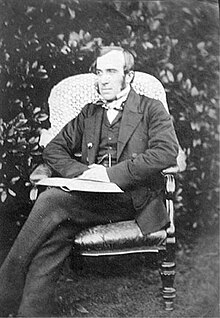
Pastor Bryce Winter, ELCR (Australia)
      Along with my dedication of this English translation to Dr. Fred Kramer, I would give honorable mention to Pastor Bryce Winter of the Australian ELCR for his splendid attempts at translating this massive 496-page work.  Pastor Winter, who is reaching an age, is perhaps the greatest living translator of Old Missouri Synod German works into English. How I wished that he could have completed his work because his work is superior to my effort. However the sheer size of this project has apparently prevented his completion of it.  Therefore with the silence of both CPH and CHI after my 2-year old warning, I am proceeding with this project with the aid of current online resources.

Tuesday, October 16, 2018

Pieper's sermon — Rom. 16:17 (1912 Synodical Conference), Part 1

      In a May 2018 blog I lamented that there were so few sermons of Pieper that found their way into publication.  But I recently discovered another sermon obtained in 1997 from Australian Pastor Bryce Winter (ELCR — Evangelical Lutheran Congregations of the Reformation) who translated it.  
      Another condensed translation of this same sermon was published in C. S. Meyer's Moving Frontiers, pp. 288-290.  And it has come to my attention from Mark Braun's A Tale of Two Synods, p. 209, that the Wisconsin Synod reprinted, possibly in English translation, this sermon in their Theologische Quartalschrift, vol. 54, July 1957.  This shows the notoriety this sermon achieved in the 20th century among Lutherans of the Old Synodical Conference before its demise.  Oh, but the subject matter was to become far from popular and indeed has become a major issue in church fellowship matters!  I will touch on this later in Part 3...
      This sermon will be presented in three parts due to its length.  One will note Pastor Winter's usual method of inserting alternate translations in parentheses for possible better understanding of the original German words.  I have made only minor edits.  Now with thanks to Australia...
Pr. Bryce Winter

==========  (p.7)  ==========
Opening Sermon (on Ro. 16:17)
Delivered by Dr. F. Pieper.
(Translation by Pastor Bryce Winter, ELCR 1997)
-----------

Text: Romans 16:17-18: Now I beseech you, brethren, mark them which cause divisions and offences contrary to the doctrine which ye have learned; and avoid them. For they that are such serve not our Lord Jesus Christ, but their own belly; and by good words and fair speeches deceive the hearts of the simple.

Venerable fathers and brethren!  In Christ, dearly beloved hearers!

If we look around in visible Christendom, then we are chiefly confronted by one extremely distressing scene: its division. Those who in the same way call themselves after Christ's name, are divided into a number of groups (factions) which are themselves engaged in mutual combat. This state of affairs is rightly deplored by all sides as miserable (pitiful) and is described as extremely harmful for church and world. Also we agree with full conviction in lamenting this state of affairs. But we are moved to examine the matter still closer when we hear and read the accusation that also just we Lutherans of the Synodical Conference cause and continue division by the position of our church, namely, in this way that we require the adherence to all parts of Christian doctrine and do not cultivate church fellowship with false doctrine. We reject the accusation raised against us as unjust and maintain the opposite with all determination that by the position of our church we are not bringing about division, but union and agreement. Who decides the propositions in this conflict? God's Word. God's Word clearly answers and decides all questions that have to be answered and decided in the church until the last day. This is also the case concerning the division within the Christian Church. The entire Scriptures are full of instruction concerning this point. In the text which has been read out we have

The instruction of the Apostle Paul concerning division in the Christian Church.

From this instruction we emphasize especially three points:

[1]   How division originates;
[2]  How division is to be judged; and
[3]  How division is to be removed.

[1] How division originates [p. 8]

First of all, we learn from our text something for our comfort. Our text reminds us, namely, of the fact that division in the Christian Church is nothing new. When we in our time lament over this division and have to endure this division, then we should not think that something strange is happening to us. The misery of division occurred also in the church of the Apostles and before the eyes of the Apostles. That also now arises (follows from) out of our text. When the Apostle still so urgently admonishes the Roman congregation with a final detailed explanation of Christian doctrine, to direct their attention on the people who are causing the division and gives instruction to isolate such people, then he is not fighting a scarecrow (dummy), but real existing dangers and actions which have already happened at other places.

However above all things the Apostle now teaches us about the important point how or whereby division originates in the Church. He says: “Mark them which cause divisions and offences contrary to (alongside of) the doctrine which ye have learned.” Thus division is then caused, division then originates, when people come forward (arise) in the Christian Church, who alongside of the doctrine, that is, teach something different than Christ's Apostles, speak something different in the Christian Church than Christ's Word and find supporters for this (error). This results from the nature of the Christian Church. The Christian Church here on earth is a completely unique Kingdom, absolutely distinct from the kingdoms of this world. The different kingdoms of this world have different rulers and laws and accordingly are ruled differently. The Christian Church here on earth is not man's, but Christ's Kingdom and has in all countries and for all times until the last day only one Ruler, Christ, and only one Law for its Kingdom by which it is taught and ruled: that is Christ's Word, the Word, that He has given to the Church through His Apostles and Prophets. There is no place in the Christian Church for a word alongside of (Christ's Word) and for a Ruler alongside of (Christ).  Christ says in regard to His Church: “One is your Master, even Christ” (Matt. 23:8), and therefore inculcates (the following) as a Law in His Kingdom: “If ye continue in My Word, then are ye My disciples indeed” (John 8:31). And that was valid not merely for the time, when Christ walked on earth, but for the Church of all times and at all places until the last day. In His High Priestly prayer Christ describes the Church until the last day as a community (fellowship) of people, who through their — that is, the Apostles' — word will believe on Him, John 17:20. St. Paul describes the Church as a house that is “built upon the foundation of the Apostles and Prophets”, Eph. 2:20, and says of his own teaching activity: “I will not dare to speak of any of those things which Christ hath not wrought [Greek: worked, Ed.] by me,” Romans 15:18. St. Peter lays down the principle for all [p. 9] teaching in the Christian Church: “If any man speak, let him speak as the oracles (Word) of God,” 1 Pet. 4:11. The unity of the Christian Church in all different kinds of circumstances, times, nations and languages consists in its adherence to the Word of Christ and its separation from those who cause divisions in departing from this Word. In order to preserve this unity and to prevent division, the Apostle Paul therefore wherever he found himself sent to the congregations and to their teachers the message and the admonition never “to teach anything different”, but to hold fast steadfastly to the form (model, pattern, example) of sound (wholesome) words (2 Tim.1:15) which they have learned from the Apostles of Christ. From Athens he writes to the Thessalonians: “Stand fast and hold the traditions [oral teachings of God's Word which were proclaimed, Ed.] which ye have been taught, whether by word, or our epistle [letter, Ed.],” 2 Thess. 2:15. He left Timothy at Ephesus in order to command (order) some that they “teach no other doctrine,” 1 Tim. 1:3. From Corinth he writes to Rome: “Avoid them”, those who teach another doctrine! Romans 16:17. From Rome he writes to Galatia and admonishes the Galatians that they have allowed themselves to be turned away to another kind of gospel, which however is not another (gospel) of the same kind (as Paul taught), Gal. 1:6 ff. And when he travels back from Europe to Jerusalem, he calls together the elders [pastors, Ed.] of the congregation of Ephesus to Miletus and warns them against people who will arise out of their own midst and will speak perverse doctrines to draw away disciples for themselves, Acts 20:29 ff.

Hence it is now clearly evident, when doctrine comes into consideration, on whom the cause (blame) for division falls in the Christian Church, namely, not on those who hold fast immovably to the doctrine of the Apostles, but rests on those who depart from it and teach a different [doctrine, Ed.].  We Lutherans of the Synodical Conference are now certain of it and have proven it before the church, that our doctrine, particularly also in the points raised in dispute, is not own word, but God's Word. We could and can in all points place the finger on God's Word and says: “There it is [Ed. stands] written.”  It is a complete overturning of the usage of Biblical language, if one claims that through our insistence on the pure, unadulterated teaching of the Word God we are causing and maintaining division in the church.

In our time one particularly demands “doctrinal freedom.” There is doctrinal freedom in the state, furthermore it is not a matter of the state to teach and to govern the Christian Church [Ed. in spiritual matters]. However there is no doctrinal freedom in the Christian Church, because in the Christian Church according to God’s command and order everyone who steps forward to teach should speak God's Word. Whoever in the Christian Church makes for himself the claim of doctrinal freedom, thereby demands the right to cause division in the Christian Church and set himself up alongside of Christ and revolts against Christ as the One Head and Ruler in the Church.

However with this we have already come to the second point concerning which we want to be instructed by the Apostle Paul, namely, how division is to be judged.
= = = = = = = =  continued in the next Part 2  = = = = = = = =

In the next Part 2, we learn from the Bible how division is to be judged...

Wednesday, November 16, 2016

Catholic Encycl.: only those “Old Lutherans” of… Missouri

[2017-06-23: updated links from HathiTrust to Google Books; Dec. 2, 2016: added new source for Pieper's quote at bottom]
      It can be difficult to figure out just what true Lutheranism is, who are the true Lutherans today.  We get some assistance in this endeavor from The Catholic Encyclopedia, volume VIII (1910).  In their article under the heading of “Justification” (p. 573-578), they first set out to explain “The Protestant Doctrine of Justification”.  As the essayist approaches the end of this section, after handling the “error” of Luther, it rejoices in the fact that practically all of Protestantism, including world-wide Lutheranism, has virtually joined with the Roman Catholic Church in acknowledging that there must be something else besides God's grace that is responsible for our salvation.  Oh, but there is a "fly in the ointment", and our Catholic essayist would not want to be accused of omitting any minor detail.  And what would be this small bit of information?  I highlight his sentence below:
1910 Catholic Encyclopedia, vol. 8, p. 576 (WikiSource)


“The strict orthodoxy of the Old Lutherans, e.g. in the Kingdom of Saxony and the State of Missouri, alone continues to cling tenaciously to a system which otherwise would have slowly fallen into oblivion.”
The "Old Lutherans" have been taken over by today's LC-MS which no longer receives censures by Romanists like the above.  It is the "pure grace" written into the Brief Statement of 1932 that is the remaining legacy of the "Old Lutherans".  But God's Grace remains for all.  He gives us His Word.
      How did I come across this "bit" of information?  It came from Franz Pieper's 1921 essay to the North Dakota-Montana District as translated by Pastor Bryce Winter of the ELCR of Australia.  Pastor Winter is serializing his translation of this marvelous history of Martin Luther at the Diet of Worms in 1521 ("Here I Stand") and I present below his Part 7 which is short, less than 5 pages long. Full Google Doc text > here <.  Highlighting and hyperlinks are my additions; original pagination retained.


Who am I?  Just an "Old Lutheran" from that "State of Missouri" from above where only pure grace is clung to — Sola Gratia!
[Note: Pieper also gave the above quote from the Catholic Encyclopedia in his Christliche Dogmatik, vol. 2, pg 670, or Christian Dogmatics, vol. 2, p. 555, mentioning Catholic author Joseph Pohle]

Wednesday, August 12, 2015

Buddhism contrasted with Christianity-Pt 1 (Monier-Williams over C.S. Lewis, Max Müller)

Sir Monier Monier-Williams
[August 12: add hyperlinks, highlighting; modernized Bible verse references.]
I have previously blogged about "Pieper's error" regarding a famous quote he used in several of his writings including his Christian Dogmatics (vol. 1, pg 15).  Recent research from Australia has re-published the actual quote made by Sir Monier Monier-Williams which deserves repeating, just as Pieper repeated it several times (bolding by Australian pastor):
In the discharge of my duties for forty-two years I have devoted as much time as any man living to the study of these books [Sacred Books of the East]. ... What we must not forget is that the key point that he makes is that right throughout all the heathen religions there is "the one refrain through all: salvation by works. They all say that salvation must be purchased, must be bought with a price, and that the sole price, the sole purchase-money, must be our works and deservings. Our own Holy Bible, our sacred Book of the East, is from beginning to end a protest against this doctrine. Good works are indeed enjoined upon us in that sacred Book of the East; but they are only the outcome of a grateful heart; they are only a thank-offering, the fruits of our faith. They are never the ransom-money of the true disciples of Christ. Let us not shut our eyes to what is excellent and true and of good report in these sacred books; but let us teach Hindus, Buddhists, and Mohammedans that there is only one sacred Book of the East that can be their mainstay in that awful hour when they pass all alone into the unseen world. It is the sacred Book which contains that faithful saying, worthy to be received of all men, women, and children, and not merely of us Christians, that Christ Jesus came into the world to save sinners.
      A great advantage for me in researching Monier-Williams is that he was English and wrote in the English language... no translation needed from German.  And could it be?... he was from Oxford University!... the same as C.S. Lewis, but at an earlier time (~1889) when apparently true Christian doctrine was not universally muddled (despised?) as it is today.  So it was an easy task to research Monier-Williams' various writings to confirm his stand on Christianity compared with Max Müller.  And Oh!... what a wonderful treasure I discovered from him as he uses his superior knowledge of the Eastern religions – not to impress the world, but to show the truth of Christianity.
      To all who would read, follow, and even quote C.S. Lewis (an Oxford don), they would do much better to read another Oxford professor to learn the truth of (mere) Christianity. —  Steve Jobs was partially raised in an LC-MS family ("Missouri Synod") but left the training of his youth to find religion in the East.  The Beatles were enamored with Eastern religions.  To say that Eastern religions are popular today would be an understatement.  But Monier-Williams (and Pieper) show us that these very intelligent (and popular) people were sucked into a maelstrom of man-made religions.  — And so I present the concluding chapter of one of Monier-Williams' great books on Buddhism.  I will present it in 2 parts:
- - - - - - - - - - - - - - - - - - - - - - - - - - -
Text extracted from Buddhism in its connexion with Brāhmanism and Hindūism and in its contrast with Christianity. (WorldCat) by Sir Monier Monier-Williams, 1889, pages 537-563; © The Chowkhamba Sanskrit Series Office (India), 1963, Second Edition.  Also in Google Books beginning here.  Pagination headers retained for reference.  Hyperlinks added for reference. Highlighting by BackToLuther.
————————————————————————————
LECTURE XVIII.
Buddhism contrasted with Christianity.
by Sir Monier Monier-Williams
(Part 1)
In the previous Lectures I have incidentally contrasted the principal doctrines of Buddhism with those of Christianity.
It will be my aim in this concluding Lecture to draw attention more directly and more in detail to the main points of divergence between two systems, which in their moral teaching have so many points of contact, that a superficial study of either is apt to lead to very confused ideas in regard to their comparative excellence and their resemblance to each other.
And first of all I must remind those who heard my earlier Lectures of the grand fundamental distinction which they were intended to establish—namely, that Christianity is a religion, whereas Buddhism, at least in its earliest and truest form, is no religion at all, but a mere system of morality and philosophy founded on a pessimistic theory of life.
Here, however, it may be objected that, before we exclude Buddhism from all title to be called a religion, we ought to define what we mean by the term ‘religion.’
Of course, it will be generally acknowledged that mere morality need not imply religion, though—taking
538 BUDDHISM CONTRASTED WITH CHRISTIANITY.
the converse—it is most undeniably true that religion must of necessity imply morality.
Unquestionably there have been great philosophers in ancient times who have lived strictly moral lives without acknowledging any religious creed at all. Many excellent men, too, exist among us in the present day, who resent being called irreligious, and yet hold no definite religious doctrines, and decline to accept any system which commits them to absolute belief in anything except an eternal Energy or Force.
Clearly the definition of the word ‘religion’ is beset with difficulties, and its etymology is too uncertain to help us in explaining it1. We shall, however, be justified if we affirm that every system claiming to be a religion in the proper sense of the word must postulate the eternal existence of one living and true God of infinite power, wisdom, and love, the Creator, Designer, and Preserver of all things visible and invisible.
It must also take for granted the immortality of man’s soul or spirit, and the reality of a future state and of an unseen world. It must also postulate in man an innate sense of dependence on a personal God—a sense of reverence and love for Him, springing from a belief in His justice, holiness, wisdom, power, and love, and intensified by a deep consciousness of weakness, and a yearning to be delivered from the presence, tyranny, and penalty of sin.
————————
1 Cicero (De natura deorum) derives religion from relego, and explains it as a diligent practice of prayer and worship. Others have derived it from religo, and hold that it means ‘binding to God.’
BUDDHISM CONTRASTED WITH CHRISTIANITY. 539
Then, starting from these assumptions, it must satisfy four requisites.
First, it must reveal the Creator in His nature and attributes to His creature, man.
Secondly, it must reveal man to himself. It must impart to him a knowledge of his own nature and history—what he is; why he was created; whither he is tending; and whether he is at present in a state of decadence downwards from a higher condition, or of development upwards from a lower.
Thirdly, it must reveal some method by which the finite creature may communicate with the infinite Creator—some plan by which he may gain access to Him and become united with Him, and be saved by Him from the consequences of his own sinful acts.
Fourthly, such a system must prove its title to be called a religion by its regenerating effect on man’s nature; by its influence on bis thoughts, desires, passions, and feelings; by its power of subduing all his evil tendencies; by its ability to transform his character and assimilate him to the God it reveals.
It is clear, then, that tried by such a criterion as this, early Buddhism could not claim to be a religion. It failed to satisfy these conditions. It refused to admit the existence of a personal Creator, or of man’s dependence on a higher Power. It denied any eternal soul or Ego in man. It acknowledged no external, supernatural revelation. It had no priesthood—no real clergy; no real prayer; no real worship. It had no true idea of sin, or of the need of pardon (p. 124), and it condemned man to suffer the consequences of his own
540 BUDDHISM CONTRASTED WITH CHRISTIANITY.
sinful acts without hope of help from any Saviour or Redeemer, and indeed from any being but himself.
The late Bishop of Calcutta once said to me, that being in an outlying part of his diocese, where Buddhism prevailed, he asked an apparently pious Buddhist, whom he happened to observe praying in a temple, what he had just been praying for? He replied, ‘I have been praying for nothing.’ ‘But,’ urged the Bishop, ‘to whom have you been praying?’ The man answered, ‘I have been praying to nobody.’ ‘What!’ said the astonished Bishop, ‘praying for nothing to nobody?’ And no doubt this anecdote gives an accurate idea of the so-called prayer of a time Buddhist. This man had not really been praying for anything. He had been merely making use of some form of words to which an efficacy, like that of sowing fruitful seed in a field, was supposed to belong. He had not been praying in any Christian sense.
Here, however, an objector might remind me that according to my own showing, various developments of Buddhism modified and even contradicted the original creed, and that what has been here said about prayer, is only strictly applicable to early Buddhism as originally taught in the most ancient texts.
I grant this—I grant that expressions of reverence for the Buddha, the Law, and the Monkhood, developed into expressions of wants and needs, and that these expressions, gradually led on to the offering of actual prayers to deified Buddhas and Bodhi-sattvas.
I admit that we ought to judge of Buddhism as a whole. We ought to give full consideration to its
BUDDHISM CONTRASTED WITH CHRISTIANITY. 541
later developments, and the gradual sliding of its atheism and agnosticism into theism and polytheism. We are bound to acknowledge that Buddhism, as it extended to other countries, did acquire the character of a theistic religious system, which, though false, had in it some points of contact with Christianity.
Nevertheless, admitting all this, and taking into account all that can; be said in favour of Buddhism as a religious system, it will be easy to show how impossible it is to bridge over the yawning chasm which separates it from the true religion.
It is, indeed, one of the strange phenomena of the present day, that even educated people who call themselves Christians, are apt to fall into raptures over the precepts of Buddhism 1, attracted by the bright gems which its admirers delight in culling out of its moral code, and in displaying ostentatiously, while keeping out of sight all its dark spots, all its trivialities and senseless repetitions2; not to speak of all those evi-
————————
2 As instances of the trivialities I give the following from the Culla-vagga (Sacred Books of the East, vol. xx. v, 31, p. 146; v. 9. 5, p. 87): —
‘Now at that time the Bhikkhus hung up their bowls on pins in the walls, or on hooks. The pins or hooks falling down, the bowls were broken. They told this matter to the Blessed One. “You are not, O Bhikkhus, to hang your bowls up. Whosoever does so, shall be guilty of a dukkata” (offence). Now at that time the Bhikkhus put their bowls down on a bed, or a chair; and sitting down thoughtlessly they upset them, and the bowls were broken. They
542 BUDDHISM CONTRASTED WITH CHRISTIANITY.
dences of deep corruption beneath a whited surface, all
————————————————————————
told this matter to the Blessed One. “You are not, O Bhikkhus, to put your bowls on a bed, or on a chair. Whosoever does so, shall be guilty of a dukkata” (offence). Now at that time the Bhikkhus kept their bowls on their laps; and rising up thoughtlessly they upset them, and the bowls were broken They told this matter to the Blessed One. “You are not, O Bhikkhus, to keep your bowls on your laps. Whosoever does so, shall be guilty of a dukkata” (offence). Now at that time the Bhikkhus put their bowls down on a sunshade; and the sunshade being lifted up by a whirlwind, the howls rolled over and were broken. They told this matter to the Blessed One. “You are not, O Bhikkhus, to put your bowls down on a sunshade. Whosoever does so, shall he guilty of a dukkata.” Now at that time the Bhikkhus, when they were holding the bowls in their hands, opened the door. The door springing hack, the bowls were broken. They told this matter to the Blessed One. You are not, O Bhikkhus, to open the door with your bowls in your hands. Whosoever does so, shall be guilty of a dukkata.” Now at that time the Bhikkhus did not use tooth-sticks, and their mouths got a bad odour. They told this matter to the Blessed One. “There are these five disadvantages, O Bhikkhus, in not using tooth-sticks—it is bad for the eyes—the mouth becomes bad-smelling—the passages by which the flavours of the food pass are not pure—bile and phlegm get into the food—and the food does not taste well to him who does not use them. These are the five disadvantages, O Bhikkhus, in not using tooth-sticks.” “There are five advantages, O Bhikkhus” (etc., the converse of the last). I allow you, O Bhikkhus, tooth-sticks.” Now at that time the Chabbaggiya Bhikkhus used long tooth-sticks; and even struck the Sāmaneras with them. They told this matter to the Blessed One. “You are not, O Bhikkhus, to use too long tooth-sticks. Whosoever does so, shall he guilty of a dukkata. I allow you, O Bhikkhus, tooth- sticks up to eight finger-breadths in length. And Sāmaneras are not to he struck with them. Whosoever does so, shall be guilty of a dukkata.” Now at that time a certain Bhikkhu, when using too short a tooth-stick got it stuck in his throat. They told this matter to the Blessed One. “You are not, O Bhikkhus, to use too short a tooth- stick. Whosoever does so, shall be guilty of a dukkata. I allow you, O Bhikkhus, tooth-sticks four finger-breadths long at the least.” ’
BUDDHISM CONTRASTED WITH CHRISTIANITY. 543
those significant precepts and prohibitions in its books of discipline, which indeed no Christian could soil his lips by uttering1.
It has even been asserted that much of the teaching in the Sermon on the Mount, and in other parts of the Gospel narratives, is based on previously current moral teaching, which Buddhism was the first to introduce to the world, 500 years before Christ2. But this is not all. The admirers of Buddhism maintain that the Buddha was not a mere teacher of the truths of morality, but of many other sublime truths. He has been justly called, say they, ‘the Light of Asia,’ though they condescendingly admit that Christianity as a later development is more adapted to become the religion of the world.
Let us then inquire, for a moment, what claim Gautama Buddha has to this title—‘the Light of Asia?’
Now, in the first place those who give him this name forget that his doctrines only spread over Eastern Asia, and that either Confucius, or Zoroaster, or Muhammad might equally be called ‘the Light of Asia.’
————————
1 Although this Lecture was written and in type before the publication of the Bishop of Colombo’s article in the July (1888) number of the ‘Nineteenth Century,’ I need not say that I wish here, as the Bishop has done, to draw attention to the collection of moral horrors’ existing in some parts of the Pārājika books—the disgusting detail of every conceivable form of revolting vice, supposed to be perpetrated or perpetrable by monks.
2 Dr. Kellogg, in his excellent work, ‘the Light of Asia and the Light of the World,’ well criticizes Professor Seydel’s Buddhist-Christian Harmony, as well as the Professor’s views on this point expressed in his work entitled ‘Das Evangelium von Jesu in Seinen Verhältnissen zu Buddha-Sage und Buddha-Lehre.’ Leipzig, 1880.
544 BUDDHISM CONTRASTED WITH CHRISTIANITY.
But was the Buddha, in any true sense, a Light to any part of the world?
It is certainly true that the main idea implied by Buddhism is intellectual enlightenment. Buddhism, before all things, means enlightenment of mind, resulting from intense self-concentration and introspection, from intense abstract meditation, combined with the exercise of a man’s own reasoning faculties and intuitions.
Of what nature, then, was the so-called Light of Knowledge that radiated from the Buddha? Was it the knowledge of his own utter weakness, of his original depravity of heart, or of the origin of sin? No; the Buddha’s light was in these respects profound darkness. He confessed himself, in regard to such momentous questions, a downright Agnostic. The primary origin of evil—the first evil act—was to him an inexplicable mystery.
Was it, then, a knowledge of the goodness, justice, holiness, and omnipotence of a personal Creator? Was it a knowledge of the Fatherhood of God? No; the Buddha’s light was in these respects also mere and sheer darkness. In these respects, too, he acknowledged himself a thorough Agnostic. He admitted that he knew of no being higher than himself.
What, then, was the light that broke upon the Buddha? What was this enlightenment which has been so much written about and extolled? All that he claimed to have discovered was the origin of suffering and the remedy of suffering. All the light of knowledge to which he attained came to this: —that

BUDDHISM CONTRASTED WITH CHRISTIANITY. 545
suffering arises from indulging desires, especially the desire for continuity of life; that suffering is inseparable from life; that all life is suffering; and that suffering is to be got rid of by the suppression of desires, and by the extinction of personal existence.
Here, then, is the first great contrast. When the Buddha said to his converts, ‘Come (ehi), be my disciple,’ he bade them expect to get rid of suffering, he told them to stamp out suffering by stamping out desires (see pp. 43, 44). When the Christ said to His disciples, ‘Come, follow Me,’ He bade them expect suffering. He told them to glory in their sufferings— nay, to expect the perfection of their characters through suffering.
It is certainly noteworthy that both Christianity and Buddhism agree in asserting that all creation groaneth and travaileth in pain, in suffering, in tribulation. But mark the vast, the vital distinction in the teaching of each. The one taught men to be patient under affliction, and to aim at the glorification of the suffering body, the other taught men to be intolerant of affliction, and to aim at the utter annihilation of the suffering body.
What says our Bible? We Christians, it says, are members of Christ’s Body—of His flesh and of His bones—of that Divine Body which was once a suffering Body, a cross-bearing Body, and is now a glorified Body, an ever-living, life-giving Body. Hence it teaches us to honour and revere the human body; nay, almost to deify the human body.
A Buddhist, on the other hand, treats every kind
546 BUDDHISM CONTRASTED WITH CHRISTIANITY.
of body with contempt, and repudiates as a simple impossibility, all idea of being a member of the Buddha’s body. How could a Buddhist be a member of a body which was burnt to ashes—which was calcined, —which became extinct at the moment when the Buddha’s whole personality became extinguished also?
But, say the admirers of Buddhism, at least you will admit that the Buddha told men to avoid sin, and to aim at purity and holiness of life? Nothing of the kind. The Buddha had no idea of sin as an offence against God, no idea of true holiness (see p. 124). What he said was—Get rid of the demerit of evil actions and accumulate a stock of merit by good actions.
And let me remark here that this determination to store up merit—like capital at a bank—is one of those inveterate propensities of human nature, one of those irrepressible and deep-seated tendencies in humanity which nothing but the divine force imparted by Christianity can ever eradicate. It is for ever cropping up in the heart of man, as much in the West as in the East, as much in the North as in the South; for ever re-asserting itself like a pestilent weed, or like tares amidst the wheat, for ever blighting the fruit of those good instincts which underlie man’s nature everywhere.
Only the other day I met an intelligent Sikh from the Panjāb, and asked him about his religion. He replied, 'I am no idolater; I believe in One God, and I repeat my prayers, called “Jap-jee,” every morning and evening. These prayers occupy six pages of print,
BUDDHISM CONTRASTED WITH CHRISTIANITY. 547
but I can get through them in little more than ten minutes.’ He seemed to pride himself on this rapid recitation as a work of increased merit.
I said, ‘What else does your religion require of you?’ He replied, ‘I have made one pilgrimage to a holy well near Amritsar. Eighty-five steps lead down to it. I descended, and bathed in the sacred pool. Then I ascended one step and repeated my Jap-jee with great rapidity. Then I descended again to the pool and bathed again, and ascended to the second step and repeated my prayers a second time. Then I descended a third time, and ascended to the third step and repeated my Jap-jee a third time, and so on for the whole eighty-five steps, eighty-five bathings and eighty-five repetitions of the same prayers. It took me exactly fourteen hours, from 5 p. m. one evening to 7 a. m. next morning, and I fasted all the time.’
I asked, ‘What good did you expect to get by going through this task?’ He replied, ‘I hope I have laid up an abundant store of merit, which will last me for a long time.’
This, let me tell you, is a genuine Hindū notion. It is of the very essence of Brahmanism, of Hindūism, of Zoroastrianism, of Confucianism, of Muhammadanism. It is even more of the essence of Buddhism, For, of all systems, Buddhism is the one which lays most stress on the accumulation of merit by good actions, as the sole counterpoise to the mighty force generated by the accumulation of demerit through evil actions in present and previous forms of life.
548 BUDDHISM CONTRASTED WITH CHRISTIANITY.
Nor did the Buddha ever claim to be a deliverer from guilt, a purger from the taint of past pollution. He never pretended to set any one free from the penalty, power, and presence of sin—from the bondage of sinful acts and besetting vices. He never professed to furnish any cure for the leprosy of man’s corrupt nature—any medicine for a dying sinner 1. On the contrary, by his doctrine of Karma he bound a man hand and foot to the inevitable consequences of his own evil actions with chains of adamant. He said, in effect, to every one of his disciples, ‘You are in slavery to a tyrant of your own setting up; your own deeds, words, and thoughts in your present and former states of being, are your own avengers through a countless series of existences.
“Your acts your angels are for good or ill,
Your fatal shadows that walk by you still.”
'If you have been a murderer, a thief, a liar, impure, a drunkard, you must pay the penalty in your next birth—perhaps as a sufferer in one of the hells 2, per-
————————
1 It is true that in the Lalita-vistara Buddha is described in terms which appear to assimilate his character to the Christian conception of a Saviour; but how could any man, however good and great, have any claim to be called either a Saviour or Redeemer, who only revealed to his fellow-men such a method of getting rid of pain and suffering, through their own works and merits, as must lead them in the end to extinction of all personal existence? The very essence of Christ’s character as a Saviour is His divine power of transferring His own perfect merits to imperfect men, and leading them from death to eternal life, not to eternal extinction of life.
2  In regard to the Buddhist doctrine of terrific purgatorial torments in some of the numerous Hells see p. 120 of this volume.
BUDDHISM CONTRASTED WITH CHRISTIANITY. 549
haps in the body of a wild beast, perhaps in that of some unclean animal or loathsome vermin, perhaps as a demon or evil spirit. Yes, your doom is sealed. Not in the heavens, O man, not in the midst of the sea, not if thou hidest thyself in the clefts of the mountains, wilt thou find a place where thou canst escape the force of thine own evil actions1. Thy only hope of salvation is in thyself. Neither god nor man can save thee, and I am wholly powerless to set thee free.’
And now, contrast the few brief words of Christ in his first recorded sermon2. ‘The Spirit of the Lord is upon Me, because He hath anointed Me to preach good tidings to the poor; He hath sent Me to proclaim liberty to the captives, and recovering of sight to the blind, and the opening of the prison to them that are bound.’
Yes, in Christ alone there is deliverance from the bondage of former transgressions, from the prison- house of former sins; a total cancelling of the past; a complete blotting-out of the handwriting that is against us; an entire washing away of every guilty stain; the opening of a clear course for every man to start afresh; the free gift of pardon and of life to every criminal, to every sinner—even the most heinous and inveterate.
Still, I seem to hear some admirers of Buddhism...
————————
2 I have not followed the exact words in our authorized translation of St. Luke 4:18, because they must be taken with Isaiah.
- - - - - - - - - - - -   To be continued in Part 2   - - - - - - - - - - - -
August 12: added hyperlinks, much more highlighting and modernized Bible verse references for ease of quick reference.  Especially of interest is that of Dr. Kellogg's The Light of Asia and the Light of the World, and of the Bishop of Colombo's writing on Buddhism.
See next post Part 2 (of 3) for the remainder of this chapter...