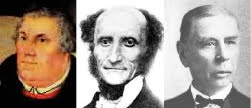
Some quotes from Chapter 2: all emphases, except underlining, are mine:
- 18: Two women testify against Pastor Stephan: "…driven by their conscience, on the same day went to Pastor Loeber and made confessions to him, which contained a terrible revelation about Stephan's fleshly sins. It was strange that both persons confessed to Pastor Loeber at different hours and without having arranged to meet each other."
- 20: "Walther was also already willing to protest against Stephan's appearance as a bishop as soon as he wanted to pretend to be a jure divino (by divine right) superior over the pastors."
- 24-25: Pastor Stephan's sin discovered, relieved of his office: "All the listeners noticed that there was an indication of a serious offence that was only now coming to light. Only now did the rumor of Stephan's disgraceful way of life penetrate through the whole settlement,…Stephan was not only relieved of his office, but also declared to have lost his property and was expelled from the State of Missouri… Pastor Loeber visited him again, accompanied by Candidate Brohm, and tried to lead Stephan to repentance, but in vain.… 'If we have now previously defended this man in ignorance and voluntary devotion, we now, since God has opened our eyes to this through his gracious guidance, publicly renounce the fallen'."
- 28: Emigration in confusion: "They were reproached at first that they should have seen through Stephan's goings-on earlier, and instead they had joined in the hierarchical way, because the whole emigration was a sinful step, and so they, the preachers, also ran away from their congregations in Saxony, they had no call here in America, emigration was pure devil's work. One began to denounce the validity of the official pastoral acts, because the romanizing Stephanism had changed into Donatism."
- 31: Walther's great rediscovery of Lutheran doctrine on Church and the Ministry: "'In this distress, when they believed that they were no longer a Christian congregation at all, … it was one man who saved them, the aforementioned Ferd. Walther.'… for it (the congregation) is the bearer and owner of all spiritual goods."
- 37-39: The Altenburg Theses (8), and their result: "As important and meaningful as the Leipzig Disputation of 1519 (Luther with Eck) became for the Reformation, so important — I dare say confidently — this Disputation held here (in Altenburg) at that time has become for the whole subsequent formation and shaping of our Lutheran Church here in the West (of America)."
- 40: "…this new arrangement of things has brought about peace and order and a very pleasant relationship between the pastors and their congregations."
- 42: “… the Missouri Synod is now accused by the people on that side of being unbiblical and un-Lutheran radicalism and independentism. They say that because here in this country 'the curb of the state is missing', so the civil conditions of North America were taken into account, and the democratic desires were yielded to [see p. 48 below] by the fact that the Missouri constitution transfers church government and the power of the keys to the individual congregation!”
- 44: [Walther] …immersed himself in the study of Luther and recognized that the thing that made Luther so strong in his struggles, whereby he not only resisted the Pope but also stood firm against Zwingli, Calvin and the enthusiasts, was Luther's faith in the Bible and Luther's abhorrence of all hierarchism in the church.
- 45: “Walther began to cast light on the decayed conditions with the same light which Luther had once resorted, with the light of Holy Scripture! Therefore, “back to Luther, for whoever goes back to Luther will be led into the Holy Scriptures! His teaching is nothing but the everlasting gospel!”
- 48: “Because Christ dwells and reigns invisibly in the hearts of his believers, only Christocracy [not democracy] practiced by the Word and the Holy Spirit takes place here.”
 |
| G.H. Loeber, O.H. Walther, C.F.W. Walther, Martin Stephan, J. F. Köstering, E. M. Bürger, Th. Brohm, E.G.W. Keyl, Hoefling |
- - - - - - - - - - - - - - - - - - - - - - - - -
The following is an English translation of C. Hochstetter's Geschichte… by BackToLuther utilizing the DeepL Translator with minor assistance from Dr. Fred Kramer's translation. All hyperlinks, highlighting and red text in square brackets [] are mine. All internal hyperlinks are active in this embedded window, external links should be opened in a new tab or window.
In the next Part 7, we present Chapter 3. — After the break below: (1) a commentary on Prof. Lawrence Rast's judgments regarding the subject matter of this Chapter 2, and (2) full very small print version of Chapter 2 for search engine searchability. —


