Search This Blog

Showing posts with label Bonhoeffer. Show all posts

Saturday, January 7, 2017

Delitzsch 7: a grieving Delitzsch; Hofmann & Frank

      Continuing from Part 6 the series on Delitzsch and German church conditions from Franz Pieper's Christliche Dogmatik, volume 1.  (Table of Contents in Part 1) …
- - - - - - - - - - - - - - - - - -
      Pieper looks on in sadness over the fall of Germany's theologians.  But a greater sadness is displayed in the grief also in the later Franz Delitzsch, who did not separate himself from the “dazzling science” of his fellow German scholars.  How the separation of Delitzsch and Walther magnifies the differences between true Christian teaching (“orthodoxy”) and “scientific theology”.  At the end of his footnote # 645, Pieper relates a most chilling end of Germany's “Lutheran” scholars: apostasy, the ultimate grief.

Translation by BackToLuther; all green shaded text was omitted in the 1950 English edition and is first published here in English; all underlined words emphasized in the original German; red text and/or red bold text is my emphasis, all notes inside square brackets [ ] are mine; many items hyperlinked for reference; hyperlinked page numbers in square brackets [ ]; all unshaded text was included in English edition but re-translated to avoid copyright complaint by CPH.

—————————  Part 7  ———————————
[217  >]
It is a pity that the American Lutheran Church’s “strictly confessional direction” and the church in Germany have come apart!  As a reminder of the original unity of spirit between Walther and Franz Delitzsch: through Walther the nature of Christianity and theology came to full development, which once connected the youthful friends in Leipzig, and which Delitzsch — we cannot escape the impression — in a certain sense grieved over to the end of his life. 645)
—————————
645) This seems to us to emerge from the letter of condolence which Delitzsch, on the death of Walther, addressed to his remaining family.  It is dated “Leipzig, Whitsun Monday 1887” and contains, among other things, the following words about Walther: “There is hardly a man living who has lived through the years of first love for the Savior and then also the labor pains under which the emigration was brought about, as I with him — God has steeled him in this fire of opposition, so that he has for our Lutheran Church become a pillar of iron and as walls of bronze (Jer.1:18) —, a miracle in my eyes in which my weak faith has often strengthened itself.  In some things we two old friends could not agree lately, [218  >] but my love and admiration did not thereby suffer, and in the foundation [Fundament] we remained one, for I live and die in the bloody merit of the Lord Jesus. … In a small way I hope to see my dear friend again, where there is no sea separating us. …  The whole Lutheran Church [on the occasion of the death of Walther] has cause to grieve with you.” (This letter is reprinted in full in L. u.W. 1887, S. 289 f.)  In the same sense, Delitzsch wrote to the author of this Dogmatics book in 1887.  The fact that the two old friends had not been able to communicate “in some things” lately came about because, under the pressure of “science,” Delitzsch changed his earlier point of view. As a “scientific theologian”, he pushed “science” as the determining principle between himself and the Holy Scriptures.  He deserted the inspiration of Scripture. That Delitzsch as a Christian adhered to the satisfactio vicaria, as we also assume in love, is a “happy inconsistency.”
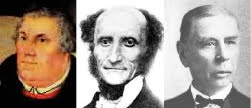
von Hofmann    —   von Frank
denied vicarious satisfaction
(apostasy)


The fact that the denial of inspiration leads to the denial of the satisfactio vicaria was already realized in his time (Hofmann [J.C.K. von], Frank [Franz Hermann Reinhold von, (see pgs 332 & 267 in 1927 Concordia Cyclopedia)]), and has since been seen as an almost universal fact.

- - - - - - - continued in next Part 8a  - - - - - - - - -

There is a biography of von Frank in the ADB by a later German theologian, Reinhold Seeberg.  In one of the last paragraphs, Seeberg states (translated):
The fact that the restored Lutheranism of our century [1904-19th or 20th century?] has not sunk into a repristination of the theology of the Formula of Concord and the dogmatics of the seventeenth century, will be emphasized once more by the merits of the two great Erlangen theologians, Hofmann and Frank.
Germany gloried in its apostasy!  If this sentence does not show the reader why the German American Lutherans of the Missouri Synod had to fiercely battle against the “great” theologians of Germany, then nothing will.  There was (and is) an outright repudiation of the Lutheran Confessions by this so-called “restored Lutheranism”, this “scientific (wissenschaftlich) theology”.  And Pieper shows that it started with “the denial of inspiration”, and ended in apostasy.  This is the Germany that Franz Delitzsch was a part of – “He deserted the inspiration of Scripture”.  None of the horrors of political Nazi Germany that Dietrich Bonhoeffer lived through can compare to the deadly theology of Germany's top “Lutheran” theologians.  The judgment by Pieper that Delitzsch did not fall to total apostasy gives a Christian no right to go down that same road thinking a little “scientific theology” won't hurt.  No, God emphatically warns against this – as a “shipwreck of faith”, 1 Tim. 1:19.  —  For my part, I'm having a hard time distinguishing between Hofmann & Frank and Kloha & Herrmann of today's LC-MS...
R. Seeberg
      And did you know?... According to the Wikipedia article on Seeberg, he...
“... had a number of important students, including Werner Elert in church history and dogma, Hermann Sasse in Lutheran studies, and most famously Dietrich Bonhoeffer in theology and ethics.” 
  Dietrich Bonhoeffer   
It is reported of Bonhoeffer that he loved the hymns of those “‘who had lived and suffered through the Thirty Years' War’, especially those written by Paul Gerhardt” (Marsh, Strange Glory, pg 233), yet when he drove through St. Louis in 1931 (p. 129), Bonhoeffer drove right past Concordia Seminary, the seat of Lutheran orthodoxy, where Franz Pieper had also extolled those old hymns of Gerhardt and the Thirty Years' War.  Why Germany's hatred of “orthodoxy”, the heart of those old hymns?   
      Oh yes, Delitzsch corresponded directly with Franz Pieper by letter.  But that did not cause Pieper to tone down his severe warning regarding the fall of the later Delitzsch who essentially repudiated his own early writings.  That warning applies to all Christians!  —  We haven't heard the last of the “grieving Delitzsch”.  But in the next Part 8a, Pieper discusses the influence of the Old Missouri Synod on World Lutheranism, and lack of it.

Thursday, February 12, 2015

Martyrs 19: George Winkler-Luther's ltr of comfort, assassination; obedience to temporal authority

     This continues from Part 18 (Table of Contents in Part 1a and Part 1b) publishing the book of Hermann Fick on the martyrs of the Evangelical Lutheran Church.  —  Part 19 presents the essay on George Winkler.
      The majority of this essay is taken up by Luther's letter of consolation for Winkler's congregation and followers.  It also contains a record of the circumstances surrounding the martyr's assassination.  This is one of the few cases where the American Edition of Luther's Works published a letter of Luther relating to a martyr... it is in vol. 43, pages 145-165.  My translation borrows from this.  

Some highlighting added hyperlinks added for reference.
------------------------------------------------------------
by C.J. Hermann Fick
(tr. by BackToLuther)
XIX.

George Winkler. [2019-05-24 fixed pg link]

"Go on! I must yet remain here, and perhaps make a Christian."
(Winkler at the parting of his companion.)
In Halle an der Saale, the evangelical Lutheran doctrine had early found entrance.   Although this city was completely subjected to the archbishop Albert of Mainz, yet the same citizens did not want to live without preachers of the Gospel.  Among these  was the chapter preacher Master George Winkler of Bischofswerda, a native of  Meissen.  He dared, in the name of God, to distribute the Lord's Supper according to Christ's institution, allowing the laity or listeners to partake of the cup.  But thereby he incurred the hatred of the Papists, who could not rest any more until they had secretly killed him in May 1527. [page 138]
His congregation was put in great sorrow over this.   Wherefore Luther, who also was deeply saddened at the assassination of this faithful witness, wrote a letter to the grieving congregation under the heading: "Consolation to the Christians at Halle Upon the Death of their Pastor,  George Winkler of Bischofswerda," wherein he also brings them the circumstances of Winkler’s martyrdom.  In it he writes thus:
"Grace and peace in Christ Jesus our Lord and Savior, Amen.  I have for a long time wanted to write to you, my beloved lords and friends, to exhort and comfort you concerning the unfortunate incident so inflicted upon you by Satan by the murder of the good pious man, Master George [Winkler], thus robbing you of your steadfast preacher and of God’s Word.  But all sorts of things have prevented me from doing this, principally my own weakness:  and even though I'm still not quite over it, I can not tarry yet longer.  And Even if we did not intend to express our sympathy immediately in this case, it would be unreasonable to remain silent in such a shameful, treacherous murder, and so let it go and bury such blood in the earth, through which the holy Word of God is testified of and is made known.
"Therefore I will bring it in writing, and help him call and cry to heaven, that so far as in us, such murder will never be concealed, until such time as that God, the Father of mercies and righteous judge, shall hear our cry, as He heard the blood of blessed Abel, and shall bring a just recompense upon that murderer and seducer, the ancient enemy.  And may He grant that Master George’s blood be a divine seed which by Satan and his member’s hands has sown in the earth, and bring forth fruit a hundredfold, so that instead of one murdered George, a hundred of other true preachers come up who do a thousand times more damage to Satan than ever this one man did, since Satan could not put up listening to many, many more like him, just as happened to the pope through the blood of John Hus.  The pope did not want to allow Hus to whisper in his little corner of the world.  Now the pope cannot prevent his shouting all over the world, until Rome itself and almost the world was too narrow for him, though it is not stopping there. Amen.
"But for you and us, dear friends, is to take comfort from this and be content.  First, that is not surprising that such murders and [page 139] misfortune happened on earth.  Because this life is not a life, but a pit of death subject to the devil, as Christ says that he was a prince of this world, and John speaks, chapter 8, that he was a murderer from the beginning and a liar.  [John 14:30, 16:11; 8:44]  When we would and must live now on earth, so we must also consider that we are guests and are located in such lodgings where the host is a rogue host, and his house has the mark or sign above the door that reads: to murder and lies. Because Christ himself has hung such signs and coat of arms over his door and attached to his house, where he says he was a murderer and a liar.  A murderer to choke the body, a liar to seduce the soul, that is his trade and his actions.  That is how he keeps house, so it goes in this hostel, because nothing is different.  And whoever are his housekeepers, they must help him; but whoever are his guests, must wait for such and carry.
"Just so he does with you even now at Halle.  There he saw that his lies should be revealed by his guest, the pious man, Mr. George, and the truth of the Holy Gospel come to the light of day, he did not know what to do otherwise, because it is his nature, than to slay him as a murderer, that only his lies would rule as all contradictions to the truth at Halle and keep the souls in perdition.
"So this is now the first piece of our comfort, that we know who is the murderer of our dear brother, Mr. George; although we can not know for certain who the squire was that commanded it, or whose fists and weapons have done the deed.  For I have heard the bishop of Mainz highly boasted as innocent, which I also wish from my heart and let it be so.  And because I well know more bishops who would do otherwise where they could or would do for their chapter tyrants, I am also truly inclined to believe, if I think anything, that I would believe that tyrants of the chapter at Mainz should have prepared the murder of Mr. George.  For they well have long since made greater slaughter because they wanted with their murderous counsel the German princes to rush at each other through the pious blood of Emperor Charles.  And so they would have Germany drowned in murder and blood, and make sure that their whorish bellows and knavish bellies are maintained in peace and joy.  But God has graciously disallowed the murderous, bloodthirsty dogs their wickedness in those days. [page 140]
"Here they are, the spiritual, holy people who hold Christianity by masses and prayers, and alongside the old murderer, their god, the Devil, with treachery and murdering have to sacrifice the whole world with intent and desire.  I suppose that it is through the same assassins that even this was done, that a lot of priests (preachers), as I hear said, have been secretly drowned in the Rhine and afterwards found dead.  I yet praise the tyrants, though they also serve the devil, who freely through the public courts daily condemn our brothers and make their deeds known.  But the assassins have not so much as an honest drop of blood in their body that they should do freely what is reserved for the power of civil authorities, but act as traitors and villains.  But go on, beloved assassins, you walk in right paths such as Cain did, who murdered his brother secretly, Ex. 4:3.  O how well this remained hidden!  So shall your murder, whoever you are, committed against Mr.George also stay secretly concealed; no one will know you, only the One who yet knew Cain.
"Well, Satan has surely done this deed, but the chapter of Mainz, I would say that I do not know for certain to accuse; but I am well aware that they have the local government, court and protection, and they have more power than the Bishop, as they have tied the hands of their bishops by oath and duty in all locations that their chapter is as powerful as Roland is of his sword, that they are called bishops but are not, and cathedral priests are bishops but are not called such: if they do not want to implement a search for such murderers and punish them with all diligence, they would surely grant such a murder and laugh in their fist that they have not ordered it otherwise; and they are to be chastised as the hijackers and highwaymen on their own road, and criminals of the imperial public peace, that they can so murder a man without investigation and prosecution, against all equity and imperial law, and do nothing.
"A second comforting fact in this murder is that the pious Mr. George was slain in obedience to his authority.  For since he was required to leave Halle and go to his superior, he had attached little importance to his own life, though he saw many evil foreshadowings, that he might be found in obedience.  In this he truly followed his Lord, Jesus Christ, so that one may say of him: he was obedient unto death [page 141] Since he acted according to the saying of St.. Paul, Rom.. 13:1-2: "be subject to temporal authority," he certainly acted in obedience to God's Word, and thus died in the Lord, that we may sing well of him, Rev. 14:13: "Blessed are the dead which die in the Lord."  Indeed not only has he been obedient, but also has loved his superior and proved this to him with body and life.  For I have heard remarkable things about how firmly and faithfully he supported the bishop during the riots and opposed the rebels with all his might, to the admiration and love of the bishop.  Now all that is repaid to him.  Such people should be killed by spiritual chapters, but rather it seems that whores and knaves should be honored by them.
"Thirdly, he was not only killed on duty and in obedience to temporal authority, but also for the sake of the Gospel, abundantly for the sake of the article that he had wanted to teach and extend both forms of the sacrament.  There a fire would break out: there must Satan together with his assassins defend themselves so that no further inroads would be made.  So they called him from a foreign diocese, as is Magdeburg, into another, as is Mainz, since he did not belong to their court system, and secretly and treacherously strangled him on the way.  For thus I am reporting that he was attacked by assassins through episcopal letters directing him from Halle towards Aschaffenburg.  But when he got there, he was detained alone, and his companion sent home back, and did not have much to say to him except that he should say: "Go on, I must yet remain here, and perhaps make a Christian."  He had anticipated, or perhaps had so much seen or heard from his assassins that he would have to stand and by a of Christ.
"For several days they kept his horse, and he was set on a fool's horse named Pastore, which was to carry him to the place of ambush and even gave him a riding companion as though to see him safely home.  On the way a village pastor offered to keep them overnight, but his companion did not wanted this.  After these things he wanted to take another well-known route through the woods, but his companion did not want, lest he escape the trap of the murderers in the bushes.  So about two miles from Aschaffenburg the dear heroes and papal knights ran to the good man and stabbed him, and have earned the hellish crown, as long as they [page 142] do not repent of it, and they and their masters will be crowned in hell by the devil himself.  So much is what I know about the matter." [end of Luther's letter]
The judgments of God were not made via this assassin.  An old writer, Hondorff, reports: "That afterwards not one of these, as many people well know, died a good death."
– – – – – – – – – – – – – – – – – – –
19.  Georg Winkler. Sources: Hondorff, Promptuarium, Thl. 1, S. 199 [here ??]. Luthers Werke, Walchs. Ausgabe, Thl. 10, S. 2161 [error? more likely p. 2260,  2264-2265; see StL ed. vol. 10, pg 1964-5; Am. Ed. vol. 43, pgs 145-165]. Seckendorf  historia lutheranismi, Buch 2, S. 83.  [Note: there is a mention of Winkler in Marvin J. Newell’s book A Martyr’s Grace…]
 = = = = = = = = = = = = = = = = = = = = = = = = = = = = = = = =
Strange Glory
by Charles Marsh

Winkler vs. Bonhoeffer: temporal authority
The subject of obedience to civil or temporal authorities is covered in this essay, as Luther confirms the Bible's teaching, especially Romans 13:1-2.  The now famous account of Dietrich Bonhoeffer, who identified himself as Lutheran, shows that he yet imagined that this Bible passage did not apply to him in relation to his German government, and so became complicent in the plot to assassinate the leader of his country.  How this stance is at variance with Luther's account of George Winkler!!  The author Charles Marsh of the latest book on Bonhoeffer, Strange Glory, states the following on page 269:
 ...the traditional Lutheran doctrine of the two kingdoms: Christians must be obedient to the earthly authorities as unto God.
Marsh makes this statement in relation to the Nazi oath of 1938 for clergy to pledge allegiance to Adolf Hitler, etc.  There is a hint in Marsh's comment that the "traditional Lutheran doctrine" is wrong because it seems to be complicent with the Nazi government's requirement.  But the doctrine Marsh states is essentially the language of the Bible, Romans 13:1-2.  So there is a great disparity between George Winkler's teaching (i.e. the Biblical Lutheran doctrine) and that of Bonhoeffer and his part in an assassination plot to kill the leader of the German government. ... No, one can hardly get much Christian doctrine from Dietrich Bonhoeffer, especially from this aspect of him.
In the next Part 20 – the martyr story of "Heinrich".

Saturday, December 27, 2014

Martyrs 1c: Caspar Tauber (not Bonhoeffer)

Caspar Tauber
[2019-09-18: unknown to this blogger, this post was republished on September 17, 2017 at  ExecutedToday.com  here, It appears that ExecutedToday.com may be a Reformed website.]
      This continues from Part 1b (Table of Contents in Part 1a and Part 1b) publishing the book of Pastor Hermann Fick on the martyrs of the Evangelical Lutheran Church. In this Part 1c, I begin with Fick's first martyr, Caspar Tauber.
= = = = = = = = = = = = = = =
The following account of Caspar Tauber's martyrdom brings tears to the eyes as he continually puts the blame only with the false teachers and leaders, the papal bishop, priests and monks, and calls to those who were stirred up by them as "dearly beloved in Christ".  How could he do this?  He believed that they too had their sins paid for by Christ... that he was in reality no better than they were before God.  Caspar Tauber believed UOJ – that God was in Christ reconciling the world (Universal) to himself (Objective), not imputing their trespasses unto them (Justification). 2 Cor. 5:19.

To renew the memory of this dear Lutheran martyr, I present Hermann Fick's account of Caspar Tauber.  May the memory of this martyr be for the reader's mental health!
Some highlighting added; hyperlinks added for reference.
------------------------------------------------------------
by C.J. Hermann Fick
(tr. by BackToLuther)
I.
Caspar Tauber. [2019-03-22 fix link]
"And if I still had eighty thousand souls, they would all be supplied today through my faith in God."
(Tauber against the Roman priests.)
Caspar Tauber was a highly respected, wealthy citizen of Vienna, Austria, and had a beautiful wife and several children.  He had everything that people highly desire.  But he left everything and denied himself; he took up his cross, and followed the Lord Jesus as a faithful disciple through shame, prison, sword and fire.
After he had championed Christian liberty often and much with words and works as a true Christian against the Antichrist, he was at last taken in solely by the Word of God in 1524.  When he had for some time patiently suffered imprisonment, the Bishop of Vienna, John of Revelles, and his assessors spent much time secretly in prison with him in order to prevent him from making his Christian separation. But in vain.  The blessed martyr chose the better part and stayed with the Word of God, fought gallantly and fearlessly, and persisted until the end.  As he was taught by the Spirit of God, he was persuaded neither by threats nor by flattery and sweet words to a defection from the Gospel.  [Page 2]
Then the servants of Antichrist tried other means. They printed a retraction that Tauber should read publicly.  In it they imputed to him out of malice the error that because Christ is a spirit, his true body and blood cannot be present in Lord’s Supper.  Furthermore in it is indicated that he said that he was both a priest, as an other ordained priest, that the keys of the church together belonged to all Christians, men and women.  Also he had rejected the intercession of the saints, purgatory, auricular confession, and the superstition that the things blest by the priest expelled the devil.  All this he should revoke and publicly renounce the Lutheran doctrine.
Now on the day appointed a high pulpit was erected in the churchyard of St. Stephen, which Tauber had to climb.  Beside him, on another pulpit, was the choral master, and around them was a considerable crowd in tense anticipation. Tauber alone remained quiet and patient in the deepest silence. Then spoke the choral master: "Tauber, you are conscious why our prince and lord, Lord Ferdinand, has put there to you to recant without doubt the articles that thus lie here before you; now then you would do enough and follow."
Then the devout Christian lifted his eyes towards heaven to God, and answered, "Dear beloved in Christ, God Almighty does not want people to be laid with heavy burdens, as He indicates in Matthew 23. Therefore is my plea to all you gathered here, and pray for the sake of God's love, to pray an Our Father, therewith the almighty everlasting God this, so to be in the right true Christian faith, to stay and remain steadfast, but these who are not illuminated, thus are yet enlightened in Christ Jesus our dear Lord."
But the choral master fell on his speech: "Tauber, you are not to preach but to recant what was previously stated."  With gentle heart he replied: "My lord, I have listened to you, so listen to me a little."  But the choral master angrily shouted: “You are not commanded to say such, but speak and read off what is set before you"  Then said Tauber to the people: “Dearly beloved, one  has sent me a writing that I should make a revocation, particularly the first article of the sacrament of the altar, which they have invented and set at their pleasure. [Page 3]  They scold me as a heretic and deceiver, and yet have not overcome me by the Holy Scriptures.  I appeal publicly here to the Holy Roman Empire, that they choose me as their judge.  I will then overcome by the Holy Scriptures, or be found unjust, so will I suffer over what set me right."  And again he said: "I testify here before everyone that I revoke absolutely nothing."  But he was ordered to descend, where he lamented, "My enemies have compassed me about, and I may never speak."  Then he was returned to prison, and the people followed him.
Then on September 10, the final judgment was made on Tauber.  Early in the morning at 7 clock he was placed before the court in the Augustinian monastery.  "Revoke, revoke, or you will die as a heretic!"  shouted the popish clergy to him.  But Tauber remained steadfast.  Whereupon the Official read in Latin the court’s judgment, declaring him to be a public damned heretic and condemned him to death.
But the martyr said to the assembled citizens: "Dear friends, I beg you, for God's sake, will ye be also my witnesses, not only here, but also by the almighty God, that they have so falsely and secretly condemned me; neither I, nor you, have all understood their words and actions. For this ye also well see that they have not presented any articles to me.  It would have been easy for me to answer, by God's grace, from divine Scriptures.  Unconquered, and even without a hearing, I must be condemned.
"If there were eighty thousand of their Doctors, so could or would they not get anything of me, because the Word of God is on my side.  In the dark have they played with me.  They are ashamed of their actions, so they hate the light.  On the Word will I persevere, die and be healed. They want to force me, and set me up with falsehoods which I have not spoken.  I have thought they should make heretics Christians, so they would make of me Christian from a heretic over my will and without all my confessions of a heretic. So God has taught me, so I must die."
Then he was led into the house of the executioners. When going in, he turned to the people with the words: "My dear brothers and merchants, write it in all the land, that the treatment of  [Page 4] Caspar Tauber was so unchristian, and that even a dishonest act was commited on him.  So you will be blessed of God."
But the anti-Christian mob was still not satisfied that they had damned innocent blood. They wanted to despise and blaspheme God and His chosen ones even higher. That is why the monks and priests spread the rumor, Tauber had given himself the executioners home with a bread knife three stitches, what he was going to die. [BTL- exact meaning unclear]  "Behold, said the impious ones, there is the gallant, Lutheran, Protestant people!  If they see that they are overcome, they despair, and bring themselves to life, on that they may not become the executioner’s part because they always scream but just now: "I want to burn; I want to be stoned to death; I want to be drowned."  [BTL- The thought appears to be that the monks/priests are saying the Lutheran martyr wants to save his life by a protest of death by beheading, a protest feigning a preference for death by burning, stoning, or drowning.  But see the refutation of this in 2nd to last paragraph.]
After such a long struggle God wanted to reveal his glory and Tauber's faith. Once again the tyrants tried to persuade him to revoke.  Many men and a great crowd gathered, eager to all learn if he would recant. But the pious Christian was not weaker but stronger and more joyful through so much pain and shame. He desired not to withdraw, but only to die.
On September 17, 1524 he won the martyr's crown.  Early in the morning at 6 o’clock he was taken to be executed on a cart.  Before him was a Roman Catholic priest who reproached him with a little board painted with a crucifix and the image of the Virgin Mary; behind him sat the executioner, beside him were seven servants of the mayor and four henchmen. So the train went secretly behind the town wall by the exchange gate out on the gravel.  Arriving at the place of execution, he went joyfully from the carriage and asked all those present that they should not be bad-tempered nor enemies towards those who would be so responsible for his death, for thus it would please God.
Then spoke the papal priest; "Tauber, will you not confess?"  The martyr replied: "Arise, my idleness, createth your cause.  I have confessed God, my heavenly Father."  The priest replied, "You should see to it that your soul is supplied." Tauber said, "I have already supplied my soul; and if I still had eighty thousand souls, they would all be supplied today through my faith in God."
Having said this, he looked up to heaven, and said, "O [Page 5] Lord Jesus Christ, you who have died for our sake and for us, I give Thee thanks that you chose me,  unworthy, and hast made me worthy to die for the sake of thy divine Word."  Then he made a cross with his right foot upon the earth and knelt down joyfully on it.
As now the executioner took off his red cap, the dear martyr spoke to him: "Dear Master, take it and carry it from me!" Then the executioner he tore the shirt of the neck Tauber however, very willing and eager to die, wound his hands one over the other, raised his eyes to heaven and said three times with a loud voice, and joyful, fervent heart. "Lord Jesus Christ, into your hands I commend my spirit."
And immediately his head fell, from which his body was dragged to a large pyre and burned.  Thus he fell asleep in the Lord.
------------------------------------------
Annotations:
1. Tauber. Sources: Histories of the holy chosen witnesses of God, confessors and martyrs, by Ludwig Rabus of Memmingen, Doctor of Holy Scripture, from the year 1557. Thl. 6, p.22. Caspar Tauber is cited by Luther as a martyr. Luthers Werke; Walch edition. vol.. 21 column 96.
= = = = = = = = = = = = = = = = = = = = = =
Dear God!  Would that thou wouldst grant me just one of the 80,000 souls that Tauber's faith would sustain.  Would that thou keep me by Thy Word as thou kept Tauber.  Wouldst thou ever keep the sign of Thy Cross in my heart, the cross that Tauber knelt on as he joyfully fell asleep in Thee. In Jesus precious name!  Amen!  Amen!
An approximation of the likely protocol of this beheading is shown >> here <<, with the shirt torn at the neck, and the sword drawn just before the beheading.
- - - - - - - - - - - - - - - - -
Dietrich Bonhoeffer has been called a "martyr", specifically in a "New York Times Bestseller" book Bonhoeffer: Pastor, Martyr, Prophet, Spy,  But I do not call Bonhoeffer a martyr, for it is well known that he was not put to death for his Christian faith, but rather for his involvement in the plot to kill Adolf Hitler.  Bonhoeffer was far from the Christian truth during much of his life, yet he had the word of truth in his mouth near the end of his life.  Some who criticize Bonhoeffer ignore this wonderful episode in an otherwise distressing life.  I will comment on this at another time but anyone who has read recent books on Bonhoeffer, including the current opus Strange Glory, will read of this event in the final chapters.  But I will read of the true martyrs of the Evangelical Lutheran Church, the ones that Pastor C.J. Hermann Fick (and Luther and Walther) write about for truly edifying stories of Christian faith, even unto death.
- - - - - - - - - - - - - - - - -
After reading Tauber's story and considering the question I posed in Part 1a, I think that it was C.F.W. Walther who encouraged Fick to write this book. — In the next Part 2, I will present Wolfgang Schuch.