Worship of Mary in the Evangelical Church. Yes, that is how it is. Unbelievable and yet true! The writer of this article has already noticed it repeatedly when he was in Leipzig and found the announcement among the church news in the Tageblatte [Daily News] that a “Salve regina” would also be sung as a motet at 2:30 on Saturday afternoon at Vespers in the St. Thomas Church. We calmed ourselves, however, by assuming that they had probably only used some famous composition of that old text, but had added a different text to it, since we could not believe that in a Evangelical church, and especially in Leipzig, a chant in which Mary is worshiped as the Queen of Heaven would be performed. But lo and behold, the other day we got hold of the musical text of the two motets which were performed on May 9 of this year in the Thomaskirche, and there again a "Salve regina" [Hail Holy Queen] by Robert Papperitz is mentioned as the second motet, and at the same time the whole text is printed, in which Mary is addressed as mater misericordiae, vitae dulcedo et spes nostra [mother of mercy, the sweetness of life and our hope], even as advocata nostra [Our advocate], and is invoked for her help. According to this, it is certain that in the St. Thomas Church in Leipzig, prayers are sometimes said to the Virgin Mary. If Pope Pius IX knew this, how he would rejoice, he, the great devotee of Mary, who raised her Immaculata conceptio to dogma and thus took her out of the ranks of the sinful children of men. (Sächsisches" Kirchen- und Schulblatt.) Also Luther once kept the beautiful melodies, which he found and with which papal idolatrous texts were decorated, but put purely evangelical texts under them. In his preface “auf die lateinischen und deutschen Begräbnißgesänge” (on the Latin and German funeral chants) of 1542, he writes of this: “The chant and the notes are precious, it would be a pity that they should perish; but unchristian and unrhymed are the text or words, which should perish. Therefore we strip such idolatrous, dead and mad texts and strip them out of their beautiful musica and put in place of them the living, holy Word of God to sing, praise and honor it with; so that such beautiful ornaments of musica serve their dear Creator and His Christians in the right way, so that He is praised and honored, but we are driven in the heart by His holy Word with sweet song, improved and strengthened in faith.” (See Luther's Works. Hall. A. Tom. XIV, 414 f. [StL 10, 1427 ff.]) Incidentally, the rationalistic sapless and powerless text of many of the more recent popular church choir hymns is not much better than a papist “Salve regina,” in addition to which the music that is supposed to decorate it is usually either a mindless tinkling, or of a thoroughly unchurchlike character. W. [C. F. W. Walther]
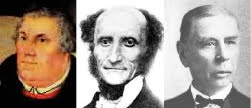
Back To Luther... and the old (German) Missouri Synod. Below are thoughts, confessions, quotations from a Missouri Synod Lutheran (born 1952) who came back to his old faith... and found more treasures than he knew existed in the training of his youth. The great Lutheran lineage above: Martin Luther, C.F.W. Walther, Franz Pieper.
Wednesday, March 15, 2023
Walther: “Unbelievable!” Salve regina in Ev. church?; Luther on Lutheran hymns

Tuesday, August 23, 2022
DL7a: Lochner defends Luther's “Pope and Turk" hymn (against LC-MS); Der Lutheraner 1894

"Lochner… is in sympathy and dialogue with… Roman Catholics".

“Keep us, O Lord, by Thy Word, And prevent the murder by Pope and Turk.”
[by Pastor Friedrich Lochner]
As is well known, this is the beginning of the hymn composed by Luther and published in 1542, which originally consisted of three verses and which he gave the characteristic heading: “A children's hymn to sing against the two arch-enemies of Christ and His holy churches, the Pope and the Turk. No doubt Luther called this hymn against the “two arch-enemies” a “children's hymn” in view of the words of the Lord at His entry into Jerusalem and into the temple, Ps. 8:3: “Out of the mouth of babes and sucklings thou hast prepared a power for thine enemies' sake, that thou shouldest destroy the enemy and the avenger.”

But if ever a hymn of the Lutheran church has experienced the hatred and contradiction of the papists from the beginning until today, then it is this children's and prayer hymn of Luther. Yes, if he had thought only of the Turk, who at that time was again harassing Christianity! But here Luther put the Pope in the same class with the Turks, and not only called both of them the “arch-enemies of Christ and His holy churches,” but also had the children in the churches and schools, in the houses and in the streets proclaim them as such! The Lutherans had to be prevented from singing this. Not only was the hymn mocked by a mean parody (mocking imitation), not only did a Bavarian duke, devoted to the pope, say one day to his courtiers: “Eating (gorging), drinking, whoring, bubens [pornographic German terms] — just don't become Lutheran and sing the God-dishonoring hymn: ‘Keep us, O Lord, by Thy Word’ [Erhalt uns, HErr, bei deinem Wort]”, but they also tried to suppress it by force in old and new times. To cite just a few examples, on December 16, 1548, the singing of this hymn was forbidden in Strasbourg with corporal punishment; likewise in 1662 with severe punishment in the principality of Oels; likewise in 1713 in all of Silesia, despite the freedom of faith solemnly assured in the religious peace. In Regensburg, only after many negotiations with the Bavarian government did the ecclesiastical ministry finally succeed in 1703 in having this hymn sung at least on the Reformation festival, that is, only once a year.
.jpg "Sieg of Magdeburg 1631 (Wikipedia)")
During the Thirty Years' War, even children had to die over this hymn. When the sinister Catholic commander Tilly, after a long siege, finally stormed the city of Magdeburg in the early morning of May 20, 1631, his soldiers raged among the overcome inhabitants more mercilessly than the Turks and worse than wild animals. While the street fighting was still raging, it happened that schoolchildren went in pairs to church, not only for Matins, as they did every morning at the beginning of school, but this time also for refuge from the murderous sword of the victors. But when Tilly heard, through the clatter of the guns, the shouting of the victors and the groaning of the wounded, that these children were singing as they marched along: “Keep us, O Lord, by thy Word,” he burst upon the crowd of children full of fury and ordered his wild Croatians to cut down these children, shoot them and throw them into the flames. Though the Pope, in his joy at the fall of Magdeburg, might now hold a Te Deum in St. Peter's — yet after his victory Tilly’s fortunes of war fell off, and remorse tormented him over this modern Bethlehem infanticide [Matthew 2:16–18].
- - - - - - - - - - - Continued in Part 7b - - - - - - - - - - -Now we can see why the LC-MS dropped the words "Pope and Turk" from Luther's most controversial hymn, because it was hated so much especially by the papists. — In the next Part 7b, we see the strength of some early Lutherans, but then sadly this began to give way and so we witness how the LC-MS has followed the way of these weak Lutherans.
Sunday, November 7, 2021
"Sing, dear daughter, sing!": Melanchthon comforted by Luther's A Mighty Fortress (1 of 2)
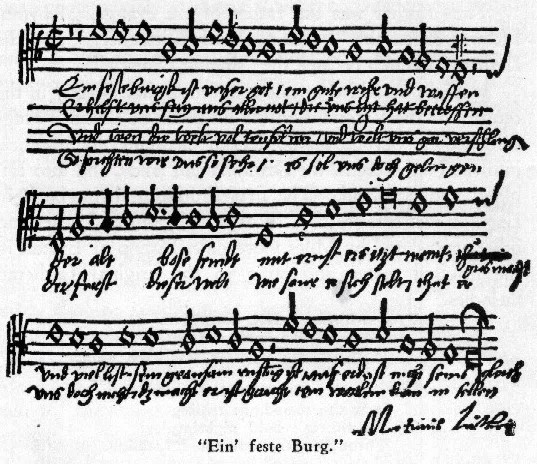
A Mighty Fortress is Our God
(Ein’ feste Burg ist unser Gott.)
[An essay by “G. B.”]
A free reworking of the 46th Psalm, composed by Luther in 1529 after the end of the Diet of Speyer, as an open protest song of the entire Protestant Church, which against all its adversaries and enemies trusted in God alone as its refuge and its fortress.

In Coburg, at the fortress, he sang this psalm daily during the Augsburg Diet in 1530, sitting at the window with his lute and looking up to heaven, and he did so, according to Selneccer's testimony, "because the enemies wanted to devour him.” According to some, he first composed this heroic psalm at the fortress of Coburg, according to others on the way, when he traveled to the Diet of Worms in 1521. Along with the song, Luther also created the melody; both are as if from one cast, flowing from the deepest, noblest enthusiasm of his mind, so that he poured his innermost being in richest abundance into the word and the melody.

Dr. Conrad Dietrich was already able to boast of the manner, that it has a special spiritual emphasis, like no other, stirs the heart, cheers it up, makes it joyful and glad in the Lord, gives courage and comfort, sap and strength, where it is only modulated and sung in faithful devotion. From the 3rd verse, the climax of the song, the heroic sense shines forth, with which Luther, in the armor of God, not being afraid even of the arch enemy, had already called out to the dissuading friends sent to him by [Georg] Spalatin on his journey to the Worms Imperial Assembly at Oppenheim: “Even if there are as many devils in Worms as there are tiles on the roofs, I will still go and not be afraid in the least. Even if [Jan] Hus was burned to ashes, the truth has not been burned with him.”

Dr. Jacob Weller [de Wikipedia] says of this verse: “These are the words of a Christian who is completely ready and firm in his faith.” Luther's contemporary, Cyriacus Spangenberg, testifies: “When I looked at Dr. M. Luther 23 years ago in Wittenberg, it seemed to me that I was looking at a large, mighty, well-armed battleship that was confidently deployed among the enemies on the rough sea.”
Very quickly, as if the angels of God themselves had sent messengers, this song spread throughout Germany and all places where adherents of the pure evangelical doctrine lived. As early as 1532, the congregation in Schweinfurt sang it in church against the will of their pastor, and the children sang it at night in the streets, whereupon the Reformation soon took place there.

Melanchthon, Jonas and Creuziger once entered Weimar in 1547, when Wittenberg had been surrendered to the enemy [Capitulation of Wittenberg] and they had been sent into exile. There they heard a little girl singing this song and were greatly comforted by it, especially by the words: “And if the world were full of devils”. Melanchthon, however, said to the pious young singer:
“Sing, dear little daughter, sing; you do not know what great people you are comforting now.”
Saturday, June 12, 2021
Language 1: Preserve the German among our youth (Part 1 of 2)
What can we do to preserve the German language among our youth?
Whatever the various opinions and expectations of the future of the German language in America, it is agreed among us that we, German Lutherans, should make every effort to preserve the mother tongue for our children and grandchildren. While the fear of the gradual extinction of German may not be without reason, and the writer of these lines himself shares this fear, we are undoubtedly agreed that we who are alive now must do everything in our power to postpone this calamitous epoch into as distant a future as possible. If there were no other reason for this, it would already be sufficient, because the German language indisputably contains the greatest treasures of Christian, healthy literature [Page 35] that only a people of recent times has to show. I am not, of course, thinking of the German literature of more recent times, which, under God's heavy judgments, has become a canal of apostasy and wickedness of recent times, and should we speak of this, we should only wish that it had never found its way across the sea to America. We have rather in mind the German literature of the old age, namely of the Reformation, to which no other of European Christianity can be placed side by side. What are all the English ascetic writings of [Thomas] Goodwin, [Richard] Baxter, [John] Bunyan, etc., against such a book as Luther's House- and Church Postils or [Christian] Scriver's Treasure of Souls [Seelenschatz]? or what is all the hymnological literature of England against a single old hymnal of the Lutheran Church? If our children forget their mother tongue, the English language in which the Lutheran Church at present has almost no literature, offers them not the poorest substitute for it. And where did the decline of the Lutheran Church in America come from? Did it not come largely from ignorance of the German language, whereby the rising generation fell into the hands of the English churches? The writer of this has heard it himself from the mouth of a grandson of one of the first German Lutheran preachers in America that ignorance of the German language became the cause of his joining the English Episcopal Church.
But what can we do? Without a doubt, we must start with our youth and lay the foundation in school. German Lutheran parents should never speak other than good German with their children in their family circle. Unfortunately, many Germans are the foolish monkeys of foreigners; they think that nothing is decent and distinguished enough if it is not put on an English footing. Understanding Germans should also show a manly sobriety in this and, although far from pedantic German pomposity, should not be ashamed of their German origin, especially in the language. Furthermore, the German language should be cultivated in our congregational schools with even greater care than is necessary in the old fatherland, so that a student learns to speak and write it with ease and the greatest possible elegance and correctness. Of course, a half-stumbling learning of German cannot arouse a preference for German. Furthermore, our pupils should be familiarized at an early age with good samples of German writers of old and new times in a suitable selection. The introduction of good German reading books for schools serves this purpose. I would remind you of Wackernagel's and Sartorius's excellent reading books, as well as the reading book edited by the North German Association, one or the other of which should not be lacking in sufficient supply in any of our schools. In order to acquire a taste for the German language, as well as a skill in reading, it is not sufficient to use only the Bible or Hübner's Histories as reading books. Finally, each of our schools should, wherever possible, have a small, selected school library, from which students could take home a book every week as a reward for their diligence and good behavior. It is hard to believe how happy children are about this, how eagerly they read, how much idleness and spoiling they are protected from, how much their older brothers and sisters, even their parents, enjoy having the beautiful children's stories read to them during the long winter evenings, and how this promotes a close, intimate family life. Praise God! The newer times are becoming richer and richer in good children's writings that can be safely given to children. Some of Schmidt's, Barth's, Stöber's, Schubart's, and above all Redenbacher's writings provide excellent material for a school library; this would gradually be expanded by good travel descriptions, such as the older ones by Harnisch and the newer ones by Grube, or by children's writings on natural history, world history and church history. The children would gladly contribute their cents, which they otherwise easily spend on candy, if they have the prospect of soon getting another new book to read. Attention cannot be drawn seriously enough to the establishment of such school libraries. If there are some passages in some of these books for young people that do not contain proofs, a Christian teacher will know how to make them harmless by correcting them in time and thereby awaken and exercise the gift of examination in the young Christians.
But over and above this, it seems to us that the least means of not extinguishing the love of the German language in our youth is to give them at the same time the most ample opportunity to learn the English language from the bottom up. If one were to try to keep the English language away from the child's field of vision, one would produce the direct opposite of love for the mother tongue. The more unreservedly the children are introduced to the English language, the more soberly they will naturally weigh both languages, and the more thoroughly they become acquainted with both languages, the more joyfully they will prefer the originality of the German language to the English language, which is colorfully adorned with foreign writings [Federn].
Wednesday, May 5, 2021
Walther on Mohammedans (and Luther's hymn); the Eastern antichrist
Distress of conscience in Turkey. The Allgemeine Kirchenzeitung of August 20 reports: In Turkey recently the Mohammedans have been denied the right to become Christians; those who have converted to Christianity have been persecuted and punished, or have been deprived of the right to erect buildings of worship, to hold public services, and to have their children educated. It is true that the four and a half centuries of unceasing prayer of the Orthodox Church against the Turks have provided so much that the Turk has little power left, indeed, he is already almost dying; but the spirit of the Eastern antichrist [Mohammed] is still stirring; hence the precious hymn: “Keep us, Lord, by Thy Word, and restrain the murderous Pope and Turk,” even now must not be silent in the Orthodox Church. W. [Walther]
- - - - - - - - - - - - - - - - - - - - - - - - - -Sunday, February 28, 2021
Children's hymn? “Restrain murd’rous Pope and Turk” - Walther on Luther's great hymn
“Keep us, O Lord, by thy Word.
And restrain the murd’rous Pope and Turk.”
When Luther had this song printed for the first time in 1542 on a special sheet, he gave it the following superscription:
“A Children’s Hymn to Sing Against the Two Archenemies of Christ and His Holy Church, the Pope and the Turks."
As a subscription, however, the song bore the following address of Luther to the children:

“Dear Christian children, sing and pray confidently against the two right and greatest arch-enemies of Christ and His members, that God the merciful Father may continue to give peace for the sake of Jesus Christ. Do your best in this, for, alas, there are few poor people who are earnestly concerned about this. Grow in the grace and knowledge of our Lord and Savior Jesus Christ. Amen.”

From this time on, this hymn has been prayed and sung almost daily by the children in the Lutheran city and village schools, mostly on their knees. This children's prayer has been wonderfully answered. The Turks, those bloodhounds who lusted after the blood of Christians and from whose attack Christianity was once not safe for an hour, prayed that children's hymn sick and dying, so that now Christianity, if it only continues to pray against the Turk, is safe from him. But as for the other arch-enemy of Christ and Christianity, the Pope, our “children's hymn” has also put a stop to him at least to such an extent that he can no longer, as he once did, murder Christians who do not want to worship him, as much as he would like to. Cf. Ps. 8:2. W. [Walther]
= = = = = = = = = = = = = = = = = = = = = = =Saturday, February 13, 2021
Walther: first pure Lutheran Hymnal in English (1879)

Notice of New Publications.
Hymn Book for the use of Evangelical Lutheran schools and Congregations. Decorah, Iowa. Lutheran Publishing House. 1879.
It is with great pleasure that we hasten to announce to our readers the appearance of a booklet with the above title. It is the same a pure, though small, but complete English Lutheran school and church hymnal. On 179 pages in duodec it contains 130 hymns together with 10 so-called doxologies, that is, one: Praise of the triune God containing final verses. We call it a pure hymnal because it contains only those English hymns which not only do not contain false doctrines, but also breathe a truly Evangelical spirit. More than half of them (72) are, as far as we can judge, excellent English translations of the best German hymns of our Lutheran Church in form and content. We call the booklet a complete hymnal not because it contains the entire English, let alone German Lutheran hymnal, but because it contains the necessary selection for all relevant cases. The ever-increasing number of hymns in our church hymnals has become more of a hindrance than an encouragement to hymn singing. In the beginning, almost every Lutheran Christian knew all the hymns in use in the church by heart and thus carried with him an extremely precious spiritual treasure. Caspar Neumann still writes in his Silesian hymnal of 1737: “My people would be ashamed if they should look into the book while singing.”

After one was anxious to look for their own hymns for every doctrine and occasion, not only do we find even in otherwise good hymnals many, so to speak, hymns made to order, especially of little poetic value, but also through the quantity and the “great” change caused by it, the acquaintance of the Christians with their best church hymns has become less and less. Our “Hymn Book” is therefore perfectly adequate to serve as a school and church hymnal. To Professor A. Crull in Fort Wayne, as the translator and collector, and to our Norwegian Lutheran brethren, as the publishers, the English Lutheran Church of this country owes a great debt of gratitude. As far as we know, the booklet is available at the address: Lutheran Publishing House, Decorah, Iowa. In the next number we hope to be able to give the undoubtedly inexpensive price of the same. May the Lord take upon this hymnal the richest blessing for the building of His English Lutheran Zion in America. W. [Walther]