Search This Blog

Showing posts with label Wohlrabe-John. Show all posts

Saturday, August 9, 2025

L09a–False charges by LCMS: Walther a Pietist? (Eggold–Piepkorn–Pelikan); Wohlrabe, McCain defend Walther

      This continues from Part L09 (Table of Contents in Part L01) in a series on the instruction of the Law by C. F. W. Walther and Martin Luther. — A preposterous charge by LCMS theologians against Walther prompted this Excursus. A refreshing rebuttal was made by more recent LCMS men.

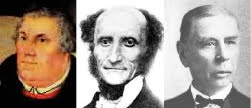
Profs. Jaroslav Pelikan, A. C. Piepkorn, Henry J. Eggold Jr.
Jaroslav Pelikan     —     A. C. Piepkorn      —     Henry Eggold     
“Walther, a Pietist”

    The matter taken up in Walther's statement #3 in Part L09 causes many of today's LCMS theologians to stumble, for they are weak on both Law and Gospel preaching. They are weak on the proper distinction of these two doctrines. Concordia Seminary Doctoral candidate Henry Eggold Jr. († 1982), in his 1962 doctoral thesis [Internet Archive], said this about Walther's preaching of the Law, p. 178:
“One of the very strong accents in Walther's preaching is his rebuking of prevailing sins. As one reads a number of his sermons at one sitting, he finds that Walther spends almost as much time denouncing a false faith as he does pleading for a true faith. When he is rebuking sin, he is in dead earnest [as if God is not?]he preaches the Law as though there were no Gospel and pictures God in the awesomeness of his justice and righteousness. His language is vigorous, blunt, and unsparing.”
Also in this essay, one discovers that Eggold references two of the leading lights of the 1974 Walkout: Drs. Jaroslav Pelikan and Arthur Carl Piepkorn. It was Pelikan who started the myth that Walther synthesized Orthodoxy with Pietism, in an article for a German theological journal in 1952 (see here, footnote #4; full text file). Then in 1961, Piepkorn referenced Pelikan's essay in an article for Concordia Theological Monthly, "Walther and the Lutheran Symbols" (see here, p. 609, footnote #17). A year later, in 1962, Eggold came out with his semi-famous doctoral thesis that referenced both of these "leading lights" as the marching orders for his work. But in reading all of Eggold's comments and judgments of Walther, it became apparent that he himself is weak on preaching the Law in comparison with Walther. Yet he proposes to judge Walther by stating (p. 255) that 
A critical appraisal of Walther's sermons will not close one's eyes to the influence of Pietism which introduced faults into Walther's preaching, namely, his tinge of legalism and his occasional advice to the terrified sinner to prayer for grace without directing him to the Gospel.”
Rev. Dr. John C. Wohlrabe Jr. (Linked In 2020)
That Walther was under "the influence of Pietism" is quite preposterous. Even Rev. Dr. John C. Wohlrabe Jr., LCMS Sixth Vice-President, admitted that Eggold's assertion of Walther's "Pietism" was questionable, stating: 
"Yet, when one carefully considers the doctrine of the church, as set forth in Walther’s other writings, as well as in his sermons, one can’t help but question this assertion. Did Walther’s addressing himself to unbelievers in his sermons come from a pietistic influence or from his doctrine of the church, which was soundly based on Scripture, the Lutheran Confessions, and such orthodox Lutheran theologians as John Gerhard?" ("The Preaching of C. F. W. Walther in View of the Doctrine of the Church", The Pieper Lectures - Preaching Through the Ages, Volume 8 (2004), p. 90)
Wohlrabe goes on to demonstrate how Eggold was wrong, that an apparent inconsistency in Walther's writings was only apparent. Even more, he asks the question (p. 91) "why has this practice [addressing unbelievers in a sermon] all but disappeared in modern preaching?" Finally, (p. 95) he states that Walther's preaching put the "stress on objectivity over subjectivity—or put another way, orthodoxy over against pietism." — 
Paul McCain

    Also Paul McCain, in a 1998 essay, wrote about Pietism and stated that "The first leaders of the Missouri Synod had to struggle against Pietism in their own lives and it has been so ever since." In a footnote to this, without naming Eggold, Piepkorn or Pelikan, said this (p. 86):
It is inaccurate to describe C. F. W. Walther as a Pietist. Anyone who makes this assertion knows little about Walther and even less about Pietism.” (The Pieper Lectures - Pietism and Lutheranism, Volume 3p. 92)
      Eggold's charge is the same as what Franz Pieper reported of Missouri's opponents who charged them with, among other things, being "Pietists". As Pieper explains in his Christian Dogmatics, Pietism is the tendency to turn Lutheranism towards Reformed territory, and Walther is far from doing that. It seems that Prof. Eggold swallowed the false theology of Jaroslav Pelikan. — And we notice why Eggold was weak as a theologian and a preacher: He was advised by the likes of Profs. Richard Caemmerer, Jaroslav Pelikan, and Erwin L. Lueker, the Walkout sympathizers of 1974. His agenda in producing his thesis was prescribed by Prof. Pelikan (who later left Lutheranism), which was to prove that Walther's preaching was a "synthesis of Orthodoxy and Pietism". Eggold's own homiletical philosophy, "Preaching is Dialogue", was possibly influenced by Prof. Caemmerer's homiletics. Prof. Eggold never changed his judgment of Walther as he repeated these same charges of "Pietism" in his "Translators Preface" to the CPH book Selected Sermons of Walther published in 1981, the year before he died. Sad. 
      The latter charge above by Prof. Eggold, Walther's statement "to pray for grace", can be answered by the Fifth Petition of the Lord's Prayer, which petitions the Lord to "forgive us our trespasses as we forgive those who trespass against us". Eggold could also charge our Lord Jesus with the same charge of "not directing the terrified sinner to the Gospel". Eggold should have studied Luther's explanation of the Fifth Petition. — He should also have listened to the Savior when He said Luke 13:3, 5: 
"I tell you, Nay: but, except ye repentye shall all likewise perish."
Eggold brings another charge against Walther that we report in the next Part L10

Tuesday, August 5, 2025

L09–III. 2., 3. Law shows our sin, even for true Christians

      This continues from Part L08 (Table of Contents in Part L01) in a series on the instruction of the Law by C. F. W. Walther and Martin Luther. — In this segment, Walther addresses two more reasons why the Law must be preached. — From Lehre und Wehre, vol. 7 (Dec. 1861), p. 364 ff.:
- - - - - - - - - - - - - - - - 
III. Why must the Law also be proclaimed in the New Testament and also to Christians?
      2. The second reason why the Law must also be preached in the New Testament is that only those who recognize their sins can come to faith in Christ and to knowledge of his reconciling and redeeming work and suffering; but knowledge of sin comes through the Law alone.
What Luther says on the preaching of the Law to show our sins:
  • “If a person is to become spiritual and come to faith, he must first be under the Law; therefore, without the Law no one recognizes himself for what he lacks; but he who does not know himself does not seek grace. But when the Law comes, it demands so much that man feels and must confess that he is not able to fulfill it; he must then despair of himself and, humbled, sigh for God's grace.”
  • For who can know what Christ suffered for us and why, if no one knows what sin or Law is? Therefore the Law must be preached where Christ is to be preached.”
Walther continues:
      3. Finally, the Law must also be preached to those who have already become true Christians, for the reason that even the believing, enlightened, born-again Christian, who is of course willing to do all good, is not yet completely enlightened and renewed, but has the old Adam, that is, flesh and blood, and therefore still needs the teaching of the Law, even terror and compulsion; as we see then that the law is also preached to Christians through the whole of Holy Scripture.
What Luther says about preaching the law to true Christians:
  • “But the matter itself and experience testify that even the righteous or faithful are subjected and delivered to death daily. Therefore, as far as they are under death, they must also be under the Law and sin. It is especially coarse and inexperienced people and harmful deceivers of consciences who want to take the Law away from the church.”
  • “Therefore the Law (as well as the gospel) must be preached without distinction, both to the righteous, or believers, and to the ungodly; … to the godly, that they may be reminded thereby to crucify and mortify their flesh, together with lusts and vices, so that they may not be secure, Gal. 5:24, for security takes away both faith and the fear of God, and makes the latter worse than the former was.”
  • “But outwardly the flesh does not yet want to do so; all kinds of filth and evil lust, anxiety for food, fear of death, avarice, anger and hatred still cling to it: the filth always remains next to the faith that it may beat and fight with it.”
  • “So divide a Christian into two parts: That he is both righteous and unrighteous. The Holy Spirit dwells in the heart, but not in the flesh, where the devil dwells with his seed”
- - - - - - - - - - - - - - - -
In the next Part L10, Walther addresses the point that makes him and Luther the perfect teachers to follow on the preaching of the Law. But first, in the next Part L09a, we call out past LCMS theologians who crassly criticized Walther… on his Pietism?

Monday, January 13, 2020

Wohlrabe & CHI – against Pieper (1 of 2)

      My recent blog revealed a 2009 Concordia Historical Institute Quarterly (CHIQ) article that spread fiction about Franz Pieper regarding his alleged departure from C.F.W. Walther in his teaching and leadership.  This blog does not intend to publish all the many examples of similar false charges, but I do want to highlight a most glaring example for today. The LCMS has been relentless in its criticisms, in its innuendos against Pieper, especially Pieper. Most of the time their fiction is mixed among supposed praises of him as a cover for their duplicity.
Rev. Dr. John C. Wohlrabe Jr., President - Concordia Historical Institute Board of GovernorsDr. John C. Wohlrabe Jr. (Editor, CHIQ; President, Concordia Historical Institute Board of Governers2nd V.P., LC-MS), in his 1982 STM thesis “The Missouri Synod's Unity Attempts during the Pfotenhauer Presidency, 1911-1935” stated the following on p. 30 (emphasis mine):
Unlike Walther..., Pieper placed more emphasis on avoiding heterodox church bodies and less emphasis on the achievement of unity.
This statement implies that Pieper did not work hard enough towards “the achievement of unity”. I have demonstrated elsewhere that Pieper's teaching followed Walther (here & here & here & here) – making Wohlrabe's assertion pure fiction. May the reader judge between this assertion of Dr. Wohlrabe and all the evidence to the contrary on this blog.  Pieper was tireless in laboring for a true unity in the Christian faith. Wohlrabe sets himself up for the charge that his Concordia Historical Institute is purposely ignoring doctrinal differences with opposing Lutherans in order to keep up contributions from, and participation by, these erring Lutherans.
Dr. Franz Pieper
"The Twentieth Century Luther"
      I want to publish this photograph (🔗) of Dr. Pieper again, because it is so striking.  He appears rather serious in his demeanor.  That serious look is an indication of a life completely dedicated to the truth of the Gospel and the Bible being proclaimed purely and defended in all its parts.  His “Last Words to his Missouri Synod” speak volumes.  His "Brief Statement of 1932" speaks volumes.  Do you see Pieper peering into your eyes now… as he reads a Scripture passage (e.g. 2 Cor. 5:19) again to us… and says

‘That is what God says. 
It needs no interpretation. 
Believe it.’

      As we read the Memories of Pieper by Ludwig Fuerbringer, the third president of Concordia Seminary, we notice that Fuerbringer did not exhibit the near apostasy of those who followed after him.  And his judgment is more to be trusted than that of Pieper's other biographer, Theodore Graebner, a co-founder of CHI and contributor to ALPB' American Lutheran, who impugned Pieper for his ecumenical work with the Norwegian Lutherans of America.  — 
      The sad part about Dr. Wohlrabe (and CHI) is that he is viewed as being "conservative", just as Graebner was, for Lutheranism. CHI even co-sponsored the "Pieper Lectures" for a time, supposedly to honor Pieper's name.  Wohlrabe wrote an essay published in Christian News in 2007 entitled "How We Got Into This Mess – A Brief History of the LCMS" (see here). Yet Wohlrabe at the same time promoted the above fiction that deceives those who would look to him for true Church History.  At the risk of making Dr. Wohlrabe appear even more foolish, I want to publish the testimony of another (former) LCMS Vice-President, Theodore Nickel, on Franz Pieper, the teacher… in the concluding Part 2. —