Search This Blog

Showing posts with label Hochstetter-Christian. Show all posts

Thursday, March 14, 2024

RH1: German pastor: Yes & No on Missouri; Hochstetter's critique (Part 1 of 14)

Pr. Christian Hochstetter
      While reviewing the essays in the Old Missouri Synod journal Lehre und Wehre, a lively article from 1882 caught my eye, for it concerned how Germany's pastors and theologians viewed the Missouri Synod in Walther's day, in the 19th century. The essay was by Pastor Christian Hochstetter, the one who would 3 years later write the well-known book The History of the Missouri Synod, 1838-1884 in 1885. This 1882 essay was prompted by a pamphlet published in Germany in 1881 by a young pastor. Here is what Pastor Hochstetter stated about this pamphlet: 
To this day no report from German state-church circles has appeared in print which acknowledges so much about the Missouri Synod as this lecture by the late Pastor R. [Rudolf] Hoffmann [RH].
I suspect that Pastor Hochstetter became motivated to write his later great history in part because of the false judgments reported in this pamphlet. But the striking part about the pamphlet was just what Hochstetter alluded to, that Hoffmann did not ignore the incredible successes evident in the (Old) Missouri Synod. And so this pamphlet represents what I would call a "Yes and No" judgment on the Missouri Synod. Hochstetter uses this to reveal the remarkable ironies that Pastor Hoffmann presents.
Die Missouri-Synode in Nord-Amerika, historisch und kritisch beleuchtet : ein Vortrag (Title page)
    Hoffmann's 33-page pamphlet was entitled The Missouri Synod in North America, Historically and Critically Examined: A Lecture (Gütersloh, 1881) (WorldCat). Although there was no online availability of the original publication before, there is now: >> here <<. One discovers that Pastor Hoffmann was young when he wrote this pamphlet, about the age of 31. And he passed away at the end of 1880, just before his writing was published. His history is remarkable for his depth of reading in Old Missouri's early writings. Unfortunately I was unable to obtain a picture of him.
      Here are some examples of Hoffmann's "Yes and No" judgment of the Old Missouri Synod, most of which Hochstetter addresses in his critique:
"Yes":
  • "Walther's [Altenburg] theses were a resounding success" (p. 9)
  • "The greater right lay on the side of Missouri" vs. Pastor Grabau (p. 16)
  • "The doctrinal unity is built on the Lutheran Confession" (p. 20)
  • "the unshakeable consistency with which they rest on the symbolic books" (p. 23)
  • Walther's "astonishing wealth of thorough scholarship" (p. 24)
  • "highly commendable that they have uncovered the hidden treasures of doctrine" (p. 25)
"No":
  • "… difficult for anyone to agree with their democratic conception of Church and Ministry" (p. 16)
  • "excessive language" (p. 19)
  • Confessions are a "paper pope" (p. 28)
  • "exaggerated Lutheranism" (p. 28)
  • "arrogance of having pure doctrine" (p. 29)
  • "unbiblical and un-Lutheran radicalism" (p. 32)
We find judgmental "whiplash" throughout Hoffmann's writing that will be evident to the reader, German or American. — I first translated Hochstetter's critique, and learned much of what Pastor Hoffmann wrote about.  So I became motivated to locate and scan a copy of Hoffmann's pamphlet because I wanted to learn all of what was being said about Missouri in Germany, because so little was written in Germany about the Missouri Synod, other than by Friedrich Brunn's Free Church. In the next Part 2, we publish the translated text of Pastor Hoffmann, then in subsequent posts, we present Hochstetter's incisive critique of it translated into the English language. 
 - - - - - - - - - - - - - - - - -  Table of Contents  - - - - - - - - - - - - - - - - -
RH1: Introduction; "Yes" and "No" judgments against the Missouri Synod
RH2: Hoffmann's pamphlet: The Missouri Synod in North America, historically and critically examined.
RH3: Missourians disturb United Church in Germany; "must we sit at their feet?" 
RH4: “historical description” sourced from Köstering's book; constitution and congregations
RH5: Missouri restricting church freedom?… compared to United (or Union) Church; Missouri grows
RH6Clouded impressions: "democratic view of Church &, Ministry" finds no agreement
RH7: Hochstetter defends against Grabau (and Hoffmann); Grabau’s use of erring Lutheran teachers
RH8: Not constitutional question, but doctrinal; calling not by Church as a whole, but whole Church
RH9Christocracy, not democracy; State churchmen = servants of state authority, "only a glittering misery"
RH10: Walther: Hoffmann criticizes, “Thank God Missouri also errs”; Hochstetter defends; Yes & No theology
RH11: Irony of Hoffmann and his United (State) Church; Repristination theology?; Chiliasm
RH12: Walther’s lament—don’t be another United Church; Iowa & Ohio shamed by German pastor
RH13: Appendix: Exegesis; Revelation; Confessionalism
RH14: Antichrist, Usury, Lutheran Orthodoxy, Predestination, Regeneration, Sunday/Sabbath

Monday, May 10, 2021

Guenther reviews Hochstetter's History (1885); Guenther vs. Peperkorn

      It is coming up on the one year anniversary (May 14), where I began my series to translate the entire book by Pastor Christian Hochstetter of the History of the Missouri Synod.  Recently I discovered, along with the book review in Lehre und Wehre by Prof. Schaller, the book review in the 1885 Der Lutheraner by Prof. Martin Guenther.  Prof. Guenther confirms the good report by C.F.W. Walther that Dr. August Suelflow reported in his 1999 book C. F. W. Walther, Servant of the Word, p. 144-145.  One may want to review those 2 previously published reviews before reading the following.  Guenther was an associate with Walther since 1873, and an early graduate from Walther's schools.  So he can be considered a young contemporary of Walther.  Let us now hear from Prof. Guenther (vol. 41, p. 112-113, translated by BackToLuther, hyperlinks added):
- - - - - - - - - - - - - - - - - - - - - - - -  

The History of the Lutheran Missouri Synod in North America and its Doctrinal Struggles from the Saxon Emigration in 1838 to the Year 1884, Presented by Chr. Hochstetter, Pastor at Wolcottsville, N. Y. Dresden, published by Heinrich J. Naumann. 1885.

The author of this paper published in 1882 in the Canada "Volksblatt" an essay running through many numbers under the heading: “The Beginnings of the Missouri Synod.” Many who read it immediately recognized the author's gift for beautiful presentation. The article was also published in the “Evang.-lutherische Freikirche” (Evangelical Lutheran Free Church) published by our brethren in Germany, and we are not surprised that it was precisely from the midst of our German brethren, who stand so faithfully by our Synod, that a request was made to the author to expand the article into a complete history of the Missouri Synod.

The author, who has been a faithful member of our Synod for 18 years, is, however, in our opinion, especially suited to write a history of our Synod for another reason; for he was a member of the Ohio Synod for some years before joining our Synod, and then a member of the Buffalo Synod for a longer time, and therefore knows these Synods, with which ours had to struggle, very well. — The “Free Church” quite correctly remarks: “No one will be able to accuse him of knowing only Missouri and therefore being biased in his judgment.” He himself says in the preface that he is “not only in many respects an eye and ear witness of what he reports in this writing, but is also to some extent grown up in the doctrinal disputes and struggles which have attended the Missouri Synod.” (p. V) “It has not become easy for us,” he adds, “the former members of the Buffalo Synod, to do right by those in whom we formerly thought we saw church destroyers; readers will . . . recognize that it was only under many a tribulation, which had to serve us for the best, and after the contest which teaches to mark the word, that we were brought by God's gracious guidance to the path which we have now trodden in unity of spirit with the members of the Missouri Synod for eighteen years.”

In the present history of our Synod, the reader will find not only a dry statement of dates and facts, but — on 480 pages — an interesting and faithful overall picture of our Synod according to authentic sources. The reader is first introduced to the prehistory of our synod: the emigration of the Saxon Lutherans, their first struggles and work, the earlier activity of Pastor Wyneken, “the father of the German-American mission”, the arrival and work of the first emissaries, especially those sent by Loehe, their entry into already existing synods and their resignation from them for the sake of truth. It is then shown how the synod was founded and how it grew so wonderfully. At its constitution (1847) it counted 22 pastors, now more than 850. The author rightly remarks that “rapid expansion sometimes also takes place in fanatical fellowships”, therefore no weight is to be attached to the growth per se. (p. 475) But this growth also has its cause. “Let it therefore be asked,” says the author, “in a narrower sense, whence does it come that congregations press to get preachers from us? Should it be because they perceive that we seek only the wool of the sheep? Or is it not rather because they know that they are not deceived by our preachers, not emptied, but well provided for?” (ibid.)

The various doctrinal battles that our Synod has fought through by God's grace are detailed: the battle with the Buffalo and Iowa Synods, and especially the final doctrinal battle for the alone correct doctrine of election by grace. In addition, it is shown how our Synod has always been willing to establish a true, God-pleasing peace with the opponents on the basis of truth: by delegating delegates to Germany, by religious discussions, by promoting the Synodal Conference, etc. Finally, the work of our Synod for the building of the Kingdom of God is presented to the reader: its institutions, its missions.

Whoever is not prejudiced against our synod, must recognize God's gracious, wonderful government when surveying the history of our synod, must admit that God has given our dear synod a high task. Before our synod was founded, unionism, rationalism, methodism, and other fanaticism prevailed in the so-called Lutheran Church in America. The author also describes these earlier conditions quite faithfully. When members of our Synod came forward with their testimony, they had to hear from nominal Lutherans, e.g. from members of the Ohio Synod: “Don't do that in America!” (p. 136.) “You want to impose on us principles that come from the “old country” (from Germany); we cannot use them here.” (p. 127.) Later, some outside our Synod recognized this task of our Synod. The author shares in the preface such a voice from the “Pilgrim” in Reading. It reads: “This is not the place to go into the history of the Missouri Synod, the largest and most important Lutheran synod in our country, but I cannot conceal, or at least hint at, the fact that there is no more obvious example of God blessing human faithfulness than the Missouri Synod. Had she not held so steadfastly to her confession of pure doctrine, had she not testified and fought so sharply against all and every deviation from the path which she alone recognized as right, had she shown herself more yielding in practice than in doctrine, had she only slightly accommodated herself to the views of our easy-moving times, she would not have achieved what she can now call her own. She has taken her reason captive under the obedience of Christ and the Lord has rewarded her. The honor of God, the truth of the Word, which found its clearest expression in the confession of the “Lutheran” church, stood and stands higher for her than the favor of the world and the windy fancies of men. If God had not had mercy on the Lutheran Church in America by placing the Missouri Synod in its midst, we would be a small group, perhaps still bearing the name Lutheran, but otherwise an open pasture for foxes and other game. When I think of what, with God's grace, has been accomplished by the Missourians, I cannot agree with the clamor against them. It is my conviction that the Missourians attribute their success to the mercy of God and not to their diligence, however proud they may be of it. The Lord bless the valiant Saxons and let their salt work ever more powerfully in the leaven of American churchmanship.” Many of those who still face us today would agree with these words if they knew the history of our Synod. May this “History” reach the hands of many of them!

There are many among our readers who have lived through the whole history of our synod and its prehistory. Should they not welcome with joy a book that presents to them the whole picture of what they have experienced and invites them to praise and glorify the goodness of God? Some of our readers are unfamiliar with the history of our synod, especially the older part. Will they, who nevertheless take such close part in the welfare of our synod, not want a history of it from the beginning to the present time?

It should also be noted that the publisher, Mr. Heinrich J. Naumann in Dresden, has had the book splendidly decorated. The price is $1.40. It can be obtained from Concordia-Verlag. G. [Guenther]

- - - - - - - - - - - - - - - - - - - - - - - - - - -
I was especially struck by the contrast between Guenther's assessment of Hochstetter as a historian:
especially suited to write a history of our Synod
“Hochstetter was a disgruntled former Buffalo Synod pastor. He can hardly be expected to present a balanced or reliable treatment of Grabau and the controversy over church and office in the mid-nineteenth century.”
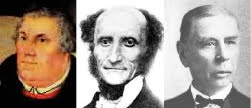
Let the reader judge!… whether they can trust Prof. Guenther or Pastor Peperkorn in their judgment of Hochstetter and his History.

Friday, May 22, 2020

History 3: What others say; Walther commends; ToC-Table of Contents (Part 3 of 20+); a BTL Book

[2023-03-31: I discovered another refreshing endorsement of Hochstetter in Prof. Kurt Marquart who stated, among other things, in Logia 1997 vol. 6, no. 2, p. 35: 
"It is a pity that Hochstetter’s gem of a history has not been translated into English. Hochstetter had been Grabau’s assistant in Buffalo, and had started out with strongly clericalist, anti-Missouri convictions. If his well-informed account especially of the Missouri-Buffalo fracas were generally known, romantic illusions about Grabau as champion of strict Lutheranism would lose all their charms. Grabau tried, tyrannically and unsuccess- fully, to transplant a state-church system without the state-church."
Compare this with Pastor Todd Peperkorn's judgment of the same here.]
- - - - - - - - - - - - - - - - -  -
      This continues from Part 2, a series publishing an English translation of Pastor Christian Hochstetter's 1885 480-page book entitled (abbreviated)
The History of the Missouri Synod, 1838-1884.
- - - - - - - - - - - - - - - - 
Historians favorable to Hochstetter's History
Ludwig Fuerbringer, circa 1931Ludwig Fuerbringer's 1936 CTM essay "Walther as Churchman" referenced Pastors Hochstetter and Köstering's histories (see this blog) as faithful narratives for Missourians to rely on – he offered no critical comments against these. — In the category of more recent LC-MS favorable theologians, along with Dr. Fred Kramer, is Dr. Cameron MacKenzie, who, while not expressly mentioning Hochstetter's work, refuted a claim of antagonist Walter O. Forster (Zion on the Mississippi, p. 523-25) concerning an account of Dr. Marbach, and so vindicates Hochstetter's History (Pieper Lectures, Vol. 10 (2006), "Call and Ordination in the Thought and Practice of C. F. W. Walther…", p. 36, n. 23). — A respected LC-MS historian, Lewis W. Spitz Sr. (1895-1996; CTSFW), in his "Preface" to his 1961 The Life of Dr. C.F.W. Walther, calls out, among others, Hochstetter's History as a trusted primary source.
August Suelflow, CHI Director († 1999)
      Another recent LCMS theologian referencing Hochstetter is CHI Director August Suelflow († 1999).  His book C. F. W. Walther, Servant of the Word, p. 144-145 states (emphasis mine):
“An important contribution in this area was made by Christian Hochstetter (1828-1905) [Find-A-Grave], who wrote a comprehensive history of the Missouri Synod. It was published in 1885, two years before Walther’s death. The book continues to be the most reliable source available from that time. Hochstetter had been a pastor in the Buffalo Synod, but joined the Missouri Synod in 1867 when his theological convictions shifted. Walther received a copy of the volume from Hochstetter and read it immediately, though with great trepidation because he was so personally involved with the Synod’s history. In a letter to the author of the book, dated July 31, 1885, Walther expressed his great satisfaction with the history:
C.F.W. Walther, father of the Missouri Synod, The American Luther
"great service which
you have rendered…
you allowed the
facts to speak"
      ‘Now after I have completed reading with great interest and joy your history of our synod, and its doctrinal controversies, I am compelled to express my deepest and most sincere appreciation to you for the great service which you have rendered by it not only to our synod, but above all to the cause of truth. At first, I grant you, I dreaded to read your splendid book, because I myself occur in it so often. I was afraid of my own evil heart, which is so greatly prone to ascribe a little also to myself for what God has done to me out of incomprehensible mercy and for [how] he has used me as his most unworthy instrument. Finally, however, after God allowed me again and again to feel my incompetence for all good and my damnableness, I overcame my dread. ... [Y]ou allowed the facts to speak, facts which simply cannot be gain-sayed. ... When I was reading your book it struck me more vividly than ever before, that next to God’s incomprehensible mercy in making us poor sinners a memorial of His free grace, the true cause of our success is the conviction (given us by God) under all circumstances to remain with His truth and the heritage of the Reformation and not to sacrifice one iota of it, even if (because of that) everything erected would be brought to ruin again. That this conviction was also mine and remained mine to this hour, I cannot deny for the sake of God’s honor, who gave it to me. Cursed be every thought that seeks to claim for itself what belongs to God, but far be it, too, out of false modesty to deny what God has done in us.’ (Letter from Walther to Hochstetter, July 31, 1885; transcription by W. K. Wadewitz at Concordia Historical Institute.)”
So pronounces C. F. W. Walther on Hochstetter's History of the Missouri Synod. All who question Walther's spiritual judgment, the "gain-sayers", are in essence fighting against Holy Scripture, the Lutheran Confessions, and Luther's Reformation.
- - - - - - - - - - - -
Historians unfavorable to Hochstetter's History
Forster's Zion on the Mississippi, old & new covers.
Generally viewed as conservative,
yet lacks spiritual understanding.
      There are several LC-MS historians and theologians who have criticized Hochstetter's History – none more severely than Walter O. Forster in his 1953 CPH book Zion on the Mississippi, a standard history in LCMS circles.  Forster repeatedly questions the testimony of several historians from the Old Missouri Synod, including Hochstetter and Walther. More importantly, he also questions their motives. He calls Walther "equivocal" (p. 303-304).  Forster gives the distinct impression that he, as the objective historian, questions Walther's honesty.  He uses phrases such as "fatuous assertions" (p. 303).  We saw above that Dr. MacKenzie refuted at least one of the spiritual judgments of Forster (on Dr. Marbach). An earlier blog post pointed out Forster's opposition to Walther's judgment of mediating theologians in Germany.
      At their worst, these unfavorable LCMS historians and theologians promote the thought that older historians such as Hochstetter could be accused of idolizing Walther, just as Pastor Martin Stephan had been. But we see that Hochstetter perfectly answers this accusation, which most Old Missouri historians faced, in an 1882 essay, p. 79 (translated):
"It must be noted that Walther does not make the spirits subject to himself but to the Word of God; but he knows how to teach it so emphatically and clearly that the truth must prove its irresistible power, that doubt must give way, while that which seemed difficult to some becomes easy and the uncertain finally becomes certain!". 
This accusation is far from the truth, for the convictions of these Old Missouri historians were made Rock solid (1 Cor. 10:4) by the Word of God, i.e. the Holy Scriptures. — The false judgments by LCMS historians is similar to a case related by August Suelflow in his book.  He reported (Servant, p. 116) on a story that the Confederate flag flew over Concordia Seminary during the Civil War period.  Suelflow continued:
"This false story has been printed as fact elsewhere, even as recently in such prominent works as Werner Elert’s Morphologie des Luthertums, [The Structure of Lutheranism, CPH 2000] Yet in his 1870 rebuttal, Walther once and for all stated:…"
 (bolding mine)
August Suelflow accepted Walther's personal testimony as the truth against a German scholar in this case.  I will follow Suelflow's testimony for the credibility of Walther, against that of LCMS historians like Walter O. Forster.  (Unfortunately Suelflow did not fully trust Walther's testimony against LCMS historians such as Forster.)
      But so as not to spoil the beauty of Hochstetter's History, I will try to refrain from too many polemics against the LC-MS's attempts to cloud, question and ignore it. Readers should just read Hochstetter's History for themselves and not just take other scholars opinions on it. Then they may judge for themselves whether this History, and others like it, deserve to be heard. (Dr Fred Kramer did, and rejoiced.) They may do this even without access to the primary sources at Concordia Historical Institute because this is Church History, and all Christians are called to judge for themselves in spiritual matters because they have God's Word – "The Sheep Judge Their Shepherds". — In the next Part 4, I begin with my publication of an English translation of... Pastor Christian Hochstetter's  †  History of the Missouri Synod  †.
- - - - - - - - - - - - - - -  Table of Contents (tentative)  - - - - - - - - - - - - - -
Part 1Lehre und Wehre (Schaller or Stoeckhardt) book review
Part 2 – Prof. Fred Kramer's "Preface" to his translation into English from the German original
Part 3 – Walther's recommendation; favorable & unfavorable historians; Table of Contents
Part 4a – Hochstetter's "Foreword": he came from outside on issue of Church and Ministry; Word of God rules
Part 4b – "Foreword", part 2 of 2; Hochstetter to Missouri on Predestination; God blessed… Missouri Synod
Part 5 – Chapter 1: Luther leaves Germany for America; Prussian Union→Emigration to America
Part 6 – Chapter 2: Stephan unmasked; Walther's Church & Ministry saves Emigration; Rast misjudges
Part 7 – Chapter 3: Ministry defended, Democratism overcome – spiritual priesthood, not ungodly lay rule
   Excursus: 1850, Walther's address on Romanizing: "zeal leads them beyond Lutheranism"
Part 8 – Chpt. 4: Wyneken–“thunder following lightning!”
Part 9 – Chpt 5: Older Synods, Methodists; better church histories of A.L. Graebner, F. Bente
Part 10 – Chp 6: Missouri’s 1st 2 years; Der Luth.; education, missions; “This is what the Lord has done!”
Part 11 – Chp 7: Loehe & Grabau: "beyond Lutheranism", fall on doctrines of the Church and the Ministry
   Excursus: LCMS & Harrison vs. Walther on "Church and Ministry"
Part 12 – Chp 8: Walther-Wyneken to Germany; reproved, response
Part 13 – Chp 9: Buffalo Colloquy; Luther's "sh*t ban"; ordination not a divine command
Part 14 – Chp 10: Loehe to Romanizing, millennialism, Antichrist error: Iowa Colloquy
Part 15 – Chp 11: Usury; 25th Anniv.;Synodical Conference; Ohio Synod falls on Election of Grace
   Excursus: Walther's "sharp polemics" against Stellhorn: on Election of Grace
Part 16 – Chp 12: Election of Grace Controversy, on Predestination; against Calvinism
   Excursus: 2 judgments of Walther: Prof. Mayes faults Walther, again (Gerhard's terminology)
Part 17 – Chp 13a: Germany supplies, fights; Election Controversy concluded: “they laugh at us…, in danger"
   Excursus: Germany–then & now: Friedrich Brunn & Martin Blechschmidt
Part 18 – Chp 13b: St. Louis: USA’s new Wittenberg; Walther's Sem. bldg addresses, greatest on USA soil
Part 19 – Chp 13c: Schwan's address; Hochstetter reviews (conclusion of book)
Part 20 – Hochstetter's obituary in Der Lutheraner (1905);  “mouth of Walther”
Part 21 – Full texts of the book, downloadable, in German and English
Part 22a – LC-MS critical of Hochstetter's History: Forster, Mundinger, Rosin
Part 22b – LC-MS criticism: Suelflow, Schmelder, Peperkorn, etc.

Sunday, June 2, 2013

Walther as Theologian – Part 3: Inspiration & Open Questions

Continued from Part 2.  Table of Contents in Part 1.
Dear God!... there are too many quotations in these essays to highlight!  How precious Thy Word is to the True Church!

Pieper points out that Walther was well known among German theologians such as Otto Zöckler.  Indeed, Zöckler says the following in his book Handbuch der theologischen Wissenschaften in enzyklopädischer Darstellung, 1889 (Google translated, page 146):
...the trend-setting North American theologian of the Missouri Synod, Walther
Unfortunately Zöckler's label of "trend-setting" was in error.  Walther was not "trend-setting", rather he went back to Luther, went back to the teaching of the true Christian church, went back to the teaching of Scripture itself.
Greek and Hebrew words have not been rendered, but are displayed as ????s (question marks).  
These can be discovered from the hyperlinks to the original text in Lehre und Wehre.
Highlighting is my own.  Underlining is in original.
Hyperlinks within this document should be opened in a new tab (or window).


At this point, Prof. McLaughlin broke this article in Lehre und Wehre into a separate month issue of the Orthodox Lutheran Theologian.  So below is what I either call "Part 4" of the OLT or Part 3b of the LuW series.  I have given it the title "Open Questions".  One quote from this section:
...every true Bible doctrine is Lutheran Church doctrine, even if it is not Lutheran Symbolical doctrine. 
The series of Walther's articles that Pieper refers to in the below installment was translated and printed in 8 issues of vol. 10 (1939) of Concordia Theological Monthly [2018-08-29: added link].– titled The False Arguments for the Modern Theory of Open Questions.  These 8 articles were reprinted in booklet form by Concordia Theological Seminary Press in the 1990s.  Pieper's installment below is a marvelous synopsis of Walther's teaching.


Let me repeat the last quote of this installment from Pastor Hochstetter:
...the Missourian teachers lay not so much in their dependence upon the Symbols, as rather in their reverence for God’s Word!
This is why they also defended the Biblical teaching on geocentricity, usury, women in the church, etc.  Christians who deny the clear Scriptural teaching on these are putting themselves on shaky ground for they are questioning that same Word that proclaims their salvation.  Those Lutherans today who wrap themselves in the term "confessional Lutherans", yet have not the "reverence for God's Word" as the true "Missourian teachers" of the old (German) Missouri Synod, are name only "confessional Lutherans".

Next is Part 4 – Lutheran Dogmaticians, Repristination.