Search This Blog

Sunday, November 21, 2021

Walther's Foreword: out from Stephan’s Romanizing (Der Lutheraner 1857) Part 1 of 2

      Fortunately Concordia Publishing still sells the 1981 book Editorials from "Lehre Und Wehre", an English translation of selected writings of Walther from that publication.  I just now pulled out my copy purchased in the late 1990s and find my personal notations throughout the book.  Because Walther's writings became so important to me, at various times I have looked for a publication that brought the same "selected writings" from his Der Lutheraner, to no avail.  There have been only piecemeal translations scattered in various writings, but many references to this flagship publication of the Old German Missouri Synod. 
Martin Stephan, leader of Saxon Lutheran Emigration
Of course with my recent rollout, now English speakers may read all of Walther's writings in Der Lutheraner in a readable English machine translation. — 
As I processed the text files of this publication, one of the writings struck me where Walther had written about the effect of the Saxon Emigration's leader, Martin Stephan. The early years of Walther in America and his relations with Martin Stephan are quite contentious among LCMS historians, so I decided to polish the translation of his "Foreword" to the volume for years 1857-1858, which was 13 years after the publication began. — 
CHI Director August Suelflow
      In his Introduction as Series Editor to the "Selected Writings of C. F. W. Walther", CHI Director August Suelflow said
"Finally we take a look at Walther the editor—one of his most important functions. Through Lehre und Wehreand Der Lutheraner Walther exerted a strong influence toward orthodox Lutheranism."
All Lutherans would do well to study this brief account, a reflection, of Walther of the early years of the Saxon Lutheran Emigration, and the beginning of the publication of… Der Lutheraner.  From vol. 14 (Aug. 25, 1857), pages 1-2 [EN]:
- - - - - - - - - - - - - - - - - - - - - - - - - - - - 

Foreword of the Editor

to the

Fourteenth Year of Der Lutheraner.

[by C.F.W. Walther]


In the autumn of 1838, about 800 Lutherans with Lutheran preachers, a certain Pastor Stephan from Dresden at their head, emigrated from Saxony to Missouri and arrived here in January 1839, except some fifty who were lost at sea and found their grave in it. Those Lutherans were under the delusion that they were the most faithful Lutherans, indeed many of them thought that they were the only faithful sons of the Church of the Reformation left in the world, that Germany had fallen and would never rise again, that God's judgments were approaching in this country and that nothing could withstand them any longer, and that the time had therefore come to flee. Matt. 24:15-16. However sincerely these Saxons meant what they said — to a great extent they left everything they held dear in this world and went to a country unknown to them at that time, from which they mostly expected and desired nothing but freedom of conscience and worship — they were themselves, however, without suspecting it, nothing less than true faithful members of the Evangelical Lutheran Church.  

 
Martin Stephan

The aforementioned Pastor Stephen was the soul of the whole. He sought the strict Lutheranism in contrast to the unionist, sectarian and enthusiastic nature of the | new faith, in that he thought and taught essentially as a Romanist or rather as a papist, namely of the Church, of the Office [of Ministry], succession, authority, constitution, etc., and exercised a practice in keeping with this. The visible Lutheran church was to him the church apart from which there is no salvation; and since he believed that he and those who followed him alone were the visible Lutheran church, it was considered a foregone conclusion among the Saxons who blindly followed him that whoever wished to be saved must flee with them and gather where the existence of a truly Lutheran church was possible. Those who did not want to leave the fatherland were considered to be, if not already lost, then in the most urgent danger of their souls. Many, therefore, who were in confusion and distress in their consciences, often torn asunder, with bleeding hearts and weeping eyes, the most sacred bonds of natural love, blood, and profession, in order to follow and be with the “emigrating church” only. In like manner as the Romanizing doctrine of the Church, so was the effect of the Romanizing doctrine of the Ministry. The office of preacher stood as a mediator between Christ and the Christians, through which alone all graces and blessedness could be obtained

J. A. A. Grabau

The ban of this Office, no matter how arbitrarily it might be imposed, went about the “church” like a speaking ghost with its finger lifted. Unconditional obedience in all things not contrary to God's Word, it was said, was owed by the “layman” to the “spiritual office,” in the face of God's disgrace and danger of eternal salvation. Even the secretly | harboring of misgivings, within the heart, against the officials, against their integrity, or even only against the expediency of their orders in the secular and ecclesiastical spheres, was regarded as a sure sign of a Judas heart. 1


1) Those who know the teaching and practice of Pastor [J. A. A.] Grabau at Buffalo and of his followers, will grant us that both are by all means nothing more than a second edition and perhaps still more obstinate implementation of Stephanism.


Thus a dark spirit of servile fear and distrust pervaded the community [Gemeinschaft], which even friends no longer dared to exclude. Hundreds felt the heavy pressure that lay upon them, and sighed for redemption, without knowing in what this redemption must consist of. The writings of the old godly fathers were eagerly read, also the confessional writings of our church, but with the glasses of preconceived opinions. [So with today’s LCMS!] The warning and punishing voice resounded everywhere: You are not what you claim to be, true Lutherans, but pilgrims to Rome and servants of men. But because this voice came mostly from those who evidently did not themselves walk faithfully in the footsteps of the fathers of our church, this voice was taken for the voice of temptation. But what happened? — The God who searches the hearts, who knows what is the mind of the spirit, and when we do not know what we should pray for, as is proper, represents us in the best way with inexpressible groaning, this God finally heard the groaning of the wretched for help in the spring of the year 1839, the meaning of which the prayers themselves had mostly not understood. [Page 2] God, then, made the man who stood at the head [Stephan] irrefutably manifest as an unfaithful and dishonest one. Hereby, of course, the foundation fell away for all that had believed on his authority. The natural consequence of this was that the very doctrines which, as was well known, had not been learned from the symbols of the church and from the writings of the old faithful fathers, immediately came into question; and behold! very soon it became evident that these doctrines also contradicted those contained in the confessions of our church [Walther gives credit to the Confessions, not himself] (the credibility of which nothing had been able to shake). In short, it was seen with horror that, in the opinion that they were the right true Lutheran Church, even the only one, they had moved further and further away from its doctrine and — had drawn nearer to Rome. Because of this, and for the sake of all the many sins that had flowed from it, they humbled themselves heartily before God and man, and now took pains to purify themselves more and more in doctrine and life. 

- - - - - - - - - - - - - Concluded in Part 2 - - - - - - - - - - - - - - -
      It continues to amaze me just how far the LCMS has returned to the Romanizing of Loehe, Grabau, and Martin Stephan, i.e. "Stephanism".  They trivialize the seriousness of the Office of Preacher (i.e. the Ministry) standing as "a mediator between Christ and the Christians". And yet they want to claim to be "confessional".  They want to claim to be following Luther.  Prof. Benjamin Mayes, in 2011, even trivialized Walther's defense against Pastor Grabau. — In Part 2, we learn what prompted the beginning of the flagship publication of Der Lutheraner, and what it had to fight against as it progressed.

Wednesday, November 17, 2021

Heshusius on Justification: a translation (Part 2 of 2) (A BTL Book)

      This concludes from Part 1, publishing a work of the great Reformation Lutheran theologian Heshusius. — This theologian was highly admired by Walther for he gave a strong defense (Wehre) of the Lutheran Doctrine of Justification. In this post, we publish an unpolished DeepL translation of the full book, so that one can follow the full progression of Heshusius's theme. 
Some Excerpts: 
p. 4: "Such examples of apostasy have occurred much in the church in all ages, and are therefore set before us by prophets and apostles, that we… remember that more of it happened before."
8: "These terrible examples should serve as a warning to all righteous, God-fearing hearts; for first of all they remind us that we should be…not relying on our intellect, learning, gifts, and steadfastness."
10: "…some are embracing the Calvinistic fancies, that some are assenting to the presumptuous synergists."
12: "…all Christians…should fortify the articles of faith in the foundation of their hearts with Holy Scripture,… that man, without all merit and worthiness, solely by the grace and mercy of God, for the sake of the mediator Jesus Christ, who hath purchased for us with his blood, righteousness and salvation."
13: "…Scriptures have shown the right foundation of this main doctrine." [Justification <—> Scriptures]
14: "when this principal point is darkened,it is difficult for any article of Christian faith to remain pure."
15: "So the Council of Trent curses: 'If any man say that men are justified by faith alonelet him be accursed." [No, Vatican II did not renounce the Council of Trent. See herehere  [WB]here [AT], here.]
327: Thus also the scholastic theologians Scotus, Occam, Thomas Aquinas,…have given more heed to philosophy than to the Holy Scriptures."
The Ten Sermons, their sub-sections
  1. How to understand the words: law, sin, righteousness, justify, grace and faith.
  2. How the doctrine of the justification of the sinner before God can be summarized in several main points.
  3. 1. Of the causes of our justification. 2. And what difference there is between our doctrine of justification and that of the papists.
  4. That we are justified by faith alone.
  5. Proof that we are justified before God by grace without merit, for the sake of Jesus Christ, through faith alone. — The first reason, Of the office of the Law. — The second reason: Of the inability of human nature.
  6. The third reason: The promise of grace. — The fourth reason: of the ministry of Jesus Christ.
  7. The fifth reason. Testimony of the Holy Spirit together with experience. — The sixth reason. To God alone belongs all the glory of blessedness. (218) — The seventh reason. Passages of Scripture on justification. (225) — The eighth reason. Examples of justification. (239)
  8. The ninth reason: The profession of the Gentiles. — The tenth reason: That faith is a pure gift of God. (264) — The eleventh reason: Parables. (268) — The twelfth reason: the eternal providence. (280)
  9. Through which heretics, and how, the doctrine of the righteousness of faith has been falsified, and through which faithful teachers God has awakened against it, and through them has preserved the unadulterated truth. — Testimony of the Fathers: (313) Ambrose, Augustine, (317), Epiphanius (320), Anselm (322), Jerome (323), Primasius (325), Theodoretus, Chrysostom (326)
  10. Refutation of the papal errors, so that they may think to obtain righteousness before God from the works of the law.
When I read Heshusius, it seems that I am reading Walther and Pieper.  Heshusius was a Lutheran, yes, he was a "Missourian!" —  My apologies for the errors and gibberish of Latin phrases that still remain to be polished in the following translation. However it is quite readable for anyone who, as Walther says,  "desires something for their soul's salvation." Translation by BTL using DeepL; highlighting and hyperlinks added:
A DOCX downloadable file is available >>  HERE  <<; German OCR'd text here)
      A side note may be added.  Prof. David Scaer (Pro Ecclesia 14 (2005) p. 143-60) and his protégé Pastor Martin Noland (PhD thesis, Union Seminary; Lutheran Clarion Sept. 2016, p. 3) want to claim that the teaching of the "Testimony of the Holy Spirit" was likely an influence from Calvin's teaching, but Heshusius is an early Lutheran theologian who explicitly taught it (Sermon #5) and yet was a strong defender against Calvinism. Could it be that Heshusius is strong on the Doctrine of Justification and… Scaer and Noland are not?

Sunday, November 14, 2021

Walther on: Heshusius, Justification; "pure doctrine… most lacking in Protestant sects" (Der Lutheraner 1876) (Part 1 of 2)

Heshusius (image from Red Brick Parsonage blog)
     Tilemann Heshusius (Red Brick Parsonage bio; books), an early Lutheran theologian, was written about in the 1876 Der Lutheraner, in an announcement of a republished Missouri Synod book of his, Ten Sermons on the Justification of the Sinner Before God (Zehn Predigten von der Rechtfertigung des Sünders vor Gott, WorldCat).  What made it of special importance was that C.F.W. Walther wrote the notice and review, and so we hear a truly orthodox commentary. 
      One of the most common things I hear from correspondents is that they think some erring parties, including LC-MS Lutherans, do not err in the fundamental Doctrine of Justification but only in certain other doctrines.  But Walther answers this with the resounding rebuttal “It is precisely the pure doctrine of justification that is most lacking in all the so-called Protestant sects.” Walther knew that Heshusius, in his Preface, teaches the same thing when he wrote
"When this principal point is darkened or adulterated, various seductions and errors must follow in other doctrines also and it is difficult for any article of Christian faith to remain pure; or if anything is ever left unadulterated, it is still without all use and power, because the above-mentioned principal source is blocked by false teaching."
This refutes those that think that the Reformed sects only err on the sacraments, but are right in the pure doctrine of Justification.  This refutes those who think that the LC-MS does not err in the Doctrine of Justification, but only in other secondary doctrines, e. g. Church Fellowship.  No, it is because they first err on Justification that they err on the Sacraments, or on the Person of Christ, or on the doctrine of the Antichrist, or on Church Fellowship, etc. — The following book announcement and review of Walther is from Der Lutheraner vol. 32 (1876), p. 72, col. 1, [EN]:
- - - - - - - - - - - - - - - - - - - - - - - - - - - - - - -  
Prof. C. F. W. Walther

Ten Sermons on the Justification of the Sinner Before God. By Dr. Tilemann Heshusius. (Reprinted unchanged from the 1563 edition.) St. Louis, Mo., and Leipzig. 1876. 

This book has just been published. It belongs to the many pearls from earlier times, which are worth being brought out of the dust of the past. As the title says, it deals with the central doctrine of our holy Christian faith, with which, as our ancients rightly said, the church stands and falls. Many people now think that even if the various so-called Protestant parties disagree in some important doctrines, they are all united in this main doctrine, the doctrine of justification, and even if there is now often a lack of thorough knowledge of many doctrines among the faithful, no believer lacks knowledge of the doctrine of justification. But this is a serious error. It is precisely the pure doctrine of justification that is most lacking in all the so-called Protestant sects. If they were pure in this doctrine, they would and should have to abandon their other errors as well; for, as Luther so often testifies: “In this article hangs and stands everything, and shows all the others with it, and everything is to be done for this one, so that whoever errs in the others is certainly not right in this one either, and even if he holds the others and does not have this one, it is still all in vain. Again, this article also has the grace, where one perseveres in it with diligence and earnestness, that it does not fall into heresy.” (Tom. VIII, p. 504.) But it is equally erroneous when so many now think that they know at least the doctrine of justification so well that they hardly need further instruction on this point. Just the opposite is the truth. There is no doctrine of the entire Christian religion that a Christian learns less than this one, and anyone who claims to have already learned it proves that he has hardly made a start in this knowledge. The greatest scholars of God have always said that they must remain students of this doctrine until their death. Therefore, not only all preachers, but all Christians who desire to grow in knowledge, should welcome with joy any writing that treats the doctrine of justification in a pure, thorough and experiential way. The present one is indeed suchThe author of it, Heshusius, was born on November 3, 1527 in Wesel in the Prussian province of Rhineland, studied in Wittenberg, and died as the first professor of theology in Helmstedt in 1588. His main activity thus falls into the frightening time after Luther's death up to and after the adoption of the Formula of Concord. In this time, when so many fell away from the teachings of the Reformation, our Heshusius was among the few faithful students of Luther. His incorruptible faithfulness also had the consequence that his whole life was almost a constant wandering from place to place. Almost regularly, after a short administration, he was expelled by the enemies of the pure doctrine or of Christian discipline. The most peaceful years of his life were the four years during which he was court preacher to Count Palatine Wolfgang of Zweibrücken in Neuburg on the Danube. It was during this time, in 1568, that he published the Ten Sermons on the Justification of Sinners before God. They deal with this doctrine in a thorough manner and in Heshusius' own, at that time so rare, fluent and granular language. The book, comprising 380 pages in small octavo and bound in pasteboard with gold title, costs $1.00.  Postage is 10 cents. It may be obtained at the address of the publisher, F. Dette, 710 Franklin Ave., St. Louis, Mo., in Leipzig von E. Bredt.   W. [Walther]

- - - - - - - - - - - - - - - - - - 
      Walther's emphasis on the Doctrine of Justification follows Luther and the Lutheran Church as we saw in many previous blog posts. And we see that Heshusius also shines as a Lutheran theologian and deserves to be read.  This brief book announcement by Walther caused me to prepare a translation of Heshusius's book and publish it… in the next Part 2

Thursday, November 11, 2021

Walther on Abortion… in 1871? Infanticide? “religionless state schools”

C. F. W. Walther, in his middle age
      The heading for this post is in the form of a question because with all the attention on abortion and abortion rights today, one might think that this practice was not prevalent in the mid-19th century.  But that appears not to be the case, as C. F. W. Walther comments on the current conditions in his time in the 1871 edition of Der Lutheraner, vol. 28, p. 4 [EN]:
- - - - - - - - - - - - - - - - - - - - - 

The murder of children in the womb, as almost all newspapers report, has become so common among Americans that Sodom seems like a pious city compared to America (Eze. 16:48, 51). The Illinois state paper, in one of its recent numbers, claims that at least a quarter-million, and probably half a million, children are murdered in the womb every year in the United States. A single female abomination in Boston has confessed that she assisted in 20,000 cases during 17 years. Would it be surprising if the earth were to rise up and America were to sink into the deepest depths? No; it is a miracle of divine long-suffering that America has not long since perished like Sodom and Gomorrah. Do you, dear reader, desire even more terrible signs of the very last time? Luke 17:26-30. W. [Walther]

- - - - - - - - - - - - - - - - - - - -
      I have not kept up with the number of abortions in America today, but it is surely a very large number.  But I was a bit surprised at the numbers in Walther's day, given the much lower population. But of greater interest was Walther's comments.  One does not hear of "Abortion" associated with the cities of Sodom and Gomorrah today by those who are fighting against it, but Walther connected them. And it is instructive to read the Bible verses that he references.  Indeed, we moderns are certainly witnesses of the incredible "miracle of divine long-suffering" today.
      In the same year 1871 Walther reported and commented on another American church publication's article on a similar subject, which could actually include Abortion.  From the Der Lutheraner, vol. 28 (1871), p. 38-39 [EN]:
- - - - - - - - - - - - - - - - - - - 

Infanticide [Kindermord]. The "Christian Ambassador" [Evangelical Association] of Sept. 20 also speaks out about this terrible American sin. He writes: 

“It is quite frightening how generally infanticide is practiced in this country. Most of these criminals want to be so 'decent' that they declare it a violation of 'good morals' to call attention to these things. They do not want to hear many addresses of Jesus from the pulpit (because of this). Of course, this is pure hypocrisy. There is a lot of talk in American circles about women's rights, they would better study what women's duties are. The terrible curse from which the American republic suffers is not the ‘disenfranchisement’ of women by men, but their dehumanization by themselves. We know of quite a number who have fallen victim to their murderous handiwork. There are also certain women who pretend to be doctors, go around the country and give lectures about things that are only calculated for women's ears, in which it is taught how fornication can be practiced in a refined way inside and outside of marriage without (as these disgraceful women say) getting into 'misfortune'. We know of cases where English churches were granted to them for this purpose. In this way thousands of hearts are poisoned and many families made unhappy. The condemnation of these child murderers must be terrible.” 

We must add: Is it any wonder that in America such more than pagan abominations flood the land, since one sends one's children to such schools where it is forbidden to expose the holy ten commandments of God to them? If there stood in the place of the religionless schools just as many and so frequented Christian parochial schools, America would then certainly not be "given to do that which is not fit" in a perverse sense. (Rom. 1:26-28.) As long as the church in America holds on to the system of religionless state schools, there is no hope for improvement, no help. These schools are the root of the tree of our ruin; to them the species must be taken, or all other measures will be lost.    W. [Walther]

- - - - - - - - - - - - - - - - - - - - 
One may note that Walther goes to the root of the malaise, the "religionless state schools" in America. These are the schools that most LCMS children have attended, including me. These schools are even defended within the LCMS.  But in 1871, Walther pronounced the awful judgment for America whose Christian children attend state schools: 
there is no hope for improvement, no help.

Tuesday, November 9, 2021

John Friedrich comforted by Luther's A Mighty Fortress (2 of 2)

      This concludes from Part 1, a Der Lutheraner essay on the great comfort of Luther's greatest hymn. — Concluding from Der Lutheraner vol 13 (1857), p. 42-43:
= = = = = = = = = = = = = = = = = = = = = =  

A Mighty Fortress is Our God

(Ein’ feste Burg ist unser Gott.)

[An essay by “G. B.”] (concluded from Part 1) 

Frederick III, Count Palatine

Prince Frederick III, Count Palatine, who was asked why he did not build fortresses in his country, answered: “‘A mighty Fortress is our God, A trusty Shield and Weapon’; so we have faithful subjects and, in case of need, a number of warriors who can resist our enemies not only with shields and weapons, but also and especially with prayer 

Gustavus Adolphus – Johann Tserclaes, Count of Tilly

This is why the noble Swedish king, Gustavus Adolphus, resorted to such arms and weapons on the morning of the battle of Leipzig on September 17, 1631, when he was facing Tilly. Before the battle began, he had his entire army sing this song, and when God helped him to victory and he saw the enemy fleeing everywhere, he threw himself on his knees in the midst of the dead and wounded, thanked God and cried out: He must keep the field 

Wolfgang, Prince of Anhalt

In 1517, Wolfgang, Prince of Anhält, whose name shines under the Augsburg Confession, was declared an outlaw [Acht] by the emperor and his land was given to a Spanish favorite. When the letter banning him arrived, he sat on horseback, rode through the dismayed city and sang this song in a bright voice on the market square as a farewell, especially the lines: Take away our bodies, etc. Afterwards, he hid in a mill for a long time, dressed as a miller, until he was reinstated in possession of his land by the Peace of Passau in 1550 

Andreas Musculus – John Frederick I, the Magnanimous (by Titian)

When Emperor Charles V dismissed the evangelical preachers in Augsburg in 1548 because they did not want to accept the [Augsburg] Interim, and especially the brave theologian [Andreas] Wolfgang Musculus had preached vehemently against it in Augsburg, they came to the imprisoned Elector of Saxony, John Frederick, who was a prisoner in Augsburg at the time, and told him as they were leaving that they had not only been deprived of their service, but that Imperial Majesty had also forbidden them to enter the Roman Empire. At this, the Elector began to weep so that tears flowed down his cheeks to the ground, stood up, went to the window, but soon turned to them again and said: 

“Has the Emperor forbidden you the entire Roman Empire?” 

“Yes!” 

Then he asked again, “Has the emperor also forbidden you heaven?
“No.”

“Well,” he continued, “there is still no need, the kingdom and heaven must remain with us, then God will also find a land where you can preach His Word.” 

He then had his saddlebag brought and said: 

“In it is everything I have on earth; from it I will give you money for the journey [Zehrpfennig], which you can divide among your brothers and companions of the cross, even though I am a poor captive prince, God will surely give me something again.” 

King Frederick William I of Prussia welcomes the Salzburg Protestants

When the expelled Salzburgers came to Darmstadt in the spring of 1732, they were accompanied by an innumerable crowd into the city church, while they sang this song as their migration passport and all the people joined in. 

Tobias Kiessling, the godly merchant of Nuremberg, tells us that he often saw and heard how, for example in Linz, Protestant men and women were dragged and packed onto ships to be taken to the lowest regions of Hungary and Transylvania. The little children were torn from their mothers' breasts and arms and the mothers were left to decide whether they wanted to stay with their children and follow the Catholic faith or to separate from them for life. The mothers wept bitterly, looked up, turned away, hurried to the mobs of other religious fighters who were being led away into exile, and sang heartbreakingly: “Take they our life, goods, fame, child, and wife, etc.” 

Huguenots's in St. Bartholomew's Day massacre
St. Bartholomew's Day massacre

This psalm was also the Huguenots' daily song of strength in those bloody wars and persecutions that came upon them in 1560-72; even when they were executed by fire and sword, they died joyfully with this song without denying their faith. A noble Catholic count who came to Germany with Charles V in 1547 once heard the Lutheran psalm sung: Ein Feste Burg ist unser Gott (A Mighty Fortress is Our God); and he said, “I will help to destroy this fortress, or I will not live.” But he suddenly fell ill on the third day afterwards and came to a terrible end.

- - - - - - - - - - - - - - - - -  End of essay  - - - - - - - - - - - - - - - - -
      We see that this hymn of Luther lived in the hearts of those who heard the sound of the Gospel, and was a constant comfort in their many persecutions. — Dear reader, if these great Lutheran leaders took comfort while under persecution for their Christian faith, should not we do the same in these Last Times?  Should not all Christian children be taught this from the earliest age to commit it to memory?  Should not all Christian households have it sung regularly? May we echo the sentiment of Melanchthon's great cry to the little girl: 
"Sing, dear little daughter, sing!"   Amen! Amen!

Sunday, November 7, 2021

"Sing, dear daughter, sing!": Melanchthon comforted by Luther's A Mighty Fortress (1 of 2)

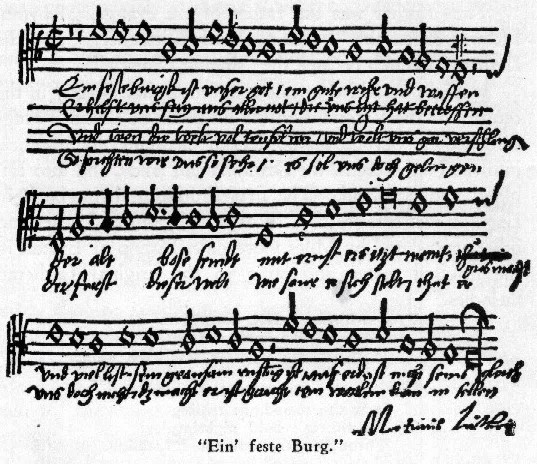
      Buried in a series of articles on Lutheran hymns, the Der Lutheraner of Nov. 4, 1857 had a section on Luther's most famous hymn: Ein' feste Burg ist unser Gott. "A Mighty Fortress is Our God",   I had to stop OCRing the German text for awhile and get it translated to find out what the author "G. B." was saying about this most famous hymn.  And as the English translation appeared to me, I had to stop… and share it with the world. From Der Lutheraner vol 13 (1857), p. 42-43:
"Ein feste Burg ist unser Gott" by Martin Luther
= = = = = = = = = = = = = = = = = = = = = =  

A Mighty Fortress is Our God

(Ein’ feste Burg ist unser Gott.)

[An essay by “G. B.”]

A free reworking of the 46th Psalm, composed by Luther in 1529 after the end of the Diet of Speyer, as an open protest song of the entire Protestant Church, which against all its adversaries and enemies trusted in God alone as its refuge and its fortress 

Luther's room at Coburg fortress during Diet of Augsburg in 1530

In Coburg, at the fortress, he sang this psalm daily during the Augsburg Diet in 1530, sitting at the window with his lute and looking up to heaven, and he did so, according to Selneccer's testimony, "because the enemies wanted to devour him.” According to some, he first composed this heroic psalm at the fortress of Coburg, according to others on the way, when he traveled to the Diet of Worms in 1521. Along with the song, Luther also created the melody; both are as if from one cast, flowing from the deepest, noblest enthusiasm of his mind, so that he poured his innermost being in richest abundance into the word and the melody.  

Conrad Dietrich, Georg Spalatin

Dr. Conrad Dietrich was already able to boast of the manner, that it has a special spiritual emphasis, like no other, stirs the heart, cheers it up, makes it joyful and glad in the Lord, gives courage and comfort, sap and strength, where it is only modulated and sung in faithful devotion. From the 3rd verse, the climax of the song, the heroic sense shines forth, with which Luther, in the armor of God, not being afraid even of the arch enemy, had already called out to the dissuading friends sent to him by [Georg] Spalatin on his journey to the Worms Imperial Assembly at Oppenheim: “Even if there are as many devils in Worms as there are tiles on the roofs, I will still go and not be afraid in the least. Even if [Jan] Hus was burned to ashes, the truth has not been burned with him.”  

Jacob Weller, Cyriacus Spangenberg

Dr. Jacob Weller [de Wikipedia] says of this verse: “These are the words of a Christian who is completely ready and firm in his faith.” Luther's contemporary, Cyriacus Spangenberg, testifies: “When I looked at Dr. M. Luther 23 years ago in Wittenberg, it seemed to me that I was looking at a large, mighty, well-armed battleship that was confidently deployed among the enemies on the rough sea.”

Very quickly, as if the angels of God themselves had sent messengers, this song spread throughout Germany and all places where adherents of the pure evangelical doctrine lived. As early as 1532, the congregation in Schweinfurt sang it in church against the will of their pastor, and the children sang it at night in the streets, whereupon the Reformation soon took place there. 

Melanchthon, Jonas, Creuziger

Melanchthon, Jonas and Creuziger once entered Weimar in 1547, when Wittenberg had been surrendered to the enemy [Capitulation of Wittenberg] and they had been sent into exile. There they heard a little girl singing this song and were greatly comforted by it, especially by the words: “And if the world were full of devils”. Melanchthon, however, said to the pious young singer: 


Sing, dear little daughter, sing; you do not know what great people you are comforting now.” 

- - - - - - - - - - - - - - - - -  Conclusion in Part 2  - - - - - - - - - - - - - - - - -
      I took great comfort in Melanchthon's resounding words, for this was after Luther's passing, during Melanchthon's time of weakening faith, yet he was facing severe persecution as a Lutheran.  How would he, the great theologian in his own right, be comforted as he was uprooted by the Papists?  He was comforted by a child singing Luther's majestic hymn.  This is a hymn for all Christians as they face the increasing persecution of this world. Sing, people, sing! – so Melanchthon calls out to us today! — There was another great Lutheran about this time who also took comfort from this hymn in persecution, in the concluding Part 2.