Search This Blog

Monday, December 9, 2019

Gerhard Forde: instructor to today's LCMS (2 of 2)

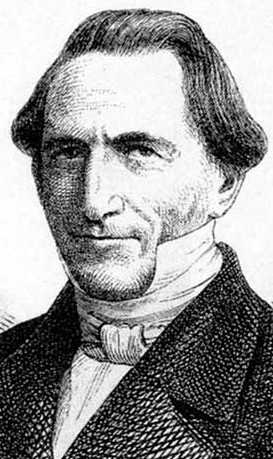
Gerhard O. Forde (ALC, ELCA professor; † 2005)
[2020-02-24: added reference at bottom to old blog]
     In Part 1, it was shown that the theologian Gerhard O. Forde questioned the foundational Christian doctrine of the vicarious satisfaction.  Forde's theology is thereby anti-Christian and unLutheran.  One would think that a synod claiming to be truly Lutheran would completely avoid Forde's theology because of this but that is not the case with the Lutheran Church-Missouri Synod.  Their new seminary textbook, to update Pieper's Christian Dogmatics, quotes him approvingly in many places, offering only minor warnings, e.g. on his Third Use of Law.

Forde in Samuel Nafzger's/LC-MS textbook Confessing the Gospel
      The following is my tabulation of the references to the works of Gerhard O. Forde, an ELCA theologian, in the new (2018) LC-MS textbook Confessing the Gospel:
Samuel H. Nafzger
General Editor
Chapter title
Primary Contributor(s)
#  Forde references
Prolegomena
David A. Lumpp
5
Anthropology
Jerrold A. Eickmann, Jerald C. Joersz, Thomas E. Manteufel, Daniel L. Mattson, Joel P. Okamoto
5
Work of Christ
Henry A. Hamann
8
Christian Life
Milton L. Rudnick, Martim C. Warth
5
Election
Robert Kolb
3
===========
Total: 26
There are approximately 26 references to Forde's writings in this 2-volume textbook for seminarians.  Most references offer no warning against his theology but rather quote him with approval.  All of these contributors are either ignorant of Forde's error on the fundamental article of the Christian faith, or what is more likely, they are, to borrow Siegbert Becker's words, "deliberately and culpably blind" to it – they are willing to overlook Forde's teaching that the Vicarious Satisfaction "creates more problems than it solves".
Walther's Works: Predestination (CPH 2018): includes 1880 & 1881 Missouri Synod pastoral conferences on controversy on "Election of Grace"
      But the ultimate tragedy of the praise of Forde's theology comes particularly in the last chapter "Election" by primary contributor Dr. Robert Kolb.  In the 2018 CPH book Walther's Works: Predestination, [2020-09-01 see also this post] it is repeatedly pointed out that one cannot hold the proper doctrine of Election of Grace without holding to the Lutheran doctrine of Universal, Objective Justification, or what is the same, the Vicarious Satisfaction.  While the author of Nafzger's textbook chapter (Kolb or Nafzger?) quotes both C.F.W. Walther and Franz Pieper in his attempt to set forth the Lutheran doctrine of "Predestination" or "Election", he then amazingly immediately follows these quotes with the following (p. 1255-1256):
"The most important North American Lutheran to articulate the doctrine of election in the late 20th century was Gerhard O. Forde (1927-2005).… Forde thereby seeks to drive home for troubled consciences the comfort that comes from knowing that before the world began God chose those to whom he has delivered his promise in Jesus Christ, and those in whom he has created faith through that same promise."
Forde demonstrates his "smokescreen" vocabulary by supposedly offering "comfort for troubled consciences" while questioning the Vicarious Satisfaction, an impossibility – as the CPH Walther's Works book demonstrates.  For Drs. Robert Kolb and/or editor Samuel Nafzger to hold up Gerhard O. Forde in the face of Walther and Pieper (and Stoeckhardt) is to join in Forde's duplicity, and thereby sadly exposes the author/editor's mixed, confusing theology.
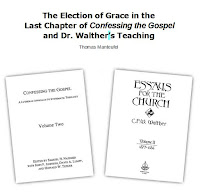
"The Election of Grace in the Last Chapter of Confessing the Gospel and Dr. Walther’s Teaching" by Thomas Manteufel (CHIQ Summer 2019)Thomas Manteufel (CSL emeritus faculty listing 2018)
      It is even sadder that Prof. (emeritus) Thomas Manteufel, in a recent article for Summer 2019 CHIQ, attempts to justify the Nafzger-Kolb textbook by highlighting its references to Walther and Pieper, while ignoring the travesty of its reference to Gerhard O. Forde in the same writing! – I am truly sorry for the seminarians that now are taught with Nafzger's textbook, and more sorry for the Lutheran congregations who will have their future pastors taught under its "Lutheran approach", instead of Walther and Pieper. — For the reader interested in a in-depth debate on "Predestination" that clearly distinguishes truth from error, the 2018 CPH book Walther's Works: Predestination is the best there is. (2020-02-24: see also this blog)

Saturday, December 7, 2019

Fundament 17: Means 8: 2 religions, only 2; Stahl, not Drucker or Warren

      This continues from Part 16 (Table of Contents in Part 1), a translation of Franz Pieper's essay on the foundation of the Christian faith ("Das Fundament des christlichen Glaubens"). — Pieper now speaks to the Church about the "Two Religions" in the world, the religions of the Law and that of the Gospel. He then again draws on Luther as be begins to finalize his segment on the Means of Grace as a "Fundament", a foundation of Christianity.  In the process, Pieper once again praises a German Lutheran statesman against Reformed attackers…
= = = = = = = = = = = = = = = = = = = = =
Text preparation and translation by BackToLuther using DeepL, Google Translate, Microsoft Translate, Yandex Translate. All bold text is Pieper's emphasis. All highlightingred text, and most text in square brackets [ ] is mine.

The Foundation of the Christian Faith.
[by President Franz Pieper, Concordia Seminary; continued from Part 16 - page 258]

The religion inborn in us is the religion of the Law, the opinio legis. According to this religion, which is ingrained in us, we consider God gracious when we see good works or what we consider to be good works in us. But because we still sin a great deal daily, and our conscience, together with the divine law, condemns us, we think that God does not want “to have our grace any more”, as Luther puts it. But against the natural religion which is inherent in us, it must be stated that the Christian religion is not a religion of the Law, but of the Gospel, according to which God has mercy on us men solely for the sake of Christ's perfect merit, regardless of our constitution and works
In other words: We have our righteousness, with which to be able to stand before God and obey God's will, not to be sought within ourselves but outside ourselves. [Objective!] As we also confess in the Formula of Concord, 92) “all our righteousness is to be sought outside the merits, works, virtues, and worthiness of ourselves and of all men”, totam justitiam nostram extra nos et extra omnium hominum merita, opera, virtutes atque dignitatem quaerendam. It consists in the righteousness of Christ or, what is the same in substance, in the forgiveness of our sins, which Christ has brought about for us and which He promises and bestows upon us in the means of grace ordered by Him. We therefore base our faith on the right foundation only when we, as Luther tends to say, “go out of ourselves” and “over us,” that is, when we believe God's grace on the basis of the objective means of grace which lie outside of us. The means of grace are the safe place determined by God, where poor sinners, a thief and a public sinner no less than Paul, Peter and John can and should find grace and salvation at all times and under all circumstances. Admittedly, the "poured in grace", in the proper Christian sense of the
-------------- 
91) St. L. XI, 453. [Lenker, v. 2, p. 43, § 28]
92) M. 622, 55. [Trigl. 934-935, § 55; BoC here]

holiness and Christian righteousness of life (justitia inhaerens) worked by the Holy Spirit, is also to be understood the determination of the “sign and witness” of our state of grace, 1 John 3:14: “We know that we have passed from death unto life, because we love the brethren”. But this righteousness of life always remains imperfect and therefore does not serve as the foundation of our confidence in the grace of God at the time of the temptation and in the agony of death. Luther points us to the true Christian practice of faith in the words: “Finally no counsel is to be had, unless you give yourself, outside your own and all human comfort, to the Word alone.” 93) By “Word” Luther understands the outer Word of the Gospel and its seal, Baptism and the Lord's Supper. 
In the question of the foundation of Christian faith, the special question also surfaced as to how stands the foundation of faith of those Reformed Christians who base their faith in the forgiveness acquired by Christ on the outer word of the Gospel, but know nothing about the sacraments, baptism and the Lord's Supper, as means of forgiving sins. Such Reformed Christians exist because they grew up among teachers who especially fight Baptism and the Lord's Supper as means of grace. Do such Christians now have the whole or only a partial forgiveness of sins? The question then came to a head as to whether the sacraments belong at all to the foundation of faith. The question has already been answered. As certainly as both sacraments are ordained by God for the forgiveness of sins (εἰς ἄφεσιν ἁμαρτιῶν) [Matt. 26:28], so certainly should Christians base their faith in the forgiveness of their sins on baptism and the Lord's Supper. In other words: Baptism and the Lord's Supper belong to the foundation of the Christian faith according to divine order. Quenstedt: Ad fundamentum pertinent. 94) But the Christians who, out of weakness in knowledge, do not know how to use the sacraments as a means of grace, but at the same time base their faith in God's graciousness on the Word of the Gospel heard or read, do not have only a partial one, but the whole forgiveness of sins, because it is not so that by the mere Word of the Gospel only one third, by Baptism the second third, by the Lord's Supper the third third of sins are forgiven, but it is so that by every species of the means of grace all sins are forgiven. Our Lutheran Confession expresses this, as we have already seen: “The effect of the Word and of the rite is the same [irrespectively, in the heart],” idem est effectus Verbi et ritus. [Apology, XIII (VII) § 5  – BoC here] This is explained in more detail in the preceding passage: “For the outward signs have been set up for this purpose, so that thereby 
-------------- 
93) St. L. XI,455 [§ 31; not in old series Am. Ed.; Lenker 11, p. 45]
94) Systema (1715) I, 355. 

the hearts may be moved, even by the Word and outward signs at the same time, that when we are baptized, when we receive the body of the LORD, they may believe that God truly will have mercy on us through Christ,” [after the German text, here in section [4], § 479 here] Would thus the sacraments be superfluous as means of grace, because already the Word of the Gospel promises and appropriates all the forgiveness of sins? So argued Zwingli and his comrades, however, against Luther in order to persuade him to let Baptism and the Lord's Supper go as a means of grace, at least not to argue hard about this point. 
In contrast to this, Luther pointed to a twofold point: 95) 1. Baptism and the Lord's Supper are not a human, but a divine order. Whoever declares them unnecessary or useless rises above God. “For whoever asks,” says Luther, “why is it necessary for what God speaks and does, he wants to pass over God, be wiser and better than God.” 2. That God offers and promises one and the same forgiveness of sins acquired by Christ not only through the word of the Gospel, but also through visible signs (verbum visibile) determined by Him, so that He, the gracious God, meets a need of souls. Scripture and experience teach that faith in the forgiveness of sins becomes very difficult for all those who are in living knowledge of their sins. To accommodate this weakness, 
God has added Baptism and the Lord's Supper to the Word of the Gospel. Holy Baptism is a private absolution in the name of the baptized person. Likewise, the Holy Supper is no less than an individual acquittal of sin in the name of the communicant, confirmed by the presentation of the body and blood of Christ. Luther's words in the Smalcald articles very emphatically point to this: 96) “The gospel does not give counsel and help against sin in only one way; for God is exceedingly rich in his grace. First of all through the oral Word, in which the forgiveness of sins is preached in all the world, which is the actual office of the Gospel. On the other hand, through Baptism. Third, through the Holy Sacrament of the Altar. Fourth by the power of the Keys and also per mutuum colloquium et consolationem fratrum. Matt.18:20: “Ubi duo fuerint congregati” [Matt. 18:20: “where two (or three) are gathered together”] With regard to such Reformed Christians who, out of weakness in knowledge, do not know how to use the sacraments as a medium of justification (εἰς ἄφεσιν ἁμαρτιῶν), two things can be said: 
1. By believing in the Word of the Gospel, they have the forgiveness of all their sins and thus life and happiness. 2. but by not knowing how to use Baptism and the Lord's Supper as a means of justification, they have less support for their faith in the forgiveness 
-------------- 
96) M., p. 319. IV. The Gospel. [Trigl. 490-491, BoC here]

Dr. Friedrich Julius Stahl, Jewish convert to Christianity, to Lutheranism
Stahl, former Jew, now
a Lutheran for the
means of grace.

of sins, as God, in His exceedingly rich grace, has intended for them. It follows from this that the Lutheran Church would act against God's will and order and would commit a robbery of the Christian if, at the insistence of the Reformed and in the interest of an external unification, it wanted to surrender the means of grace character of the sacraments. The “dilettante” [Friedrich Julius] Stahl is right [see Fundament 15] that he finds Luther just as great in Marburg [against Zwingli and Reformed] as in Worms [against the Pope and papists]. Rudolf Kögel, who rebukes Stahl, 97) thus reveals a lesser spiritual and theological knowledge
-------------- 
97) RE.2 XIV, 589. The article by Kögel on Stahl has passed also into RE.3
= = = = = = = = = =  continued in Part 18  = = = = = = = = = =
Two Religions, only two
Prof. William. Danker, Concordia Seminary, "Walkout" professor      Pieper's "Two Religions" teaching upset modernist "missions" theologians in the LC-MS, e.g. "Walkout" Prof. William Danker. who wanted to claim that Buddhism also teaches a religion of Grace. Of course Danker was deceiving himself, as others who fully understood Buddhism knew that it actually teaches "salvation by works". Pieper was only following Martin Luther who preached on this in his sermons (my emphasis):
“Therefore he who has comprehended this revelation and testimony of the Holy Spirit can judge all such doctrine well and correctly and differentiate as follows: There are two types of life and work. The one is my life and work which must be carried out in accordance with the Ten Commandments; the other is that of Christ my Lord, which is recorded in my Creed. My salvation and happiness and all consolation for my conscience depend on the latter.…” — Martin Luther, Am. Ed. 24, Sermons on Gospel of St John Chapters 14-16, p. 296
Pieper never stopped teaching this.  He taught it in his textbook Christian Dogmatics, and also taught in one of his "Luther Hour Lectures" that was published posthumously in 1933 in CTM here, here, here, and here. On page 658 he stated "There are only two religions in the world. ... (1) the forgiveness of sins is based upon God’s grace in Christ, ... (2) the other ... entirely or partially obtained by the deed of men." — No, there are not three or three hundred religions in the world, there are only two.

Friedrich Julius Stahl (not Drucker or Warren)
      Pieper did not mention Stahl  in his Christian Dogmatics, but he certainly gave Stahl high praise in his Das Fundament series.  Historians have a hard time trying to figure out Stahl.  Encyclopedia Judaica says that "he grew up in an Orthodox Jewish family, but converted to Lutheranism in 1819, seemingly more out of inner conviction than in order to obtain a government post in a Catholic country." Apparently the Jews acknowledge that Stahl was no longer a Jew after his conversion to "inner conviction" Christianity, although they may claim him for their "Jewish race".
Peter Drucker; Pastor Rick Warren
      I mentioned in an earlier segment that the noted Peter Drucker, who was born into a Jewish family that had converted to a "'liberal' Lutheran Protestant household", considered himself a follower of Stahl.  However Drucker did not appear to defend his "liberal Lutheranism" like the great Friedrich Julius Stahl did.  Instead one finds that the noted Pastor Rick Warren gained his erroneous theology and methods from him. (see here for summary history)
The more recent well-known Peter Drucker was not like Stahl in spiritual matters for Stahl upheld the Lutheran doctrine in a surprising way, as Franz Pieper praises. Friedrich Julius Stahl upheld the Lutheran doctrine in a surprising way that "wannabe" Drucker ("management by objectives") and Warren ("Purpose Driven Life") do not.  

And I suspect that Stahl never criticized Martin Luther for his writings… against the Jews. — In the next Part 18

Sunday, December 1, 2019

UOJ & the Witness?; the Gospel, not universalism; Part 2 of 2

      This concludes from Part 1, a "repristination" of an 1890 Lutheran Witness article defending Universal, Objective Justification (UOJ).  The author "G. A. M.", with his article, played a part in my return to Christianity (#5), to Lutheranism.

CONCLUSION
      With all the attention that this blog has given this doctrine, it is still largely ignored in the LC-MS.  We even see that prominent theologians such as Dr. Robert KolbDr. Detlev Shulz, and Pastor Martin Noland are quite confused on it, even expressly opposed to it.
Samuel Nafzger's 2-volume textbook Confessing the Gospel (CPH 2018)
Samuel Nafzger's textbook Confessing the Gospel, would seem to do a credible job of covering this doctrine in the "Work of Christ" section, p. 475-477, sub-section "Objective Reconciliation". But it also, in the same section, brings up the much misused warning against "universalism" and unfortunately leaves the impression, once again, that faith is a condition for Justification. But one could forgive this.  One might want to grant Nafzger (and Henry A. Hamann) some credit for this, but on page 1165 ("Last Things"), the textbook states:
“Some have proposed that salvation is universally available. [But it is “universally available”!] For example, the Second Vatican Council held… Many who have held this position have argued that non-Christian religious communities are means by which God extends his grace.” 
The author(s) wants to lump "universally available" (cp. John 3:16) with so-called "universalism" ostensibly to protect the doctrine of "faith". This is exactly the charge of Papists against Luther's preaching of the pure Gospel since the beginning of the Reformation – that the pure Gospel is "a license to sin". It was the charge of the Iowa Synod and other opponents against the old Missouri Synod.  If a preacher does not preach the Gospel "as if there were no Law", he does not yet know the pure Gospel, does not yet know "The Proper Distinction of Law and Gospel". —

UNIVERSALISM?… OR THE GOSPEL?
      An antidote to Nafzger's confusing textbook is the exegesis of Prof. George Stoeckhardt (see this blog, emphasis mine):
Prof. George Stoeckhardt, Old Missouri professor“The passage treated above, vv. 18-19 [Romans 5:18-19], is the locus classicus for the doctrine of the general or, so-called, objective justification. Here the Apostle teaches and testifies expressis verbis, that the righteousness of life has been made available for all mankind and that the many have been placed before God as righteous, as already stated in v.16: that from the offenses of many there has come "righteousness: δικαιώμα", and that all men have been justified and absolved of all their transgressions. Most modern expositors, and some ancient ones, refer these apostolic words to the believers; that is, to all those who through faith belong to Christ. They make the comment that such a restriction is self-understood. But that is pure arbitrariness. When one permits himself to apply such glosses to the text, all trustworthiness of exegesis disappears. In these three sentences, faith is not mentioned with a single syllable.” — George Stoeckhardt, Romans, p. 239-240.
Samuel Nafzger, chief editor of the textbook "Confessing the Gospel: A Lutheran Approach to Systematic Theology"Compare Stoeckhardt's last sentence above to Nafzger's textbook, p. 476 (emphasis mine):
“According to both Scripture and the Lutheran Confessions, objective and subjective justification must always be presented in the same context. One is justified by grace, for Christ’s sake, through faith (AC IV). These three phrases properly form one unit. If faith is omitted, there is the danger of universalism.”
Nafzger's seminary textbook is essentially charging Prof. Stoeckhardt (and Walther) with "universalism", just as "enthusiasts" of all stripes charge against true Lutheranism. Nafzger's textbook is pressing the Confessional phrase "through faith" as if it were a condition for Justification because it raises the warning of universalism. AC IV does not warn against "universalism" at this point, it is warning against our "own strength, merits, or works".
      Nafzger's textbook makes no mention of the open and subtle opposition to this doctrine by the opponents of the Missouri Synod. (see here) It makes no mention of the confusion and compromises by the erring LC-MS after Pieper's death, e.g. by Prof. Wm. Arndt. It makes no mention of the warnings by the Synodical Conference brethren against the erring LC-MS on this doctrine (see here). The Brief Statement of 1932 (and Pieper) clearly defended against them.  Some may argue that Nafzger's textbook is not about polemics, but that would not be true because he openly defends against the "fundamentalist-evangelical" understanding of Scripture in his section on "Holy Scripture" (p. 738 f.). The useless opposition, debate, and demotion of Universal, Objective Justification in the LC-MS continues "here and now". —
      This Witness article is quite notable because there was so little pure teaching on this doctrine in the English language, except for Prof. Rudolf Lange, and by Prof. Friedrich Bente.  The American Lutheran Publicity Bureau and the Witness became major instruments for the syncretism and unionist efforts within the changing Missouri Synod and the later LC-MS.  Indeed, in the Lutheran Witness article of Part 1 we have a surprise – a clear presentation of the pure doctrine and a wonderful specific defense against "Ohio's great error" in English.  And the author "G. A. M." names the theologian that Pieper did not, Prof. Matthias Loy, and sarcastically calls him "Prof. Toy".  This isn't just history, it is "here and now".  — Again, the above article required no translation on my part and can be read directly in Google Books.  But I am publishing it "here and now" so that it may be given the prominence it deserves.  While in later years the Witness would not be so clear in its defense against the Ohio and Iowa Synods (today's ELCA), this article is surprising in its forthright warning.  Its beauty is in its presentation of the clear testimony, in the Ohio Synod's own words, in "black and white", that it had changed its position from 1872 to 1890.  And in the process, they had fallen on the foundation of the Christian faith. —  I searched long and hard to find other writings by the dear author "G. A. M." but found none in the WitnessLehre und Wehre, or Der Lutheraner… too bad.
      This blog post (soon) leads into publishing an English translation of one of Franz Pieper's series of "Luther-Hour Lectures" that clearly taught his seminary students to preach… UOJ.  If your pastor is not preaching UOJ, then he is not preaching the Gospel and is closing the door to The Open Heaven.