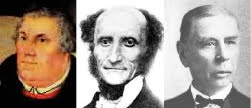
This continues from Part BWC3f in a series (Table of Contents in Part BWC1) presenting Walther's edition of Baier's Compendium of Positive Theology. — This segment introduces Chapter V, Justification. While Synoptic Text Information Services and Dr. Jack Kilcrease focus on the the doctrine of the "Atonement", the Lutheran Confessions place "Justification" at the top. While these are closely related, there are differences. But the differences won't be found by asking the AI machines, which can be rather confusing, one must listen to truly Lutheran theologians. (Though Cambridge helps.) — From pages 240-258:
Notable Quotes: (Italics follow the original. All quotes not from Baier are from Walther's additions of quotes from third parties. Authors are indicated in bold text. Red text indicates my comments.)
[Chapter V. Of Justification]
240-241: Smalcald Articles (Luther): "From this article one cannot deviate or give way, even if heaven and earth should fall or whatever does not want to remain. …on this article stands everything that we teach and live against the Pope, the devil, and the world. [Trig. p. 461 & 463]
241: Apology of the Augsburg Confession: The Doctrine of Justification "which also principally serves for a clear and correct understanding of the entire Holy Scripture, and shows the way to the unspeakable treasure and the true knowledge of Christ alone, and also opens the door to the entire Bible alone"
%20crop2.jpg)
245: Meisner: "So true is that proverb of Luther's, which he used more than once: 'Justification is the article by which the church stands or falls.'" (…[Gospel Coalition (Reformed), Piepkorn; it was Walther before Piepkorn!])"
246: J. A. Osiander: "if he [man] has no righteousness, then he is not justified physically, but in a forensic sense, because he is acquitted, however guilty he may be."
248: Quenstedt: "the manifestation of accepted justification by good works, as Jas. 2:12: 'Abraham was justified by works.' Where the apostle is not speaking of that justification by which we are judged righteous by God, but of the showing and demonstration of faith by works, by which a man proves and declares to another that he is truly righteous and faithful."
251: B. Meisner: "The third kind is imputed or evangelical righteousness, which is not to be sought in us because of the depravity of nature…but outside of us." [I.e. "extra nos".]
252: Kromayer: "…justification will not admit of more or less, but will be equal for all believers, nor will it be acquired by degrees, but will be accomplished in an instant."
253: Quenstedt: "the Papists, who contend that the thing by which…man is justified…cannot be and is not called the imputed righteousness of Christ, but the infused habit of righteousness and love"
255-6: Dannhauer: "Imputed righteousness is by reckoning [λογισμῷ]… 2. a gracious λογισμός, according to grace; 3. a satisfactory λογισμός, whose foundation is the payment of a ransom [λύτρον] for us"
257: Kromayer: "however much the act of redemption was finally accomplished in the fullness of time, its fruit was nevertheless extended both forward [New Testament times] and backward [Old Testament times]."
258: A. Osiander: "I answer [the Papists]: The works of the law and of nature are not given, for they are mere sins, since they proceed from a bad tree and are therefore bad fruit (Matt. 7)"
.jpg "Robert Bellarmine")
258: Quenstedt: "Bellarmine [Catholic (Jesuit) theologian]…: ‘The common opinion of theologians is…that grace is a supernatural habit infused into us by God, by which the soul is adorned and perfected, and thus made just and pleasing and acceptable to God."
In the next Part BWC3h…

No comments:
Post a Comment
Comments only accepted when directly related to the post.