Search This Blog

Tuesday, August 2, 2022

Excursus: Walther reviews Gräbner's book on Luther; no "nasty stains that spoil"

[2023-09-12: added note below on WELS pastor's English translation.]
      This is an "excursus" to follow a Der Lutheraner essay on the life of Prof. A. L. Gräbner (Part 3c).  Here we present an English translation of C. F. W. Walther's book review of Graebner's book on Luther's life Lebensbild des Reformators den Glaubensgenossen in Amerika or Portrait of the Reformer's Life to Fellow Believers in America. Walther's comments are instructive for us today as he distinguishes what makes a good biography of Luther vs. what does not. The year was 1883, the Jubilee year of the 400th anniversary of the birth of Dr. Martin Luther. Many books were published on the Reformer for this occasion, but Walther's short article explains to us the distinction in the quality of these books.  — Graebner's book is a perfect complement to Pastor Hermann Fick's wonderful book of Luther from  1869. From Der Lutheraner, vol. 39 (1883), p. 120:
- - - - - - - - - - - - - - - - - - - - - 

Dr. Martin Luther. Portrait of the Reformer's Life to Fellow Believers in America Drawn by A. L. Gräbner. Milwaukee, Wisc. Published by Geo. Brumder. 1883.


Legion is the name of the Luther jubilee writings that have already appeared this year. Among them, the descriptions of Luther's life undoubtedly take the first place. The really good ones of these Luther biographies are, however, unfortunately, only a very small number. Apart from those in which a thoroughly false picture of Luther is sketched, many of the better ones also contain nasty stains that spoil the beautiful picture sketched. This is not the case with the picture of Luther which our dear friend and brother Gräbner, professor of theology at the seminary of the Wisconsin Synod in Milwaukee, has "drawn for the fellow believers in America. Among the few good ones, the same is indisputably the best, not only from this year, but also from this century. It is true that, as he himself openly admits at the beginning of his work, he has consulted and used in his work what has been written before him about Luther's life, namely the relevant work of the United [Prussian Union] professor Dr. [Julius] Köstlin, which is mostly based on thorough source studies; however, as not only Prof. Gräbner testifies, but as the comparison irrefutably shows, this has always been done “with the preservation of an independent judgment”. In short, whoever wishes to have a new, more detailed Luther biography, which presents the true Luther correctly in all aspects, we can only recommend Gräbner's biography urgently. The research of many only now discovered documents has spread a light over many things concerning Luther, over which a certain darkness was hovering until now. Therefore, the work of Gräbner is not dispensable by any older writing of this kind. May therefore the stupendous faithful diligence with which it has been worked out find its richly deserved reward at least in the fact that many hands reach for it and many hearts are strengthened by it in the faith in the truth which God, through His chosen armament, drew Luther out of God's Word into the light again four and a half hundred years ago. May especially all Lutherans within our orthodox Synodal Conference, from whose midst the work has sprung by God's grace, recognize and faithfully use the gift that He has given them above all. The publisher has delivered more than he promised. He had promised the completion of the work only for the month of October; but to our great joy, it is already available in its entirety, and, worthy of the excellent content, excellently equipped, both in terms of type, paper and binding. Forty-eight beautiful illustrations adorn the text. With a volume of 543 pages, the price of $2.50 is a very modest one. May the Lord Himself make way for the book to find entrance into many Lutheran homes and to bestow the richest blessings for time and eternity. W. [Walther]

- - - - - - - - - - - - - - - - - - - - - - - 
Walther's statement that even the better Luther biographies "contain nasty stains that spoil the beautiful picture" strikes against many of the volumes of the CPH American Edition of Luther's Works, even the so-called "New Series".  More will be said about this later.  Also Walther mentions the name of the Dr. Julius Koestlin, the well known German historian of Luther, and reveals that he was a professor of the unionistic "Prussian Union". Walther clearly places Graebner's historical judgment over Koestlin's.  Today LC-MS scholars routinely place erring German theologians over the Old Missouri's historians.  Perhaps the LC-MS might want to take the words "Missouri Synod" out of their name? 
       Fortunately I do not have to translate this book into English since Pastor Waldemar D. Loescher has already done this 8 years ago in 2014, and the Wisconsin Synod offers a free download on their "Essays" download website. [2023-09-12: Available in Kindle format here.: By God's Grace The Life of Dr. Martin Luther 1483-1546] — In the next Part 4a of the Der Lutheraner series, we publish a review of another excellent book, this time one by Franz Pieper.

Saturday, July 30, 2022

DL3c: A. L. Gräbner—a prince in the realm of knowledge

      This concludes from Part 3b (and an Excursus) (Table of Contents in Part 1) in a series presenting Der Lutheraner, 1888-1934, in English. — The wide range of knowledge that A. L. Graebner, the third editor, possessed is astonishing.  I counted a dozen fields of knowledge from this history. But his writings showed that he used them all only in the service of his theology.  From Der Lutheraner, vol. 76 (1920), p. 5-8 [EN]:
- - - - - - - - - - - - - - - - - -

August Gräbner.

When Gräbner was a student at the high school in Fort Wayne, he was hindered many times by eye weakness and missed many classes. What he missed then, he later caught up with by iron diligence, given his excellent talent, and overtook others who were formerly ahead of him. After graduating from the seminary at St. Louis, he served as a teacher in the Lutheran college at St. Louis, and later in the college and seminary of the Wisconsin Synod at Watertown and Milwaukee, Wis. In the year of Walther's death he was appointed professor of theology at the St. Louis seminary. He was well equipped to do so, possessing thorough knowledge in all branches of theology. At the meeting of the Synodical Conference in 1886, the last one that Walther attended, Gräbner had the presentation. After he had given his lecture on inspiration, which was exhaustive of the subject, Walther remarked that the lecturer had dealt with the matter so exhaustively, having anticipated everything, absolutely everything, so that nothing remained for others to add; and he [Walther] really only pointed out the deviations from the pure doctrine in the writings of some German theologians in modern times.

Gräbner was a man of self-control and cool calmness; he had a distinguished appearance and was also a prince in the realm of knowledge. If, according to a published outline, theology is the queen to whom all sciences are subservient, [p. 7] the theologian Gräbner was rightly, and not without success, anxious to seize the territory subservient to his queen. He was at home in the field of philosophy, mathematics, the old and a whole number of new languages, literature, history; he was also at home in the more distant fields of jurisprudence, natural sciences, medicine, and he was also no stranger to the field of art, music, painting and poetry.

Gräbner was called upon to fill the gap in the editorial staff of the “Lutheraner” caused by Günther's death. Under his editorship, the “Lutheraner” celebrated its fiftieth anniversary. In preparation and introduction to it, Gräbner wrote a number of articles: “The beginnings of the ‘Lutheraner’ and what we can learn from it"; “The reception of the ‘Lutheraner’ once and now"; “The usefulness of the ‘Lutheraner’ once and now"; ‘The Lutheraner’ as a synodical organ The first number of the “Lutheraner” of September 7, 1844, was issued in exact replica with No. 1 of the 51st volume. 

"application of the divine Word to the life of Christians"

To him, too, the highly learned man, God's Word was the life element, the Alpha and Omega of his theological thinking and judgment. He made especially the application of the divine Word to the life of Christians the subject of many “Lutheraner” articles. Looking far and wide, he surveys the rich organization of Christian life in its various ramifications, expressions and relationships, and examines them against the yardstick of divine truth. He generously lets appear whole series of articles, articles which, if necessary, complement each other, interrelate with each other and together form a whole. These series of articles, also dealing with contemporary conditions, are extremely rich in teaching, admonition, warning and consolation for the edification of the church. As a master of language, he finds the expression corresponding to his thoughts, the representation suitable for his purpose. The stream of his speech flows majestically, full and deep and yet clear and transparent like crystal. Thus, in a series of articles, he treats the Christian's relationship to God's Word: Of the right fear of God's Word; of the right love for God's Word; of the right trust in God's Word. In 1893 and 1894, he examines the life of a Christian in civil relations and in relation to the world: Of incurring debts frivolously; of saving; the A. P. A. (American Protective Association); women's rights; on corpse burning; of striking; on the labor question; in the world, not of the world, etc. Then in 1895 follows the precious series of articles from Christian Church Life: The local Christian congregation; the establishment of a Christian congregation; of public worship; the Christian congregational school; the doctrine and practice of our synod; of congregational meetings; baptism and confirmation; the care of confirmed youth; church charity; of bequests for church purposes; the church magazine. Stöckhardt and other colleagues of Gräbner contributed to this series of articles: on the establishment and maintenance of the public preaching ministry; Christian teaching; the parish council; private pastoral care; confession; church discipline; church missionary activity; the synodical community. — The Lord of the Church called Prof. Gräbner to heavenly rest on December 7, 1904, after a long period of infirmity from diligent, blessed work. ——————

The three dear men of great merit to the Church, Walther, Günther and Gräbner, have gone to the rest of God's people. They have devoted a considerable part of their lives to the care and work for the “Lutheraner”; [p. 8] they have laid down and left behind in the columns of the “Lutheraner” an inestimable wealth of Christian teaching and experience for the edification of God's Church — useful and necessary not merely for the days gone by, but also for the present. Blessed is he who knows how to lift up this treasure!

May the Lord our God be with us, as he was with our fathers! May the course of the “Lutheraner” be a blessing also in the future!                                                                    J. S.

- - - - - - - - - - -  End of essay; series continues in Part 4a  - - - - - - - - - - -
I was surprised that A. L. Graebner was the actual author of the "breathtaking" 1886 essay to the Synodical Conference that defended the pure doctrine of the Inspiration of Holy Scripture. I had thought that because Walther was present that he at least delivered a portion of it. But the above history reports that Walther's only involvement was to show the "deviations from the pure doctrine in the writings of some German theologians in modern times." Nevertheless we get confirmation that Walther heartily approved of Graebner's work. I would invite the reader to read, or reread, that presentation of A. L. Graebner because of its thorough coverage of this contentious doctrine even today, even within the LC-MS. May the name of A. L. Graebner be forever blest because of this essay. — It would certainly have grieved Prof. Graebner that his own son Theodore would so dramatically cause division within the Missouri Synod! — In the next Part 4a, a review of a very special book of Pieper's essays in English. But first, another Excursus publishing Walther's book review of Graebner's great biography of Luther.

Wednesday, July 27, 2022

Guenther's Walther, A Life Portrait, now in English (A BTL book)

      This is an "excursus" to follow a Der Lutheraner essay (Part DL3b, Table of Contents in Part 1) on the life of Martin Günther.  In it we publish Guenther's 1890 German language book Dr. C. F. W. Walther: Lebensbild, a biography of C. F. W. Walther, in English. Guenther was the editor of Der Lutheraner during the last 14 years of Walther's life.  He would have worked closely with Walther as editor and fellow professor at Concordia Seminary.  And he was one of Walther's earliest students.  When I translated and polished the text of this book, I was quite surprised at its quality, details, and spiritual insight. It brings to light the life of the father of the Missouri Synod.
Notable excerpts:

6: "God did not want him to become a musician,… worked in him the decision to choose theology"

15: "the High Consistory forbidding him to continue teaching the doctrine of man's natural perdition,"

17: "'I sometimes argued with my principal about whether everything in the Bible was reliable, divine truth'"

24: "He was under a godless rationalistic superintendent,… unbelieving and hostile village schoolmaster,… Walther was repeatedly put on trial"

31: "…forbidden to practice confession, to suspend even the most unrepentant people…, 'such preachers in Saxony who did not even baptize in the Trinity'"

32: "How gladly the Lutheran preachers and laymen would have … separated from the deeply corrupt apostate national church!… Therefore, they saw emigration to a country where religious freedom prevailed as the only way out of the increasingly unbearable oppression of conscience, "

32: "…, the above-mentioned pastor in Dresden [Pastor Martin Stephan] called on all Lutherans, …, who were under pressure of faith, to emigrate"

44: Walther"… immersed himself, as far as his weakness allowed, in Luther's and other fathers' writings"

46: Altenburg Debate: "…was the Easter Day of our hard-trodden congregations, where they, like the disciples of old, saw the Lord again"

54: "…if anyone believes that priestly rule still exists in our congregation, he should … read the statutes of our congregational order"

55: "Walther expressed the wish: 1. that the name of the church not be that of a man"

62: "God had led them out of dangerous, Romanizing teachings [to]… Lutheran doctrine of church, preaching ministry, [or]… lost forever"

63: "But now the time came when Walther's effectiveness was to extend into the widest circles…to publish a leaflet … ‘Der Lutheraner’"

65: "A first, a main fruit of the "Lutheraner" was the formation of the German Lutheran Synod of Missouri, Ohio, &c. St."

69: "How much light was shed on church and ministry, especially by Walther!… a synodical association… only a consultative power,"

70: "…far from diminishing the congregation's rights, sought rather to preserve them"

74: "Walther was intent on publishing a new Lutheran hymnal… the main consideration in selecting [hymns] was that they be pure in doctrine…"

77: "…the writers of our daily papers,… have mocked with impunity that there are still people in our city who believe in a God"

83: "On festive occasions… nothing to be seen or heard of insipid merriment or mere carnal gaiety… occasional jokes" [There were indeed "jokes".]

86: "The Romanizing Lutherans of America, to whom Walther referred… were Pastor Grabau…"

87: "…a protest against the assertion of hierarchical principles within the Lutheran church"

89: "For Löhe [or Loehe] and his friendstook a wrong, Romanizing direction.… a doctrinal difference between Pastor Löhe and our synod

90: "Prof. Walther declared that he had no pleasure in traveling to Germany as a delegate of the Synod."

93: "In Erlangen, Walther met his childhood friend Dr. Delitzsch"

93-94: "a friendly relationship [with Loehe] was only temporary… [for him] the confessional writings … did not have such a unifying power"

94: Walther: "…that one could always get cheap and good Bibles that contained the correct Luther text"

94: 1853 Synod: "…[Der Lutheraner's] style of writing would henceforth be adapted to the capacity of the people even more than it had been before"

98: "in 1854 — as an opposition synod — the Iowa Synod came into being, to which Löhe wanted to assign his disciples"

99: Iowa Synod: "strive for further development of the doctrine…church and ministry, to be 'open questions'"

99: Iowa: "a result of these chiliastic views, they denied… that the pope was the Antichrist." [just like today's LC-MS]

100: 1855 Walther on Iowa Synod & Loehe: "having gained prestige in the church through their former faithfulness, want to use this prestige to lead us away from it again. Here we mean men like Löhe."

106: Walther on Missouri Synod: "It is a return of the days of our [Lutheran] fathers and of Acts. 2"

114: "denying church fellowship to the Iowans for the sake of a difference in the doctrine of Antichrist"

118: "the formation of the 'Evangelical Lutheran Synodical Conference'"

121: In 1872 "Walther laid the foundation for the 'English Lutheran Conference of Missouri'

129: Walther refused honorary doctorate from German university: "'I would feel a crowned ass…' [erring] doctrinal position of Göttingen faculty."

130: "the … Synod of Ohio … to confer the title of Doctor Theologiae on Professor C. F. W. Walther"

146: Walther in 1881: "Do not think that I am a mere head scholar. Already 50 years ago [c. 1831], by God's grace, I came through a long and heavy anguish of my heart to the realization of my sinful end and thereupon to the knowledge of the truth.

148: "nothing that has been brought forward against our teaching has been able to convince me of an error. My conscience is caught in God's Word"

149: ""it is not right to say: 'I am chosen because I believe', but that one must say: 'I believe because I am chosen'."

162: Walther's and his sermons: "memorized most diligently until he went to church"

165: Delegate Synods: "these dear, good men… have been sent as representatives of the congregations" [Old Missouri sent only men]

166: Walther's visits to sick young girl: she "finally looked forward to her death with great joy"

172: "For the books he published he took not a cent in remunerationflourishing of the 'Concordia Publishing House'."

175: "… he was able to amuse society with a fine joke, not with jokes that were inappropriate for Christians, but… within the bounds of godliness."

176 & 179: "Walther did not, as some do, have a particular favorite doctrine, but all doctrines, and that from their center, the doctrine of justification." <——> "Again and again Walther returns to justification by faith alone."

180: "He knew Luther's writings exactly…excellent instructions for the study of Luther's writings"

181: "This gift served him well in the … defense of doctrine, in disputations, in religious discussions"

182: On usury question, "… he could not depart from right doctrine even if the synod fell to pieces"

184: "In the Lutheran Synod of Australia, too, Walther is spoken of with high esteem "

196: "The center of his sermons as well as of all his addresses and writings is for him the Lutheran doctrine of justification"

228: Letter to Wyneken: "But, my dear Wyneken, now also recognize with gratitude that your wretched body and your mind, so often sunk in melancholy, are truly nothing other than the hallmarks of the Lord Jesus, so that you are adorned. I am confident that the song of defiance is also yours to sing: "I will not die, but live and proclaim the work of the Lord," Ps. 118" [Walther did not counsel his friend Wyneken, who was in a state of melancholy, to go to earthly counselors or psychologists or psychiatrists, like LC-MS pastors do. Old Missouri pastors certainly did not, and would not, use these modern "sciences" to counsel their congregational members!]
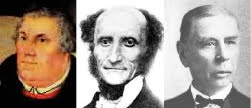

Now I present Guenther's authoritative history of Walther's life in English:
The text of this book may be downloaded here; the German original text is here. Google Book here.

LC-MS judgment of Guenther's book:
     Modern LC-MS historians, such as Walter Forster and Carl Mundinger, downgrade Guenther's history on certain "facts" and use terms such as "purely fictitious" and that Walther was an "extremely zealous Stephanite" and a "rabid Stephanite". Mundinger claims that Walther's "rabid Stephanism had gotten him into endless trouble with both the civil and the ecclesiastical authorities in Saxony", a statement which willfully ignores Walther's own testimony of how these "ecclesiastical authorities" fought against his orthodox teachings, as Guenther's history documents. But pure doctrine seems to matter little to today's LC-MS historians like Pastor Todd Peperkorn, making their "history" fictitious in places. The result, and the aim, of modern LC-MS histories is essentially that people should read their histories, the New Missouri's histories, not the histories by the Old Missouri Synod.  Dear reader, read Guenther's history and judge for yourself whose history is "purely fictitious" and whose is not. (Hochstetter's history is treated in the same way by LC-MS historians.) — We continue our series of blog posts on the publication Der Lutheraner and its writings in the next Part 3c.

Sunday, July 24, 2022

DL3b: #2 - Martin Guenther—"guarded pure doctrine"

      This continues from Part 3a (Table of Contents in Part 1) in a series presenting Der Lutheraner, 1888-1934, in English. —  How does one follow the great Walther?  We find here the man who did it admirably.  This history complements the memorial address that Franz Pieper gave at his "home going". You will find many writings in the "Lutheraner" of Günther with the signature of "G.".  From Der Lutheraner, vol. 76 (1920), p. 5-8:
- - - - - - - - - - - - - - - - - - 

Martin Günther.

Günther had entered the college at Altenburg and moved with it to St. Louis in 1849. He served the church forty years, twenty of which were in the pastorate at Cedarburg, Wis. and Saginaw, Mich. and Chicago, Ill. While still in the pastorate at Saginaw he wrote the excellent book, “Populäre Symbolik” [Popular Symbolics], which has won recognition and praise beyond the borders of our continent, even in Europe. His sermon was simple and straightforward, like his whole being and appearance, but at the same time it was textual, well-ordered, easy to grasp, rich in content and doctrine, lively and lively in its delivery. An former pastor who sat under his pulpit for years confessed: All the sermons that Guenther preaches are fit to print. He served the Synod of the then Northern District as secretary for six years, His lectures to the students were without pomp and state, matter-of-fact and soberly delivered, but dug from the depths, pure gold of doctrine, apt and clear, exact and sharp, concise and brief, reliable and certain. [p. 6] Not all of his listeners appreciated what was offered in an inconspicuous shell. 

"With a watchful eye, he guarded pure doctrine"

While still in the pastorate he had written many things for the “Lutheraner”: “J. Gerhard's Life", “Petrus Paulus Vergerius", “The Jesuits” and others; now, as a professor, he had to do the main work in editing the “Lutheraner”. The “Lutheraner” was then, as now, edited by the teaching staff of the theological seminary in St. Louis, and Walther, who continually took an active part by industrious writing, had the decisive word as founder of the paper, as president of the seminary, and from 1864 to 1878 as president of the synod, and in the last period of his life among colleagues, most of whom were his students; to Günther, however, fell the work of the actual editor. He introduced himself to the readers with the detailed Foreword to the 30th volume of the content: Where God's Word speaks, freedom ceases for a Christian, and where God's Word is silent, no compulsion applies. This was soon followed by discussions on Lutheranism and union, rebuke of false doctrine in periodicals, and so on. With a watchful eye, he guarded pure doctrine like the apple of his eye. In his articles he proves to be a reliable teacher of divine truth and a knowledgeable guide to the knowledge of the errors of the times. Clear in the pure doctrine, faithfully adhering to the recognized truth, resolute and unyielding against any error, no matter how glaring: this is the character expressed in Günther's articles. A respected father of the synod, who knew Günther well, once said that it was to be expected that Günther would write solid articles, but that he would know how to lead a newspaper for the Christian people with such skill and in such a popular manner was a joyful surprise for him.

Günther, the modest, selfless man, was held in the highest esteem by those who were closest to him and knew him best. The president of the seminary, Dr. F. Pieper, gave expression to this esteem when he said at the coffin of the deceased: “He was characterized by a clear and sure knowledge of the pure Christian doctrine as it is testified in the confession of our church. He possessed in an outstanding degree the gift of distinguishing between right and wrong doctrine. And just as he was wholeheartedly devoted to pure, unadulterated doctrine, so he also shared with all serious and well-instructed children of God the characteristic of being heartily hostile to all falsification of wholesome doctrine. In this sense he worked in oral discourse and in writings and exerted a far-reaching influence on our Synod and the Church in general. It is true that his effectiveness was more silent. He rarely took the floor in public church meetings. But it was given to him before others to testify in clear, concise written expression to the saving truth and to refute error. Thus God made him a blessing to the church through years of editorial work, especially on the ‘Lutheraner’.” And his pastor, Dr. C. C. Schmidt, confessed in Günther's funeral oration: “What he taught, he also lived. That is the good testimony we must give to the deceased.”

After a sermon preached on Whit Monday morning in 1893, Günther was suddenly called away from his blessed ministry as a result of a stroke. “In the midst of his work, and indeed from the occupation which had always remained his dearest, from the effectiveness of a preacher of the Christian congregation, and in his workroom, in which he was accustomed to spend most of the hours of the day and night, and without having felt the nearness of death, tasted the bitterness of death, he has been called home to the rest of the accomplished, to the eternal holiday of the faithful servants of God.” The man who wrote this succeeded Günther on the editorial board:

- - - - - - - - - - -  Concluded in Part 3c  - - - - - - - - - - -
It is Guenther's quality of "heartily hostile to all falsification of wholesome doctrine" that gradually, almost imperceptibly, began to fade from the pages of Der Lutheraner after the turn of the century. That is what separates the Old Missouri from the LC-MS. I invite the reader to read the address of Pastor C. C. Schmidt, the "prince of preachers',  on Guenther. I did. — In the concluding segment Part 3c, our historian gives details on A. L. Gräbner that perhaps some may not have known. But before that, we insert an Excursus to present Martin Guenther's book about the life of C. F. W. Walther.