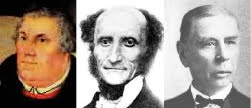
This continues from Part BWC1 in a series (Table of Contents in Part BWC1) presenting Walther's edition of Baier's Compendium of Positive Theology. — This post presents some highlights that I noted while polishing the translated text. In other words, what jewels did I uncover? These quotes are among those which Prof. Krauss judged that were added with "such astonishing dogmatic meticulousness".
Notable Quotes: (Italics follow the original. All quotes not from Baier were from Walther's additions.)
XXII: On Acts 15:2: "it is not enough in the church, if we strive to lead or move men to the exercises of piety … rather chose to enter into and sustain a considerable dispute."
3: Baier: "…we do not concern ourselves with the different kinds of pagan theology, full of lies and impious superstitions".
9: Baier: "the end of natural theology is rightly said to be to render man inexcusable, and to lead him gradually to supernatural theology"
16: Luther: "a person to whom the law is presented soon says, 'Yes, it is so; I cannot deny it.' You could not so quickly persuade him otherwise, unless it had first been written in his heart"
20: Chemnitz: "Natural knowledge must be subordinated to divine revelation in the Word; so that, wherever it disagrees or conflicts, the natural must yield to the divine"
25: Cicero: "yet all believe that there is a divine power and nature"; "It is innate in all, and as if engraved on the mind, that there are gods."
29: Flacius: "Sciences are most commonly taught in a threefold order: by synthesis or composition, as they are made; by analysis or resolution, as they are applied to use; and finally by definition and division, how they can be understood most briefly and most quickly. . . Theology is most conveniently taught by synthesis…"
31: Ovid: "We strive for the forbidden and always desire what is denied."; "What is permitted is unwelcome; what is forbidden burns more acutely."; "I see better things and approve them, I follow worse things." [Walther masterfully quotes the pagan philosophers who spoke from what Baier calls "a certain supernatural divine revelation".]
34: Calov: "…science is cognition that is evident and perfect; which likewise does not entirely apply to theology, whose knowledge is rather non-evident, since it deals not with ἐπιστητά or knowable things, but with τὰ πιστά or believable things, and thus its mysteries are to be believed, not known; it commands reason in its cognitions to be taken captive".
35: Antithesis: Kahnis: "Theology is the scientific self-awareness of the Church".
35: Baier: "…revealed theology, in the principal articles of Christian doctrine which are called mysteries, draws its conclusions from divine revelation alone, which is naturally not self-evident."
37: Meisner "after comparing the theologian with the physician, he says that the internal end of theology is the theological healing, or working for the salvation of man".]
41: Baier: "faith in Christ is also rightly counted among the causes of salvation…Not, however, in itself and absolutely considered…but in relation to the object, which is Christ the mediator." [Baier clarifies this point, as he should. Walther backs this up with quotes from Gerhard and Quenstedt.]
46: Smalcald Articles: "The Papists cite Augustine and certain Fathers who have written about purgatory… We have another rule, namely, that the Word of God establishes the articles of faith and that no one else, not even an angel, does so."
50: Hollaz: "Some fundamental articles of faith are read ρητως or in explicit words in the sacred writings; some are contained in the sacred Scripture only διανοητικώς (intellectually) …which are perceived from it by a manifest and immovable consequence"
50: Luther: "It is certain, whoever does not rightly believe one article or will not (after he has been admonished and instructed), certainly does not believe any with earnestness and true faith…For all heretics are of this sort: first they begin by denying just one article…"
51: Luther: "Thus in theology, a small error overturns the entire doctrine. Therefore, doctrine and life must be kept as far apart as possible"
In the next Part BWC1b we continue with Notable Quotes from Volume I.

No comments:
Post a Comment
Comments only accepted when directly related to the post.