Search This Blog

Sunday, October 20, 2019

Gerhard Forde denies Gospel – "corrupt tree", attacks Vicarious Satisfaction (Part 1 of 2)

[2025-04-24: updated several links; 2019-12-15: added note on Kilcrease at bottom in red.]
Who is Gerhard O. Forde? († 2005)
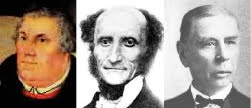
Gerhard O. Forde, images from 1990 book "Theology is for Proclamation", and from latter year      As Wikipedia reports, he was a pastor and professor in the American Lutheran Church and the later ELCA

What did Prof. Forde teach?  
      One needs to read no further than the following statement from his 1990 popular book Theology is for Proclamation, p. 119, under subsection "Atonement Theories":
“…theological theories about atonement do not bring about actual reconciliation. A construct, for instance, like vicarious satisfaction, taken to mean that God in the abstract is somehow moved objectively to change from an attitude of wrath to one of mercy or love by the sacrifice of Jesus on the cross, always creates more problems than it solves.” (emphases mine)
Essentially Prof. Forde taught that the "vicarious satisfaction" worked by Christ on the cross was, in his own words, a "theological theory", a "construct" which "creates more problems than it solves".  —  I remember very well reading Franz Pieper's Christian Dogmatics as I was returning to my Christian faith, how those terms "vicarious" ("substitutionary"), and "satisfaction" (the effect of appeasing God's wrath against all the sins of all men), translated me into heaven.  It perfectly summarizes the Gospel as found in 2 Cor. 5:19 and many other passages.
      Prof. Forde also taught on many other theological subjects in his writings.  But Christ said:
A good tree cannot bring forth evil fruit,
            neither can a corrupt tree bring forth good fruit.
Matt. 7:18
Prof. Forde's theology is a "corrupt tree", because it calls the Scriptural Gospel a "construct", a "theory" that "creates problems".  To question the Gospel as a teacher is more dangerous than an outright denial of it, for it can deceive those weak in the faith. All of his theology, therefore, whatever he teaches with this "theology", is suspect or confusing at best, faith destroying at worst. — 
      I am certainly not the only one warning against Forde's apostatizing doctrine against the Gospel:
(1) Prof. Kurt Marquart († 2006), in his 1977 book Anatomy of an Explosion ($4.99), compares Forde with German theologian J.C.K. von Hofmann:
  • p. 39: "Von Hofmann, who replaced both inspiration and the atonement with a curious 'Law/Gospel' brew of his own, is today being rediscovered by anti-traditional Lutherans in America." [i.e. Forde]
  • p. 101: "Both Walther and Pieper, as we have seen, protested most vigorously against… von Hofmann, who denied not only verbal inspiration, but even Christ’s sub­stitutionary atonement. Hofmann’s radically unorthodox approach was recently, and most warmly, again commended by ALC theologian Gerhard Forde!"
(2) Dr. Jack Kilcrease, (*) in his 2012 CTQ essay "Gerhard Forde's Theology of Atonement and Justification: A Confessional Lutheran Response", presents a scholarly review of Forde's theology, with warnings:
  • p. 282: "Forde's rejection of the confessional Lutheran understanding of atonement also causes a significant deviation from the historic Lutheran teaching regarding justification."
  • p. 284: Forde's "description of justification is in total disagreement with the confessional and biblical authorities".
  • p. 285: Forde "considers the idea of vicarious satisfaction to represent a mere 'abstract payment'".
  • p. 286: "Forde quite specifically attacks the idea of a purely forensic justification".
According to the 2019 LCMS Convention Workbook, p. 95, Dr. Kilcrease is on the LCMS CTCR commission until 2022.
       OK, so it is agreed that the theology of Gerhard Forde is very dangerous and should be avoided at all costs among Lutherans… right?  This is true even when Forde's theology is common today, even in external Lutheranism.  Forde's theology is not even worthy of reporting on this blog – the world is filled with his "corrupt tree" theology.  So why do I make a point of it?  Oh, but it is not so in today's LCMS.  That Forde's theology is boldly taught in today's LC-MS (also Dr. Kilcrease's synod) is demonstrated in the next Part 2.
- - - - - - - - - - -
2019-12-15: Dr. Kilcrease has added 2 more items to his defense of "substitutionary Atonement": (1) his 2018 book The Doctrine of Atonement: From Luther to Forde (Wipf & Stock, 2018); and (2) his 2018 CTQ essay "Johann Gerhard, the Socinians, and Modern Rejections of Substitutionary Atonement". Both give a scholarly review of even more erring modern theologians and a generally good defense of the "substitutionary atonement".

Saturday, October 19, 2019

Fundament 9: Synergism 3: Saints & Fathers?; Rick Warren's Decision Theology… and Peter Drucker?

      This continues from Part 8 (Table of Contents in Part 1), a translation of Franz Pieper's essay on the foundation of the Christian faith ("Das Fundament des christlichen Glaubens"). — I recall reading Luther about Saint Bernard years ago and wondering about this ancient Father.  Luther always saw where their faith was, even through their weaknesses.  How comforting to hear that the Reformer never demoted the ancient Fathers but only complained, about these weaknesses, "up to them", not down on them. Pieper teaches exactly the same way as Luther did in this installment. I learned here that even the usually strong Chrysostom had some weaknesses.  Although he does not do it here, Pieper even raises Copernicus's name, even with his weakness on his "science".
= = = = = = = = = = = = = = = = = = = = =
Text preparation and translation by BackToLuther using DeepL, Google Translate, Microsoft Translate, Yandex Translate. All bold text is Pieper's emphasis. All highlightingred text, and most text in square brackets [ ] is mine.

The Foundation of the Christian Faith.
[by President Franz Pieper, Concordia Seminary; continued from Part 8 - page 104]

When Erasmus, for the protection of synergism, pointed out that such people, whom Luther also regarded as “saints”, had taught human “free will” in matters of salvation in their speeches and writings, Luther explained these thoughts in his writing De Servo Arbitrio [The Bondage of the Will or “Bound Choice”]: The saints are completely different people “inter disputandum”, that is, when they speak or write in front of an audience, than when they step in a small room before their God, pray to God and deal with God. In front of an audience, they attribute to man a fortune to behave correctly towards grace (vim, quae ad gratiam sese applicat); But as soon as they step before God, they completely forget (penitus obliti) their own assets, despair of themselves, count themselves among the damnable sinners with all other men and cry out only for mercy (desperantes do scmet ipsis ac nihil nisi solam et puram gratiam longe alia meritis invocantes) and speak like Saint Bernard on his deathbed: “I have lived godlessly,”Perdite vixi.” And how does Luther explain this contradiction between theory and practice in the saints as well? This way: In the public debate, they would please people (verbis et disputationibus intenti sunt); for example, when it is necessary to assert an earlier position.

But as soon as they step before God, they completely forget (penitus obliti) their own assets, despair of themselves, count themselves among the damnable sinners with all other men and cry out only for mercy (desperantes do scmet ipsis ac nihil nisi solam et puram gratiam longe alia meritis invocantes) and speak like Saint Bernard on his deathbed: “I have lived godlessly,”Perdite vixi.” And how does Luther explain this contradiction between theory and practice in the saints as well? This way: In the public debate, they would [page 105] please people (verbis et disputationibus intenti sunt); for example, when it is necessary to assert an earlier position. But as soon as they step before God, their actual Christian attitude (affectus), which is still in them, asserts itself, according to which they not only do not praise their own good behavior, but even accuse their whole natural being of being hostile to God. 51) 

[Martin] Chemnitz has in his examination Concilii Tridentini the section “Veterum Testimonia de Justificatione”, 52) in which he proves that also such church fathers, who falsify the Christian doctrine of justification before the greater public and from the safe lectern (in declamatoriis rhetoricationibus and in otiosis disputationibus) by mixing it with one’s own works, forget all their own works and praise the sola gratia when they stand in front of God’s judgment seat in temptation and distress of death (quando in tentationibus et meditationibus quasi ad Dei tribunal sistunt).

Chrysostom and Basil speak synergistically in writings on the human will in conversion. The Formula of Concord 53) therefore warns against this talk: “As to the expressions of Chrysostom and Basil: Trahit Deus, sed volentem trahit; tantum velis, et Deus praeoccurrit, [‘We need only to will, and God has already come to us.’] likewise, the saying of the Scholastics (and Papists), Hominis voluntas in conversione non est otiosa, sed agit aliquid, that is, God draws, but He draws the willing; likewise: Only be willing, and God will anticipate you” and judges of these expressions, “they are not in harmony with the form of sound doctrine, but contrary to it, and therefore ought to be avoided when we speak of conversion to God.” But Chrysostomus is another man in his communion prayer. Gerhard 54) communicates this prayer, in which Chrysostom not only stands beside but also under a whore. Chrysostom prays: “As you did not push back a whore and sinner like me (similem mihi) when she came to you and touched you, so you wanted to be moved by the same affect of heartfelt mercy against me a sinner, when I came to you and touched you. And as thou hast not abhorred the unclean and despicable mouth of that with which she kissed thee, abhor not my mouth, which is even more unclean and shameful than the mouth of that sinner”. Likewise Basil is another man in his communion prayer, which Gerhard also communicates 55) and in which he says, among other things: “Accept me, Most Gracious Lord, as the whore, as the thief, as the tax collector, and as the prodigal son, and take from me the heavy burden of my sins, which thou bearest the sins of the world”. [page 106]
On this point, in the past and in our time, a more lenient 
-------------- 
51) Opp. lat. v. a. VII 166 St. L. XVIII, 1730. [Am. Ed. 33, p. 77]
52) Edition of Genevae 1667, p. 141 ff.
53) M. 608, 86. [Trigl. 913, § 86; BoC here]
55) Ibid.                

assessment of synergism has been pleaded. It was said and is said: “We admit, however, that no synergist, as long as Christian faith is still in his heart, asserts before God his different behavior or his lesser guilt or his omission of wanton reluctance, etc.”. But because there is the possibility of double-entry bookkeeping, that is, because it is possible that someone who teaches synergistically in public actually means the sola gratia in his heart and sits on the same bench of sins with others, synergism should be given a lenient treatment. On the other hand, it must be stated that the Formula of Concord requires that the recognition of the same guilt and the same evil behavior in comparison with other people is the teaching of Holy Scripture.

Scripture teaches: “There is no difference: for all have sinned, and come short of the glory of God; being justified freely by his grace through the redemption that is in Christ Jesus”. (Rom. 3:22-24) 

Then the “happy inconsistency” of such synergists, who believe better before God than they teach before men, can also easily turn into an “unhappy consequence”. It is very obvious that they seduce their own hearts, that is, begin to believe for themselves what they teach others, especially since self-righteousness and elevation above others are also in the flesh of Christians. That is, as we heard from Luther, the “sorrowful secret deceit” through which also “the greatest saints” have fallen, “that is why Christ himself holds it before the apostles”.  And what confusion such people have caused in the Christian church by teaching the different behavior and the lesser guilt, even without believing these things themselves! We see this in Melanchthon, who through his synergistic speeches plunged the Lutheran Church into a thirty-year struggle. For this reason the Lutheran Church truly had cause enough, in its Formula of Concord, to sweep out so thoroughly in Melanchthon and his followers the doctrine of a different behavior and lesser guilt, and so enormously put the doctrine of Scripture back on the lampstand: “There is no difference”: those who become saved, when they compare themselves with those who are lost, must in their turn recognize the same guilt and the same evil behavior. Also in the American Lutheran Church there was a tremendous onslaught, which restored the different behavior and the lesser guilt in the doctrine of conversion and election of grace again. If the entire American Lutheran Church had yielded to this onslaught, which was also generously supported from abroad, there would be no faithful Lutheran Church in the United States at that time

The Church still calling itself Lutheran would have abandoned the sola gratia and thus the foundation of the Christian faith against the protest of Holy Scripture and against the protest of its confession. For only this is Christian faith, “which relies on grace alone”. 57)    F.P.    
-------------- 
57) Apol. M. 97. [according to German text; Trigl. 187, § 55; BoC here: “the promised mercy”]
= = = = = = = = = =  continued in Part 10  = = = = = = = = = =
Rick Warren's book, "The Purpose Driven Life"

      Synergism rules in much of American "Protestantism".  Pastor Rick Warren's The Purpose Driven Life has flooded the Christian book stores in recent years, selling many millions.  This book clearly bases its thrust on Billy Graham's "decision theology" – in other words, the poison of Synergism. Below is a set of quotes that drives home the point:
p. 84: “When you decide to live a totally surrendered life…” — 137: “You become a Christian by committing yourself to Christ” — 177: “You must make a counter-culture decision to focus on becoming more like Jesus.” — 179: “The process of becoming like Christ always begins with a decision” — 177: “When the first disciples chose to follow Jesus,…” 
This last quote of Pastor Warren is so striking, for it explicitly refutes what Christ said to His disciples:
        Ye have not chosen me, but I have chosen you. — John 15:16
According to the Wikipedia article on him, Pastor Warren is Southern Baptist and "considers Billy Graham, Peter Drucker and his own father to be among his mentors".  The name of Peter Drucker is significant and he will come up again in the next sub-section of my series on Pieper's Das Fundament book, on the Means of Grace, beginning in the next Part 10

Sunday, October 13, 2019

Churchman 3: Against Romanizing; invisible Church; one True Visible Church; Local Congregation

      This continues from Part 2 (Table of Contents in Part 1), a series presenting Ludwig Fuerbringer's 1936 essay "Walther as Churchman". — Several of the Walther's major writings are highlighted in this segment.  These shook up the erring Lutherans worldwide, including those in Germany.  Several missionaries left the well-known Leipzig Mission because it would not recognize Holy Scripture for what it is… God's Word (not man's word). Fuerbringer lists some of the names of those who left for the Missouri Synod.  Some notable names were not mentioned and I will reveal these after the narrative below.
= = = = = = = = = = = = = = = = = = = = =
Original German essay in CTM, vol. 7 (October, 1936), p. 721-730full text here. Text preparation and translation by BackToLuther using DeepL, Google Translate, Microsoft Translate, Yandex Translate. All bold text is Fuerbringer's emphasis. All highlightingred text, and most text in square brackets [ ] are mine.

Walther as Churchman.
[by Ludwig Fuerbringer; continued from Part 2]
Walther's activities and merits as a churchman then found further expression in three main writings, the importance and meaning of which must never be forgotten, and the content of which should also become flesh and blood in our ministry and far-flung congregations in the so-called “New Era” and in the English language. These are the writings: “The Voice of our Church in the Question of Church and Ministry” of 1852, repeatedly published, last in Germany in 1894; furthermore “The Evangelical Lutheran Church, the True Visible Church of God on Earth", first presented as a synod paper in 1866 and then published in book form; and “The Proper Form of an Evangelical Church Independent of the State” of 1852, which was last published in Germany in 1894. If the first writing is mainly dogmatic in content, the second is, so to speak, a continuation; but the third is thoroughly practical and shows the proper application of the right doctrine of Church and Ministry
The significance of the first-mentioned <page 725> writing in the time in which it appeared can hardly be overestimated. On the then very controversial questions: What is the Church? What is the Ministry? this writing was positively enlightening against all high church, romanizing views, as they were represented in Germany by leading theologians and in America especially by Grabau and the Buffalo Synod founded by him. Of the Church, the first of the nine theses said: 
The Church in the proper sense of the word is the congregation of saints, that is, the totality of all those who, through the Gospel, are called out of the lost, damned human race by the Holy Spirit. And of the preaching office [or preaching ministry] the seventh of the ten theses said: “The holy preaching office is the power conferred by God through the congregation as owner of the priesthood and of all ecclesiastical authority to exercise the rights of the spiritual priesthood in public office of the fellowship”. 4) 
        Zorn      —     Willkomm
It is perhaps not generally known that this writing had the approval of such distinguished Lutheran theologians as Harleß and Guericke and that the Leipzig Mission Director Hardeland warmly recommended this essay to the pupils in the Leipzig Mission House, among whom at that time were Zorn, Willkomm und Zucker, so that they would be able to come out of the confusion. 5)
———————
4) Kirche und Amt [Church and Office], p. 1, 354. [2nd ed. 1, 315; English: The Church and The Office of The Ministry CPH 2012, M. Harrison, translator; Church and Ministry, CPH 1987, J.T. Mueller, translator.]
5) I know this from Zorn's and Zucker's personal communications, and Willkomm also published it in the “Ev.-Luth. Freikirche”, 52,125. This was the first word heard about Missouri by these three men, who were all later led to Missouri.
———————
To justify the second writing, Walther said at the 1864 Synod Convention that we 
“had so far been compelled chiefly to advance the doctrine of the invisible Church as the congregation of saints, as the one holy Christian catholic church, and to resist the error that the visible Lutheran church was the one holy Christian church. For the sake of this struggle, we have often been regarded and suspected as such who are held low by the true visible Lutheran Church and who are of a united mind, as if we were indifferent to which visible church fellowship one belonged. Now that battle is victoriously fought, God be praised!, in that in recent times no one dares any more to publicly describe the visible Lutheran Church as the one holy Christian Church, except for which there is no salvation; even Pastor Grabau had for a long time not pronounced this as bare and decisive as he had done before. So, in order to overcome that misunderstanding, as if we had nothing to do with the true visible Church, as if all the church fellowships were of equal value to us, we should now go to work with joy, to also discuss  <page 726> the doctrine of the Evangelical Lutheran Church as the true visible Church of God on earth from Holy Scripture and from the confessions of our Church together and to reproach ourselves for the purpose that we are not only certain of it, but will also be glad that we are not members and servants of a false but of the right church, building on the right Zion”. 6) 
And then Walther shows clearly and in detail in this essay that the Lutheran Church really celebrates the true visible Church. This essay was reprinted in 1920.
———————
6) Twelfth and Thirteenth Synod Reports, 1864 and 1866, p. 39, 40.
———————
In particular, the third essay should either be translated into English or presented in free English to the present generation; for Walther, after preliminary remarks on the concept of an Evangelical Lutheran local congregation independent of the state, treats them in these three chapters: “Of the rights” of such a congregation, “of the duties” thereof, and “of the exercise” of such rights and duties. The third chapter is the main chapter and is divided into seven sections: 
“1. Of the church assemblies. 2. the exercise of the duty of a congregation, to take care that the Word of God dwells abundantly among them and goes forth as prevalent. 3. the exercise of the duty of a congregation to care for the purity of doctrine and life and to discipline its members in relation to both. 4. the exercise of the duty of a congregation to also take care of the earthly life of its members. 6. to take care of the exercise of the duty of a church to be orderly and honest in everything it does. 6. the exercise of the duty of a congregation to work diligently, in the bonds of love and peace, also with the orthodox Church besides her of unity in the Spirit. 7. the exercise of the duty of a congregation to help in its part so that the Church may be built and promoted as a whole”. 7)
———————
7) Die rechte Gestalt, p. IX. [CPH translation: The Proper Form…]

= = = = = = = = =  continued in Part 4  = = = = = = = = =
Theodore Naether, Franz Mohn: missionaries to India from Old Missouri Synod
Others Who Left for Walther's Church
      Fuerbringer did not include later German missionaries who left their German church bodies, ones who came during the time of Franz Pieper's tenure as the head of the Synod and/or the Seminary.  Along with Zorn, Willkomm, and Zucker were Theodore Naether and Franz Mohn.  A brief history of them is properly being highlighted by Concordia Historical Institute (CHI) in their MELIM page (*).  Unfortunately those men, if they were to rise from their graves, would testify against CHI's LCMS on its sorry defense of the Inspiration of Holy Scripture.  They staked their spiritual lives on Walther's and Pieper's teaching.

Language Looms on Missouri's Horizon
      Fuerbringer touches on the issue of transitioning from the German to the English language and appears to appeal for more work to be done on this for the rich treasures in Walther's writings so that the laity may read from him.  What puzzles me is that he did not do any of Walther's major writings himself.  Nor did he perform translations of any of Pieper's books.  —  In the next Part 4