Search This Blog

Thursday, September 12, 2019

Fundament 2: Unitarians; American classic literature; Lodges

      This continues from Part 1 (Table of Contents in Part 1), a translation of Franz Pieper's essay on the foundation of the Christian faith ("Das Fundament des christlichen Glaubens"). —  Pieper begins with those who practically admit that they are not Christians – the Unitarians.  And he reveals just how widespread this belief is among Americans, then and now.  They are in our heads, in our reading…
= = = = = = = = = = = = = = = = = = = = =
Text preparation and translation by BackToLuther using DeepL, Google Translate, Microsoft Translate, Yandex Translate. All bold text is Pieper's emphasis. All highlightingred text, and most text in square brackets [ ] is mine.

The Foundation of the Christian Faith.
[by President Franz Pieper, Concordia Seminary; continued from Part 1 - page 35]

The Unitarians and the Foundation of the Christian Faith.

The Unitarians deny the Holy Trinity. This includes the denial of the eternal essential (metaphysical) deity of Christ and, consequently, the denial of the vicarious satisfaction of Christ (satisfactio vicaria).  As surely that the Christian faith is not faith in a mere man, but faith in the living Son of God, (Matt. 16:16) and not only faith in Christ as a model of life, but is faith in the only mediator between God and man, who has given himself a ransom (ἀντίλυτρον) [1 Tim 2:6] for all for that such would be preached in his time, (1 Tim. 2:5-6) so surely have all Unitarians, the Unitarians of former times and in our day, completely abandoned the foundation of the Christian faith. They stand outside the Christian Church, extra ecclesiam, as the first article of the Apology of the Augsburg Confession says. The Unitarian religion is, according to Scripture, blasphemy and idolatry.
Unitarianism has also become widespread in our country, in the United States. It has also generally penetrated the Reformed sects, formerly called “Orthodox” sects, in contrast to Unitarianism, and already holds the majority in some of these sects. At the Northern Baptists gathering last year in late May and early June [page 36] in Milwaukee, the “modernists”, that is, the Unitarians, won out across the board. 
Unitarianism, as the Baptist fundamentalists in Milwaukee testified, had also invaded the Baptist mission to heathens, and Dr. Stratton of New York made the correct observation that the Christian Church certainly had no advantage from this Baptist missionary activity. The heathen were “converted” not to Christ, but away from Christ. — 

Furthermore, we must also not forget that the Unitarian religion is a large part of our American classics literature. S.J. Barrows, the author of the article “Unitarianism in Samuel Macauley Jackson's Concise Dictionary of Religious Knowledge, for example, uses Emerson, Irving, Hawthorne, George W. Curtis, Longfellow, Holmes, Bryant, and historians Prescott, Bancroft, Motley, and others. Therefore, our teachers at our colleges are staggered off their position when reading from these Unitarian writers. The same applies, of course, to reading German classics such as Lessing, Schiller and Goethe.
Furthermore, we must not overlook the fact that Unitarianism also approaches us in the form of the religion of the Lodge, and especially to our congregations. The official Lodge religion of the main lodges is decidedly Unitarian. It’s content is that every man can go to heaven on account of one's own virtue, with the explicit rejection of the Christian belief that only faith in the crucified Christ is the way to heaven. Thus in Webb’s Monitor of Freemasonry  by Robt. Morris, p. 280 [1959 ed., p. 385] : 
So broad is the religion of Masonry, and so carefully are all sectarian tenets excluded from the system, that the Christian, the Jew, and the Mohammedan, in all their numberless sects and divisions, may and do harmoniously combine in its moral and intellectual work with the Buddhist, the Parsee, the Confucian, and the worshiper of Deity under every form.” 
According to Mackey, Lexicon of Freemasonry  (p.404) [1860 ed., p. 287], the lodge members are also committed to a religion. But it is a commitment to the lodge religion with the express exclusion of the Christian religion. “They  [the lodge members, including those who still want to be Christians] are not permitted to introduce them [namely their “peculiar opinions”] into the lodge or to connect their truth or falsehood with the truth of Masonry.” This establishes the practice of our congregations against the lodges. The practice of our churches against the lodges is based on this. If lodge members notify us for church fellowship, e.g. at the Lord's Supper, we do not have the right to consider them Christians. Because they are members of a society that confesses the Unitarian religion in the most pronounced and abrupt form, they must first prove their Christianity. And this can only happen if their involvement with the Lodge’s religion and any participation in the [page 37] exercise of Lodge religion is renounced. That's not asking too much. Even the weakest Christian sees the justification of this demand.  We must not underestimate the work that the Holy Spirit has in every one, even the weakest Christian. If a person has recognized himself as a damnable sinner before God and trusts in God's atoning blood of Christ—and only such a person can Pastor and congregation hold as a Christian and admit to Communion—he recognizes the lodge religion as a direct denial of Christianity and participation in the Lodge worship as idolatry, with which he wants to have nothing to do. Where in a congregation the Lodges have gained room, it is usually the case that at the first registration for the Lord's Supper, the report of the examination of Christian status is missing. There was no need to inquire whether the person in question recognizes himself as a poor sinner and that the foundation of his confidence before God is the blood of Jesus ​​Christ, the Son of God, which makes us clean from all sin. It is obvious that this test concerning the Christian faith of those who seek communion with us belongs to the concern of the souls and conscientious administration of the sacrament. In this way of dealing with the so-called Lodge Question, hundreds, even thousands of pastors of the Synod have either managed to keep their congregations completely free of lodges or, if individuals have strayed into the camp, return them to the communion of the Christian Church. They acted in the knowledge that the Lodge religion is Unitarian which clearly and boldly pushes aside the foundation of the Christian faith, namely the forgiveness of sins alone for the sake of the blood of the Redeemer. Our pastors acted and will act so in the knowledge that not postponing serious pastoral care is proper here, because it is the life and death of the souls who were purchased by Christ's blood for their life.      F.P.
= = = = = = = = = =  continued in Part 3  = = = = = = = = = = 

      There seems to be nothing written by later LC-MS authors on the matter of lodge members in their churches.  I suspect that any semblance of spiritual discipline, as Pieper outlines for true "Missourians", is largely dispensed with today.
Norm Habel's book "Why on Earth are you still a Lutheran? Memoirs of a Heretic"
      A more recent account of a handling of a congregation member who was also a Freemason was given by LC-MS pastor Norman Habel in the early 1960s in Brooklyn, New York.  Habel eventually became one of the professors of Concordia Seminary who removed themselves in the 1974 "Walkout".  , He was rather forthright in his 2015 book Why on Earth are you still a Lutheran? Memoirs of a Heretic when he recorded the following conversation with a parishioner (p. 37):

‘Good evening! I am Hans Schmidt, the chairman of the congregation.’
‘See this badge on my lapel? It identifies me as a Freemason. Plan to do anything about it, Pastor?’ The Lutheran Church had publicly declared that Freemasons were heretics, or at least far from the faith, and good Lutherans dare not join them.
Rather taken aback, I invited Hans inside to discuss my understanding of my role: I was expected to preach the sermon, visit the sick and bury the dead... especially bury the dead.
‘My God, you’re young’, said Hans. ‘Hope you survive. Many haven’t. Anyway, welcome to Ft Hamilton Lutheran Church’
I was a gullible boy from the Australian bush thrown into an American jungle. I had been invited to ‘fill in’ for a couple of months at a parish in Brooklyn, New York.

Habel's forthright narrative reveals that he had not been properly trained by his LC-MS teachers (or he had forgotten their teaching) on how to confront such a member as this, as Pieper taught above.
      Pieper includes a rather comprehensive list of American literary figures who wrote from a Unitarian viewpoint.  I have wondered why he did not include Mark Twain since Twain became largely a scoffer of religion through his writings of humor and otherwise, even as he had been identified as "Presbyterian".  He was a member of the Masonic Lodge during his early life. Pieper had plenty of American writers to identify with Unitarianism without the inclusion of Twain, but I remember reading Twain's fictional books as required reading in the education of my youth and can say that he impacted my Christian faith in a negative way, just as Pieper lamented how this was happening in his day. —  In the next Part 3

Monday, September 9, 2019

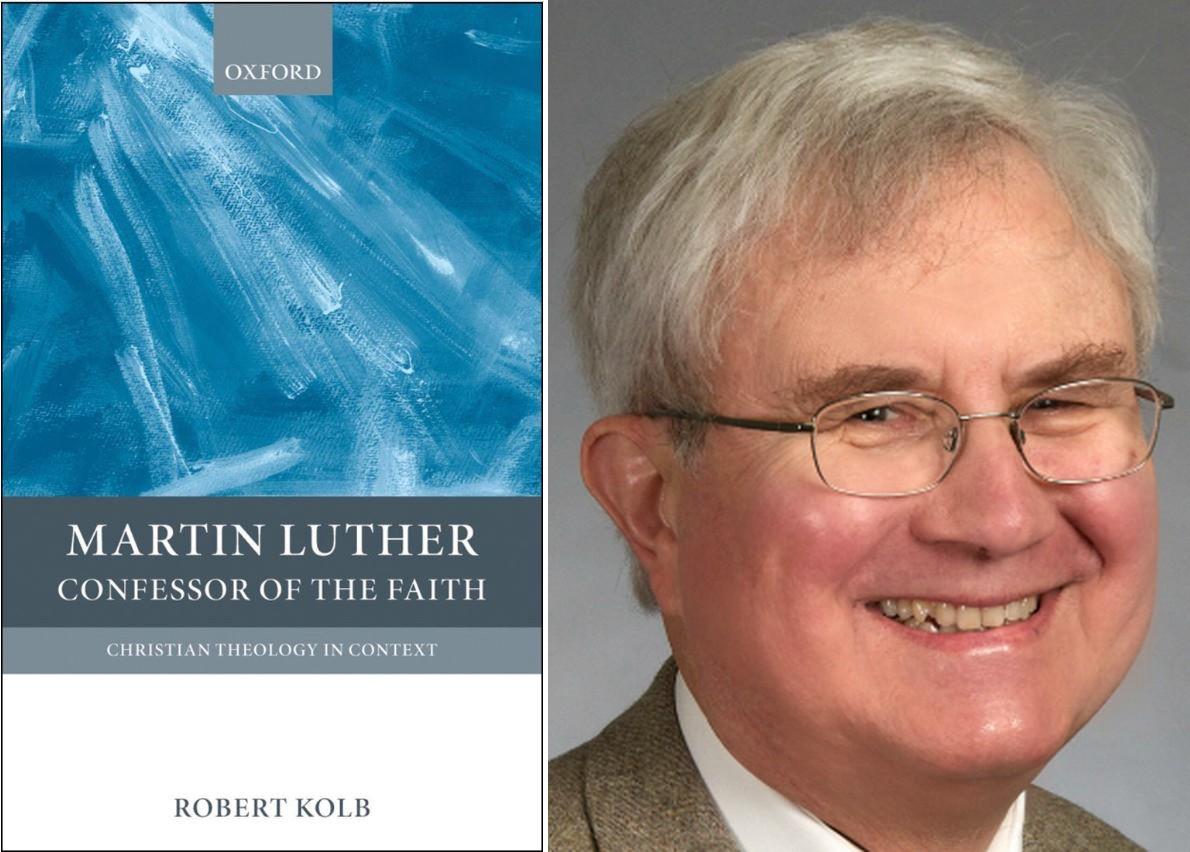
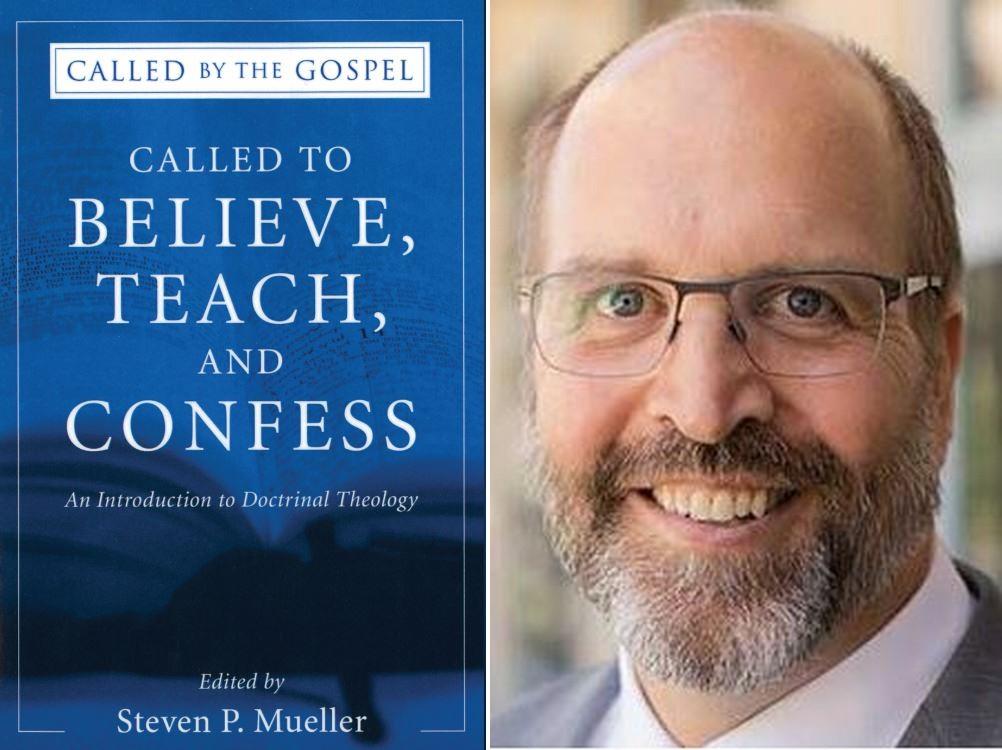
Makes righteous? or declares? 2 LCMS theologians (Robert Kolb vs. Steven P. Mueller)

      Two recent readings from LC-MS theologians have exposed both a confusion of the Lutheran Doctrine of Justification and… a surprisingly good book.  Before I say more, let me show the exact comparison of statements in the following table:
(Oxford University Press, ©2009)
(Wipf & Stock, 2005) 
Dr. Robert Kolb
Prof. (emeritus), Concordia Seminary
Dr. Steven P. Mueller (CV)
Dean of Christ College
Concordia University-Irvine
page 124: Martin Luther’s “beginning ‘to understand God's righteousness as that through which, as through God’s gift, the righteous person lives, namely on the basis of faith, and that it means the passive [righteousness] through which the merciful God makes us righteous ("iustificat") through faith’ (Hab. 2:4).”
page 237: “Infused righteousness is another way of saying that God makes us actually righteous … In contrast, imputed righteousness gives comfort and assurance. God has not changed our nature… We are declared righteous and just because of Christ.”

Which is it: "makes us righteous" or "declared us righteous"? Does God "make us righteous", which allows the thought that we are then able to be a party in the process of conversion? Or has God objectively, because of Christ's vicarious satisfaction, pardoned the sin of (or declared righteous) the whole world of sinners in His heart?
      In the first column Dr. Kolb interpreted Luther's Latin words (WA 54:186.5-8, LW 34:337; StL14:447) as "God makes us righteous" but he translated the same Latin word "iustificat" as "justifies" or "justify", not "makes righteous", in his Book of Concord (2000), p. 89:48, 125:31, 127:45, 130:62, etc. (see here for iustificat in BoC).  It is puzzling as to why Kolb would write the phrase "makes us righteous" in 2009 while he earlier in 2000 translated the same word as "justifies" or "justify". — The confusion of Dr. Kolb on "Justification" was not surprising to me given his uninterrupted actions of unionism.  I am also not surprised that most LCMS theologians are also confused on the Lutheran Doctrine of Justification.
      But I was surprised to discover the other book, one that has much to recommend it from a Lutheran standpoint, even with some notable caveats.  Dr. Mueller directly refutes the translation of Dr. Kolb, and from a thoroughly Lutheran standpoint. (Mueller also teaches Universal, Objective Justification – UOJ).
      So why make such a fuss over this seemingly minor, insignificant change of wording by Dr. Robert Kolb?  It is because it is a matter of spiritual life and death. It touches the "Foundation of the Christian Faith", a subject for which Dr. Franz Pieper is the best teacher since C.F.W. Walther.
- - - - - - - - - - - - - - -
      As much as I would like to praise Steven Mueller's book more, yet I would have to ask him some pointed questions. In particular: why does another teacher at his Concordia University-Irvine under his leadership, Associate Professor of History and Theology Clinton J. Armstrong, call the Lutheran reformer Jakob Andreae guilty of "backstabbing", having "plenty of baggage", "vitriolic and histrionic", etc. in his book Lutheranism vs. Calvinism: The Classic Debate at the Colloquy of Montbéliard 1586 (p. xii)?

Saturday, September 7, 2019

Pieper's Das Fundament: The Foundation of the Christian Faith, a BTL Blogspot Book (BBB)

      The decision to publish the following came from a writing of Wallace McLaughlin from 1947, A Former U.L.C. Pastor Looks at the Agreement.  McLaughlin was working hard then, in the centennial year of the Missouri Synod, to inform his LCMS of the dangers of joining in fellowship with liberal American Lutherans because of their false doctrines.  McLaughlin knew first hand about these erring Lutherans because he was formerly one of them.  But during that time, he had grown in spiritual knowledge and began teaching his congregation pure Christian doctrine and began to use the writing of... Franz Pieper.  As he writes: "I used such literature as Pieper's Fundament des christlichen Glaubens in preparing doctrinal presentations for my congregation."  The reference is to a 1925 CPH book.  Wallace McLaughlin was a teacher in the mold of Franz Pieper, and one of the greatest Lutheran teachers of the last 75 years in worldwide Lutheranism.  And so, this translation was undertaken at his recommendation. McLaughlin would later, after he had left the LC-MS to form the Orthodox Lutheran Conference, be the one who translated Pieper's complete series "C.F.W. Walther als Theolog" into English (now available in a printed book).
      The following is from a 6-part running series in Lehre und Wehre in 1925.  The series was then assembled and republished in book form in the same year (see WorldCat).  It is one of the few books published of Pieper's writings outside of his magisterial Christliche Dogmatik books.  I struggled with the decision on whether to translate it because of the amount of work it required – it was a 48-page book.  But as I proceeded, it became increasingly apparent why McLaughlin had chosen it, for it is a wonderful summary and defense of Christian doctrine.  Pieper's Brief Statement was 22 pages long, this was 48 pages.  So it could be called a "Supplement to the Brief Statement".
      Note well, Pieper did not use the words "Lutheran faith", but rather the "Christian faith".  This is because his essay will show definitively that the differences that other fellowships hold against the Lutheran faith are actually held against the Christian faith, against the teaching of Holy Scripture.
      The German word for foundation is "Fundament", a word that strikes our English ears as the root of the term "Fundamentalist".  Don't let the irony be lost on this — the constant attacks by LC-MS teachers without any praise for the Fundamentalists' defense against modernists, … could it be that they have lost their "Fundament", their foundation?  We will learn about this in the last sections…
      I now begin my 21-part series that will not be presented contiguously because of its length.  Pieper lays out for us that, although the world (and external Christendom) may relegate true Lutheranism to the dust bin, the reality is that one must die on the foundation of the Lutheran faith to enter the Kingdom of Heaven. (Matt. 7:21)
= = = = = = = = = = = = = = = = = = = = =
Text preparation and translation by BackToLuther using DeepL, Google Translate, Microsoft Translate, Yandex Translate. All bold text is Pieper's emphasis. All highlighting, red text, and most text in square brackets [ ] is mine.

The Foundation of the Christian Faith.
[by President Franz Pieper, Concordia Seminary, St. Louis, Missouri] 
-------- [page 33] -------
The present time offers ample opportunity to deal with this topic in more detail. Our church papers have reported on the dispute that is currently taking place in the sectarian churches of our country between fundamentalists and modernists. We also remember that in earlier times many pamphlets had been exchanged on whether the doctrines by which the Reformed Church is separated from the Lutheran Church are touching the Foundation of the Christian faith or not. 1) The Reformed were in general always inclined to answer the question with no, while the Lutherans represented a decided yes. 

In our time, then, the claim has come to the fore, that the question of the foundation [das Fundament] of the Christian faith should not be treated at all, because its treatment, as the past taught, necessarily ends without result. So for example, the Erlangen theologian [J.C.K.] von Hofmann, who is reckoned among the more positive modern theologians, suggests that “on the difference between the fundamentalists and the non-fundamentalists, there has been fruitless dispute up to this day”. 2)
The situation claimed by von Hofmann would naturally be catastrophic for the Christian faith. Faith without a foundation [Fundament] would no longer be faith, but constant doubt, the opposite of faith. (Rom. 4:20, 21; Heb. 11:1 ff.) But the matter stands, thanks to God, not so. We can only remain uncertain of the foundation of our Christian faith as long as we have not yet recognized, or have forgotten, what is the content or object of God's infallible Word, Holy Scripture, and thus also the foundation [Fundament] of faith whereby a person becomes a Christian and remains a Christian. The Christian faith does not consist of the teaching that there is a God who rewards the good and 
---------------                               

[page 34
punishes the evil. This belief is also found among the Gentiles. (Romans 1 and 2) The Christian faith is faith in the Gospel of Christ, (Mark. 1:15) that is, faith in the forgiveness of sins, which Christ, the incarnate eternal Son of God, through his vicarious satisfaction (satisfactio vicaria) has acquired for all men and has proclaimed through his Word until the Last Day in the Christian Church and by the Christian Church in the world so that it may be believed by men. When the apostle of Christ calls to the jailer of Philippi terrified by his sins, "Believe on the Lord Jesus ​​Christ," [Acts 16:31] he names the foundation of the Christian faith. He means Christ, the Savior crucified for the sins of the world, as he also summarizes the contents of his Christian sermon of 1 Cor. 2 as follows: “For I determined not to know any thing among you, save Jesus Christ, and him crucified.” [1 Cor. 2:2] But this sermon generates the Christian faith in a human heart and becomes eo ipso the content or object or foundation of the Christian faith. 
The foundation of the Christian faith is described by Luther in his classic explanation of the second article: “I believe that Jesus Christ, true God, begotten of the Father from eternity, and also true man, born of the Virgin Mary, is my Lord, who has redeemed me, a lost and condemned creature, purchased and won me from all sins, from death, and from the power of the devil, not with gold or silver, but with His holy, precious blood and with His innocent suffering and death.” 
For faith in the forgiveness of sins for the sake of Christ's satisfactio vicaria can we also use faith in divine justification without the works of the Law, because Scripture expresses the forgiveness of sins and justification as synonyms, Rom. 4:6-8: “Even as David also describeth the blessedness of the man, unto whom God imputeth [or credits/counts/declares] righteousness without works, Saying, Blessed are they whose iniquities are forgiven, and whose sins are covered. Blessed is the man to whom the Lord will not impute sin.” Our righteousness before God is the forgiveness of our sins for Christ's sake. Whoever does not believe this Scripture doctrine of the forgiveness of sins for Christ's sake or the justification without works, is not faithfully in Christ in the meaning of Scripture. His faith does not have the foundation God has given. He is still, or again, outside the Christian church. As Paul so powerfully warns the Galatians: “Christ is become of no effect unto you, whosoever of you are justified by the law; ye are fallen from grace.” (Gal. 5:4) On the other hand, Paul confesses his and all Christians faith [page 35] at all times and in all places so: “Knowing that a man is not justified by the works of the law, but by the faith of Jesus Christ, even we have believed in Jesus Christ, that we might be justified by the faith of Christ, and not by the works of the law: for by the works of the law shall no flesh be justified.” (Gal. 2:16)  This article of the forgiveness of sins for the sake of Christ, or of justification without works, by faith, is known to Luther as “the chief part and cornerstone which alone produces, nourishes, builds, sustains and defends the Church, without which the Church of God cannot exist one hour”. 8) And in another passage he adds, "those in the world who do not teach it are either Jews or Turks or papists or sectarians.” 9)
-----------
8) Erlangen Opp. var. arg. VII, 512; St. L. XIV, 168. [not in Am. Ed.]
9) Ad Gal. Erl. I, 20; St. L. IX, 29. [Am. Ed. 26, p. 9]
-----------
Now let us see what position the religious fellowships around us have on the foundation of the Christian faith, namely 
a. the Unitarians
b. the Roman Church
c. the Calvinist and Armenian Reformed sects and the synergistic Lutherans, 
d. the deniers of the God-ordained means of grace and 
e. the deniers of the inspiration of the Holy Scriptures.
= = = = = = = = = = continued in Part 2 = = = = = = = = = =

      Pieper answers the question: "Who is outside the Christian church?" -- and in this series he gets into the specifics of just how broad this field is, but "strait is the gate, and narrow is the way, which leadeth unto life, and few there be that find it" (Matt. 7:14). Let us now walk with Pieper down the Scriptural "garden path" and note the dangerous forks in the road. In the next Part 2...

= = = = = = = = =  Table of Contents  = = = = = = = = =
Part 1 – Introduction: McLaughlin's teaching aid; Fundamentalists, non-Fundamentalists
Part 2 – Unitarians; American classic literature; Lodges
Part 3 – Papacy and Lodges compared – one class, both are enemies of Christianity
Part 4 – Papacy 2 – Lodge outdone by Papacy; Luther declares Antichrist
Part 5 – Papacy 3: Luther’s experience; soul murder, Hell…; Papacy or… the Pope?
Part 6 – Reformed, first the Calvinists; Calvary Chapel example
Part 7 – Reformed: Arminianism; Synergism in Lutheranism; Piepkorn: "merciless", "monotonous"
Part 8 – Synergism 2– foundation abandoned; Grace; Erwin Kolb's confession, ‘But I have to believe, don’t I?’
Part 9 – Synergism 3: Saints & Fathers?; Rick Warren's Decision Theology… and Peter Drucker?
Part 10 – Means of Grace 1: Deniers of the Means; Nafzgers' folly
Part 11 – Means 2: Luther & enthusiasts; Nafzgers; Eric G. Phillips
Part 12 – Means of Grace 3: Can the Reformed be saved?; no certainty in enthusiasm
Part 13 – Means of Grace 4: German theologian vs. Luther’s teaching
Part 14 – Means of Grace 5:Luther's counsel continued
Part 15 – Means of Grace 6: “experience theologian”, bad psychologists, “insanity”; Julius Stahl
Part 16 – Means of Grace 7: Papists’ “infused grace”; LC-MS falsifies Church History
Part 17 – Means of Grace 8: Two religions, only two; Stahl, not Drucker or Rick Warren
Part 18 – Means of Grace 9: Luther’s summary and proof; erring LC-MS
     Walther & Scripture 1; Walther: call me a Biblicist, please! LCMS: not us, please!
Part 19 – Scripture 1: Schriftprinzip!
     Walther & Scripture 2; Deny divinity of Scripture? = "No more in faith”; Engelder's blind spot on Elert
Part 20 – Scripture 2: “outside the faith”, ultimate warning; “be silent… let them go”; Pelikan, Appold
     Walther & Scripture 3; CHIQ's fiction against Pieper, also Lutheran / Christian Cyclopedia
Part 21 – "The Final Word" [2025-11-28: added downloads of entire series]