Search This Blog

Saturday, April 11, 2015

Martyrs 24b: Auto da fé: Lutherans &... a Jew?; Herrezuelo cries out

   This continues from Part 24a (Table of Contents in Part 1a and Part 1b) publishing the book of Hermann Fick on the martyrs of the Evangelical Lutheran Church. — Part 24b concludes the account of the Auto da fé at Valladolid, the Spanish Inquisition against Lutherans.


Lutheran Martyrs and a Jew

      This portion presents Pastor Hermann Fick's comments on Jews that were put to death by the Spanish Inquisition.  —  Indeed, Hermann Fick expresses some indignation at the Inquisition for condemning Jews to death.  But that is not why he mentions this aspect of the Inquisition.  Rather Fick brings out this detail to further condemn the Roman Antichrist's reviling of true Christians, as the Inquisitors combined a Jew with the Valladolid Lutherans to revile them.  So the Jews of today, and their sympathizers, may take away some measure of "comfort" that a true Lutheran pastor grants them some "sympathy", but this is demolished with his description of "dishonor", "blaspheme", and "defile" in relation to the Roman Antichrist's use of a Jew against the Lutheran martyrs.
     The analogy to today's LC-MS is striking for they would say that in their condemnation of Martin Luther over the Jews, they were only following this "indignation" that even Pastor Hermann Fick showed over a Jew being put to death by the Spanish Inquisition.  But today's LC-MS would never then openly condemn the Spanish Inquisition for its use of a Jew to dishonor, blaspheme and defile the Gospel of Christ through the Valladolid Lutheran martyrs.
      The effects on modern history by the Spanish Inquisitionand its head, the Pope in Rome – should be quite obvious to all in this account of the Auto da fé in Valladolid -- the tortures, the yellow gowns (Sanbenitos), the killings.  So why does modern history rather attribute so much of today's evil to Adolf Hitler and the Nazis?... as some have even called Hitler the "Antichrist?"  They should rather be seeing the effects of the true Antichrist, the Pope in Rome, on ALL modern history...
==>> Why does the LC-MS tell all Lutherans that they are to be "haunted" by Martin Luther's remarks about the Jews, when they should rather be weeping (as Fick and I do) for the Lutheran martyrs murdered by the authority of the Pope in Rome?
Some highlighting added; hyperlinks added for reference.
------------------------------------------------------------
by C.J. Hermann Fick
(tr. by BackToLuther)
The sixth sentence of condemnation was issued on the dry bones and picture of the blessed woman Leonora de Bivero, [or Dame Leonore de Bivero in Foxe], although they had never heard that she had any opinion for or against the Roman Church.  This godly woman was the mother of the five mentioned convicted siblings and had died long before.  She had heartily loved the true Christian religion during her life, led a blameless transition, and let preaching and Christian gatherings be held in her home.  Her excavated bones were brought in a coffin, after which her figure could be seen, and the solicitor spoke over them the judgment that her bones and dead form be burned as a Lutheran to ashes, and all her goods should be confiscated, that also her house be torn down to the ground, and [page 190] in memory of the place a marble stone should be erected on which the cause of her burning and this devastation would be recorded for everyone with engraved letters. [Where is this place; is monument still standing?]
For the seventh was Alfonso Perez, a priest at Valencia, condemned that he should first be demoted, then burned as a heretic and his property be confiscated for the king.
Now that the aforementioned persons and dry bones had received their judgment, the bishop of Valencia came forward in his episcopal attire, and began to solemnly demote the dear martyrs Cazalla, Francisco de Bivero and Alfonso Perez as no longer priests, while he gave each a cup in his hand, and withdrew from them the priestly garments one by one, as he had first put on them. Then he took from them of the priestly ordination according usual popish use on fingers, lips and head, whereupon they were again dressed in the Sanbenito and had placed on each man a paper hat.  Although Cazalla began to speak and ask the Princes and Lords to grant him a hearing, he could not obtain it, but was driven back hard and unkind, and pushed to his place.  Nevertheless, he said in a loud voice that his faith for which he was thus treated, was not heretical, but in agreement with the pure, infallible Word of God.  For the same he would be also ready and willing to die, as a devout, right Christian, and not like a heretic.
The eighth brought forward was Don Pedro Sarmiento, Knight of the Order of Alcantara, who was at Valencia and was the son of the Marquis de Poza.  He was publicly proclaimed a heretic, and condemned that he should wear the Sanbenito for the rest of his life and sit forever in prison.  In addition, he should be deprived of his Order of Knights and all his goods, and he would have no right to wear gold, silver, pearls or precious stones.  After him was called his wife, Maria de Figueroa, who would be cried out as a heretic and condemned as her husband with the same punishment.  For the tenth, Don Luis de Rojas, the son and heir of the Marquis de Poza, was called and publicly declared a heretic, but in consideration of the great intercession that happened for him, he was only sentenced that he bear the Sanbenito to the town hall and should be deprived of all his goods.  This was followed by Mrs. Anna Henriques, resident of Toro, daughter of Count Ascanzes, and mother of the Marquis de Poza, former wife of Mr. Alfonso de Fonesco. She was also declared a heretic and condemned, that she should carry the Sanbenito to the city hall and be deprived of all her goods.
Furthermore Christoval del Campo [or Christobal de Ocampo], a citizen of Samora [Zamora?], was called forward and proclaimed a heretic and condemned to the fire; his property should be forfeited to the common chest. [page 191]  The same judgment was received by another citizen of Zamora, Christoval de Padilla.  The fourteenth was Antonio de Huezvello [or Antonio Herrezuelo], a Bachelor of Theology, who had lived at Toro.  He was announced as a heretic and condemned to the fire: his property should be confiscated.  He had a bit put in his mouth so that he could not speak to the people, nor could make a confession of his faith.  For the fifteenth, Catalina de Roman [or Catherine Roman de Pedrosa, pgs 202-203] was called from her seat, a citizen of Pedrosa [Pedroda del Rey?], and condemned that she should be deprived of all her goods and burned.  The licentiate Francisco Errem, a native of Peñaranda [de Bracamonte or de Duero],  was condemned likewise as an abominable heretic, burned alive and his property should be confiscated.  After this was called Mrs. Catalina Ortega [or Donna/Dona Catherine de Ortega], residing at Valladolid, a daughter of the solicitor Fernando Piazo, and the widow of the captain Louis [or commander Loaisa].  Because she was held by the rest as the teacher, she was publicly decried as a noble and exceptional heretic and condemned to the fire: her property to be forfeited to the royal chamber.  In the eighteenth and nineteenth places were Isabella de Strada [or Isabella d’Estrada] and Juan Velasques [or Valazquez], both of Pedrosa.  They were sentenced to be burned and forfeit their goods.  The same sentence was given a certain Blechschmidt, who had been an elder of the church, and had granted his house as a meeting place for the Christians.
However the servants of the Roman Antichrist were not satisfied to take from these dear evangelical Lutheran martyrs only their property and their lives, for they sought in the most deceitful way to even rob them of their honor.  In order to more blaspheme [schmähen] and defile [schänden] the divine truth of the Gospel and its Confessors, and cause suspicion by the ignorant, they now presented a Jew and Marrano from Lisbon in Portugal by the name of Gensalo Vaes [or Gonzalez Baez], who had fallen again to Judaism after his baptism, and condemned him also that he should lose his property and be burned at the same time with the Lutherans in judgment.  It was generally [überhaupt] an excessive [unerhörte] tyranny to punish these people with death for the sake of their false religion.  However, while the Inquisitors combined this Jew, who had denied the Lord Jesus, together with the Lutherans, and condemned him to the same punishment, they wanted to create the false impression for the poor people, as if the Lutherans would also reject the Lord Jesus.  But disciple is not above his master, nor the servant above his lord, Matt. 10:24.  But also our Lord Jesus Christ was reckoned among the transgressors and crucified in the middle between two criminals.
Then Juana de Silva was called, the wife of Juan de Bivero, brother of Dr. Cazalla.  They declared her [page 192] a heretic and put a robe of shame on her to wear for life, as a sign of her crime, and all her goods should be robbed.  Further, Leonora de Cisveros [or Leonora de Cisneros or Eleonora de Cisneros], the wife of the previously mentioned Bachelor Antonio de Huezvello, as well as Marina de Sojavedra, the wife of Cisveras de Sareglio, and Daniel Quadra, a Pedrosa native, were convicted, decried as total heretics, and that they should lose all their property and do penance in prison for life clothed with robes of shame.  Maria de Royas [or Donna Maria de Roxas], the sister of the Marquis de Royas, was condemned that she carry a robe of disgrace to the city hall, lose her goods and should ever repent, but as such grace happened to her because she had been a convent nun and came from noble lineage.  Then was brought forward and convicted Antonio Dominigo [or Santo Domingo (Fray antonio de)] of Pedrosa, that he be dressed with a yellow coat, stand a three-year prison sentence, lose all his property and should do repentance so for his heresy.  Finally, the twenty eighth prisoner Anthony Basor [or Anthony Wasor] was called forward.  Because he was an Englishman, he received the verdict that for his crime he should bear the Sanbenito to the City Hall, imprisoned a year in a monastery and be taught in the Roman Church teachings as necessary.
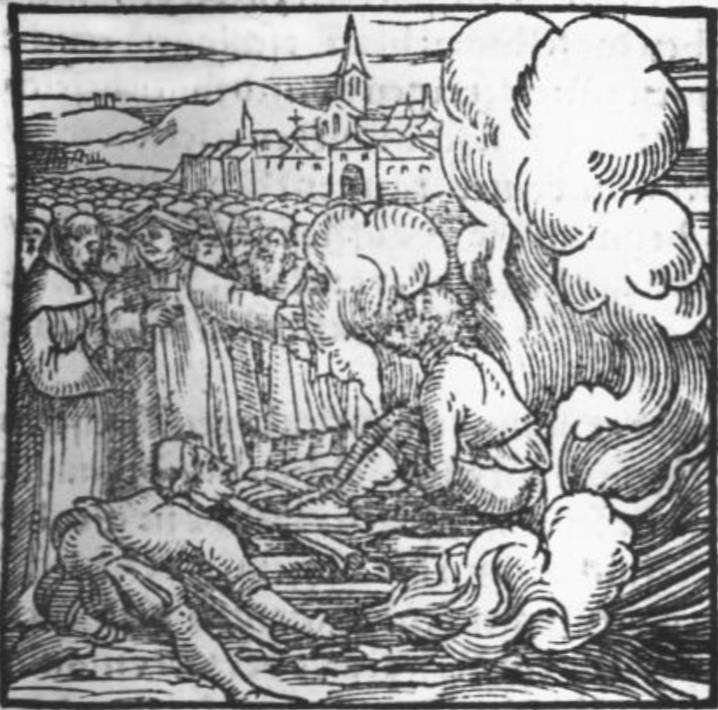
After these convictions were spoken, the dear Confessors were condemned to death by fire together with the coffin of the dead woman and her portrait sitting there, then were passed to the secular authorities and the executioners with orders to carry out the executions immediately.  Then they all were immediately seized and bound facing rearward upon an ass, and so accompanied by many armed and armored soldiers they were led out to the place of judgment, which lay outside the city and was called Del Campo.  Fourteen poles were erected spaced equally from each other on which the dear martyrs were lashed, and strangled first according to Spanish habit, then burned to ashes.  An exception was made with the blessed Antonio Huezvello [or Antonio Herrezuelo]. Because he violently loathed the clergy of the Pope in and out of prison, his mouth was blocked with a bit and so the faithful witness was burnt alive.
So these faithful Christians, for the sake of truth and the pure Word of God, were led like sheep to the slaughter, and had not only each other for Christian comfort, but also exhorted all bystanders to the knowledge of Christ, so that are all were highly surprised to see only their constancy and their calm and gentle end.  And hereby ended this miserable spectacle worthy of weeping.  However the reporter who wrote this news from Spain to Germany noticed that there was a rumor that there were probably thirty seven other Lutherans still sitting imprisoned with which they were willing to perform a similar tragedy before long.
– – – – – – – – – – – – – – – – – – –
24. Auto da fé in Valladolid. Sources:  1. Crocius, p. 1012.  2. Herrn Baker’s vollständige Historie der Inquisition, p. 772 or here,  3. Foxe, The acts & c, p. 47l.  –  Leonora de Cisveros had suffered death according to testimony of the Papists, as if her body were of stone and not of flesh; as it says in the Unschuldige Nachrichten from 1718, p 242. She must have been burned later also.  Her name is mistakenly written as Lisveros on page 192. [See “Leonor de Cisneros”: Profile in Faith on Leben.us website; also here, and here]
= = = = = = = = = =   End of Auto da fé in Valladolid.   = = = = = = = = = = =

These martyrs of Spain were not Reformed, or Calvinists, or Erasmian, or "reflecting evangelists", or "semi-Protestants", or any other notion of Reformed or secular historians... they were condemned and died as Lutherans!  Historians generally put the spotlight on Dr. Cazalla, but I am perhaps most impressed with Antonio Huezvello/Herrezuelo because...
"he violently loathed the clergy of the Pope in and out of prison"...
... and so the Spanish Inquisition had to mechanically close Herrezuelo's mouth to shut him up!  Oh dear Huezvello/Herrezuelo! ... this blog post is dedicated to your memory because your mouth is now wide open and your "violent loathing of the clergy of the Pope" continues!  The Gospel of Jesus Christ cries out against the papists with a loud, loathing cry for it condemns their robbing of its power... today!... here and now!
- - - - - - - - - -
This ends Hermann Fick's account of the Spanish martyrs.  He goes on from here to cover the martyrs in Italy, but I may take a break from translating this work for awhile...

Tuesday, April 7, 2015

Martyrs 24a: Auto da fé at Valladolid; caught as Lutherans

   This continues from Part 23d (Table of Contents in Part 1a and Part 1b) publishing the book of Hermann Fick on the martyrs of the Evangelical Lutheran Church. — Part 24a presents the essay on the well known Auto da fé in Valladolid with its multiple martyrs.
      Why do I persist in presenting this Lutheran account of the martyrs when there is so much information already on the Internet?  It is because there is so much misinformation related to these martyrs, such as this example from an 1851 book by an expulsed member of "Primitive Methodist" sect, who uses portions of John Foxe's Acts and Monuments:
"To return to Spain. A remarkable oneness of purpose actuated the leading evangelists of that country. They were not at first so much indebted to Germany as might be supposed. The religious wars and persecutions of their own country had provoked reflection. Not only the Koran, but the Old Testament, had been a household book through long ages of trial.  Prevalent idolatry and fiend-like persecution had closed the heart of the afflicted Jew against the evidences of Christianity."
This assessment of Church History deflects the "oneness of purpose" among the followers of Luther in Spain away from the Reformation, away from the Reformer, Martin Luther.  It shows a willful ignorance of the singular power of Luther's Reformation.  Even the Romanist Spanish historian Llorente admits (pg 196 ff.) that these Valladolid martyrs were Lutherans.  And so I continue this Lutheran martyrology.

Some highlighting added; hyperlinks added for reference.
------------------------------------------------------------
by C.J. Hermann Fick
(tr. by BackToLuther)
Auto da fé in Valladolid. [2020-04-06 fixed link]
"And one of the elders answered, saying unto me, What are these which are arrayed in white robes? and whence came they?  And I said unto him, Sir, thou knowest. And he said to me, These are they which came out of great tribulation, and have washed their robes, and made them white in the blood of the Lamb."
Rev, 7:13-14
At this time, since many people of high and low estates were caught as Lutherans, the inquisitors decided to show their power and strength even in a public spectacle before the whole world, and to hold an Auto da fé, which means in German: to hold to an act of faith.  This was their name for their solemn executions of Christian believers, as the wretched Papist tyrants were under the delusion that they were performing a God pleasing work, as the Lord Christ declared before, "Yea, the time cometh, that whosoever killeth you will think that he doeth God service." John 16:2.   Except it is a far more correct naming of such executions as an act of faith because the Christians steadfastly confessed their faith in front of everyone by God's grace unto death.
It was in 1559, when the inquisitors held captive a large number, including many distinguished persons, as Lutherans, bound at Valladolid, where [page 187] the King of Spain usually kept his court encampment.  There they setup in the market before the city three large, far-reaching show stages or scaffolding, with chairs, benches and a gallery, whereupon the royal personages should sit together with other lords and courtiers to view this bloody, or rather fiery tragedy.  Not far from the city were 14 high-stakes or poles erected with some steps where l4 Lutherans should be burned.
Now when the 21st day of May had dawned, early in the morning at 6 o’clock, the Princess Juana,
Auto da fé in Valladolid
sister of
King Philip and regent of his kingdom, and his son, the young Prince Don Carlos, together with many other princes, lords and courtiers, assembled with great pomp on the gallery and settled there.  However, all around the stages, the whole marketplace, and all houses and roofs were filled with an immense number of spectators from all ranks  who stood looking out of the windows and from the houses to hear the verdicts of the Inquisition and to look at the court.  When the royal and princely persons were seated and waited a long time, the Inquisition judges emerged in their splendor, led by the Archbishop of Seville, as the chief of the synagogue of the inquisitors of the Inquisition Council along with other bishops of the country and the king's counselors, and mounted the other stage.
Now then the princes, and the other spiritual judges and councillors took their places by their station, surrounded by a large number of archers, halberdiers and armed soldiers, while four heralds of the coat of arms were doing their service and the imperial marshal carried the bare sword and the countless masses expectantly watched: there were led up as a spectacle and triumph the poor servants and witnesses
Sanbenito depiction
       by Goya
of the Lord Jesus, about thirty in number, caught  and bound, with burning candles in their hands and all clothed as dishonest people with yellow shameful gowns or
Sanbenitos that were decorated with red crosses.  Along with them was also brought to the stage the coffin and picture of a noble woman who had died long before, and during her life should have been a Lutheran, in order to receive her judgment.  Those [page 188] which should be condemned to death had paper hats which the Spaniards call Coaca on their heads, and a black linen-covered crucifix was carried ahead of them as a sign of mourning.  Then they were put in an order, one after the other, according to how they were considered guilty.  The noblest of all was the Augustinian monk, Doctor Cazalla, Canon of Salamanca, a very famous theologian and excellent man, who had been for some years a court preacher of Emperor Charles V in Upper and Lower Germany. Therefore, he had been placed ahead of the others, to a higher bench.  He along with his whole family was imprisoned soon after Charles's death, and in 1559 thirteen people among this family were burned.
Then came a Dominican monk, named Melchior Cano, who gave a sermon lasting about an hour.  After the sermon, the General Procurator went by his show stage with the archbishop of Seville to the Royal Gallery, which were connected to each other so that one could go from one to the other, and solemnly administered to the royal and princely people the following oaths, where each one of them had to lay two fingers on a Crucifix painted in a missal: "Your Majesties are sworn to favor and promote the Holy Inquisition, and not only to not prevent it in any way, but also will support with all force to kill all those who separate themselves from the Roman Church and join the sect of the Lutheran heretics without respect of persons, from whatever standing, dignity or condition they may nevertheless be from."  Also the second oath was "Your Majesties will swear that they will force all of their subjects to submit to the Roman Church and to keep their commandments in honor, and to help them resist those who still cherish the heresy of the Lutherans or any take any part of it."  All royal and princely persons swore obediently to this oath, after which the Archbishop uplifted his hand and gave them his blessing, saying: "God bless your Highnesses, and grant them long life!"  The same swore also the remaining states and lords who were present in large numbers, each according to his rank. [page 189]
After completion of this wicked ceremony, the condemnation of the poor prisoners was read in the order listed publicly and in a loud voice, whose whole crime was that they loved the pure evangelical Lutheran doctrine agreeing with the Gospel of the Lord Jesus, and rejected the superstitious human institutions of the Roman papacy. The Procurator Solicitor or great-collector of the Pope began with the already mentioned Dr. Augustino Cazalla, [or Cacalla in Foxe] whom he called from his seat that he should come near and listen to his judgment, which read thus: Because one would certainly know that Cazalla was a teacher, preacher and as it were the flag leader of the Lutheran sect in Spain, so one should therefore first solemnly degrade him, and then immediately burn him, but confiscate all his goods for the betterment of the Inquisition. [See here for painting of this event, text in Spanish]
The second one called by the Solicitor was Francisco de Bivero [or Francis de Bivero from Foxe], Cazalla's brother and minister to Valladolid, who was also sentenced to the fire. But because he was very popular with the people and a most eloquent, zealous man who had confessed the truth freely inside and outside the prison, his mouth was so connected that he could not speak a word. They were worried that he would open his mouth too much, and thus attract the people and show his innocence in the light of day.
The third was a sister of the two mentioned martyrs, Mrs. Blanca de Bivero [or Dame Blanche de Bivero in Foxe], and she was condemned in the same way to death by fire.
Fourthly was Juan de Bivero, a brother of the preceding who was cried out as a heretic and condemned to eternal prison, and that he should wear a Sanbenito or yellow gown of shame throughout his life as a sign that he was disreputable and would be deprived of honor.  Fifth, was a sister of the same, Constantia de Bivero, [or Dame Constance de Bivero in Foxe], widow of Fernando Ortis, who had been for a while at Valladolid, condemned to be burned with her brothers.
= = = = = = = = = =   concluded in Part 24b   = = = = = = = = = = =

The Spanish Inquisition is rather well known in history.  Yet it is distorted in many ways to diminish its infamy, whether by the Roman Church, the Reformed, or secular historians... though there are surprisingly some who are not completely blind to how it affected later history.  —  There is currently a blog from Valladolid (in Spanish) that presents additional information on this Auto da fé with more pictures.

It is noteworthy that the Auto da fé is also covered in the Jewish Encyclopedia, as they attempt to honor the Jews who were also put to death by the Roman Antichrist.  But the only reason for mentioning this is that it also relates to a portion of Fick's history of the Lutheran martyrs at Valladolid... coming in the next Part 24b.  Hmmm, Lutherans and... Jews?

Thursday, April 2, 2015

Martyrs 23d: San Roman's passion==Christ's Passion; fiery flame of the Lord; Steadfast Lutheran, Steadfast Martyr

     This continues from Part 23c (Table of Contents in Part 1a and Part 1b) publishing the book of Hermann Fick on the martyrs of the Evangelical Lutheran Church. — Part 23d concludes the story of Francisco San Roman.
      It is the Holy Week as Christians remember the sufferings of our Saviour as He carried the weight of all the sin of the whole world on Himself.  This concluding segment on San Roman reminds us of this very suffering of our Saviour... in a most spectacular way.

Some highlighting added; hyperlinks added for reference.
------------------------------------------------------------

by C.J. Hermann Fick
(tr. by BackToLuther)
The other was horrified at these words of San Roman, and began to weep bitterly, for he had a heartfelt sympathy with him.  But because the relentless carriage driver so impetuously hurried him away, he could answer nothing else than that he sighed much and wept over his misery.  In this deplorable situation, with burdening chains bound to a carriage, now the dear martyr was dragged with the imperial court, brought with him to Africa where the emperor went at that time, and was led back and forth until the Emperor was beaten and then returned to Spain.  There have been also some who said that the Emperor was therefore not victorious because he allowed such abominable tyranny and rage against Christian blood.  As soon as they came to Spain, the blessed Francisco was immediately handed over to the Inquisition, which racked him even more terribly than he had ever been troubled in his prison, on the sea, and by the soldiers.  They threw him into a dark prison and sent him the most unlearned monks who tormented him unceasingly and violently assailed him so they could make him apostate of the perceived truth.  They led him out sometimes for spectacles in front of the people and did all kinds of disgrace to him; they cursed and blasphemed [page 183] him abominably every day.  But God strengthened his faithful disciple by His powerful grace that he never became fainthearted or despondent in spite of all the pain and torment, even more from the Word of God, but he was from day to day only more joyful and bold and persistently steadfast in faith.  He continually denied the false doctrine of the monks, which they gave out as the highest wisdom of God, and but claimed that this was the truth, what they condemned as heretical.
The epitome of his doctrine, which he confessed publicly and in a clear voice to his end, was the following.  He said that no man by his wealth and power, by his good works, holiness or worthiness could earn forgiveness of sins, righteousness or eternal life before God, but that all men, out of God’s pure grace and mercy, without any human merit, for the sake of the Mediator Jesus Christ, the Son of God, who cleansed us by his blood from our sins, appeased the wrath of the Father, and had restored the salvation of the human race which must be blessed.  The teaching of the monks from the sacrifice of the Mass, that they (ex opere operato) earned forgiveness of sins for the living and the dead for this work's sake, he rejected entirely.  He also condemned the doctrine of auricular confession, the narration of all the sins, of the suitable satisfaction for the sins by Purgatory, by papal indulgences, by invocation of saints and images, saying such would be an abominable blasphemy against God, and reduced the holy bloodshed of Christ our Lord.
Finally, the Papists let all hope dwindle in turning away this steadfast Lutheran from the faith.  Therefore they, the "Holy fathers," as the inquisitors called themselves, condemned publicly that he should be burned alive as an obstinate heretic, for defending blasphemous and false doctrine.  Some people who were present at this judgment later testified to Enzinas that there were at the same time many criminals on trial with him, but none of these villains had been condemned to death, but only our Francisco.  So furiously the Roman church hates the true children of God.  The blessed martyrs was therefore taken out alone in front of the city to his death, as this [page 184] was thought by everyone to be an abomination. Also they put on his head a paper crown on which many execrable devils were painted, and reviled him so incessantly with abusive words, that they are harder to listen to for a Christian than even to suffer death.  However, there stood before the town a wooden cross.  When one came now to it, the monks instructed him to worship it.  But the faithful witness replied heart joyfully: "Christians do not worship wood.  But he confesses to be a Christian who presently feels the divine assistance, and worships with all his heart and faith his God, just as He requires of us."  Wherefore he earnestly asked the inquisitors that they would take him to where he would be condemned.  There the people arose, which flowed with him in numbers, to the place of his voice and railed against him as a heretic who refused to worship the cross.  However the poor blind people astonished themselves over the divine strength, which was according to their opinion in this cross, that it did not want to be worshipped by such heretic.  Indeed! soon went out the cry that God had done a special miracle on this cross, therefore they thought it was so great and holy that in throngs they with drawn swords hastily chopped up the cross well into a thousand pieces and tore it; and whoever could only get a small piece of it thought himself blessed, because they ascribed to this wood the strength that it would be able to cure all kinds of diseases.  

Arriving at the place of judgment, the monks sought again to persuade him to recant with many troublesome and useless words.  But San Roman was determined now to seal with his blood that evangelical Lutheran doctrine which he had already confessed by so many tortures.  Therefore he spoke boldly even to his enemies, strengthened by the Holy Spirit, that they should go ahead and finish what they decided to do with him; he did not need these words, they would not want to spend the time in vain.  When they heard this, they put him in the middle of the stake, tied him up and set fire to the wood in many places. As now the flames of the fire surrounded the dear confessor, he lifted his head a little because of smoke or something else.
The inquisitors attributed this as a sign that he would recant; therefore in haste they took him off the pyre before the fire had done particular damage to him [page 185] and asked him again if he would recant.  When the gallant hero of the faith heard this, he turned happy and fearless like a lion to them saying: "Why should you yet rage for all generations?  How are you yet so spiteful and unfavorable to me that with this delay you begrudge me such a great good, to which I hasten!  Will you even lead me from the way of eternal glory? Why will you not grant my blessedness to me?  Why do you rob me of my highest honor?"  The Inquisitors now saw clearly that they had made a mistake. They therefore let the steadfast martyr be thrown into the fire again, of which he was not at all alarmed.  He burned yet a little while, and then fell asleep joyful in Christ. This happened in the year 1542.
However, the inquisitors also did not rest even after the death of this blessed blood witness.  They declared him publicly to be a damned heretic of which no one should ask, and the holy, pious monks said Amen to that, and agreed with them.  Indeed!  they made the unanimous decision in all their schools that this Francisco should be held as a heretic and no one may hope that he had been saved.  And those who speak against it, act against the Holy Roman Church, whose decision must necessarily be certainly believed both in heaven above and on earth beneath.   In contrast, there were some marksmen of the emperor, who collected the ashes of Francisco's body and diligently kept them as a special sanctuary. And the envoy at that time of the King of England desired that he should be given written notice of the case record and regarded our Francisco as a true martyr of the Lord Jesus Christ.  But when this came to the attention of the Inquisition and the Emperor, they were so angry over it that he cast the marksmen into prison, and had the envoy removed from the court for a time.
So the holy San Roman completed the victory run of faith with joy. He was a burning and shining light, a fiery flame of the Lord.  From Bremen, where he was so wonderfully came to the knowledge, through the Netherlands, Germany, Africa and Spain he glorified the name of the Lord through his confessions and torture.  He had desired that his parents, his native city, and his beloved Spain be enlightened with the Word of God. [page 186]  But God had decided it differently: he must himself, on a flaming pyre, throw light in the darkness and the shadow of death of the papacy on the benighted of Spain as a powerful fire sign, which showed all the people to the Word of God.  Only the Day of Judgment will disclose in how many hearts he thereby gave the brilliance of the Gospel.  However his example awakens us to be equally fiery in love to the Lord, in a time when the love in many grows cold.
= = = = = = = = = =  End of history of Francisco San Roman  = = = = = = = = = = = =

Who would argue that today is not "a time when the love in many grows cold"?  Fick said: "Only the Day of Judgment will disclose in how many hearts he thereby gave the brilliance of the Gospel." –  Oh dear Francisco! your story shines in MY heart, today!  Would to God I had a tiny piece of the shining faith you had!
Note to the Holy Roman Catholic Church:  
Francisco San Roman IS in heaven.  And his "blood witness" continues to this day against you.
- - - - - - - - - - - - - - 
There is a website called Steadfast Lutherans catering largely to members and pastors of the LC-MS.  If those members are true to that name, they will read of this "Steadfast Lutheran" who remained as a Steadfast Martyr of the Evangelical Lutheran faith.  Perhaps they will then ask why their LC-MS is so friendly towards the Roman Catholic church of which Hermann Fick says it  "hates the true children of God".  Perhaps they will ask "How come?", how come their LC-MS cannot quite confess with the Lutheran Confessions that the Pope in Rome is the true Antichrist?  Is it because they are not quite sure if it really is "by grace alone"?
(The series of martyrs continues in Part 24a...)