Search This Blog

Showing posts sorted by relevance for query brings not only his own theology but that of the First Walther. Sort by date Show all posts

Monday, December 10, 2012

The Second Walther on... the first Walther's textbook.

In the previous post, Ludwig Fuerbringer, President of Concordia Seminary, reminisced in 1947 about the new young professor, Franz Pieper, that joined the great C.F.W. Walther in St. Louis in 1878, a professor destined to become not only Walther's successor, but one who carried on Walther's greatness in spiritual matters.  I will have more on this below.

But Fuerbringer also reminisced in 1931 (see older blog) about Franz Pieper where he recalled the very first article published by the new, young professor in 1878.  Walther was so highly regarded in the old (German) Missouri Synod — the laity, the pastors and teachers alike saw in Walther's teaching the truth of Christianity,  first and foremost his Doctrine of Justification.  But it seemed that in 1878 there was not an up-to-date textbook for the seminarians to use in their studies...  up-to-date in refuting all of the errors where modern theologians attacked Christian doctrine, especially in Germany but also in America.  Various members of the (old German) Missouri Synod were clamoring for Dr. Walther to produce a dogmatics textbook... a book that could be used for training new pastors in pure Christian teaching.  So Walther selected an old German textbook by Johann Wilhelm Baier that he considered to have a basis of good Lutheran doctrine, a textbook previously re-published by Eduard Preuss in Germany in 1864.

And in 1878, a new young professor had joined the faculty – Franz Pieper.  So in the premier journal of the old (German) Missouri Synod, this issue,
began the great career of the new, young Professor Franz Pieper on pages 371 - 372:
.
.
Literature.
Johann Wilhelm Baier's Compendium Theologiae Positivae. 
Presented anew by C.F.W. Walther. Fourteenth edition, corrected and enlarged. In the City of St. Louis, printed by the Missouri Lutheran Synod (Concordia Publishing). 1879.
A work will appear, God willing, next year with the above title in books whose first pages have just left the press.  Professor Dr. Walther has moved to publish this work long desired by various quarters, in particular with regard to the needs of our theological seminary, by getting relief for the time-consuming work of dictation.  —  The following remarks may serve for the general characterization of Walther's work.  He does not as editor bring his own explanations, but allows for the presentation, conclusion and defense of divine truths from the most eminent orthodox teachers of the Church, especially those that occurred in the 16th and 17th centuries.  The original plan was to print only these testimonies that were given by Dr. Walther in his dogmatic lectures as explanations on the Compendium of Baier.  But then it was considered more appropriate to reproduce again the entire Compendium of Baier  and get a correct copy of this work – the Schlawitz edition; then insert the illustrative quotations at the relevant passages.  One may say that this work will give us a full insight into the dogmatic work of our Church.  In particular the implementation is very detailed in locis or parts of locis which are in our time in part not clearly understood, in part disfigured completely.  It must also be noted that the sentences of Baier which are exposed to misunderstanding learn from other old dogmatists their correction position.  Because Baier's Compendium treats theology only thetically, the antitheses are put up in the citations also against old and new false teachers.  However, from newer times, only those best known dogmatists who still take up the predicate "Lutheran" for themselves are considered here. 
As this work now is to be first for the aid of dogmatic teaching at the local seminary, it will also be welcomed with joy by every pastor who has kept interest in the detailed study of Lutheran theology.  —  The exterior features of the work are excellent.  In the format of Lehre und Wehre, it brings the sections of Baier in large print, the notes of Baier in ordinary print, the quotations of Dr. Walther in smaller print.  The latter are also indented so that they can be distinguished at first sight.  So that the reader can get an idea in what relation the explanatory citations stand to the text of Baier, it should be noted that the first chapter of the Prolegomena which includes 42 pages in the Schlawitz edition (kl 8 °), takes pages 1-79 in the present work.     The first issue will be ready in a few days for shipment. The price of a booklet of 96 pages is  50 Cents.  Those wanting to order should promptly submit to the "Lutheran Concordia - Verlag", St Louis, Mo.  
                                      F.P. [Franz Pieper] 
- - - - - - - - - - - - - - - - -
The highlighted portions of Pieper's article show that Walther was like Luther in that he could judge the old "dogmatists" as Luther could judge the old church fathers.  Luther could judge St. Augustine and St. Bernhard  — Walther could judge Hunnius, Quenstedt, and Baier, Lutheran dogmatists of the 16th and 17th centuries.  Both could accept their predecessors where they taught the full grace of God... and correct them where they started to cause a question on that grace.  Luther stood above the old church fathers with his faith  —  Walther stood above the old dogmatists and could see all the way back to Martin Chemnitz and Martin Luther.  Both stood by faith, faith in God's grace.  Franz Pieper, the new young professor, stood shoulder to shoulder with both.

You can read the translated headings of this book at Project Wittenberg (here).  You can read Benjamin T. Mayes short review of Walther's edition on Amazon here.  Mayes actually sold reprints of it some time ago (here). And you can actually see (and read in Latin) Volume 1 (here) and Volume 3 (Google Play here).  Here is the title page of Volume 1:

You may be able to buy old used copies, usually for a high price.  Paul McCain had a copy of this for sale some time ago and said this in a blogpost (here if unloadable):
"In 1865, Dr. C. F. W. Walther wrote that he had been persuaded to try and write his own dogmatic textbook, but this, unfortunately, never happened. Instead, synodical president H. C. Schwan “compelled” Walther to publish an edition of Baier’s Compendium that would include “annotations,” and that edition began coming off the press in May 1879. Besides correcting the publishing errors of earlier editions, Walther included copious quotations from sixteenth- and seventeenth-century theologians as elaborations on Baier’s terse comments. In this translation, the major loci and footnotes to them are from Baier. The interspersed quotations from Luther, Chemnitz, Gerhardt, et. al., were added to this edition of Baier by Walther."
But McCain's statement is not quite true, at least in a spiritual sense... for you can save yourself a lot of trouble by just buying the "updated" textbooks of The Second Walther (that young fellow) that brings not only his own theology but that of the First Walther – C.F.W. Walther (The American Luther).

What textbook?  This:


It has already been conveniently translated
 <<== from German into English ==>>


These textbooks: 

Christian Dogmatics 

4 vol. set  by Franz (Francis) Pieper

Walther's dogmatics textbooks were finished... by Franz Pieper!

According to President Matthew Harrison,
"Every Missouri Synod pastor has studied this text for his basic Christian doctrine."
Would to God every new (English) LC-MS pastor, professor and teacher actually taught and preached according to this textbook, the textbook that he is supposed to have learned. Would to God they would have learned from that "young fellow" who carried the torch passed by C.F.W. Walther, the teaching of God's grace, until the day he died in 1931.  Sad to say that for the most part, Franz Pieper is not only not followed, but in many cases is ridiculed... a ridicule that applies equally to Walther and Luther.

Yes indeed, President Harrison, the Christian religion is not popular, sometimes not even with your LC-MS.

Wednesday, August 19, 2020

Hist16: Chp 12— Election of Grace Controversy, on Predestination

      This continues from Part 15 (Table of Contents in Part 3), a series presenting an English translation of Pastor Christian Hochstetter's 1885 496-page book entitled (abbreviated) The History of the Missouri Synod, 1838-1884. It also follows an Excursus on a "sharp polemic" of Walther against one of his bitterest opponents. — The doctrine at issue in this chapter is called in German "Gnadenwahl" which translates properly into "Election of Grace". It is only "a consolatory article" of faith (FC, Ep 11, 1)Unfortunately this term is usually shortened in translation to just "Election" or "Predestination" and so it loses the all important qualifier "Grace". (The dispute in America is sometimes referred to as the "Predestinarian Controversy".)
Walther's Works: Predestination (CPH 2018); Conversion and Election (CPH 1913, Franz Pieper)But I was glad to see that Dr. Fred Kramer translated the term properly as… "Election of Grace" in his translation, and so I would honor him on this.  Those who lose their way on this doctrine are essentially going astray on just what divine "Grace" really means.  But not the Old Missouri Synod. — Two fruitful readings to accompany this chapter would be: (1) the 2018 CPH book Walther's Works: Predestination, which contains the translation of the two excellent Pastoral Conferences of 1880 and 1881 (German texts here & here) discussed in Hochstetter, and (2) Franz Pieper's masterful 1913 book Conversion and Election, A Plea (Hathi, German: Zur Einigung).
Some quotes from Chapter 12: (353-409)
357: Walther to F. A. Schmidt: “Well then, you want war, you shall have war
358: Schmidt: “May the Colossus of the Missouri Synod break into a thousand pieces.”
359: "Calvinist error also dominates the whole of pantheistic philosophy of all times."
360: "Modern Christianity is designed to make people think that they are great saints."
361: "God has not only chosen for salvation, but also for the whole Christian life."
362: "Schmidt and his followers attack… the confession of our Church"
362: "also the faith of man cannot be the cause of God's election"
363: "Faith is not a cause of election but the consequence of it"
365: "the formula intuitu fidei not only unclearly indicates the relationship of faith to the election of grace, but that it even allows, and even has already experienced, an interpretation that is harmful to the doctrine of free will."
367: Did Walther teach "in view of faith" (intuitu fidei)?: "Anyone who says so is lying."
370: "perversion… if we are accused… of excluding faith,… disregarding… salvation through faith alone."
374: "Faith is not to be introduced here as the cause;My faith does not make me certain of this"
375: "A judge is just… This would lead to the result that it would no longer be an election of grace".
377: Stellhorn's error on Election of Grace: "some people do not notice the deception"
378: God: "I did not pass you by, … The fault is yours that you are going to hell."
379: "It is an election of grace for us in our salvation.… revealed…in the Holy Scriptures, not a trial."
381: "man's self-decision instead of divine grace"
382: "the elect remain elect, even during a temporary apostasy, as David's example shows"
383: "an election made 'in view of faith'… must fall out on the side of the semi-Pelagian Arminians,"
383: "Calvin's doctrine is based much more on an election of wrath than on a election of grace"
383: "We Lutherans do not know such ready-made saints."
385: Christ "is the book of life,… There is no book of death"
385-6: "abominable Calvinists… teach that the order of salvation is for the pious… children of God alone!"
393: Luther: "This predestination of God is a cause for many to stand fast, for no one a cause to fall."
394: “Allwardt: 'I do not know whether I am chosen in the strict sense!'… what kind of faith … rests on uncertainty?… the Roman Catholic doctrine of doubt… nobody can be sure whether he will be saved!
398: "they want… passive behavior a property of the natural man… prepare himself on his conversion"
401: Walther: "We do not want to give man a share in his salvation, but give glory to God alone."
401: "the accusation of Calvinism… was intended to … justification to their synergism"
403: Ohio: "that man converts… by the grace of God alone is a completely unreasonable doctrine."
405: "In this matter, then, the crown of all doctrines must be at last preserved, the doctrine of justification"
407: Stoeckhardt: "no glory for our opponents that today's mediating German theology…approves of them"
409: Walther: "the high article of the Election of Grace, which is so incomprehensible to reason"
Images of some men appearing in Chapter 12: (353-409)
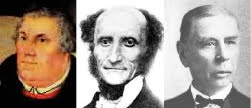
     Schmidt  ———  Stellhorn  ———  Tressel ——— Schwan —— O. Fuerbringer  ——   Allwardt   ——   Lehmann   ——   Brobst
    G. Fritschel  ———  Sihler  ——  E.A.W. Krauss —— Philippi —— A.L. Graebner  Stoeckhardt ——  Pieper  ——  R. Lange
- - - - - - - - - - - - - - - - - - - - - - - - -
The following is an English translation of C. Hochstetter's Geschichte… by BackToLuther utilizing the DeepL Translator with minor assistance from Dr. Fred Kramer's translation.  All hyperlinkshighlighting and red text in square brackets [] are mine. All internal hyperlinks are active in this embedded window, external links should be opened in a new tab or window.

      Walther's masterful handling of opponents as weak Christians during discussions (see p. 365-366) calls for a further personal testimony from CHIQ article in 1931.  This will be presented in the next "Excursus" and will be compared to a misjudgment against Walther by a Fort Wayne seminary professor. — After the break below, an example of a well-known Calvinist author/preacher of today, then the customary fine print version of the above chapter.  In the next Part 17Chapter 13a. 

Friday, March 6, 2026

AG7d: MacKenzie's "second error in Walther's citing of Luther"

      This continues from Part AG7c (Table of Contents in Part AG1a) in a series presenting Walther's essays to the Western District that supported his theme "That Only Through the Doctrine of the Lutheran Church is All Glory Given to God Alone". — In researching all the LC-MS and WELS theologian's writings on Walther, Luther, and Luther's writing The Bondage of the Will (or De Servo Arbitrio), none was more offensive than that of Prof. Cameron MacKenzie's from 2011, a writing supposing to honor Walther. Although I represented the main points of his essay in my 2012 blog post, yet it was not a well researched response, only pointing out the false "honoring" of  Walther. And MacKenzie's references were rather detailed enough so that I shied away from digging deeper since that time. But after translating Walther's 1873 and 1874 Western District essays in this series, I determined to do the deeper research. What I found only confirmed my 2012 judgment of Prof. MacKenzie's diatribe. — The best way that I know to present my case is to reproduce an excerpt from MacKenzie's essay of Walther's so-called "second error". — All highlighting, red text within square brackets [] (there is a lot of red text!), and hyperlinks are mine:
- - - - - - - - - - - - - - - - - - - - - - 
Prof. Cameron MacKenzie

MacKenzie: Walther's Use of Luther    269


A second error in Walther's citing of Luther is more serious but quite understandable [“quite understandable”? Why “understandable”? This is the first statement in Walther’s favor.] also. Walther is concerned to shield Luther from the charge of Calvinism, especially with respect to the Bondage of the Will. [Which Burnell Eckhardt also does in his helpful article in Logia. (Logia vol. 7 (1998), no. 4, pp. 23-30)] On the one hand, Walther knows that Luther thought this one of his best works.75 [Oh really? Luther: “I acknowledge none of them to be really a book of mine, except perhaps the one On the Bound Will and the Catechism] On the other hand, Walther also admits that "on occasion he [Luther] speaks in terms similar to Calvin"; he insists, however, that Luther's purpose was not to teach absolute predestination but "to deny the existence of man's free will in spiritual matters." Walther then cites the Augustana and the Formula in order to make the point that the Lutheran Church teaches that "man's salvation is exclusively a gift of God; in the case of damnation he is exclusively on his own.''76  [How is this pointing out Walther’s “second error”?]

So far so good. [Really? Admitting that Walther had something “good”? MacKenzie is surely loading his gun. This is the second statement in Walther’s favor.] Walther, however, wants specifically to rescue Luther from the accusation by others (Walther mentions the Iowa Synod77) that he, like Calvin, taught that God did not intend all people to be saved. Walther roars back with what appears [only appears?? This is actually the third statement in Walther’s favor.] to be an unanswerable quotation from Bondage,

God does not deplore the death of his people which he works in them, but he deplores the death which he finds in his people and desires to remove from them. . . . For he wills all men to be saved [1 Tim. 2:4], seeing that he comes with the word of salvation to all, and the fault is in the will that does not admit him, as he says in Matthew 23[:37]: "How often would I have gathered your children, and you would not!"78

__________________________

75 Convention Essays, 38-39 (1873 Synodal-Bericht des Westlichen Districts, 54).

76 Convention Essays, 39-40 (1873 Synodal-Bericht des Westlichen Districts, 54-55, 56).

77 According to Peter J. Thuesen [who quotes Mark Twain’s blasphemous saying], Predestination: The American Career of a Contentious Doctrine (Oxford: University' Press, 2009), 156, Gottfried Fritschel accused the Missouri Synod in 1870 of "slavish dependence" on Martin Luther even though he had "obviously erred" in his Bondage of the Will. Thus began a preliminary' battle regarding predestination between the Missouri and Iowa Synods even before the formation of the Synodical Conference which would shatter over the same subject just a few years after its founding (1872). For details regarding the Missouri/Iowa skirmish, see Hans R. Haug, "The Predestination Controversy in the Lutheran Church in North American" (Ph.D. dissertation, Temple University, 1968), 109-235. [Note: John Brenner of the WELS discounts Haug as writing from “a perspective of modern ecumenism which often fails to grasp the historic Lutheran stress on agreement in doctrine for the unity of the church”.]

78 Convention Essays, 40-41 (1873 Synodal-Bericht des Westlichen Districts, 56).


        270 Concordia Theological Quarterly 75 (2011)


This is a great quotation for Walther's position.79 [Really? Admitting that Walther had a “great quotation”? Again, MacKenzie is loading his gun. This is the fourth statement in Walther’s favor.] Unfortunately, it is also somewhat [only “somewhat”? Why equivocate?] misleading, for it contains an ellipsis of over 40 lines [Oh my! How terrible! But I count only 33-36 lines, depending on how one counts them. See ellipsis image here. MacKenzie is guilty of exaggerating. Why?] (in the Walch edition to which the Proceedings refer 80) that qualifies greatly what Luther is saying. [As it should, to distinguish the revealed God from the hidden God!] Walther has omitted the reformer's statements regarding the hidden will of God that is very different from the revealed will. [So what?? As if Walther omitted these statements to deceive his readers! “over 40 lines?” But he only omitted them because they were not appropriate for his point. And MacKenzie is implying that Luther was also a Calvinist.] So, for example, Walther has omitted this statement, "But God hidden in his majesty neither deplores nor takes away death, but works life, death, and all in all,"81 and this one, "God does many things that he does not disclose to us in his word; he also wills many things which he does not disclose himself as willing in his word. Thus, he does not will the death of a sinner, according to his word, but he wills it according to that inscrutable will of his."82

Now it may [may?] be that one can actually rescue [“actually”? — But no “rescue” is needed for those who can read Luther properly! See Brenner and Siegbert Becker. MacKenzie cannot.] Bondage of the Will from the charge of Calvinism—and Walther returns to this task a couple more times in his essays to the Western District83but Walther's citation from Luther in this instance is not a sufficient representation [Walther’s quote gets to the heart of Luther on the matter against Calvin, and MacKenzie wants to question this?] of what the reformer

_______________

79 And it brings Luther right into line with the Formula. [Are you surprised by this MacKenzie?] This was basic to Walther's thinking about Luther—the reformer and the Lutheran Confessions spoke with one voice. [But does MacKenzie also bring “Luther right into line with the Formula”? The Formula itself does! But MacKenzie later says the “whole approach to Martin Luther as…infallible teacher” is “long gone”. If that is so, then MacKenzie is denying that his own teaching is “confessional” since the Confessions 1) state that they are scriptural and 2) praise Luther’s doctrine.] Cf. LuW 21 (1875): 67, in which Walther equates Luther with the Book of Concord, "They do not know us who label our theology that of the seventeenth century. As highly as we treasure the immense accomplishments of the great Lutheran dogmaticians of this period, it is nevertheless not really to them that we return, but rather above all to our precious Book of Concord and to Luther, in whom we recognize the man whom God chose as the Moses of his church of the New Covenant, to lead his church, which had fallen into slavery to the Antichrist, out of that slavery. He is the column of smoke and fire of the Word of God, clear and pure as gold as it is." Quoted and translated in Kolb, "Luther for German Americans," 99. [It appears that MacKenzie’s venom towards Walther, and Luther, may have been instigated by the “scholarship” of Dr. Kolb. He refers to Kolb about a dozen times in this essay.]

80 Johann Georg Walch, ed., D. Martin Luthers sowol in deutsche als lateinischer Sprache verfertigte und aus der letztem in die erstere übersetzte sämtliche Schriften, 24 vols. (Salle im Magdeburgischen: Druckts und verlegts Johann Justinus Gebauer, 1739-53).

81 LW 33:140. "Gott aber, wie er verborgen ist in der Majestät, trauert nicht, nimmt den Tod nicht weg, sondern wirket Tod, Leben, etc., alles in allen." Walch 18: col. 2235 [W2 (StL) 18, 1795; StL 18, 1795 (EN); WA 18:685].

82 LW 33:140. "Es thut Gott viel Dinges, das er uns durchs Wort nicht zeiget; er will auch viel Dinges, das er uns durchs Wort nicht zeiget, dass ers will. Also will er den Tod des Sünders nicht nach dem Willen, den er durchs Wort offenbaret hat; er will aber nach dem verborgenen, unerforschlichen Willen." Walch 18: col. 2236 [W2 (StL) 18, 1795].

83 1874, Convention Essays, 67-68 (1874 Synodal-Bericht des Westlichen Districts, 33- 36); and 1877, Essays 2: 142-143 [All Glory to God, p. 225-228] (1877 Synodal-Bericht des Westlichen Districts, 97-100). In the latter case, Predestination, Walther admits that "contrary to our usual practice," he has cited Luther rarely and undertakes to produce only passages that show he was not a Calvinist. [Burnell Eckhardt does the same here (Logia vol. 7 (1998), no. 4, pp. 23-30).] Presumably, there were other passages not so dear. [Why this critical remark? Implies that Luther was a Calvinist?] Walther also includes (p. 143) the same misleading [“misleading” according to MacKenzie.] quotation from Bondage of the Will that he had used in 1873.


MacKenzie: Walther's Use of Luther    271


actually said. Walther omitted the evidence that did not immediately confirm Walther's own position.84 [Why this comment if Walther proved his point? This is poor theology!]

____________

84 Another part of the problem may ["may"? Pure speculation.] be that Walther read Luther in the context of later Lutheranism. As Robert Kolb, "Interpreter of Luther," 482, suggests, "[Walther's] knowledge of Luther came from his own reading of the sources, but that reading has been poured into forms and categories dictated by later generations." [What?! We see more evidence of Dr. Kolb's speculative thinking influencing MacKenzie's thinking.]

- - - - - - - - - - - - - - - - - - - - - - 
On page 273, MacKenzie makes the incredible statement:
"But Walther is long gone and so is his whole approach to Martin Luther asinfallible teacher."
This assertion is an untruth since Walther in the very same 1873 Western District essay stated that "Luther was not a prophet and apostle who could not have been mistaken", see AG1b blog, p. 48. In this essay, MacKenzie actually distances himself, and his LC–MS, not just from Walther and Luther, but from Lutheranism! One can only hope that Prof. Cameron MacKenzie has seen his error and turned from this venomous position. — In the next Part AG8a, the 1882 Western District essay.