Search This Blog

Tuesday, October 17, 2023

Preuss6: a house of cards—dismantled secret plan

[2023-11-07: correct name at bottom, Robert Louis Wilken]
      This continues from Part 5 (Table of Contents in Part 1) in a series presenting C. F. W. Walther's account of Dr. Eduard Preuss's apostasy to the Roman Catholic Church. — Walther reveals now how Preuss's coercive business practices found him out. Prof. Fuerbringer admitted that he could not figure out why Preuss defected. Walther explains in the narrative below what the actual reason was. — From Der Lutheraner, vol. 28 (Feb. 15), pp. 74-75. 
- - - - - - - - - - - - -    An Apostasy.    - - - - - - - - - - - - -

[by C. F. W. Walther; Part 6]

However, 


1. when we revealed to Preuss at the end of November, that the person in question had informed us conscientiously of a contract he had secretly concluded, by means of which he [Preuss] had already made himself obligated to give up his office at the seminary, and that this contract was null and void, since it concerned a matter dependent on the Synod; 

2. when we, in response to the statement that no one could prevent him from publishing an entertainment paper independent of the Synod, which he had now lost in his dismay, gave him reason to consider that such a paper published in opposition to the Synod would not hold a soul in the Synod either; 

3. when, therefore, his whole plan, which had hitherto been cleverly concealed and apparently well laid out, collapsed before his eyes like a house of cards and he had to fear being appointed to office it was only now that he came to the fore, namely immediately on the following day, with the unexpected opening: that he had “lost the conviction of the correctness of the whole Lutheran doctrine of justification” and that therefore he is “bound by his conscience (!)” to “resign his theological professorship at the local Lutheran Concordia College”.

"Pope's Church his last, only, remaining refuge"

We are, however, of the conviction that Preuss, if he ever stood in a living faith (which we leave aside), did not really have a conviction of the correctness of the Lutheran doctrine of justification for a long time; but it is equally certain that this could not have been the actual cause of his resignation and apostasy to the Papist sect.  This is because at the same time, until his secret agreement was revealed, he was nevertheless <page 75> playing in the most skillful manner the decidedly faithful Lutheran and the most enthusiastic member of the Missouri Synod, while he was working on playing a card from his hand to his advantage against that same synod. The sudden dismantling of the plan (for which he still hoped to win against the publisher) to obtain a lighter, more pleasant and at the same time more profitable position, furthermore the danger associated with being a secret salesman of the Synod and as a secret opponent of the same, and therefore finally the conviction that the Pope's Church was his last, only, remaining refuge for him—this and nothing else forced the unfortunate man to resign himself and to become Roman.


Finally, as for the explanation contained in a letter of resignation, that he had also "been misled by the Lutheran doctrine of the perfect forgiveness of sins," that he had recognized God's "punishments" in the "vituperations" against him because of his "former impulses," as he put it, although he had believed in Christ: this statement may well contain some truth. But what can be concluded from this at the same time is that Preuss, in the terrible shame with which he came to us covered with, according to his own admission always saw only “punishments” with which God pursued him from country to country because of his “former impulses”: we do not want to decide this, but leave it to the One in whom “the darkness hideth not from thee; but the night shineth as the day”. [Psalm 139:12] But that the feeling of being persecuted by God's punishments could not have driven Preuss into the Pope's Church is only too certain, since, as is well known, it is precisely this “church” that gives no consolation against that feeling, but rather confirms the same as correct through its doctrine of the forgiveness of sins.

- - - - - - - - - -  Continued in Part 7  - - - - - - - - - - -
It was a struggle to translate the last paragraph above. But Walther's last sentence came through loud and clear. To jump to the church with "no consolation" is to jump into the fire.
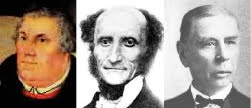
     Dr. Eduard Preuss may be compared with the likes of former LC-MS men Jaroslav Pelikan, Robert Wilson, [2023-11-07: should be Robert Louis Wilken, 1936-, Coming Home Network, YouTube, text], and Richard John Neuhaus — all who left the Lutheran Church. Walther's scathing response to Preuss will give a sense of how he would respond to these former LC-MS men — and to all those of the "Walkout" crowd of 1974. — In the next Part 7…

Saturday, October 14, 2023

Preuss5: "we trusted, in love"; he "did not resign voluntarily"

     This continues from Part 4 (Table of Contents in Part 1) in a series presenting C. F. W. Walther's account of Dr. Eduard Preuss's apostasy to the Roman Catholic Church. — By his own theological actions, Preuss was a dishonest hypocrite between his former and later life, resorting to morally unthinkable actions. And his secret business dealings revealed below by Walther (who should know better than anyone) only confirm his inner self. — From Der Lutheraner, vol. 28 (Feb. 15), pp. 74.
- - - - - - - - - - - - -    An Apostasy.    - - - - - - - - - - - - -

[by C. F. W. Walther; Part 5]

 
"a thoroughly, almost unprecedentedly dishonest character"

What can we say about that? — We think that only those who have lost a feeling for truthfulness, sincerity, and honesty for his own person, only those do not see that Dr. Preuss, if he has not lied in his letter of resignation, then he was hypocritical in his articles for the Abendschule and Lehre und Wehre. And that if he was not hypocritical in these articles, then he was so in his letter of resignation. That is, that in any case, whatever case we may assume, he has revealed himself as a thoroughly and almost unprecedentedly dishonest character. For it is conceivable that even an honest man, although tormented by grave doubts about Lutheran teachings, may remain in the Lutheran office for a time, hoping to be released from his doubts, and remaining silent until then about the teachings which have become really uncertain for him; but unthinkable, it is morally unthinkable, that the one whose faith is shaken in the main doctrine of the Lutheran Church [Justification] should at the same time not only still present this main doctrine orally and in writing, but even defend it with great zeal and apparently great assurance of faith and faithfulness, and even cite the antagonism of certain doctrines against that main doctrine which has become uncertain to him as the last, highest, most certain proof that such doctrines must be erroneous. But the latter was done by Preuss in those articles. And at the same time that the Antichrist was publicly portrayed, he surrendered his body and soul to the same a few days later. The world so often says that preachers and theologians themselves do not believe what they preach and write. As unjust as this is now, when the world thereby declares all preachers and theologians to be hypocrites, it cannot be denied that there are also preachers and theologians who preach and write what they themselves do not believe, that is, hypocrites; a striking example of this is Preuss, according to his own admission.

he stood in the deepest shame

Perhaps this still seems to stand in the way of many: First of all, that Preuss experienced among us Lutherans a love which he did not experience anywhere else; that we Lutherans, when he stood in the deepest shame before the whole world, [See Ziegler, p. 290 fn # 8] endangered our own good name by accepting him and, while we reaped shame for it, tried to help him again to a good name, because since there was no compelling proof of guilt, we trusted, in love, his personal assertions that he was innocent; secondly, that Preuss among the Lutherans obtained suitable and rewarding offices according to his gifts. Some may wonder therefore what could have made him, other than his conscience, suddenly give up all this, voluntarily resign himself, and now throw himself into the arms of a community of which he <column 3> did not know whether it would give him a better lot?


Unfortunately, however, it is a fact that Preuss did not resign voluntarily, but only sent in his resignation because he had to fear dismissal. By a strange chain of circumstances at the end of November last year [1871] we discovered that Preuss had already long ago besieged the publisher of a Christian, entertainment newspaper dependent on the synod [Abendschule?] to accept him as co-owner. And when he was not able to achieve this, he had already drawn up a contract on July 22, 1871, signed it himself and coerced the aforementioned publisher into co-signing it, in which Preuss, behind the back of the synod in which he held office, made it binding as soon as the other counterparty would be required to resign from office, namely to “turn his entire working time over to the good editorial work and constant improvement” of that newspaper, on the condition that of reaching a certain number of subscribers he would receive an annual salary of $4000, and as editor, with the increase in the number of subscribers, to receive an ever-increasing salary punctually on the specific day. At the same time, Preuss had insisted that this agreement should be kept strictly secret until the proper time. As long as this matter was still pending and Preuss thought that it was certain of its goal by the signed secret contract, as long as there was not to be discovered the slightest doubt about any Lutheran teaching by Preuss, so he rather taught and defended orally and in writing each of them with all his dialectical gifts so abundantly given to him 6), and declared himself continually ready to step into the breach for any point of our church doctrine. 

————————

6) Dialectical gifts are gifts to prove and disprove in disputation.

————————

"Die Abendschule" masthead, 1867- - - - - - - - - -  Continued in Part 6  - - - - - - - - - - -
      In the above, reference is made to the Abendschule, a popular newspaper by the Missourian Louis Lange. A previous blog post gave some information on it. — It is evident that Walther did not enjoy giving the full account of Dr. Preuss's coercive business dealings. — In the next Part 6…

Tuesday, October 10, 2023

Preuss4: writes against Purgatory, then resigns

      This continues from Part 3 (Table of Contents in Part 1) in a series presenting C. F. W. Walther's account of Dr. Eduard Preuss's apostasy to the Roman Catholic Church. — Walther continues his examples of Preuss's powerful polemics, with portions from his last writings as a Lutheran, just before he went out the door. — From Der Lutheraner, vol. 28 (Feb. 15), pp. 74.
- - - - - - - - - - - - -    An Apostasy.    - - - - - - - - - - - - -

[by C. F. W. Walther; Part 4]


… Also in the December issue of Lehre und Wehre last year, he published the conclusion of an article against the Hades doctrine [“X.” listed as the author] of the Romanizing neo-believers [Neugläubigen], that is, against the doctrine that after death men do not immediately go either to hell or to heaven, but to an intermediate place, which they call Hades, where the souls can still do something for their salvation. In it Preuss speaks of the Papists as people who are even worse off with their purgatory than the Romanizing neo-believers, and in so doing he refers to the fact that the doctrine of an intermediate place and intermediate state cannot be accepted simply because it contradicts the pure Lutheran doctrine of justification. For example, he writes on p. 357: 

“Papists also try to strengthen their intermediate state with passages like Matt. 5:26 and Matt. 18:34, which are to strengthen their purgatory”. 

Whereupon he then shows that these and other passages confirm nothing less than this error, and finally adds p. 361: 

“Thus all the pillars have proved to be null and void, so that the intermediate-state theologians tried to support their theory allegedly from the Holy Scriptures. And it remains with the old simple doctrine of our dear Lutheran Church, a doctrine which is in truth witnessed by the Holy Scriptures, even by the New Testament, on almost all its pages.” 5) 

Image of purgatory by Ludovico Carracci (Wikipedia)

On page 362 Preuss also writes: 

“The Pope may invent a purgatory. God's Word has no material for it. Our dear Luther has therefore also rejected it, along with other papal imaginings [Fündlein], far from himself.” 5) 

Preuss cites abundant testimonies from Luther's writings, among others also p. 364, the passage in which Luther shows that the Papists mainly, for the sake of 2000 drachmas written of in 2 Maccab. 12:43, cling to their doctrine of purgatory. After Preuss had also quoted hymn verses from Lutheran hymn books, which testify that the believers enter heaven for salvation as soon as they die, he concludes his essay on p. 365 with the following words: 

“Against the whole singing church as well as against the whole teaching church, the German innovators enter into battle. And if it were only that; but they argue against the Bible itself! For the Scriptures of both Testaments know, as we have seen, only two places where the souls of the dead go, not three or four. Against these scriptural passages those intermediaries violate; and not only against these! Rather, they threaten the pure doctrine of justification itself. 5) For if men after death do not fall into two groups, wretched and saved, neither do they fall into two groups before that. So it does not say before that: before God unjust or just! Thus the blood of Christ does not cleanse from all sins. So too the justification has its stages. — With the late [E. W.] Hengstenberg <column 2> the error has really developed. First in the doctrine of the state of souls after death and then in the doctrine of justification he gave way to truth. His Scheol doctrine, especially with regard to the Old Testament, long before his aberration in that main point, indeed—as much as the writer of these lines knows—was never different from the modern one opposed here. It is dangerous to give up any point of faith even the slightest.”

————————

5) Emphasized by us.

————————

So Dr. Preuss had this printed on December 1, 1871. And on the same day (!!) he submitted in writing his resignation, in which he stated as his reason: because he had “lost the conviction of the correctness of the whole Lutheran doctrine of justification after several months of heavy struggles”! — 

- - - - - - - - - -  Continued in Part 5  - - - - - - - - - - -
      It is difficult to imagine one so devious as Dr. Eduard Preuss! In my opinion, only C. F. W. Walther was spiritually capable enough to perceive Preuss’s faults before he resigned, and assess the whole affair afterwards. — The polemic against the well-known German theologian Hengstenberg reveals his Romanizing tendency, something usually not mentioned about him. — In the next Part 5…