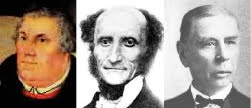
.jpg "Walther, Melanchthon, Luther")
"How much would we have preferred to be able to help that only the memory of Melanchthon should be kept alive from the time of his faithfulness and blessed efficacy, but that the memory of him from the time of his softening and falling should be wiped out and buried forever!"
The “Carrying” of Melanchthon on the Part of Luther.
[by C. F. W. Walther, Part 1]
After Luther's death, it has often been pointed out to those Lutherans who did not want to hold fraternal, altar and church fellowship with manifest false teachers within our church, that Luther, as we know, had himself cultivated such fellowship with Melanchthon, even after the latter had no longer agreed with Luther on several important points of doctrine. *) Such Lutherans, it was claimed, obviously wanted to be more strictly Lutheran than Luther himself. A Lutheran in Luther's sense should not break off fellowship with the erring who still professed the faith of our church, but should rather bear and tolerate it, as Luther once did with a Melanchthon.
,%20Woehling,%20p%2055.jpg "Carl Manthey Zorn, Otto Willkomm, J. F. Zucher (former East Indian missionaries)")
In recent times this was also reproached to those East Indian missionaries [Zorn, Willkomm, Zucker] who had been dismissed and who declared that they could no longer remain in the service of the Leipzig Missionary Society if the latter did not break away from fellowship with notorious false teachers in which it is known to stand. Missionary Zorn wrote to us from East India that Director Hardeland had said to them, the missionaries troubled in their conscience, “You want to be more orthodox than Luther. — You have to take a man as a Lutheran for as long as he is Lutheran, that is, not to separate from him when he professes to be Lutheran. Here,” it goes on, “Luther's carrying of Melanchthon from 1542-1546 was cited (and cited again and again) as a resounding example of healthy church practice from the fundamental period of the Reformation.”
————
*) This was done by, among others, the crypto-Calvinist Dr. Caspar Peucer, Melanchthon's son-in-law, in his Tractatus historicus de Melanchthonis sententia de controversia Coenae Domini, 1576, and the Philippists at the Altenburg Colloquium in 1568, who went further, claiming that Luther agreed with Melanchthon's deviations from the earlier doctrine.
(LuW 322)
If Melanchthon had really already become apparent in Luther's time as a stubborn false teacher, and if Luther had really let Melanchthon have his way during this time, then one would have to admit that those Lutherans who do not want to cultivate fellowship with false teachers appearing in our church [i.e. theologians claiming to be Lutheran] do not act in Luther's sense, at least not according to Luther's example.
But the matter stands, thank God, quite differently; and the intention of the present article is to prove this.
.JPG "Prof. Friedrich Bente, Concordia Seminary")

.jpg "St. Louis Edition of Luther's works (Mezger, Denkstein)")
%20Luther_Weimar_Ausgabe.JPG "Weimar Edition (Wikipedia)")


.jpg)


.jpg "Valentine Löscher (Wikiepedia)")
.jpg "Abraham Calov")