I have been spending many days (actually weeks) working to provide not only scanned copies of old Missouri essays and published writings, but now also the actual text files extracted by OCR. As a result, I have added dozens of links to text document files (in German) to my Convention Essays reference blog post.
Another goal of mine is to provide the complete text to all 3 of Pieper's original German Christliche Dogmatik volumes. Recently I finished extracting the text of the easiest volume – "Volume 4", the Index (or "Register") by Ernst Eckhardt. That is now available in a link in my original posting offering links to scanned copies of all volumes. It is also available via this link. It is amazing to me that when one opens this Google Doc file in the Chrome Browser, it offers an immediate English translation that takes about 20 seconds for the whole book (I timed it.) — I am also providing a text box in this post of this same document for reference. (Highlighted text is mine):
Who was Ernst Eckhardt? And what good is his Index in the German language for the English-speaking world when one can obtain the more extended Index in the English Volume 4? I will cover these topics in this continuing series – Part 2 is next...
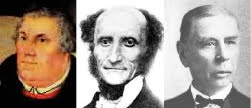
Back To Luther... and the old (German) Missouri Synod. Below are thoughts, confessions, quotations from a Missouri Synod Lutheran (born 1952) who came back to his old faith... and found more treasures than he knew existed in the training of his youth. The great Lutheran lineage above: Martin Luther, C.F.W. Walther, Franz Pieper.
Monday, August 24, 2015

Thursday, August 13, 2015
Buddhism contrasted with Christianity-Pt 3 (Monier-Williams over William J. Danker... and David Scaer)
This concludes from Part 2 adding information and comments on the writing of Monier Monier-Williams on Buddhism vs. Christianity.
In my initial blog post on "Pieper's Error", I reported that I was unable to find out from Concordia Publishing House how they discovered "Pieper's Error" to correct it from Max Mueller to Monier-Williams. Since that time, further research is conclusive that the discovery was made from a 1977 article by Prof. William J. Danker after he (and his more famous brother Frederick W. Danker) had been removed from Concordia Seminary for false teaching. (Note to CPH editors: you can now add notes to your file for anyone who asks you, that it was Danker's essay that was the impetus to correct "Pieper's error" in Christian Dogmatics, Volume 1, page 15)
An LC-MS trained liberal "Lutheran" teacher, Prof. William J. Danker († 2001), attempted (in his essay pg 238) to refute Monier-Williams and claimed that a "Pure Land Buddhism" had a "sweeping emphasis on salvation by grace through faith in Amida Buddha". He even claimed that "ideas of salvation by grace are not unknown in Hinduism" (which Prof. David Scaer of Fort Wayne repeats). Danker of course gives his interpretation from an erring perspective as he discards Holy Scripture and muddles the teaching on pure grace, grace alone, and Justification. But most importantly, all Christians can judge Prof. William J. Danker to be utterly foolish in these claims for they know beforehand (a priori) that he was deceived. How so? Because Holy Scripture says so:
I cringed in places where it seemed that Monier-Williams allowed too much credence to Buddhism and other Eastern religions in this essay. But these misgivings melted away as Monier-Williams throws all ideas of man-made religions to the ground in relation to the Truth. And although Pieper erroneously identified his quote to be that of Max Müller, yet Pieper's confirmation of this message is one of the greatest Christian compliments ever pronounced on an Englishman! The exception to this would be for those Lutherans in England who desperately worked to get the true religion to that country during the Reformation century.
May the name of Monier-Williams be remembered through Franz Pieper's quote of him and by his wonderful defense of the only true religion.
- - - - - - - - - - - - - - - - - - - - - -
Anyone who would claim that Monier-Williams was not conversant with the religion of Buddhism or that Buddhism may have changed or have variants since his day would thereby indicate a presumption. Monier-Williams had extensive first-hand knowledge among the people of India. — Many today would look to Mahatma Gandhi and his "Gandhism" to understand the Eastern religions. — In my initial blog post on "Pieper's Error", I reported that I was unable to find out from Concordia Publishing House how they discovered "Pieper's Error" to correct it from Max Mueller to Monier-Williams. Since that time, further research is conclusive that the discovery was made from a 1977 article by Prof. William J. Danker after he (and his more famous brother Frederick W. Danker) had been removed from Concordia Seminary for false teaching. (Note to CPH editors: you can now add notes to your file for anyone who asks you, that it was Danker's essay that was the impetus to correct "Pieper's error" in Christian Dogmatics, Volume 1, page 15)
An LC-MS trained liberal "Lutheran" teacher, Prof. William J. Danker († 2001), attempted (in his essay pg 238) to refute Monier-Williams and claimed that a "Pure Land Buddhism" had a "sweeping emphasis on salvation by grace through faith in Amida Buddha". He even claimed that "ideas of salvation by grace are not unknown in Hinduism" (which Prof. David Scaer of Fort Wayne repeats). Danker of course gives his interpretation from an erring perspective as he discards Holy Scripture and muddles the teaching on pure grace, grace alone, and Justification. But most importantly, all Christians can judge Prof. William J. Danker to be utterly foolish in these claims for they know beforehand (a priori) that he was deceived. How so? Because Holy Scripture says so:
1 Cor. 2:9 – Eye hath not seen, nor ear heard, neither have entered into the heart of man, the things which God hath prepared for them that love him.Danker would have shrugged off this verse just like Hermann Sasse shrugged off Pieper's use of John 10:35 -- "The Scripture cannot be broken." But dear reader, you may not shrug off Scripture... if you covet your soul's salvation. — Indeed, I claim Danker's refutations as a proof of the trustworthiness of Monier-Williams' account. Danker may have had experiences in the East (especially Japan), but whatever good was done in his mission work in the East was not from his errors and weaknesses but from whatever truth remained from his schooling at Concordia Seminary. Unfortunately his "Japan Lutheran Church" is plagued with his unionistic (at times false) teaching. Prof. Scaer calls Danker's writing "a fascinating article" (search "a fascinating article" here), certainly because he follows Danker's false teaching. And both Danker and Scaer would say they were teachers of the Christian faith. (Note to Japan Lutheran Church: look to Franz Pieper's teaching to find the path to the true Lutheran teaching, the pure teaching of Grace.) —
I cringed in places where it seemed that Monier-Williams allowed too much credence to Buddhism and other Eastern religions in this essay. But these misgivings melted away as Monier-Williams throws all ideas of man-made religions to the ground in relation to the Truth. And although Pieper erroneously identified his quote to be that of Max Müller, yet Pieper's confirmation of this message is one of the greatest Christian compliments ever pronounced on an Englishman! The exception to this would be for those Lutherans in England who desperately worked to get the true religion to that country during the Reformation century.
May the name of Monier-Williams be remembered through Franz Pieper's quote of him and by his wonderful defense of the only true religion.
- Monier-Williams: "...throughout all the heathen religions there is the one refrain through all: salvation by works. They all say that salvation must be purchased, must be bought with a price, and that the sole price, the sole purchase-money, must be our works and deservings. Our own Holy Bible, our sacred Book of the East, is from beginning to end a protest against this doctrine."
- Galations 2:16 – Knowing that a man is not justified by the works of the law, but by the faith of Jesus Christ, ... for by the works of the law shall no flesh be justified.
- Ephesian 2:8-9 – For by grace are ye saved through faith; and that not of yourselves: it is the gift of God: Not of works, lest any man should boast.
Wednesday, August 12, 2015
Buddhism contrasted with Christianity-Part 2 of 3 (Monier-Williams)
This continues from Part 1 the chapter from a book by Monier-Williams. Please note that Part 1 was updated significantly since first published. It has been republished August 12, 5:30 pm EST.
This text may be followed in Google Books here.
This chapter has stirred my faith so much that I am stretching this series out to Part 3 with some additional information and comments.
This text may be followed in Google Books here.
————————————————————————————
LECTURE XVIII.
Buddhism contrasted with Christianity.
by Sir Monier Monier-Williams
(Continues and concludes from Part 1)
by Sir Monier Monier-Williams
(Continues and concludes from Part 1)
Still, I seem to hear some admirers of Buddhism...
————————
550 BUDDHISM CONTRASTED WITH CHRISTIANITY.
say: We admit the force of these contrasts, but surely you will allow that in the moral law of Buddha we find precepts identically the same as those of Christianity—precepts which tell a man not to love the world, not to love money, not to hate his enemies, not to do unrighteous acts, not to commit impurities, to overcome evil by good, and to do to others as we would be done by?
Well, I admit all this. Nay, I admit even more than this; for many Buddhist precepts command total abstinence in cases where Christianity demands only temperance and moderation. The great contrast, as I have already explained, between the moral precepts of Buddhism and Christianity, is not so much in the letter of the precepts, as in the power brought to bear in their application.
Buddhism, I repeat, says: Act righteously through your own efforts, and for the final getting rid of all suffering, of all individuality, of all life in yourselves. Christianity says: Be righteous through a power implanted in you from above, through the power of a life-giving principle, freely given to you, and always abiding in you. The Buddha said to his followers: ‘Take nothing from me, trust to yourselves alone.’ Christ said: ‘Take all from Me; trust not to yourselves. I give unto you eternal life, I give unto you the bread of heaven, I give unto you living water.’ Not that these priceless gifts involve any passive condition of inaction. On the contrary, they stir the soul of the recipient with a living energy. They stimulate him to noble deeds, and self-sacrificing efforts. They compel him to act as
BUDDHISM CONTRASTED WITH CHRISTIANITY. 551
the worthy, grateful, and appreciative possessor of so inestimable a treasure.
Still, I seem to hear some one say: We acknowledge this; we admit the truth of what you have stated; nevertheless, for all that, you must allow that Buddhism conferred a great benefit on India by encouraging freedom of thought and by setting at liberty its teeming population, before entangled in the meshes of ceremonial observances and Brahmanical priestcraft.
Yes, I grant this; nay, I grant even more than this. I admit that Buddhism conferred many other benefits on the millions inhabiting the most populous part of Asia. It introduced education and culture; it encouraged literature and art; it promoted physical, moral, and intellectual progress up to a certain point; it proclaimed peace, good will, and brotherhood among men; it deprecated war between nation and nation, it avowed sympathy with social liberty and freedom; it gave back much independence to women; it preached purity in thought, word, and deed (though only for the accumulation of merit); it taught self-denial without self- torture; it inculcated generosity, charity, tolerance, love, self-sacrifice, and benevolence, even towards the inferior animals; it advocated respect for life and compassion towards all creatures; it forbade avarice and the hoarding of money; and from its declaration that a man’s future depended on his present acts and condition, it did good service for a time in preventing stagnation, stimulating exertion, promoting good works of all kinds, and elevating the character of humanity
Then again, when it spread to outlying countries it
552 BUDDHISM CONTRASTED WITH CHRISTIANITY.
assumed the character of a religion; it taught the existence of unseen worlds; it permitted the offering of prayers to Maitreya and other supposed personal saviours; it inculcated faith and trust in these celestial beings, which operated as good motives in the hearts of many, while the hope of being born in higher conditions of life, and the desire to acquire merit by reverential acts, led to the development of devotional services, which had much in common with those performed in Christian countries. Nay, it must even be admitted that many Buddhists in the present day are deeply imbued with religious feelings, and in no part of the world are the outward manifestations of religion—such as temples and sacred objects of all kinds—so conspicuous as in modem Buddhist countries.
But if, after making all these concessions, I am told that, on my own showing, Buddhism was a kind of introduction to Christianity, or that Christianity is a kind of development of Buddhism, I must ask you to bear with me a little longer, while I point out certain other contrasts, which ought to make it clear to every reasonable man, how vast, how profound, how impassable is the gulf separating the true religion from the false philosophy, and from the later religious systems developed out of it.
And first, observe that Buddhism has never claimed to be an exclusive system. It has never aimed at taking the place of other religions. On the contrary it tolerates all, and a Buddhist considers that he may be at the same time a Hindu, a Confucianist, a Taoist, a Shintoist, and even, strange to say, a Christian.
BUDDHISM CONTRASTED WITH CHRISTIANITY. 553
A Christian, on the other hand, holds as a cardinal doctrine of his religion, that there is only one Name under heaven given among men, whereby any human being can be saved. To be at the same time a believer in Christ and a believer in Buddha implies an utter contradiction in terms.
Then it need scarcely be repeated here that Christ is before all things a majestic example of a great historic personality. Any really historical, matter- of-fact account of the life of Buddha, like that of the life of Christ by the four Evangelists, may be looked for in vain through all the Buddhist scriptures. The Buddha’s biography is mixed up with such monstrous legends, absurd figments, and extravagant fables, that to attempt the sifting out of any really historical element worthy of being compared with the pregnant simplicity—the dignified brevity of the biography of Christ, would be an idle task.
Still we may note two or three obvious points of comparison and contrast.
And perhaps the most important is, that Christ constantly insisted on the fact that He was God-sent, whereas the Buddha always described himself as self sent. How indeed could the Buddha have said ‘the great I AM hath sent me unto you1’ when he had no belief in the eternal existence of any Ego at all? Not even in the reality of his own individuality.
All that he affirmed of himself was that he came into the world to be a teacher of perfect wisdom, by
————————
1 Exodus 3:14.
554 BUDDHISM CONTRASTED WITH CHRISTIANITY.
a force derived from his own acts. By that force alone he had passed through innumerable bodies of gods, demi-gods, demons, men, and animals, until he reached one out of numerous heavens, and thence by his own will descended upon earth and entered the side of his mother in the form of a white elephant (see pp. 23, 477). Let those who speak of his 'virgin-mother’ bear this in mind.
Christ, on the other hand, made known to his disciples, that He was with His Father from everlasting, ‘Before Abraham was, I am.’ Then in the fulness of time, He was sent into the world by His Father, and was born of a pure virgin, through the power of the Holy Spirit, in the likeness and fashion of men.
Next let us note a vast contrast in the fact that Christ was sent from heaven to be born on earth in a poor and humble station, to he reared in a cottage, to be trained to toilsome labour as a working-man; whereas the Buddha came down to be born on earth in a rich and princely family; to be brought up amid luxurious surroundings, and finally to go forth as a mendicant-monk, depending upon others for his daily food and doing nothing for his own support.
Then, again, Christ as He grew up showed no signs of earthly majesty in his external form, whereas the Buddha is described as marked with certain mystic symbols of universal monarchy on his feet and on his hands, and taller and more stately in frame and figure than ordinary human beings (see pp. 476, 501).
Then, when each entered on his ministry as a teacher, Christ was despised and rejected by kings and princes.
BUDDHISM CONTRASTED WITH CHRISTIANITY. 555
and followed by poor and ignorant fishermen, by common people, publicans, and sinners; Buddha was honoured by kings and princes, and followed by rich men and learned disciples.
Then Christ had all the treasures of knowledge hidden in Himself, and made known to His disciples that He was Himself the Way, and the Truth, — Himself their Wisdom, Righteousness, Sanctification, and Redemption. Buddha declared that all enlightenment and wisdom were to be attained by his disciples, not through him, but through themselves and their own intuitions; and that, too, only after long and painful discipline in countless successive bodily existences.
Then in regard to the miracles which both the Bible and the Tripitaka describe as attestations of the truth of the teaching of each, contrast the simple and dignified statement that ‘the blind receive their sight, the lame walk, the lepers are cleansed, the deaf hear, the dead are raised up, and the poor have the gospel preached unto them 1,' with the following description of the Buddha’s miracles in the Mahā-vagga (1. 20, 24)2: ‘At the command of the Blessed One the five hundred pieces of fire-wood could not be split and were split, the fires could not be lit up and were lit up, could not be extinguished and were extinguished. Besides he created five hundred vessels with fire. Thus the number of these miracles amounts to three thousand five hundred.’
Then, although each made use of missionary agency,
————————
556 BUDDHISM CONTRASTED WITH CHRISTIANITY.
the one sent forth his high-born learned monks as missionaries to the world at the commencement of his own career, giving them no divine commission; the other waited till the close of His own ministry, and then said to His low-born, unlearned disciples, ‘As My Father hath sent Me, even so send I you' (St. John 20:21).
Then, when we come to compare the death of each, the contrast reaches its climax; for Christ was put to death violently by wicked men, and died in agony an atoning death, suffering for the sins of the world at the age of thirty-three, leaving behind in Jerusalem about one hundred and twenty disciples after a short ministry of three years. Whereas the Buddha died peacefully among his friends, suffering from an attack of indigestion at the age of eighty, leaving behind many thousands of disciples after forty-five years of teaching and preaching.
And what happened after the death of each? Christ, the Holy One, saw no corruption, but rose again in His present glorified body, and is alive for evermore— nay, has life in Himself ever flowing in life-giving streams towards His people. The Buddha is dead and gone for ever; his body, according to the testimony of his own disciples, was burnt more than 400 years before the Advent of Christ, and its ashes were distributed everywhere as relics.
Even according to the Buddha’s own declaration, he now lives only in the doctrine which he left behind him for the guidance of his followers.
And here again, in regard to the doctrine left behind by each, a vast distinction is to be noted. For the
BUDDHISM CONTRASTED WITH CHRISTIANITY. 557
doctrine delivered by Christ to His disciples is to spread by degrees everywhere until it prevails eternally. Whereas the doctrine left by Buddha, though it advanced rapidly by leaps and bounds, is, according to his own admission, to fade away by degrees, till at the end of 5000 years it has disappeared altogether from the earth, and another Buddha must descend to restore it. (Compare Postscript at end of Preface, p. xiv. )
Then that other Buddha must be followed by countless succeeding Buddhas in succeeding ages, whereas there is only one Christ, who can have no successor, for He is alive for ever and for ever present with His people: ‘Lo, I am with you alway, even unto the end of the world.' [Matt. 28:20]
Then observe that, although the Buddha’s doctrine was ultimately written down by his disciples in certain collections of books, in the same manner as the doctrine of Christ, a fundamental difference of character— nay, a vast and impassable gulf of difference— separates the Sacred Books of each, the Bible of the Christian and the Bible of the Buddhist.
The characteristic of the Christian’s Bible is that it claims to be a supernatural revelation, yet it attaches no mystical talismanic virtue to the mere sound of its words. On the other hand, the characteristic of the Buddhist Bible is that it utterly repudiates all claim to be a supernatural revelation; yet the very sound of its words is believed to possess a meritorious efficacy capable of elevating any one who hears it to heavenly abodes in future existences. In illustration I may advert to a legend current in Ceylon, that once
558 BUDDHISM CONTRASTED WITH CHRISTIANITY.
on a time 500 bats lived in a cave where two monks daily recited the Buddha’s Law. These bats gained such merit by simply hearing the sound of the words, that, when they died, they were all re-born as men, and ultimately as gods.
Then as to the words themselves, contrast the severely simple and dignified style of the Bible narrative, its brevity, perspicuity, vigour, and sublimity, its trueness to nature and inimitable pathos, with the feeble utterances, the tedious diffuseness, and I might almost say ‘the inane twaddle’ and childish repetitions of the greater portion of the Tripitaka (see note 2, p. 541).
But again, I am sure to hear the admirers of Buddhism say: Is it not the case that the doctrine of Buddha, like the doctrine of Christ, has self-sacrifice as its key-note? Well, be it so. I admit that the Buddha taught a kind of self-sacrifice. I admit that he related of himself that, on a particular occasion in one of his previous births1, he plucked out his own eyes, and, that on another, he cut off his own head as a sacrifice for the good of others; and that again, on a third occasion, he cut his own body to pieces to redeem a dove from a hawk2. Yet note the vast distinction between the self-sacrifice taught by the two systems. Christianity demands the suppression of selfishness; Buddhism demands the suppression of self, with the one object of extinguishing all consciousness of self. In
————————
1 It is necessary to point out that these acts of self-sacrifice took place in former states of existence, for when a man becomes a Buddha he has no need to gain merit by self-sacrifice.
2 See p. 130.
BUDDHISM CONTRASTED WITH CHRISTIANITY. 559
the one, the true self is elevated and intensified. In the other, the true self is annihilated by the practice of a false form: of non-selfishness, which has for its real object, not the good of others, but the annihilation of the Ego, the utter extinction of the illusion of personal individuality.
Furthermore, observe the following contrasts in the doctrines which each bequeathed to his followers: —
According to Christianity: —Fight and overcome the world.
According to Buddhism: —Shun the world, and withdraw from it.
According to Christianity: —Expect a new earth when the present earth is destroyed; a world renewed and perfected; a purified world in which righteousness is to dwell for ever.
According to Buddhism: —Expect a never-ending succession of evil worlds for ever coming into existence, developing, decaying, perishing, and reviving, and all equally full of everlasting misery, disappointment, illusion, change, and transmutation.
According to Christianity, bodily existence is subject to only one transformation.
According to Buddhism, bodily existence is continued in six conditions, through countless bodies of men, animals, demons, ghosts, and dwellers in various hells and heavens; and that, too, without any progressive development, hut in a constant jumble of metamorphoses and transmutations (see p. 122).
Christianity teaches that a life in heaven can never be followed by a fall to a lower state.
560 BUDDHISM CONTRASTED WITH CHRISTIANITY.
Buddhism teaches that a life in a higher heaven may be succeeded by a life in a lower heaven, or even by a life on earth or in one of the hells.
According to Christianity, the body of man may be the abode of the Holy Spirit of God.
According to Buddhism, the body whether of men or of higher beings can never be the abode of anything but evil.
According to Christianity: —Present your bodies as living sacrifices, holy, acceptable to God, and expect a change to glorified bodies hereafter.
According to Buddhism: —Look to final deliverance from all bodily life, present and to come, as the greatest of all blessings, highest of all boons, and loftiest of all aims.
According to Christianity, a man’s body can never be changed into the body of a beast, or bird, or insect, or loathsome vermin.
According to Buddhism, a man, and even a god, may become an animal of any kind, and even the most loathsome vermin may again become a man or a god.
According to Christianity: —Stray not from God’s ways; offend not against His holy laws.
According to Buddhism: —Stray not from the eightfold path of the perfect man, and offend not against yourself and the law of the perfect man.
According to Christianity: —Work the works of God while it is day.
According to Buddhism: —Beware of action, as causing re-birth, and aim at inaction, indifference, and apathy, as the highest of all states.
BUDDHISM CONTRASTED WITH CHRISTIANITY. 561
Then note other contrasts.
According to the Christian Bible: —Regulate and sanctify the heart, desires, and affections.
According to the Buddhist: —Suppress and destroy them utterly, if you wish for true sanctification.
Christianity teaches that in the highest form of life, love is intensified.
Buddhism teaches that in the highest state of existence, all love is extinguished.
According to Christianity: —Go and earn your own bread, support yourself and your family. Marriage, it says, is honourable and undefiled, and married life is a field on which holiness may grow and be developed. Nay, more—Christ Himself honoured a wedding with His presence, and took up little children in His arms and blessed them.
Buddhism, on the other hand, says: —Avoid married life; shun it as if it were ‘a burning pit of live coals’ (p. 88); or, having entered on it, abandon wife, children, and home, and go about as celibate monks, engaging in nothing but in meditation and recitation of the Buddha’s Law—that is to say—if you aim at the highest degree of sanctification.
And then comes the important contrast that in the one system we have a teaching gratifying to the pride of man, and flattering to his intellect; while in the other we have a teaching humbling to his pride, and distasteful to his intellect. For Christianity tells us that we must become as little children, and that when we have done all that we can, we are still unprofitable servants. Whereas Buddhism teaches that
562 BUDDHISM CONTRASTED WITH CHRISTIANITY.
every man is saved by bis own works and by his own merits only.
Fitly, indeed, do the rags worn by the monks of true Buddhism symbolize the miserable patchwork of its own self-righteousness.
Not that Christianity ignores the necessity for good works; on the contrary, no other system insists on a lofty morality so strongly; but never as the meritorious instrument of salvation1—only as a thank-offering, only as the outcome and evidence of faith.
Lastly, we must advert again to the most momentous —the most essential of all the distinctions which separate Christianity from Buddhism. Christianity regards personal life as the most sacred of all possessions. Life, it seems to say, is no dream, no illusion.
‘Life is real, life is earnest.’ Life is the most precious of all God’s gifts. Nay, it affirms of God Himself that He is the highest Example of intense Life—of intense personality, the great ‘I AM that I AM,’ and teaches us that we are to thirst for a continuance of personal life as a gift for Him; nay, more, that we are to thirst for the living God Himself and for conformity
————————
1 A Buddhist writer in a Buddhist magazine, published in Ceylon, has lately taken me to task for asserting in a recent speech that Christianity denies the all-sufficiency of good works as an instrument of salvation. It is easy to quote passages, such as those in the epistle of St. James, in support of his one-sided view of this question, but I need scarcely say that the writer has much to learn as to the true character of our Bible, in which no text has full force without its context, and no part can be taken to establish a doctrine without a comparison with other parts, and without the balancing of apparent contradictions in both Old and New Testaments.
BUDDHISM CONTRASTED WITH CHRISTIANITY. 563
to His likeness; while Buddhism sets forth as the highest of all aims the utter extinction of the illusion of personal identity— the utter annihilation of the Ego —of all existence in any form whatever, and proclaims as the only true creed the ultimate resolution of everything into nothing, of every entity into pure nonentity.
What shall I do to inherit eternal life?—says the Christian. What shall I do to inherit eternal extinction of life?—says the Buddhist.
It seems a mere absurdity to have to ask in concluding these Lectures: —Whom shall we choose as our Guide, our Hope, our Salvation, ‘the Light of Asia,’ or ‘the Light of the World?’ the Buddha or the Christ? It seems a mere mockery to put this final question to rational and thoughtful men in the nineteenth century: Which Book shall we clasp to our hearts in our last hour—the Book that tells us of the dead, the extinct, the death-giving Buddha, or the Book that reveals to us the living, the eternal, the life-giving Christ?
POSTSCRIPT.
Since the printing of my concluding Lecture, it has occurred to me that I ought to make a few remarks in regard to a very prevalent error—the error that Buddhism still numbers more adherents than any other religion of the world. For these remarks the reader is referred to the Postscript at the end of the Preface (p. xiv).
= = = = = = = = = = = = = = = = = = = = = = = =
This chapter has stirred my faith so much that I am stretching this series out to Part 3 with some additional information and comments.
Subscribe to:
Posts (Atom)