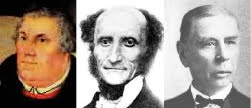
While translating and polishing the text of Walther's essay for the 1883 Western District, I ran across a short explanation of the relationship between Episcopalians and Lutherans. This was also of interest because the first congregation to form among these German Lutheran immigrants first met in an Episcopalian church building, as all histories report. But these histories generally do not report how that relationship ended. In Baepler's Century of Grace p. 33, it was reported that in 1839
The older Walther serves the congregation which remained in St. Louis and is permitted to worship in the Episcopal Church.
From pp. 36-37 of the original report to the 1883 Western District convention, the younger C.F.W. Walther wrote about this:
)%20crop1.jpg)
It is commonly believed that the Episcopalians are closest to us Lutherans because they have pretty much the same doctrine of Baptism as the divine Word and, at least, do not speak out so decisively in favor of the Reformed doctrine of the Lord's Supper. The fact that they differ from us in their church constitution is considered incidental. But this is not so. What separates us from them, what once separated our first congregation in St. Louis from them, after the Episcopal Church had gladly allowed them to use its church for a time, concerns the great principle of Christianity, according to which we Lutherans grant Christians their full Christian freedom and do not grant any church minister power alongside the power of the Word as a power bestowed by God.
So we see that the first "Missouri Synod" congregation, when confronted by this disparity of doctrine, had to find another meeting place and could not be seen as in fellowship with the erring Episcopalians. This historical fact should confront today's LC–MS as a word of warning for their pastors acting like the Episcopalians, particularly those associated with the "Gottesdienst" organization.

No comments:
Post a Comment
Comments only accepted when directly related to the post.