This continues from Part AG1d (Table of Contents in Part AG1a) in a series presenting Walther's essays to the Western District that supported his theme "That Only Through the Doctrine of the Lutheran Church is All Glory Given to God Alone". — We move on to the following year's 1874 Western District essay where Walther addresses his Thesis III, part 4, the General Will of God's Grace., and part 5, the Reconciliation and Redemption of the Human Race. — This segment contains Walther's masterful defense of Luther's writing The Bondage of the Will that is so troublesome for several prominent LC-MS theologians. See also Part AG1d, p. 79. — From pp. 30-43 in the original:
Notable Quotes:
31: "a great mistake of modern theology, that one thinks of God without God's Word and then says: This is how he is."
31: "we know that he really wants to save all men; he has revealed this to us in his Word"
31: "God is not like a person who is sometimes friendly, sometimes grumpy, but a being constantly glowing with love."
32: "If a man will not hear God's Word…the will of God to save him is nevertheless a serious one"
32: "such a person…likes it where the devil is served"
33-35: Walther's great defense of Luther's The Bondage of the Will.
33: "some false Lutherans consider our Luther to be a particularist, i.e. someone who believes that God basically only wants to be merciful to some people…" [E.g. Robert Kolb, Cameron Mackenzie, Roy Suelflow.]
35: "In the image of God there is no wrath in his nature and being, and certainly nothing but pure love and goodness."
36: "So when Christ cries out woe over the ungodly, this too…is a voice of his saving love."
36: "these kinds of judgments of wrath only belong to the time of grace; when this is over, the time of wrath begins."
37: "If we do not know that God wants to save everyone, we must forever doubt whether we are in a state of grace, whether our faith is right"
38: On supralapsarians and infralapsarians: "…God is turned into a hypocritical God and the tears of Christ over Jerusalem into hypocritical tears. What an abominable dishonoring of God!"
38: "where has God revealed that he wants to act according to this [His] power? Nowhere. Rather, God has revealed that he wants to have mercy on all men"
39: "God did not actually build hell for people, but for the devils. That is why he once said to the damned: 'Depart from me, ye cursed, into everlasting fire, prepared for the devil and his angels.' [Matt. 25:41]"
39: "Universalists deny the redemption of Jesus Christ. They only speak of a love of God apart from Christ."
40: On the 1) general will of grace and of the 2) election of grace: "…we too are certainly in great danger of violating one of these two doctrines in one way or another through the devil's cunning."
40: "Zwingli and Calvin were philosophers…Calvinism flooded Switzerland, France, England and Holland in particular."
41: For Calvinists, "when the Bible uses the word 'all' or the expression 'without distinction' or when it says: 'God wants to save sinners', it always refers only to the elect."
41: "For it is inexplicable to our reason that the Chinese…have been without the preaching of the Gospel for so long.…this is the abyss the Calvinists could not get over"
41-42: Walther on Philosophy:
41: "Calvin's doctrine looks like a harmonious whole that solves all the riddles of reason."
41: "Luther's doctrine, on the other hand, fits reason neither back nor front. Of course, the apostles and prophets are to blame for this…"
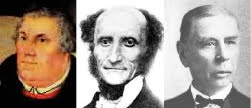
.jpg "Immanuel Kant, Friedrich Schelling, Georg Wilhelm Friedrich Hegel")
42: "For Calvin is quite the same as our modern philosophers, except that he still cites Bible verses for his cause. These philosophers, such as [Immanuel] Kant, [Friedrich] Schelling, [Georg Wilhelm Friedrich] Hegel, are therefore actually better, for they do not attach Bible verses to their philosophy."
42: "we do not seek a doctrine that forms a system, like philosophy.…Christianity, however, is not such a science."
42: "We see that many children are deceived and lost…But it is important to note that there is a mystery here"
It should be noted that in the year of this essay, 1874, there was already a discussion on whether the 12th point, Election of Grace, should be pulled forward because of the attacks on this doctrine by the Iowa Synod. It was surely Walther who made the point that this doctrine should only be dealt with after "we have gone through the other doctrines that precede it in the third thesis". See Part AG1. — In the next Part AG2b, Walther addresses the fifth point of his Thesis 3, the Reconciliation and Redemption of the Human Race.

No comments:
Post a Comment
Comments only accepted when directly related to the post.