Search This Blog

Wednesday, February 22, 2023

Un5: Lutherans not "partakers of errors of others"

      This continues from Part 4 (Table of Contents in Part 1) in a series presenting an English translation of Walther's "Foreword" on Unionism to the 1871 volume of Lehre und Wehre. — Here Walther gets into the heart of his defense of the Lutheran Church, and warns those who err against Biblical Christianity. — Walther’s teaching that even in the Roman Church there can be true believers becomes a part of the defense against Unionism.
- - - - - - - - - - - - - - -  continued from Part 4  - - - - - - - - - - - - -

yet remain in it instead of leaving it

With these principles of altar and pulpit fellowship, however, neither our Confession nor our theologians who are faithful to the Confession contradict themselves. If our church has constituted itself into a separate fellowship, it has not done so, nor does it do so now, because it thought or wanted to be Christ's church alone; but because it does not want to make itself partaker of the errors of others. It wants to be what every visible church should be, a confessional fellowship, and indeed a fellowship of pure confession. By its separate existence, therefore, it does not disassociate itself from the true Christians of the other church fellowships, but only from the errors of the latter. By its separate existence, it does not want to actually condemn and banish the believers in Christ among the erring [Irrgläubigen], or to shun them as heretics; it can only, while it considers itself inwardly most intimately united with them before God, so long as they stand in fellowship with the erring, in order not to deny the truth, not cultivate confessional fellowship with them, thus also not altar and pulpit fellowship. But just as he who separates himself from men for the sake of God's truth and honor is never to blame for the separation, but he who compels him to do so, so also the blame for the separation of the Lutherans from the true believers [Gläubigen] hidden among the erring lies not on the Lutherans, but partly on those who err, among whom some true believers are as if in captivity, and partly on the believers themselves, when they recognize the error of their fellowship and yet remain in it instead of leaving it and joining the banner of the orthodox. Those believers are suspended from the fellowship of orthodox believers by their involuntary membership in a sect, without being inwardly unworthy of this fellowship, just as, according to Matt. 5:23-24, those believers are suspended from Holy Communion without being in themselves unworthy communicants who are not yet reconciled to a brother; but those who voluntarily remain in the sect in spite of better knowledge suspend themselves from the fellowship of orthodox believers. The separate existence of our (page 8) church does not involve a schism, because it has not separated itself from the true church, but rather from the fellowships which had already caused "separation and trouble apart from the doctrine," in order not to share with them the sin of schism, but to remain in the unity of the true church.

Johannes Musaeus (Wikipedia)

This is also how our fathers viewed the matter. Thus, among others, the great Jena theologian Johannes Musaeus, who, as is well known, was often rebuked precisely because of his thoughtful stand against the Helmstadt syncretists, wrote, 1681: 

“Concerning the communication in the doctrines of faith, although the disputing parties, as far as they are regarded as visible assemblies, do not communicate with the Lutheran Church, the true believers among them do communicate with it, who do not subscribe to the gross errors of the parties, but have and keep in their hearts the doctrine necessary for salvation, by God's grace, pure and unadulterated.... But concerning the use of the sacraments, other true believers cannot commune with us therein, unless the visible assembly, under which they are, communicate with us in the same, or they must leave the same and go out from it, as they are also bound to do, Rev. 18:4.” (Vertheidigung des unbeweglichen Grundes, dessen der Augsb. Conf. verwandte Lehrer zum Beweis ihrer Kirche sich gebrauchen. [Defense of the immovable ground, which teachers related to the Augsburg Confession use to prove their church.] Jena, 1654. p. 23. f.) 

How correct these principles are with respect to believing members of the Roman church, even the General Council will probably acknowledge; for we do not want to fear that in this body altar and pulpit fellowship will be considered permissible even with so-called Catholics, as long as they want to remain in the Roman church. But is it not a crying inconsistency not to extend this to all other erring fellowships? For if, for example, certain Reformed, as soon as and because they can be regarded as sincere Christians in love, are therefore to be admitted to our communion and to our pulpits, then one cannot, without contradicting oneself, exclude even a so-called Catholic, if he can be regarded as a Christian, whether he be a layman or a priest. 

- - - - - - - - - -  continued in Part 6  - - - - - - - - - - -
  This essay was published just before the final essay, in a series of 8 convention essays, that Walther delivered during the years 1866-1871. These essays carried the series title "The True Visible Church", a phrase that was used repeatedly in this essay. The two essays in 1868 were on the Lutheran Doctrine of Justification, and Walther here, in 1871, taught that this doctrine, and the Lord's Supper, must be protected from Unionism and syncretism. — In the next Part 6

Saturday, February 18, 2023

Un4: Reformed, Baptists, Methodists — their errors

      This continues from Part 3 (Table of Contents in Part 1) in a series presenting an English translation of Walther's "Foreword" on Unionism to the 1871 volume of Lehre und Wehre. — I found most helpful how Walther gives the most basic leading error of the 3 major sects. What is their chief claim to… infamy? 
- - - - - - - - - - - - - - -  continued from Part 3  - - - - - - - - - - - - -
blind man be led by another

These latter words must necessarily be added to those that deal with those who err out of simplicity within the sects, if one does not want to wantonly impute to our Confession a doctrine that it does not have. It is true that, according to the first quotation, our church is far from being able, e. g. from condemning all Reformed Christians who still err in the article of Holy Communion, or all Baptists who still err in the doctrine of infant baptism, or all Methodists who still err in the doctrine of the marks of the state of grace; but our church is as far from allowing a Reformed, Baptist, Methodist to her altar, or even a Reformed, Baptist, Methodist preacher to her pulpit, without having first "reminded, instructed, warned," and induced them to "go and turn to the infallible truth of the divine Word with us, and our churches and schools." On the contrary, our Church declares that in the opposite case "one blind man is led astray by another." 

Martin Luther

Hence our church has also taken Luther's anti-unionistic judgment into its Confession and made it its own, “as the most distinguished teacher of the Augsburg Confession declares”: 

“I count them all in one pie, that is, for Sacramentarians and enthusiasts, such as they are, who do not want to believe that the Lord's bread in the Lord's Supper is His true natural body, which the ungodly and Judas receive orally just as much as St. Peter and all the saints; whoever, I say (page 6), does not want to believe this, let him leave me alone, and only hope for no fellowship with me; nothing else will come of it.” (Formula of Concord, Solid Decl., Art. VII.) [#33, Triglotta

Hereby our church publicly and solemnly renounces church fellowship, not only with the coarse Zwinglians, but also with the fine Calvinists; and he who does not do so with her, pleads in vain that he has signed all her confessions without reserve. In her best days, our church so little regarded the mere signing of her symbols as a sufficient proof of orthodoxy and of belonging to her, that she rather excluded from co-signing those who were suspected of false doctrine and who nevertheless wished to sign. The formal confession, if it does not become a deed, is not only worthless, but can even be used as a shield to protect against just attacks. But how much our Church demands of a church in order to be able to enter into fellowship with it, it states clearly and unambiguously in the following words of our confession: "We also believe, teach, and confess that no church should condemn the other, that one has less or more external ceremonies uninvited by God than the other, if otherwise in doctrine and all the articles thereof, as well as in the right use of the holy sacraments, it has kept unity with one another". (Formula of Concord. Epitome. Art. X.)

That all the orthodox teachers of our church have ever taught and acted in accordance with this confession needs no proof for anyone who knows them even to a certain extent. Whoever desires testimony to this will find it abundantly communicated in the report of the negotiations of our Synod of the Western District of the year 1870. [Walther's Works: Church Fellowship, pgs 145-192] We repeat here only the following from the great number of pertinent quotations communicated. 

Georg König, Professor

Georg König, Professor primarius at Altorf, 1654, a theologian who was praised above others for being "a peace-loving man," writes: [Church Fellowship p. 184-185]

"If a Calvinist desires that a Lutheran preacher administer the Lord's Supper to him, then he is either a layman or a preacher, and the latter is either uninformed or well-instructed. If he is uninformed, he will perhaps not know the difference which exists between us and the Calvinists in regard to this doctrine, especially since the latter also want to pretend that they teach that the body and blood of Christ are truly present in the Lord's Supper. Then one must take the greatest care not to admit him to the Lord's Supper, since he knows nothing of the matter and is still filled with his delusion. Rather, he must first be openly instructed as to how far we differ from one another in this doctrine, and it must be clearly explained why one part can neither commune with the other, (page 7) because the Supper of the Lord, among other final purposes, also has to be a mark and watchword of the religion that each one professes. For those who fellowship with a church in the reception of this sacrament, thereby publicly confess that they accept the doctrine of that church, and reject that which is contrary to it, and thus separate themselves from the others. It is therefore necessary that he first accept our confession, reject Calvinism as erroneous, and separate himself from it, if he wishes to partake of our communion. Rather, however, this caution will be needed if the Calvinist is a well-informed one." (Casus conscientiae, p. 597. sq.)

- - - - - - - - - -  continued in Part 5 - - - - - - - - - - -
In the next Part 5, Walther turns up the heat in his warning against… Unionism.

Tuesday, February 14, 2023

Un3: Christians are among erring, but no fellowship with them; "our little Lutheran Zion"

      This continues from Part 2 (Table of Contents in Part 1) in a series presenting an English translation of Walther's 1871 Lehre und Wehre "Foreword" on Unionism. — Walther carefully reviews the difficult distinction between the teaching that there are Christians in the erring sects and that fellowship with them by Lutherans cannot be allowed. 
- - - - - - - - - - - - - - -  continued from Part 2  - - - - - - - - - - - - -

Every true Lutheran will of course heartily agree when it says in the “Preface” to our confessional book: [from the German; English: § 20 Triglotta]

"As for the Condemnationes, the establishment and condemnation of false and impure doctrine, especially in the article of the Lord's (page 4) Supper, they must be expressly and distinctly stated in this declaration and thorough exposition of the disputed articles, so that men may beware of them, and for many other reasons may not be evaded: Similarly, it is not our will and opinion that this refers to persons who err out of simplicity and do not blaspheme the truth of the divine Word, but rather to entire churches within and outside the Holy Roman Empire of the German nation, but that with this alone the false and seductive doctrines and the same stiff-necked teachers and blasphemers, whom we by no means intend to tolerate in our dominions, churches and schools, are actually rejected (palam reprehendere et damnare), because they are contrary to the expressed Word of God and cannot exist alongside it; that devout hearts may be warned for the same. Since we have no doubt at all that many pious, innocent people are to be found even in the churches, which have not hitherto compared themselves with us, who walk in the simplicity of their hearts, do not rightly understand the matter, and have no pleasure at all in the blasphemies against the Holy Supper, as it is held in our churches according to the foundation of Christ, and is unanimously taught by virtue of the words of His testament."

Indeed, herewith a comfort is expressed for us Lutherans, which we cannot let ourselves be snatched away from at any price, the comfort, namely, that Christ's invisible church of pardoned and blessed Christians lies hidden even among the most erroneous sects, as long as these still essentially retain God's Word; that therefore our little Lutheran Zion is by no means the Church, apart from which Christ has no subjects and apart from which there is no salvation, the church xxx έξοχή. We, the Missourians, have for several decades been in a hot fight with Buffalo, which, in good Papist fashion, wanted to make the visible Lutheran Church the Church of the Third Article, the One, Holy, Christian, Catholic Church, and rejected the doctrine of our Church, that outside of it there is also Christ's Church and therefore grace, salvation, office, calling, keys, etc., as unionist fanaticism. But the question whether there are true believers and children of God outside the Lutheran Church, and the question whether one can have pulpit and altar fellowship with members of an erring fellowship, are quite different, so that our church, as decidedly as it affirms the first question, just as decidedly denies the other

the proper form of a true visible church

It is true that our Church acknowledges that even in the erring fellowships there are "many pious innocent people who walk in simplicity of heart," but she does not say that with such, even if they live in the erring fellowships, she can have pulpit and altar fellowship. (page 5) The former concerns the belief that there is an invisible church extending over the whole of baptized Christendom; the latter, on the other hand, concerns the proper form of a true visible church. Immediately after the above testimony from the Preface to our Book of Concord, our church, speaking of those true believers in the sects, continues thus:

infallible truth of the divine Word
"Hopefully, when they are properly instructed in doctrine, they will, by the guidance of the Holy Spirit, go and turn to the infallible truth of the divine Word with us and away from churches and schools. As then it is incumbent upon the theologians and ministers of the church, that from God's word they also duly remind and admonish those who err out of simplicity and ignorance, of the danger of their souls, lest one blind man be led astray by another." 3

————————

3) It should not be forgotten here that the preface mentioned also belongs to our church Confession as an integrating part of it, therefore the signature given to the Book of Concord also refers to this preface of it, indeed, that especially this Preface determines the meaning of the signature. Cf. Carpzov's Isag. in libros symb. 14. 29. and Hutter's Concordia concors, c. 24, p. 106. and c. 26, p. 208.

- - - - - - - - - -  continued in Part 4  - - - - - - - - - - -
Walther speaks of "the most erroneous sects" above — so who are these "sects" and what are their chief errors?  We find out in the next Part 4

Saturday, February 11, 2023

Un2: The General Council turns away from orthodoxy

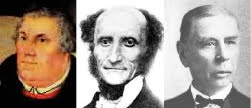
      This continues from Part 1 (Table of Contents in Part 1) in a series presenting an English translation of Walther's "Foreword" to the 1871 volume of Lehre und Wehre on Unionism. — Walther continues his searching essay exposing the mediating General Council. He originally had high hopes that Pastor Brobst of that synod, pictured below in the left panel, would have enough influence to bring them to a pure confession of the truth.  One finds many references to Brobst in the early years of Der Lutheraner,  but now we see that Brobst's proposals to his Council were rejected and so he was surely disappointed in this. 
- - - - - - - - - - - - - - -  continued from Part 1  - - - - - - - - - - - - - 

Accordingly, it is clear that the [General] Council does not want to reject all errorists, but only open heretics, in addition to those who cherish errors in which salvation is impossible, such as Socinians, Unitarians, Universalists, and Rationalists, for the Council gives the exact definition of a heretic in the words cited. It fearfully avoids being specific and declaring that, in short, it wanted all non-Lutherans, e.g. all Reformed, Presbyterians, Methodists, etc., to be rejected from their pulpits and altars. 1) The Council allows those who err because of weakness (as a result of upbringing and instruction (page 3) and of prejudices imbibed under certain relationships), in short, all those whom it believes it can still consider Christians in the erring fellowships.

__________ 

Pastor Brobst (Find-A-Grave); Prof. C. P. Krauth (Wikipedia)

1) How the Council stands as a whole is shown by the fact that it rejected the version of the answer proposed to it by Pastor Brobst, which was also read out, as the Lutheran and Missionary [C. P. Krauth, Editor] reports, and instead adopted the most flexible version. In the version proposed by Pastor Brobst it had said, among other things: “Since communion and pulpit fellowship are church fellowship, it must be established as a general rule that only Lutheran Christians are to be admitted to Lutheran altars and only orthodox Lutheran pastors are to be admitted to preach on Lutheran pulpits." But that was already too clear (?) a tone. It sounded too anti-unionist and could have offended the delicate ears of the distinguished Presbyterian and Methodist "brethren." We say advisedly that it shows how the Council as a whole stands, for Brobst's proposals show that individual members of it stand quite differently. But a church body is not to be judged by those who are not heard [i.e. Pastor Brobst, and Prof. Krauth] in it, but by those who are the deciders.


We confess that we had little hope that the Council would give a reasonably satisfactory answer to the questions presented by Minnesota; but that the former would venture so brazenly into the light with such crass unionist principles, we had not expected. After the omissions of Dr. Krotel and some others, the alternative arose that either they would have to leave the Council, or that the Council would have to declare itself Unionist; but in view of the progress which this body had made in Lutheran organization during the last few years, it did not seem impossible that it would rather sacrifice some of its most gifted men than offer them the pure Lutheran character. It evidently preferred the latter, however.

To be sure, the Council points out in its justification that 


"in harmony with the confessions and theologians of our Church, the General Assembly of the Church makes a distinction between such doctrines as are fundamental to the continuance of Christianity, i.e. 'essential to the true knowledge of Christ and to faith in Him'; and between such doctrines as are fundamental to the whole completeness of our Christian faith, i.e. 'essential to the true knowledge of Christ and to faith in Him'; without which one cannot hope to be saved. "between such doctrines as are fundamental to the true knowledge of Christ and faith in Him, without which one cannot hope to be saved; and between such doctrines as are fundamental to the whole completeness of our Christian faith, i.e., to the complete and faultless (absolute) perfection of Christian doctrine, without which, if one does not wish to judge uncharitably, it may yet be possible to attain to salvation."— 2)


alone, correct as this distinction is, there is no justifying reason in it for the Council's unionist practice.

________________

2) We quote from the German text of the Council's resolutions given by Pastor Brobst.

- - - - - - - - - -  continued in Part 3  - - - - - - - - - - -
Walther highlights the tactic of unionists to avoid being specific in their wording.  After Luther's death, some Lutherans were avoiding the term "sola fide" in a proposed settlement with Catholics (Augsberg Interim). This is a good lesson for all Christians as they judge the teaching of the various church denominations, even within Lutheranism. — In the next Part 3

Sunday, February 5, 2023

Walther, 1871: "True Union, our Ev. Luth. Church", against Unionism (Part 1 of 8, Un1)

Cover leaf of 1981 edition, Editorials from "Lehre und Wehre"
      More than forty years ago, in 1981, Concordia Publishing House published a book, Editorials from "Lehre und Wehre" (LuW), of English translations of some of C. F. W. Walther's editorials to the theological monthly Lehre und Wehre. Most of these were "Forewords", the first essay of each new year.  Readers who have not already obtained this book, or others, from the CPH library "Walther's Works" would do well to get these. In particular, the essays in the Church Fellowship book are basic to fully understanding this important topic. 
      Unfortunately CPH did not (or would not) translate all of his editorials and major essays. Very little newly translated material was added for the "Walther's Works" library. So to add to the CPH collection on "Church Fellowship", I am presenting a polished English translation of Walther's "Foreword" for the year 1871, volume 17. — The background for this essay is that although the General Council Lutherans had made progress towards removing false teaching, largely due to Walther's Lutheran confessionalism, yet they too, along with the very liberal General Synod, were now weakening.  As one reads the history of the General Council, a forerunner of today's ELCA, it is a sad fact that its highly-regarded Prof. Charles Porterfield Krauth was not able to keep the Council from falling into Unionism. — From Lehre und Wehre vol. 17 (1871) pp. 1-11 [EN]. All underlining follows Walther's emphasis, highlighting is mine:

Foreword.

"One is now so stupid in thought or so demure in speech that one must offend if one is to speak and hear the truth."

(Hamann 's Werke. II, 235.)

The English rightly call the question of union the "question of the age”. For indeed the question which now chiefly agitates our time in the sphere of the church is none other than this. If formerly the main burning question in the church was: Where is the truth? Where is the true church? Now, however, we are weary of disputing about this, and declare the claim of every church to have the truth and to be the true church to be sectarian a priori. Through the devastation which rationalism has wrought in all ecclesiastical fellowships, such great antagonisms have arisen between the baptized Christians that the differences of the confessions [or denominations] appear to the great majority of them as utterly irrelevant, and the assertion of them, as if they still formed a partition between the Christians, either as pitiable parochialism or as detestable hatred of peace. Now that within each confessional church a few have returned to the confession of certain general truths of Christianity, it is thought that not only the last unfinished earlier struggles within Christendom before the intrusion of the overthrowing rationalism need not be taken up again and brought to a settlement, but that the whole struggle within the church during the time of its existence and the boundary divides that have arisen as a result can be ignored and, so to speak, the ecclesiastical development can begin anew. All those who again recognize Christianity as a religion of supernatural revelation should unite, if not to form an ecclesiastical body, then to form a great evangelical alliance against the powers of unbelief, which are uniting more and more. (page 2).

This spirit of union is not only to be found in those who call themselves United [the Prussian Union, Reformed with Lutherans], but in all the so-called Protestant churches, even in the Lutheran, and in this also in our dear America.

As far as the Lutheran Church in this country is concerned, strange changes for the better have indeed taken place in the short time of the existence of our Synod; but now that it has finally come to the point where all leaven of the unionist spirit is to be swept out of it, the wholesome movement seems to want to come to a standstill.

Many think that now that the General Council has emerged from the apostate Lutheran Church here in America and has reaffirmed, in no uncertain terms, all the symbols of our church, it is only a matter of subtle differences which have been revealed by the well-known "Four Points" [of Charles Porterfield Krauth] which the Ohio Synod presented to it as a test of its orthodoxy and Lutheran character, and for the sake of which it is micro-logical hair-splitting to argue. But this is by no means so. With the answer which the General Council itself gave at its last convention last year to the questions about pulpit and altar fellowship [Pittsburgh Declaration], it proved that its main representatives and leaders are still completely dominated by the unionist spirit and have not yet arrived at the truly Lutheran position. According to this answer, the Council only wants to reject from its pulpits and altars those who have:

“deliberately, maliciously and persistently apostasized from the Christian faith as a whole or in part, especially as it is contained in the confessions of the universal church, namely in its purest form, as it now exists on earth, i.e. the Evangelical Lutheran Church, who therefore overturn the reason known therein, assert, defend and spread such heresies in defiance of the admonitions of the church, and thereby lead souls astray from the way of life..”

- - - - - - - - - -  continued in Part 2  - - - - - - - - - - -
While Walther in 1871 states that "the differences of the confessions [or denominations] appear to the great majority as utterly irrelevant", Dr. Robert Kolb, professor emeritus of Concordia Seminary, said in 2001 that Walther
Dr. Robert Kolb, professor emeritus, Concordia Seminary
"provide(s) us with an ecclesiology shaped for a world in which the church was conceived of as divided into 'Konfessionen.' There is no readily understandable American translation of that concept! We have missed the chance to compose an expression of our ecclesiology for the denominational age of North American Christianity.… We will reap only confusion and contention among ourselves and in our relations with other churches if we do not begin soon to formulate a proper expression of Biblical truth regarding the church for a post-denominational age."

A "post-denominational age"? And Walther is not "a proper expression of Biblical truth"? It appears that Dr. Kolb is not only a part of what Walther calls "the great majority" who think that the "Konfessionen" are irrelevant, but that our age needs "to formulate a proper expression of … the church". Is that not the same as modernism? Dr. Kolb demonstrates his own syncretism by these comments and actually fights against Walther. His antagonism is to be expected given his own unionistic endeavors with erring Lutherans! — In the next Part 2, we get more details of how some members of the Council tried to stem the tide.
- - - - - - - - - - - - - -  Table of Contents  - - - - - - - - - - - - - - - 
Part 1: Walther's LuW "Foreword" against Unionism
Part 2: General Council turns away from orthodoxy
Part 3: Christians are among erring, but no fellowship with them; "our little Lutheran Zion"
Part 4: Reformed, Baptists, Methodists — their errors
Part 5: Lutherans not "partakers of errors of others"
Part 6: Fundamental doctrines, narrow vs. broad sense
Part 7: True Visible Church = True Union Church = the Evangelical Lutheran Church
Part 8: Postscript: Unionism & prayer fellowship (Der Luth. 1908);  LCMS: Scott Murray, Samuel Nafzger