Search This Blog

Thursday, December 6, 2018

Walther: Schriftprinzip! Foreword 1886 Lehre und Wehre, Part 1 (Dorpat; not one faculty protest; Baltic Protest)

[2020-09-01 fixed broken link; 2019-02-18: fixed missing underlining]
      I have mentioned several times my work of translating Walther's much quoted "Foreword" [Vorwort] to  the 1886 volume of Lehre und Wehre, the primary journal of doctrine and its defense. The work is now finished and I will begin publishing it in serialized form. — To say that the Inspiration of Holy Scripture is a burning issue in today's Church is an understatement for everywhere one turns in theological teaching and discussion, the truth of the whole Bible is questioned. This is well attested in LC-MS Pastor Philip Hale's 2016 book. Every Christian who covets certainty for their soul's salvation can never attain this certainty… apart from what God says. But this confusion should not trouble Christians for it has always been so, as we see a passionate Dr. Walther plead with his readers in a defense (Wehre) against “biblical, Lutheran scholars” who, while professing to be great defenders of the Bible, nevertheless maintain a mediating “balance” with the notion that the Bible contains errors, contradictions, etc.
      This work is a part of a trilogy, “Walther's Trilogy on Inspiration” during his final full season of teaching, 1885-1886:
  1. “Walther's Evening Lectures on Inspiration” [2020-09-01 fixed broken link] translated by Prof. (emeritus) Thomas Manteufel, 
  2. “Vorwort” (Foreword) to Lehre und Wehre 1886 (this translation), and 
  3. 1886 Synodical Conference Report, (text) “Theses on the Divinity of Holy Scripture”, an essay that has Walther's authority even if Prof. A.L. Graebner was the official presenter.
There is overlapping subject matter between these three works, and I may point out some of these as space permits. I will give further information and comments along the way of what is planned to be a 17-part series.  There is much to say – I have worked on this translation over a period of many months. The following translation largely follows the original German pagination with only a few exceptions where broken footnotes across more than more than one page were combined.
- - - - - - - - - - - - - - - - - -  -
Translation by BackToLuther; all highlighted text, text in square brackets and in red font are my additions.
(page 1)  
Volume 32      January 1886.    No. 1.
Foreword.
(by C.F.W. Walther)
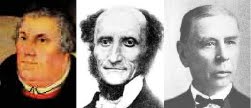
W. Volck
"Scriptures contain all sorts of errors"
In February 1884, Professors Dr. W. Volck and Dr. F. Mühlau [Heinrich Ferdinand Mühlau, 1839-1914] in Dorpat [now Tartu] held two public lectures concerning the Bible in the auditorium of the university building in front of an invited gathering of the educated people of the city. [see also 1886 SCR] Volck dealt with the question: “To what extent is inerrancy to be attributed to the Bible?” Mühlau: “Do we possess the original text of the Holy Scriptures?” The former made it his mission to prove that the Holy Scriptures, however, contain all sorts of errors in historical, geographic, natural history and similar things. It is reliable only in so far as it is the document of the history of the salvation revelation. Nevertheless, in order to show how a reader of the Bible, or rather of the biblical expository (for the vulgar layman, who, of course, relies on the scientifically educated theologians), was nevertheless able to read the true from the erroneous Scripture, he declared:

“The separation of the area of the unmistakable from where error is possible, and further – to make distinction of the essential and non-essential in the Bible, the interpreter must judge all particulars of their contents according to their relationship to salvation, which is realized in the story reported by it. He must see whether and in what context it stands with the same.” The final decision as to whether something in the Scriptures is true or false, material or merely incidental, contains indifference, is in a sense God's Word or only a human opinion, therefore, belongs to the interpreter of Scripture, and of course only the one who has understood how to abstract from Scripture a strictly closed doctrinal whole, and can now state exactly what belongs to it, and what does not.

The latter, Prof. Mühlau, simply negated his question by saying that “none of the numerous duplications in the Old Testament, according to their words, harmonize completely among themselves”, and regarding the New Testament (page 2), “of the great multitude of manuscripts, two do not completely agree with each other”.

Had theologians who called themselves Lutheran published such statements representing the Holy Scripture as a book full of errors in the 16th and 17th centuries, so would however without a doubt all Lutheran faculties to a man at once protested loudly and solemnly. But what happened this time? Not one faculty of Lutheran name raised even a slight protest. Rather, they all say nothing about this to our knowledge. So they decided it as a great indiscretion to disapprove of Volck and Mühlau already stepping before the great lay audience with the teachings of the modern religious theological science of the Scriptures, likewise they decided to recognize the aforementioned as their proper representatives, that is of modern-believing theology. Therefore, the silence.


But while not a single well-known theologian of the present raised his voice against the Dorpat lectures renouncing the ground-breaking heresy contained therein, some modern-faith theologians, such as Prof. Dr. Luthardt in Leipzig and Prof. emer. Th. Harnack in Dorpat, the former in the notice of the relevant writings, the other in a separate writing, rather expressly and without reserve agreed with the entire contents of the Dorpat lectures.  


It was and is truly refreshing therefore that a whole district synod, that of the Livonian island of Oesel [Oesel is now Saaremaa in Estonia] through one of its members, Pastor N. v. Chr. Nolcken  from Prude on Oesel, published a well-motivated “Protest”, having made the decision by a formal order, “as their common consent”. This protest concludes with the following words:

“I for my person herewith register, as a member of our regional church and as an appointed servant of the same, my protest against our confessional (i.e. bound to the Symbols and the Bible) theological faculty of Dorpat [now Tartu] in two of its members (and witnessed on the part of others) who have apparently fallen from the Bible and are teaching this waste to the young theologians and spreading it in the congregations.  So God help me, that my soul should not have any fellowship with this! — Amen!” —  

God bless the dear man and the whole venerable Synod for this faithful testimony, and may He remember them on the Day of Judgment and renew the many tottering souls in their faith in the Book of all books redound. 1)
———————
1) Pastor von Nolcken reports in his edition of the “Protest” among other things: “It has come to my attention from Dorpat the painful complaint: that many were confused and saddened. A lady had said with tears about the Bible: (page 3) ‘I can not read it anymore!’ – Well – that will be required! – It was also strange to me that I had just received from Dorpat this spring (1884) the account of the blessed going out [Hingange] of a ‘Peace in the Country,’ which, of course, happened before those lectures had been held, but which contained a moment for which I can only relate to events in the university town with which the lectures in question are closely connected. It had, according to this report, called out to the dying, to awaken from the long agony: ‘Believe, believe, believe everything written in Scripture! Every word is truth!’ This is a sacred protest from the ‘narrow’ and ‘bigoted’ against the drift of academic stupidity that becomes unfit for faith and confession.”
= = = = = = = = = =   continued in Part 2     = = = = = = = = = = =

      I attempted to locate more information on the dear Pastor von Nolcken whom Walther praised in his "Protest" against all the famous German theologians, but was unable to.  Perhaps he can be judged to be among what Franz Pieper called the "little noticed pastors", the ones who will lead the Church in troubled times... like Pastor Philip Hale.  —  We are just getting started... for Walther is setting the stage for the greatest plea, in all of Christendom, in the last several centuries, for the truth of the Bible... in the next Part 2.

= = = = = = = = = =   Table of Contents   = = = = = = = = = =
Dedicatory post - to Pastor Philip Hale
Part 1 - Intro; Dorpat: Scripture has errors; German theologians - no disagreement; Protest!
Part 2 - Walther's first response, names well-known German theologians (von Hofmann, Kahnis, etc.)
Part 3 - Walther's damnamus: “worst false prophets"; Luther, new Inspiration theory? Kolb devalues Scripture
Part 4 - Luther a “modern theologian”?; Pieper's defense; Tholuck's error; Barnbrock
Part 5 - Myths of Luther: "hay, straw, stubble", "epistle of straw"; James Swan
Part 6 - Luther says: 4 Words, 5 Testimonies (Walther’s short lists of Luther quotes)
Part 7 - Hijack Luther? Luther's building blocks; Jn 10:35, Franzmann: "None"; LCMS "laughingstock"
Part 8 - Thesis 1: “All Scripture of Holy Ghost” - Luther, not CTCR, Franzmann, Voelz, Paul L. Maier; Scripture from God
Part 9 - Thesis 1 (cont'd); "empty sham", "Heilsgeschichte" of von Hofmann, Bible verse ban; Becker's folly
Part 10 - # 2, 3 – What is a Prophet?; Nothing in Scripture without purpose; M. Becker folly, Pelikan fiction
Part 11 - #4 – INERRANCY! LUTHER!; Bible in a bag?; Gerhard Maier’s denial; Fred Kramer's defense
             (also attacks by CTCR 1963, Fred Kramer, Robert Kolb, Samuel Nafzger, Peter Nafzger)
Part 12 - #5 & 6 – No contradictions; 6. Bound to every letter; Arndt falters; Voelz ‘doubts’
   Excursis: Manteufel's 2 essays: UOJ-1998; Walther on Scripture-2004 (unauthorized); "move out"… or not?
Part 13 - #7 simple, minor things; #8: sexual matters; Schroeder/"Moderates" vs sola scriptura
Part 14 - #9 – Lack of proper order?; Reu's reticence; Boehme's defense
Part 15 - #10: Natural History; #11: Chronology of Bible; the surprising Preus brothers
Part 16 - #12 – NT is the proper interpreter of OT; LC-MS/CTCR – “accommodational” for Jesus
Part 17 - #13 Even if cannot understand…; Walther's Warning; Franzmann's/LC-MS smokescreen
Part 18 - Walther's Other "Thirteen Theses" – Luther's Doctrine of Inspiration of Holy Scripture

Sunday, December 2, 2018

2 Books missing in CPH 2018 Christmas catalog (No Walther?)

      I received by mail the CPH 2018 Christmas catalog about 2 weeks ago.  I don't usually spend much time with their catalogs as I am interested in spiritual content rather than pseudo-spirituality.  But even I was surprised by the lack of books by the Missouri Synod's founding father C.F.W. Walther.  Without fully investigating the matter, I blurted out my comment on the cover page "Nothing on WALTHER" as a summary judgment on Concordia Publishing House and its sponsoring LCMS.  I must of course beg forgiveness from CPH for my error on this point as they do in fact offer one book on page 26, their 2010 edition of Walther's Law and Gospel.  If they would forgive me this error, then maybe they would also answer why (1) they do not offer Walther's much touted book Pastoral Theology and (2) why they seem to be late in coming out with the next "Walther's Works" book Predestination scheduled for "Fall 2018"? (Oh, that's right, Fall does not officially end until December 21...)

      Anyway, the gaping hole, the lack of "Walther's Works", can be filled marvelously by the following 2 books for holiday reading and/or gift giving:

$19 shipped @ Lulu
(1) Although I had stated in an earlier announcement that I would give news of further developments on the availability of the new book Dr. C.F.W. Walther as Theologian compiled by GPP Publishing, I have been surprised to be informed that the book is already "ink on paper"... as the left sidebar pictures show. The pictured book is not my copy – I am still anxiously awaiting delivery from Lulu.  The publisher has put a very reasonable price on this book.  For the past 80 years, Walther has been pigeonholed for only his Proper Distinction Between Law and Gospel book, but this book is actually the far better book for lay people to get to know the "whole Walther".  I know this book will be my evening reading for years to come... over and over again, to make notes in the margin as I go, just as Prof. Ludwig Fuerbringer did with Pieper's Dogmatik.

Get this book from Lulu Amazon===>>>  HERE  <<<===. [Updated 2023-08-03]

      I had been aware of this book from information published in Herman Otten's Christian News 2 years ago, but for some reason held off purchasing it.  After now receiving it, I am sorry that I waited so long.  There are very few books today actually defending the Inspiration of Holy Scripture, but this book may be the best one being sold today, except perhaps Theodore Engelder's The Scripture Cannot Be Broken.
      A thorough review of this book is beyond the scope of this blog post, but I would highlight a few delicious aspects. First of all it is unapologetic for being a polemical book, and it defends not just against unnamed "liberals" but it names prominent teachers of Hale's own LC-MS who teach all of its future pastors. I would especially mention his glaring exposure of Prof. James Voelz of Concordia Seminary, St. Louis and (2) Prof. David Scaer of CTS-Fort Wayne. These 2 teachers have essentially denied their subscription to the Lutheran Confessions, and are therefore unLutheran. I may quibble that certain other prominent teachers are not named, but the strength of Hale's defenses are sufficient to cover most of the field.
      Another strength of this book is the exposure of "famous" German theologians who are so treasured in the LC-MS as its great lights: Ebeling, Sasse, Löhe, Bonhoeffer, Werner Elert, even Brunner, and perhaps others.  I appreciated Hale's explanation of the false charge of "docetism" by these errorists.  Hale is following the old Synodical Conference as it also defended against this same charge in the essay delivered to the 1886 Synodical Conference. — I also appreciated his overturning of "popular, rationalizing systems". The chief current example of this is the misuse of Luther's phrases "theology of the cross" and "theology of glory".
      Hale is not afraid of being labeled a "fundamentalist" for he knows where that charge typically comes from today, the deniers of Inspiration.  Franz Pieper defended perhaps the greatest teacher of "The Fundamentals", B.B. Warfield, for his stand on Inspiration.
      There are a few other quibbles beside the one mentioned earlier, one being the wish that he had quoted even more from Walther and Pieper who are the greatest lights on this teaching of perhaps the last 400 years.  Other minor quibbles were sufficiently recovered from in his own words elsewhere in the same book.
      There is only one caveat that I would openly caution this great "voice in the wilderness", the wilderness being the LC-MS.  It is basically the same weakness for which I was compelled to defend against with Profs. Eugene Klug, Siegbert Becker, and Pastor Paul Burgdorf, (editor of the great periodical The Confessional Lutheran) and others.  I would hold him to what he stated himself on page 296:
“Inspiration is not the most important truth, but it is part of God’s truth, and one that cannot be taken for granted in these last days. The Reformation clarified the doctrine of justification…”
Pastor Philip Hale
"Gospel reductionism" and Justification
At just this point, you, Pastor Hale, are not to concede the charge made by some conservatives against the "moderates", that of "Gospel reductionism".  That term implicitly grants the errorist as having the true Gospel, but I would not grant this to these so-called "moderates", especially the "Walkout faculty majority" of 1974 at Concordia Seminary.  I would not grant the pure Gospel to all those teachers denying the Inspiration of Holy Scripture.  They joined in fellowship (and in spirit) with the ALC at that time, a church body opposed to the Doctrine of Universal, Objective Justification.  The ALC was opposed to the pure teaching on Conversion and Election of Grace. I would not grant the doctrine of the pure Gospel to those who even said they agreed with Walther on his teaching of "Law and Gospel" (p. 233 here), for they did not properly distinguish the Gospel from the Law, for the Gospel must be preached as if there were no Law.  This cannot be done (that is to confess "Jesus is Lord") without the Holy Spirit. And as you teach in your book, the Spirit comes only by The Word.  Luther practically stood alone again at Regensburg 1541 because he held to sola gratia, not the infused grace of the Roman Church.
 - - - - - - - - - - - 
      Hale finishes well, quoting Martin Luther (p. 297):
“For if they believed that these [words of Scripture] were God’s words they would not call them ‘poor, miserable words,’ but would prize a single tittle and letter more highly than the whole world, and we would fear and tremble before them as before God himself. For he who despises a single word of God certainly prizes none at all.” -- Luther, Confession Concerning Christ’s Supper (1528), LW 37:308
Because this book arrived on the eve of the publishing of my new translation of a major writing of Walther, I want to confirm Pastor Hale in this marvelous endeavor of his, his book that surely mirrors Franz Pieper’s earliest “Brief Statement”  – “I believe, therefore I speak”.  Even with the caveat I have mentioned, I dedicate the following series, a translation of Walther’s "Foreword" to the 1886 Lehre und Wehre, to
Pastor Philip Hale
True Missourian
2nd Pieper Award – "Little Noticed Pastors"
... the award for "little noticed pastors" who will lead the Church in troubled times.
      Now I will begin my next series in a following blog post, a translation of C.F.W. Walther's great plea for the teaching of the Inspiration of Holy Scripture, at the beginning of the last full year of his life, 1886.

Friday, November 30, 2018

Pieper tribute 4: Honoring the Ministry

      A few LC-MS theologians today sometimes honor Franz Pieper for his defense of the doctrine of the Ministry or what is called in German the term Amt, Office of Preaching.  But practically all of these do not defend all the Lutheran doctrines that Pieper taught.  Most glaringly, they do not teach and defend his pure Doctrine of Justification and the Doctrine of Inspiration.  This makes whatever praise they have for Pieper's teaching suspect.  — But in the following "tribute" from 1931, we hear one of the best testimonies of Pieper on this teaching:
= = = = = = = = = = = = = = = = = = = = = 
The Many-Sided Dr. Pieper.
Honoring the Ministry.
The Lutheran Witness, September 29, 1931, p. 327

“During the summer of 1888 I, then a student of the seminary, was serving the congregation at Carondelet in the absence of Rev. Achenbach. Rev. C. C. Schmidt asked me to conduct services for him in Holy Cross one Sunday afternoon. Before the service Dr. Pieper also came into the vestry and sat down. He was to christen a child after the sermon. When I arose to go before the altar or on the pulpit, Dr. Pieper quickly arose to open the vestry-door for me. Dr. Pieper always acted the gentleman; but I did not look upon this action of his as a mere act of courtesy, but rather as an act of reverence for the preacher of the Word of God, even though this preacher happened to be one of his students. This seemingly insignificant incident I always remembered.”
Rev. J. H. Todt, Manistee, Mich.
= = = = = = = = = = = = = = = = = = = =
The reverence Pieper held for the Ministry was truly a holy reverence. He believed God went with His Word. 
      My mother dearly wanted one of her boys to be a pastor, but none of us did.  I suppose when older ones chose the field of Engineering, that also held my interest. I chose the lesser field, by far. But I remember that after an older brother went to Valparaiso University and we also visited that campus to see him, I was almost shocked at how different their worship was, how different their overall attitude toward the Bible was, than my upbringing.  I remember how I determined then that I would NOT go to Valparaiso University because of this.  At least in this, I made the right choice, even if it was a state university (Purdue).
      This account of Pieper opening the vestry-door reminded me of another door, the Gates of Heaven, and how he labored to keep the pure Lutheran teaching of "The Open Heaven". — Further tributes from the 1931 issues of The Lutheran Witness will follow.

Sunday, November 25, 2018

Pieper tribute 3: “Street-Car Nickel” & conscience (Lutheran Witness, 1931)


      One will not find in The Lutheran Witness of Pieper's time, either before or after his passing, any extensive articles on Pieper's theology.  One can find at least some essays of this type in the German language periodicals Der Lutheraner and Lehre und Wehre.  The chief editor of the Witness was Prof. Theodore Graebner who would in a few years explode into syncretistic actions. I suspect that Graebner was already, in 1931, harboring weakness in maintaining the doctrines of the faith.  But before his sad downfall, Graebner still published some words of praise for the departed chief teacher of the Missouri Synod since Walther's passing in 1887, 44 years of leadership in following God's Word. — Here is another short tribute that Graebner published in the months following Pieper's "going home".  It is not about Pieper's doctrine, it is about his life:
= = = = = = = = = = = = = = = = = = = = = = = = = 
The Many-Sided Dr. Pieper.*
* Most of these reminiscences were sent to the undersigned for his biographical sketch of Dr. Pieper, but were received too late for inclusion in that treatise.  G. [Th. Graebner]
The Lutheran Witness, September 29, 1931, p. 327
The Street-Car Nickel.
How about cheating the street-car company out of a street-car fare? The late Dr. F. Pieper, while president of Synod, sat at dinner with a group of delegates, when the above question was put. Some one said, “If I am not approached for my nickel by the conductor, I’ll keep it.” The Doctor answered, “I prefer to call the conductor’s attention to the fact that he has overlooked me and to hand him my nickel. The devil is always planning to tempt a Christian and to get him to doubt that he is a child of God and saved. When he charges a Christian with having deserved the wrath of God and damnation, he usually does not hold up to him that he has stolen a hundred or a thousand dollars, but that he has cheated some one out of a penny or a nickel. And just these petty things can cause the Christian’s conscience untold agony. So I would rather a thousand times have paid my little street-car fare than expose my conscience to such torture. Besides, in spite of all my efforts to be scrupulously conscientious even in little things, I know that I am sinful from tip to toe, for all of which I continually approach my God, believing in the full atonement of Christ, saying: ‘Purge me! The blood of Jesus Christ, His Son, cleanseth us from all sin [1 John 1:7].’ ”
Rev. J. D. Matthius, Indianapolis, Ind.

= = = = = = = = = = = = = = = = = = = = = = = = =
Pieper's response to the situation reminds me of Joseph's response to Potiphar's wife in Genesis 39:9. I was pleased to see a pastor from Indiana, my home state, offer his public praise of Pieper. Further tributes from The Lutheran Witness will follow.

Monday, November 19, 2018

J.T. Mueller’s poem for Pieper (1931 Luth. Witness)

      Continuing the series of posts on the tributes for Dr. Franz Pieper after his "going home" on June 3, 1931, it is fitting that the poem of the younger associate, J. T. Mueller, who lived the longest (†  1967) among the erring generation after him, should be published.  Although Mueller did not follow Prof. P. E. Kretzmann in leaving the LC-MS in 1950, and had some weaknesses, yet he maintained Pieper's Biblical, confessional doctrines throughout his lifetime.  As was mentioned in a previous post, he even translated his own English abridgment of Pieper's Christian Dogmatics back into German so that the Missouri Synod could furnish a concise book of orthodox Lutheran teaching to the German theologians after World War II (Bad Boll conferences).  It is sad to say that even though the Allies won the military war against the Germans, yet the modern German theology that battles against orthodoxy and against Pieper/Mueller's teaching is now the norm in all external Christendom. —  But enough of the world and today's LC-MS, I now present Mueller's heartfelt tribute to the "going home" of the "Twentieth Century Luther":
= = = = = = = = = = = = = = = = = 
The Lutheran Witness
Vol. L.              ST. LOUIS, MO., JUNE 23, 1931.            No. 13. (p. 213)
In Memory of Our Teacher Dr. Francis Pieper.
† June 3, 1931. †


He lived immortal; for to him to live
Was solus Christus;1) both by word and pen
His only message was a grand amen
To God’s pure Word; naught else he had to give.


Sola Scriptura2) was the constant source
From which he drew theology divine
And sola gratia3) the matchless mine
Of sinful man’s sole solace and recourse.


Salvamur sola fide.4) So did he
Rest every dogma on the precious blood
Which from Messiah’s wounds on Calvary


Flowed for mankind with universal grace.
With Paul and Luther by the cross he stood
And visioned God in Christ with open face.

St. Louis, Mo. John Theodore Mueller.


1) Christ alone.     2) Scripture alone.   3) Grace alone. 4) We are saved by faith alone.

= = = = = = = = = = = = = = = = = 
Further tributes to Pieper's memory from the Lutheran Witness in 1931 will follow.

Friday, November 9, 2018

“We Do Not Interpret”… in Pieper’s ‘Bible Church’


[2018-11-14: restored italicized words in Pieper quote]
      In a blog from 2013, I reviewed Dr. Lawrence Rast Jr.'s essay for the 2004 Reformation Lectures (Archive) series sponsored by Bethany Lutheran Theological Seminary.  In that essay, Dr. Rast extracted a testimony of Dr. Franz Pieper from a 1931 issue of The Lutheran Witness after Pieper's passing in June 1931.  I marveled at the beauty of that testimony and determined to locate the source of it in the Sept. 29, 1931 issue of The Lutheran Witness.  When I came upon it, I found that the full story had not quite been given by Dr. Rast, for it concluded with an assertion nearly equal in beauty to Pieper's phrase, so I want to present this "reminiscence" in its full glory:
- - - - - - - - - - - - - - - - - - - - - - - - - -

“We Do Not Interpret.”
The Lutheran Witness, September 29, 1931, p. 326-7

“One morning in the year 1917 Dr. F. Pieper was lecturing to his class in Dogmatics, presenting, as usual, one of the great doctrines of Holy Writ. The ‘Deity of Christ’ was the subject under discussion on that morning, — a mystery which no man by nature can understand, but which faith gladly accepts as true. Dr. Pieper had just finished bringing a striking Bible-passage as proof for this Christian doctrine, when a student, having asked for the floor, arose and said:

‘Doctor, will you kindly give us your interpretation of that verse again.’
Dr. Pieper looked disturbed, slightly bewildered, then, peering sympathetically and intently into the eyes of the questioner, slowly and emphatically said:

‘My interpretation? Never! We do not interpret Scripture. Just listen to that passage again.’

The doctor then read slowly (sounded like an angel) and with great emphasis the passage in question and added:

‘That is what God says. It needs no interpretation. Believe it.’ —

There was a moment of silence, and I assure you God had spoken through His noble instrument, Dr. F. Pieper, that man of God with a simple childlike faith. I have mentioned this incident to a number of Reformed pastors with whom I have come in contact, as the manner and way in which all our theology is taught at Concordia Seminary, and they were dumbfounded at our ‘Thus saith the Lord,' ‘Thus it is written.’ As long as our dear Church has professors, pastors, teachers, and laymen that adhere to that principle, it will be and remain the ‘Bible Church.’”  

Rev. Benedict Schwarz, Chappell, Nebr.
- - - - - - - - - - - - - - - - - - - - - - - - - - 

Dear God!... where did that ‘Bible Church’ go?  —  How wonderful Rev. Schwarz reported this story! — There were several other "reminiscences" of the recently "gone home" Pieper in the issues of the 1931 Witness.  I will present more of these in later posts.