Search This Blog

Showing posts with label Walther. Show all posts

Monday, December 1, 2025

What is Christmas? Walther on Jn 1:14; why this is important (for Advent season)

      While working on a re-translation of Walther's 1882 essay to the Western District, I ran across a timely section that would be appropriate for this Advent season. Walther was covering the question of who our prayers are to be addressed. After defending against the papal church's worship of the past saints, he moves on to the pernicious error of the Reformed and the papists. We pick up on what he has labeled as his "Thesis II", p. 44-45:

Thesis II.

Our church teaches that Christ, God and man in one person, is to be invoked and worshipped, not his divinity alone.

When considering this thesis, one would naturally like to delve deeply into the wonderful doctrine of the person of Jesus Christ, of the personal union of both natures in Christ, and of the communication of attributes. But here we must content ourselves with the simplest explanation.

The Gospel of John begins with the mysterious and sublime words: 

"In the beginning was the Word, and the Word was with God, and the Word was God. The same was in the beginning with God. All things were made by him; and without him was not any thing made that was made. In him was life; and the life was the light of men... And the Word was made flesh, and dwelt among us, (and we beheld his glory, the glory as of the only begotten of the Father,) full of grace and truth" (John 1:1-4, 14).

With these words, the Holy Spirit reveals to us that the eternal personal Word, through whom all things were made, that is, the true, living God Himself, became man. He, the only begotten Son of God, did not merely take up residence in the flesh; that could be an indwelling of God, as every believing Christian may experience. No, it says: “The Word was made [or became] flesh!” This is the greatest, highest, deepest, most wonderful, most worshipful mystery of divine wisdom and mercy among all those that God has revealed to us in His Word. Even the apostle Paul, filled with admiration through the Holy Spirit, must exclaim: "Great indeed is the godly mystery: God is revealed in the flesh! " (1 Tim. 3:16). Yes, even the holy angels desire to look into this depth, as Peter writes in the first chapter of his first letter, 1 Pet. 1:12.

However incomprehensible this mystery is, Holy Scripture speaks of it in very unambiguous terms. In Col. 2:9, Paul says: “In Him (in Christ) dwells all the fullness of the Godhead bodily” (σωματιχώς), that is, just as the soul dwells in the human body, so that both constitute a spiritual-physical human person, so the whole fullness of the Godhead dwells in Christ's human nature, so that Godhead and humanity are one divine-human person. As it says in the Athanasian Creed: “Just as body and soul are one human being, so God and man are one Christ.”

Therefore, Holy Scripture also calls the God-Christ as Man and the Man-Christ as God, and speaks of human things concerning the God-Christ and divine things concerning the Man-Christ. It says, <page 45> for example: “The Prince of Life” — that is, the true God — “you have killed”; “the Lord of Glory” — that is, the true God — “you crucified.” (Acts 3:15, 1 Cor. 2:8) “Christ comes from the fathers according to the flesh, who is God above all, blessed forever” (Rom. 9:5), so the true God has a human lineage. “God acquired the church through His own blood.” (Acts 20:28). “The blood of Jesus Christ, the Son of God, cleanses us from all sin.” (1 John 1:7). Here, Holy Scripture attributes something purely creaturely and human to God, namely that He has blood. But again, Scripture speaks of divine things concerning Christ, who is human. It says: “The holy one to be born of you” — that is, the true man — “will be called the Son of God” (Luke 1:35), that is, He will be the Son of God. “The second man is the Lord from heaven” (1 Cor. 15:47). Christ himself, in his state of humiliation, calls Himself “the Son of Man who is in heaven” and “ascends to heaven” as the one who came down from heaven. (John 3:13). Yes, when He once asked His disciples, “Who do people say that the Son of Man is?” and Peter answered, “Thou art the Christ, the Son of the living God,” Christ does not reject this answer as blasphemy, but on the contrary praises Simon Peter, because this was not revealed to him by flesh and blood, but by His Father in heaven. (Matthew 16:13, 16)

- - - - - - - - - - - - - - - - -
It there ever was a teaching to explain the spiritual importance of Christmas, this is it. Lutherans pray to the Christ who was both God and Man in One Person. Other churches avoid the humanity of Christ when praying to him. — A translation of the full essay will be forthcoming in some weeks. —

(A previous translation of the above was done for CHI Director August Suelflow in the 1990s,  and was most recently published in the 2016 CPH book All Glory to God, pp. 389-390.)

Tuesday, December 3, 2024

Walther's hermeneutics essay: 1867 Northern District; Fuerbringer compared (Hrm01)

[2025-04-18: updated links, pages 17-18 & 34]
      While reviewing the convention essays of the old Missouri Synod, I ran across the essay that the Director of Concordia Historical Institute, August Suelflow, had overlooked as being delivered by C. F. W. Walther. As called out on my "Convention Essays" blog, Franz Pieper identified Walther as the uncredited essayist for the 1867 Northern District convention: "Principles of the Lutheran Church on the Interpretation of Scripture". I had originally labeled this essay as addressing the subject of "exegesis", but after researching the terminologies of this field, I discovered that it may be more appropriately labeled as dealing with Biblical Hermeneutics. After realizing that this was one of the essays on my "Convention Essays" blog which did not offer an English translation, I decided to put the effort into getting it properly translated. 
 
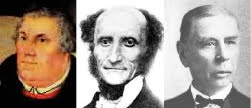
C. F. W. Walther — Ludwig Fuerbringer
    C. F. W. Walther                                L. Fuerbringer
       orthodox                                        mediating?
    Judging by the popularity of my upload of Prof. Ludwig Fuerbringer's Theological Hermeneutics, it would seem that Walther's essay will have great interest for anyone interested in what was taught by the old Missouri Synod, especially by Walther himself. Of course Walther dealt with this subject in other writings, e.g. his True Visible Church book, his edited Baier-Walther Compendium, and his many writings in the publications Der Lutheraner and Lehre und Wehre.
      A casual comparison between Walther's essay and Fuerbringer's booklet seems to indicate that the latter is more technical, and even relied on unorthodox German theologians: Schleiermacher, Cremer, and Zezschwitz. Walther uses no Greek or Hebrew words. Also while Fuerbringer mentions the errors of the "Romanists" and the "Reformed", Walther calls out these fellowships, the "Papists", "Reformed" and "enthusiasts", nearly 10 times as often. Walther's essay includes many quotes from the Confessions, Luther, Gerhard, Pfeiffer, Baier, etc. Fuerbringer only references his sources but does not quote them. He includes no references to the great John Gerhard. — Overall, while Fuerbringer does make good use of Luther's writings and the Lutheran Confessions, yet his technical treatment and weak statements leaves one wondering if he was inclined to take a mediating position. He used statements that opened the door for later "Walkout" sympathizing LC-MS theologians like Profs. Robert H. Smith and Norman Habel
      Not so with C. F. W. Walther:
Page 9: "For the papacy is also a vain enthusiasm." 
10: "The enthusiasts falsely refer to the passage: 'The letter killeth, but the spirit giveth life.' (2 Cor. 3:6)"
13: "The papists' theology teaches that we must doubt grace…"
25: "diabolical doctrines of the pope and the papists"

Other notable quotes from this essay:
8: "Everyone must have divine certainty from Holy Scripture itself, not standing on the light of nature, but on the light of the Holy Spirit."
9: "…the Holy Spirit has placed the words in such a way that the meaning intended by Him can be recognized from them. — It is on such certainty of the Holy Spirit that a Christian bases his consolation in mortal distress."
11: "No man has the right to interpret Scripture, but only the Holy Spirit."
12: "The Lutheran Church has confessed that the Pope [not just the Papacy] of Rome is the Antichrist. Anyone who does not believe this is not a Lutheran." [Can we not conclude that some theologians in the LC-MS are not Lutheran?]
17-18: "God has never directed us to tradition, but to the Scriptures alone." [Against Prof. Joel Biermann's teaching on the place of "tradition" in theology.]
19: "The inner light of which the enthusiasts, especially the Quakers, boast is the devil's light."
20: "What follows from the Scriptures is what it says. The Bible does not contain the word "triune", nor does it say "three persons", and yet Christians believe and confess it… Almost all doctrines of Christianity are the result of such conclusions." [Against the revered LC-MS theologian Martin Franzmann who said that there are no scripture passages clearly establishing the inerrancy of Holy Scripture.]
22: "…not to doubtful passages, e.g. … to John 6, for there is no trace of Holy Communion."  [Against Prof. David Scaer]
25: Luther: "But if any of them should challenge you, saying, 'We must have the interpretation of the Fathers, that the Scriptures are dark,' you should answer that it is not true.… They speak such things only to lead us out of the Scriptures and exalt themselves as masters over us, that we should believe their dream sermons." [Against Prof. Joel Biermann of CSL.]
28: Luther: "the Scriptures are their own light. This is how it is when Scripture interprets itself."
30: "the newer theologians… have invented a completely new doctrine of the Lord's Supper, which they base on John 6, but which does not speak of the Lord's Supper." [Against Prof. David Scaer]
34: "Even those who do not know the basic languages can be divinely certain that their German Bible is the Word of God, because they receive the testimony of the Holy Spirit through it." [Not spoken of by Fuerbringer. See Pieper's quote of this in  C.D. 1, p. 348]
39: Gerhard: "Allegories, tropologies, and anagogies are not different senses, but different inferences from that one sense" and Pfeiffer: "for not to mean merely one thing is to mean nothing certain".
40: "A signpost must show so clearly that only one way can be understood. The newer theologians claim that the Scriptures have a multiple meaning… But no Christian can comfort himself with this, because he must be continually in fear as to what is the meaning intended by the Holy Spirit."
41: "There is no second sense of the word in Scripture, only of things."
41: "Even if Luther almost always gives a secret interpretation of the Gospel in his Church Postils, he was too fond of the weakness of his time, and no one is entitled to follow him in this. The listeners demanded it; but since Luther spoke of nothing more than faith and love in these secret interpretations, the listeners themselves finally grew tired of it, which is why we find nothing more of the secret interpretations in the House Postils, which were written later." [That Walther is a Lutheran theologian of the first rank is exhibited here as he calls out Luther's use of "secret interpretations", but shows these came from the early Luther's Church Postils, which the later, stronger Luther outgrew with his House Postils. (Ref. Klug, House Postils, "Preface", p. 13) An analogy to this is when Luther outgrew his respect for the Pope, and later identified him as the very Antichrist.]
49: "A Christian has to do only with those things that are so certain that he can live and die on them."

      The following is the English translated file that utilized the DeepL Translator as its basis, and was somewhat polished. It includes numerous hyperlinks for navigation and to its references for immediate access, especially for the Lutheran Confession (Triglotta), and Luther's Works (St. Louis Edition and American Edition):
A file without highlights may be directly accessed >> here <<; the German text >> here <<.

      May this uncovered essay of Walther provide readers with the defense and comfort they need for their faith, so that the the doctrines of the Holy Scriptures are so certain for them that they "can live and die on them". Amen!

[This is the first in a series on Lutheran Hermeneuts, Table of Contents here, in Part Hrm02.]

Saturday, March 9, 2024

"According to a pure understanding": true unity of the Church

      Ten years ago I did a blog post where I tried to expand upon the meaning of Article VII of the Augsburg Confession for the unity of the Church. Where Article VII spoke of agreement on "the doctrine of the Gospel", I asked the rhetorical question: "Could the Augsburg Confession be quite serious at this point in emphasizing the pure Gospel?" At that time I was not aware of what the original text said in the German version. Here are the relevant texts for comparison, as published in the venerable Triglotta:
(1) In the English it reads:
And to the true unity of the Church it is enough to agree concerning the doctrine of the Gospel and the administration of the Sacraments.
(2) In the original Latin, it reads as translated by Google Translate and Yandex Translate:
And for the true unity of the church, it is enough to agree on the doctrine of the Gospel and the administration of the sacraments.
(3) However the German language version is more explicit, for it does not want a misapplication of this article by opponents (DeepL/Google Translation):
For this is enough for the true unity of the Christian Church, that the Gospel is with one accord [einträchtiglich] preached according to a pure understanding, and the sacraments are administered according to the divine Word.
So the simple phrase "the doctrine of the Gospel" is clarified by the addition of "according to a pure understanding" of this Gospel. The Roman Catholic and Reformed errors on the Gospel take away this "pure understanding". Now I have, in the German original text, a confirmation of my point that all disunity in the Church is caused by an impure understanding of the Gospel. And a true unity was restored by C. F. W. Walther with his pure teaching of the pure Gospel, i.e. 

the Lutheran Doctrine of Justification.

Wednesday, July 27, 2022

Guenther's Walther, A Life Portrait, now in English (A BTL book)

      This is an "excursus" to follow a Der Lutheraner essay (Part DL3b, Table of Contents in Part 1) on the life of Martin Günther.  In it we publish Guenther's 1890 German language book Dr. C. F. W. Walther: Lebensbild, a biography of C. F. W. Walther, in English. Guenther was the editor of Der Lutheraner during the last 14 years of Walther's life.  He would have worked closely with Walther as editor and fellow professor at Concordia Seminary.  And he was one of Walther's earliest students.  When I translated and polished the text of this book, I was quite surprised at its quality, details, and spiritual insight. It brings to light the life of the father of the Missouri Synod.
Notable excerpts:

6: "God did not want him to become a musician,… worked in him the decision to choose theology"

15: "the High Consistory forbidding him to continue teaching the doctrine of man's natural perdition,"

17: "'I sometimes argued with my principal about whether everything in the Bible was reliable, divine truth'"

24: "He was under a godless rationalistic superintendent,… unbelieving and hostile village schoolmaster,… Walther was repeatedly put on trial"

31: "…forbidden to practice confession, to suspend even the most unrepentant people…, 'such preachers in Saxony who did not even baptize in the Trinity'"

32: "How gladly the Lutheran preachers and laymen would have … separated from the deeply corrupt apostate national church!… Therefore, they saw emigration to a country where religious freedom prevailed as the only way out of the increasingly unbearable oppression of conscience, "

32: "…, the above-mentioned pastor in Dresden [Pastor Martin Stephan] called on all Lutherans, …, who were under pressure of faith, to emigrate"

44: Walther"… immersed himself, as far as his weakness allowed, in Luther's and other fathers' writings"

46: Altenburg Debate: "…was the Easter Day of our hard-trodden congregations, where they, like the disciples of old, saw the Lord again"

54: "…if anyone believes that priestly rule still exists in our congregation, he should … read the statutes of our congregational order"

55: "Walther expressed the wish: 1. that the name of the church not be that of a man"

62: "God had led them out of dangerous, Romanizing teachings [to]… Lutheran doctrine of church, preaching ministry, [or]… lost forever"

63: "But now the time came when Walther's effectiveness was to extend into the widest circles…to publish a leaflet … ‘Der Lutheraner’"

65: "A first, a main fruit of the "Lutheraner" was the formation of the German Lutheran Synod of Missouri, Ohio, &c. St."

69: "How much light was shed on church and ministry, especially by Walther!… a synodical association… only a consultative power,"

70: "…far from diminishing the congregation's rights, sought rather to preserve them"

74: "Walther was intent on publishing a new Lutheran hymnal… the main consideration in selecting [hymns] was that they be pure in doctrine…"

77: "…the writers of our daily papers,… have mocked with impunity that there are still people in our city who believe in a God"

83: "On festive occasions… nothing to be seen or heard of insipid merriment or mere carnal gaiety… occasional jokes" [There were indeed "jokes".]

86: "The Romanizing Lutherans of America, to whom Walther referred… were Pastor Grabau…"

87: "…a protest against the assertion of hierarchical principles within the Lutheran church"

89: "For Löhe [or Loehe] and his friendstook a wrong, Romanizing direction.… a doctrinal difference between Pastor Löhe and our synod

90: "Prof. Walther declared that he had no pleasure in traveling to Germany as a delegate of the Synod."

93: "In Erlangen, Walther met his childhood friend Dr. Delitzsch"

93-94: "a friendly relationship [with Loehe] was only temporary… [for him] the confessional writings … did not have such a unifying power"

94: Walther: "…that one could always get cheap and good Bibles that contained the correct Luther text"

94: 1853 Synod: "…[Der Lutheraner's] style of writing would henceforth be adapted to the capacity of the people even more than it had been before"

98: "in 1854 — as an opposition synod — the Iowa Synod came into being, to which Löhe wanted to assign his disciples"

99: Iowa Synod: "strive for further development of the doctrine…church and ministry, to be 'open questions'"

99: Iowa: "a result of these chiliastic views, they denied… that the pope was the Antichrist." [just like today's LC-MS]

100: 1855 Walther on Iowa Synod & Loehe: "having gained prestige in the church through their former faithfulness, want to use this prestige to lead us away from it again. Here we mean men like Löhe."

106: Walther on Missouri Synod: "It is a return of the days of our [Lutheran] fathers and of Acts. 2"

114: "denying church fellowship to the Iowans for the sake of a difference in the doctrine of Antichrist"

118: "the formation of the 'Evangelical Lutheran Synodical Conference'"

121: In 1872 "Walther laid the foundation for the 'English Lutheran Conference of Missouri'

129: Walther refused honorary doctorate from German university: "'I would feel a crowned ass…' [erring] doctrinal position of Göttingen faculty."

130: "the … Synod of Ohio … to confer the title of Doctor Theologiae on Professor C. F. W. Walther"

146: Walther in 1881: "Do not think that I am a mere head scholar. Already 50 years ago [c. 1831], by God's grace, I came through a long and heavy anguish of my heart to the realization of my sinful end and thereupon to the knowledge of the truth.

148: "nothing that has been brought forward against our teaching has been able to convince me of an error. My conscience is caught in God's Word"

149: ""it is not right to say: 'I am chosen because I believe', but that one must say: 'I believe because I am chosen'."

162: Walther's and his sermons: "memorized most diligently until he went to church"

165: Delegate Synods: "these dear, good men… have been sent as representatives of the congregations" [Old Missouri sent only men]

166: Walther's visits to sick young girl: she "finally looked forward to her death with great joy"

172: "For the books he published he took not a cent in remunerationflourishing of the 'Concordia Publishing House'."

175: "… he was able to amuse society with a fine joke, not with jokes that were inappropriate for Christians, but… within the bounds of godliness."

176 & 179: "Walther did not, as some do, have a particular favorite doctrine, but all doctrines, and that from their center, the doctrine of justification." <——> "Again and again Walther returns to justification by faith alone."

180: "He knew Luther's writings exactly…excellent instructions for the study of Luther's writings"

181: "This gift served him well in the … defense of doctrine, in disputations, in religious discussions"

182: On usury question, "… he could not depart from right doctrine even if the synod fell to pieces"

184: "In the Lutheran Synod of Australia, too, Walther is spoken of with high esteem "

196: "The center of his sermons as well as of all his addresses and writings is for him the Lutheran doctrine of justification"

228: Letter to Wyneken: "But, my dear Wyneken, now also recognize with gratitude that your wretched body and your mind, so often sunk in melancholy, are truly nothing other than the hallmarks of the Lord Jesus, so that you are adorned. I am confident that the song of defiance is also yours to sing: "I will not die, but live and proclaim the work of the Lord," Ps. 118" [Walther did not counsel his friend Wyneken, who was in a state of melancholy, to go to earthly counselors or psychologists or psychiatrists, like LC-MS pastors do. Old Missouri pastors certainly did not, and would not, use these modern "sciences" to counsel their congregational members!]


Now I present Guenther's authoritative history of Walther's life in English:
The text of this book may be downloaded here; the German original text is here. Google Book here.

LC-MS judgment of Guenther's book:
     Modern LC-MS historians, such as Walter Forster and Carl Mundinger, downgrade Guenther's history on certain "facts" and use terms such as "purely fictitious" and that Walther was an "extremely zealous Stephanite" and a "rabid Stephanite". Mundinger claims that Walther's "rabid Stephanism had gotten him into endless trouble with both the civil and the ecclesiastical authorities in Saxony", a statement which willfully ignores Walther's own testimony of how these "ecclesiastical authorities" fought against his orthodox teachings, as Guenther's history documents. But pure doctrine seems to matter little to today's LC-MS historians like Pastor Todd Peperkorn, making their "history" fictitious in places. The result, and the aim, of modern LC-MS histories is essentially that people should read their histories, the New Missouri's histories, not the histories by the Old Missouri Synod.  Dear reader, read Guenther's history and judge for yourself whose history is "purely fictitious" and whose is not. (Hochstetter's history is treated in the same way by LC-MS historians.) — We continue our series of blog posts on the publication Der Lutheraner and its writings in the next Part 3c.