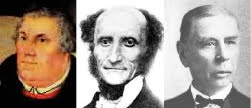
This continues from Part BWC3e in a series (Table of Contents in Part BWC1) presenting Walther's edition of Baier's Compendium of Positive Theology. — This segment concludes Chapter III, then introduces Chapter IV, Regeneration and Conversion. — Also we begin to see the importance of Walther's added quotes, as he uses these to correct Baier's and his father-in-law Museaus's synergistic tendencies. — From pages 168-240:
Notable Quotes: (Italics follow the original. All quotes not from Baier are from Walther's additions of quotes from third parties. Authors are indicated in bold text. Red text indicates my comments.)
168: Gerhard: "our theologians on this question is that faith alone justifies, yet it is not alone, that is, it is not separated from charity and other good works"
168: Luther: "For they [Sophists/Papists] say that faith…does not justify unless it is informed by charity,"
%20crop2.jpg)
170: Luther: "Therefore, when they [Papists] attribute justification to faith only because of charity, they attribute nothing at all to faith.…Let the sophists therefore go to hell with their impious and pestilent gloss." [See this blog post.]
172: Smalcald Articles: "For the Holy Spirit does not let sin reign and gain the upper hand…but rather restrains and prevents it from doing what it wants. But if it does what it wants, then the Holy Spirit and faith are not present"
173: Gerhard: "they [Papists] also say faith can exist alone without good works…Hence, they decree fornicating believers, adulterous believers, stealing believers, avaricious believers, drunkards, blasphemers, etc., as the Council of Trent, Session 6, chapter 15, decrees" [Notwithstanding "Catholic Answers", on James 2:24, tries to negate Trent which stated that faith isn't lost with "every mortal sin".]
176: Gerhard: "These are the words of the blessed Luther, which are drawn from the theological rule: 'Faith alone justifies,' although it is never alone, that is, separated from good works."
[Chapter IV. Of Regeneration and Conversion]
179: Huelsemann: "vivification and regeneration are nowhere said to happen day by day…but in an instant there is a translation from death to life, namely, a spiritual one"
180: "Regeneration, strictly speaking, signifies nothing other than conversion or the very gift of faith."
184: Brenz: "The Gentiles (Acts 10) are manifestly proven to have been regenerated by faith and renewed by the Holy Spirit even before baptism… it was nevertheless necessary to obey the ordinance [Baptism].
185: Dannhauer quoting Ae. Hunnius: "For although they were first converted and regenerated through the hearing of the Word, nevertheless that gift of regeneration was wonderfully increased and enriched in them through baptism."
186: "But concerning these [those who have lost their faith], it should be noted that if they are to be regenerated again, baptism is not to be repeated on that account, but they are to be brought to repentance through the word of the law and the gospel" [This was my situation.]
188: "it must by no means be held that natural powers, and the acts depending on them, contribute anything effectively to the production or acquisition of faith."
189: Luther: "…one should therefore say first, that they are all dead…it helps nothing to obtain forgiveness of sins, until they are born again and become new men"
189: Quenstedt: "because the Galatians had been regenerated through Paul, but having been seduced by the pseudo-apostles, they had lost the grace of regeneration…Adam, Lot, David, Peter, who all lost the grace of regeneration by sinning, yet recovered … through the Word of God"
190: Quenstedt: "Calvinists, who oppose the loss of the grace of regeneration and νίοθεσίας (adoption), and hold that the repetition of regeneration is absurd"
192: Huelsemann: "the Formula of Concord…teaches that the conversion of a man to God is the work of the Holy Spirit alone, to which the will of the man being converted contributes nothing"
198: "since Scripture teaches no satisfaction to God acceptable or valid in itself other than that of Christ, … by which one is first brought to Christ the Mediator, and through Him further to God, being reconciled by the merit of Christ"
199: "the flesh, even in the converted, still lusts against the Spirit, Galatians 5:17, which would not happen if the evil concupiscence had been or could be entirely expelled."
.jpg "Johann Musaeus (Wikipedia)")
203: Quenstedt: "The preparation has its own degrees and occurs successively; the translation itself from the state of wrath to the state of grace, however, happens in an instant and in a moment"
209: Kromayer: "a distinction must be made between ecclesiastical and spiritual actions. Ecclesiastical actions are, for example: reading the word of God, going to church, hearing sacred sermons, and indeed with attention; spiritual ones are, for example: believing the divine word, believing that Christ died for one, etc. The former are still in our own hands; the latter, however, are not."
211: Dannhauer: "‘If,’ says Gerhard, ‘new obedience is established as an essential part of conversion, there will be no firm promise of reconciliation with God and of the remission of sins, because our reconciliation with God and the remission of sins will be judged by the quality and quantity of the new obedience. [Compare with Dr. Scott Keith, Concordia-Irvine.]
213: Apology of the Augsburg Confession: "they [Papists] teach that one can merit grace through repentance…for faith distinguishes the repentance of Peter and Judas. But the adversaries do not think at all of the Gospel and faith"
216: Quenstedt: "Arminians…ascribe the cause of faith partly to the grace of God in Christ, and partly to man and his free will"
218: Kromayer: "For one unregenerate person is not more disposed to grace than another, but one is less indisposed than the other, . . . because sin, to which one allows more rein than the other, does not dispose to grace, but rather hinders it"
223: "And so it is rightly said: Grace precedes, the will accompanies."
223: Calov: "However, it is not…asserted that before conversion man is a fellow-worker and cooperates in his own conversion. Such a thing is nowhere taught by the Formula of Concord, as the new synergists contend." ["New synergists" to which Baier and his father-in-law Museaus tended.]
225: Strasbourg: "The determination of our will in the first act of conversion has always been by the orthodox ascribed, not to the power and cooperation of man, but to the Holy Spirit, working through the Word upon a will that is passively inclined."
228: B. Meisner: "Augustine…: ‘Grace…is not grace in any way, unless it is given freely in every way.'"
229-230: Luthardt, a synergist: "repentance and faith are demanded of man as his performance"; Kahnis, synergist: "Melanchthon had, through the doctrine of the cooperation of the human will in appropriating salvation (Synergism), entered upon the right, evangelical, and at the same time truly traditional path"
231: J. Olearius: "A man can…in no way oppose the infinite power or omnipotence itself, but rather [can resist] grace and its order"
In the next Part BWC3g…

No comments:
Post a Comment
Comments only accepted when directly related to the post.