Search This Blog

Showing posts with label Confessing the Gospel-Nafzger. Show all posts

Saturday, March 4, 2023

Un8: Unionism & prayer fellowship (Der Luth. 1908); LCMS: Scott Murray, Samuel Nafzger

[2025-05-24: see added note at bottom on Pres. Harrison on this; 2023-12-06: see this site for further helpful links on this subject.]
      This concludes from Part 7 (Table of Contents in Part 1) in a series presenting an English translation of Walther's "Foreword" on Unionism to the 1871 volume of Lehre und Wehre. — To follow up on the Walther series against Unionism, there was a small blurb in Der Lutheraner on an event in 1908 regarding the practice of prayer fellowship. The occasion was the opening of a new General Synod (a forerunner of today's ELCA) church building in Baltimore where Methodist, Presbyterian and Episcopalian officials, even a Jewish Rabbi, were present.  The officiator lamented that a Roman Catholic representative was not present, although a hymn of Cardinal Newman was sung.  This event is a strong reminder of when, in 2001, LCMS Atlantic District President David Benke prayed among an even more eclectic group. — From Der Lutheraner, vol. 64 (1908), p. 111 [EN]:
- - - - - - - - - - - - - - - - - - 
 
Colloquy of Thorn (image: https://toruntour.pl/4341/colloquium-charitativum-torun)
Colloquy of Thorn, 1645
      On prayer fellowship with those of other faiths and the remarks on this in No. 3 of Der Lutheraner a pastor of our Synod writes us: "It was very interesting to me when I recently read that our fathers acted just as we do." He then shares a passage from Krasinski's History of the Reformation in Poland about the religious discussion at Thorn in 1645 between Lutherans, Roman Catholics, Reformed, and Herrnhuters [Bohemian Brethren]. The Polish king wanted to reconcile the different church communities of his country in the interest of unionism through this religious discussion. In the report, which we have translated back from English into German [now back to English], it says: "At the general meeting on September 16, the denominations could not agree on the prayer with which each meeting should begin. The Roman Catholics wanted the Bishop of Samogita to read out a prayer at the beginning of each meeting, in which nothing was contained against the teaching of the other denominations, and that all present should repeat it. The Reformed and Herrnhutters agreed to this, but the Lutherans refused to pray together with people from whom they differed in faith." Our reporter adds: "From this it is clear: 1. that we are acting just as the faithful Lutherans of Poland did in 1646; 2. that this desire to pray publicly with false believers and misbelievers is a Reformed, Herrnhutian trait and foreign to the faithful Lutheran Church; 3. that in such indifference not truth, but untruth wins; for here it was Rome that won the day to the mischief of Poland." L. F. [Ludwig Fürbringer]
- - - - - - - - - - - - - - - - - -
Profs. Timothy Schmeling (ELS), John Brug, Wisconsin Lutheran Seminary
Who would deny that Poland is now a Catholic country? — I suspect LCMS scholars will label this report as "apocryphal" or spurious. But Calvinist Krasinski would have little motive to give a false report. — This DL report has been cited in recent years by Profs. Timothy Schmeling of the ELS and John Brug of Wisconsin Lutheran Seminary. Brug pointedly contrasts a writing of LCMS VP Scott Murray with the actions of the Lutheran fathers at the Thorn Colloquy in 1645. We quote:
“In a recent issue of LOGIA (Easter 2004 [13-2, p 8]) Scott Murray claimed, 'Our church fathers insisted on beginning with prayer when they participated in theological discussions with the Reformed and Roman Catholics in the seventeenth century. Only when the Catholics demanded to be the only ones to pray did the Lutheran party refuse to pray. More recently the so-called 10-10 meetings between ELCA and LCMS began with chapel in the respective national headquarters.' Does Calov’s report of the colloquy [of Thorn] permit such an interpretation? We will see that it does not.”
Brug also pointed out a similar falsehood that was stated by Dr. Samuel Nafzger:
“In an essay published in the Concordia Journal, July 2003, Samuel H. Nafzger, executive secretary of the Missouri Synod’s Commission on Theology and Church Relations, renewed the claim that the LCMS never held a unit concept of fellowship which included prayer on the same level as the means of grace as expressions of church fellowship, though he did grant that some in the LCMS may at times have had such a notion.”
Members of the LC-MS may think that their Synod is not unionistic with the ELCA and others, but their Lutheran fathers would say otherwise.  The ELCA is not Lutheran in their teaching.

[2025-05-24: It has been pointed out elsewhere that Pres. Matthew Harrison also spoke like Dr. Scott Murray on an Issues, etc. program in 2015
"I think, however, it’s always been recognized, and I think from the earliest times – and we disagree with the Wisconsin Synod on this – but it’s always been the case from the earliest times of the Lutheran Church that we, at the Colloquy of Thorn, for instance, and in other instances, Reformed, Catholic, and Lutherans came together and they held prayers before sessions, praying for unity. I think that is certainly not inappropriate."]

Harrison can "think" all he wants but he cannot truthfully claim that "it’s always been the case" that true Lutherans prayed with those who did not hold to the Biblical, Confessional, Lutheran faith.

Friday, September 3, 2021

LCMS on Antichrist: “hypocritically professing loyalty” (Part 3 of 3)

2021-10-03: Addendum added below on so-called "Gottesdienst" teaching.
      This concludes from Part 2, presenting an English translation of Walther's stinging essay against "Lutherans" who do not teach that the Pope is the very Antichrist. — Now we need to fully expose the actual, official teaching of the LCMS.  Ask any LCMS pastor today: "Is Pope Francis the Antichrist"? At best you will get an equivocal answer, with few exceptions. So what is taught in LCMS seminaries?… what is taught to its lay people?  Do they hold up the teaching of its fathers? … of the Lutheran Confessions?

Teaching in the seminaries: (see also this post from 2 years ago)
      The official textbook in the LCMS for doctrinal teaching in it seminaries is Confessing the Gospel: A Lutheran Approach to Systematic Theology - 2 Volume Set (CPH 2017, $89.99).  Although it does not have a specific section dealing with "Antichrist", the section on the "Last Things" deals the most with it. On page 1138 we read (emphasis mine): 
Confessing the Gospel: A Lutheran Approach to Systematic Theology - 2 Volume Set (CPH 2017)
“THE SMALCALD ARTICLES AND THE TREATISE
…In the six years that had elapsed since Melanchthon wrote the Apology, it had become clear to Luther that the papacy would not change its views, particularly with regard to justification by grace through faith. His conclusion was stark: “[The papacy] is the true end-times Antichrist, who has raised himself over and set himself against Christ…(SA II, 4, 10)”
What is wrong with this quote from the Lutheran Confessions?  It changed the specific confessional words of "Papst" (German) or "papum" (Latin) or "Pope" (English), into "The papacy." If "papacy" was meant, Luther would have written "Papsttum".  But he wrote "Papst".  None of the English translations of the Book of Concord translate this as "The papacy", all of them translate it properly as "Pope" or "pope", even the liberal, unionistic Kolb-Wengert  edition, p. 308-309. Also the Brief Statement of 1932 translates it as "the Pope".  So why would editor Samuel Nafzger's textbook change the wording of the Book of Concord?  It is because they, Nafzger and his LC-MS, do not teach as the Confessions teach on the Antichrist.  We get further concrete evidence of this in the following.

Teaching to the laity:
       The Wikipedia article on Confessional Lutheranism tipped me off to this issue among external Lutheran bodies who self-identify as "Confessional". Since 2012, or earlier, in their FAQs, they have stated the following in answer to questions on their teaching on the "Antichrist":
“The LCMS does not teach, nor has it ever taught, that any individual Pope as a person, is to be identified with the Antichrist.”
One may view a PDF that was evidently printed at an earlier time (2012?) below – scroll down to "Connection between the antichrist and the pope":
In stating it this way, they are not confessional Lutherans, even if they agree with Isaac Newton on this point.
Graphic from: LCMS.org/about/beliefs/doctrine
      The LCMS trivializes the Lutheran Confessions and exposes it's actual “quatenus” position on them.  The forceful emphasis in the phrase “nor has it ever taught” shows that it was inserted to soothe their conscience on this point, for it demonstrates that the “The LCMS does not teach, nor has it ever taught,” as the Old Missouri Synod taught. — President Matthew Harrison confirmed his support of Loehe (over Walther?) in a recent promotional statement for a 2020 CPH book, a Matthew Carver translation of a liturgical book by Friedrich Lochner, using the phrase "[Lochner's] great contemporaries like Löhe".  Lochner, while using, and correcting, some of Loehe's liturgical work, would hardly affirm President Harrison's and the LCMS's position on the Antichrist because he firmly upheld Walther's confessional Lutheran teaching on the Antichrist, despite any claim to the contrary. Even a casual perusal of Old Missouri periodicals shows that they specifically speak of individual Popes who served in the office of the Pope as continuing to fulfil the confessional statement that “he [not it] is the very Antichrist”. 
      This is not a trivial issue and Walther perfectly highlights its importance. Walther battled the Iowa Synod on exactly the same terminology issue in Der Lutheraner, vol. 23 (1867), p. 157. The Iowans said: 
"Because… the Apology calls the papacy also a part of the kingdom of Antichrist, and the Apology is just as much a confession of our church as the Smalcald Articles, we combine both passages, explain the more general by the more specific, and say: the pope or the papacy is the right Antichrist."
To this Walther commented: "A clumsier sophistry has hardly ever been made." [See also Walther's the Eastern District essay of 1870, with Walther present, (in English) here.] [2024-11-28: undated info on authorship.]
      What is the greatest impediment to a resurgence of true Lutheranism in the world today? It is the Lutheran church body that teaches
the papacy is the true end-times Antichrist”,
not
the Pope is the very Antichrist”,
it is 
the Quatenus LCMS!
- - - - - - - - - - - - - - - - - - - - - - - - - - 

Monday, June 21, 2021

Can only reading the Bible convert anyone?

      The following short blurb appeared in Der Lutheraner and caused me to rejoice at its testimony by the Old German Missouri Synod.  Ask any LC-MS pastor today the question above and you will at best get an equivocal answer.  Not so by Der Lutheraner, vol. 8 (August 4, 1852) p. 198-199:
= = = = = = = = = = = = = = = = = = = = 

Conversion through reading the Bible.


At the beginning of the 17th century, a Jew named [Christian ben Meir Biberbach] Gerson lived in Recklingshausen in Westphalia. Besides the sin of usury, which completely dominated him, there lived in his heart a bitter enmity against Christianity, which often gave vent to blasphemies against Jesus. He, too, seemed to be under the judgment of hardening, with which the unfortunate Israel has been punished for 1800 years after the rejection and cruel murder of its Messiah. But what happened? Once a poor Christian widow came to the usurer to borrow some money from him against high interest. But she had nothing to pledge for it but a beautiful copy of the New Testament Scriptures in Lutheran translation. Gerson finally accepted the pledge. But when he saw that it was the book of the Christians, an eagerness arose in him to know what foolish things might be written in it. He takes two other Jews with him and reads the holy book with them. At the beginning, all of them spill out terrible blasphemies about what they have read. But Gerson, the deeper he gets into it, becomes more and more restless. He feels emotions in himself that he never felt before. He looks up the passages of the prophets in which, according to the testimony of the evangelists, Jesus of Nazareth is prophesied as the Messiah of the people of Israel and of all the nations of the earth. “There I found,” he himself wrote in a book he later published on the Talmud [Des jüdischen Talmuds fürnehmster Inhalt], “such a light that I have to thank God for it.” He was overcome by truth. He therefore went to Halberstadt, where he took lessons for a year from a godly preacher and was then baptized. But after God had shown him mercy and had so graciously saved him from great hellish darkness, the desire arose in him to become an instrument through which others could also share in this grace. He therefore studied theology in Helmstädt, taught many distinguished persons the Hebrew language, which he understood thoroughly, published several writings to expose the Jewish errors and finally died as a pastor in the principality of Anhalt, September 25, 1627.

= = = = = = = = = = = = = = = = = 
Prof. Peter Nafzger, Concordia Seminary
     I would repeat a statement, from a previous blog post, by Prof. Peter Nafzger of Concordia Seminary, St. Louis, son of Samuel Nafzger, from his book Towards a Cruciform Theology of Scripture, p. 111): 
"Luther would also refer to Scripture as a ‘means-of-grace-word.’” Nafzger immediately follows this with the comment: “But this was not his normal way of speaking. He usually emphasized the need for the oral proclamation [over reading?] of the Word, as well as Paul’s comment that faith comes through ‘hearing’".
Prof. Nafzger explicitly wants to teach that "hearing" the Word excludes the reading of Scripture. But Merriam-Webster includes the following in its definition of "hearing": "to be generally known or appreciated" which can also be achieved by only reading. Or does Prof. Nafzger think that his book can only be "heard" if it is audibly heard, and not read?

Tuesday, July 21, 2020

LCMS-Harrison vs. Walther on "Church and Ministry" (Excursus)

      This post is an excursus to the previous post "Hist11: Chapter 7" of Hochstetter's History.  The depth that the LCMS has fallen to Romanizing becomes even more apparent from this History and has caused me to produce a separate blog post instead of an add-on to the previous post. This matter is not a minor doctrinal issue for Lutherans, but about "far-reaching doctrinal differences".
Reversing Walther's teaching
by Matthew Harrison
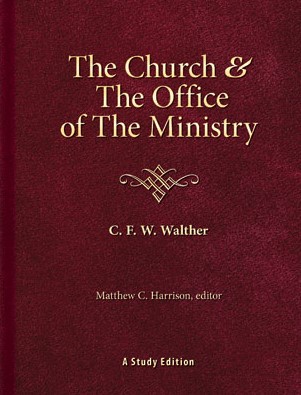
LC-MS Pres. Harrison with Vice Presidents (2019)      Hochstetter's chapter 7 hits home against President Matthew Harrison and his LC-MS today. While Harrison praises Walther in his editorial comments in his re-translation (and mis-translation) of Walther's Kirche und Amt, (Church & Office, CPH 2012), he reinterprets the Lutheran Confessions and misunderstands Christ's words in Matthew 18:17-20.

Synecdoche: figure of speech
      Harrison makes maximum use of the term "Church" as a synecdoche, a figure of speech, in order to confuse the term's various meanings, thereby making even Holy Scripture uncertain.  It is a clever way of achieving his aims, making it seem like he is following rather than overturning Walther's teaching. This is indeed poor praise of Walther, for Walther clearly teaches what Harrison says he did not.  And Hochstetter is another witness against Harrison, along with J.T. Mueller whose better translation, Church and Ministry, in most cases is the correct meaning.  I may quibble with some of Mueller's paraphrasing, but not his general understanding of Walther. Unfortunately for Harrison, Hochstetter confirms Walther's true teaching, and Hochstetter's work was personally approved by Walther, and so Harrison cannot easily separate Walther from his later true followers, those who properly understood the rights of congregations or the local church.  Too bad for Harrison, we meet a true "Missourian" in Hochstetter, a label that Harrison explicitly derides in his later books, his books that came after his At Home in the House of my Fathers.
Confessing the Gospel (CPH 2018)
      The latest textbook of doctrine to come out of the LCMS, Samuel Nafzger's Confessing the Gospel (CPH 2018) which was personally approved by Harrison, even states (p. 1013): 
Walther’s understanding of the doctrine of the office of the public ministry may be summarized in the following points: … (7) God brings men into the pastoral office through the call of the congregation, to which the power of the keys is given.”
But Harrison attempts, with his editorializing, to claim that Walther taught that the term "church", the entity empowered to call a pastor, does not mean just the local congregation.  He says (p. 212):
I do not believe the Missouri Synod's decision to 'call' clergy to its district or national work–a practice that was ratified by convention in the early 1960s–is fundamentally at odds with Walther's views.”
How ironic it is that a textbook of doctrine with Harrison's support, which can lay little claim to orthodoxy, would affirm Walther's teaching on this very point that Harrison explicitly denies.  President Harrison essentially openly identifies with those who staged the 1974 Walkout from Concordia Seminary! And doubly ironic is the fact that Nafzger's textbook quotes J.T. Mueller's translation, not Harrison's translation, in the subsections dealing with "The Church" and "The Ministry"!  How embarrassing for Harrison that his great work is not even mentioned anywhere in Nafzger's textbooks. No, not once.

Luther's Works, volume 40, p. 371 (Gemeine translated as congregation)Gemeine and Gemeinde
      Harrison also plays fast and loose with the German terms Gemeine and Gemeinde and tries to use the change in spelling from the archaic Gemeine to the more recent spelling Gemeinde, claiming it can also be used as "Church" in the wider sense.  But not only does J.T. Mueller translate it properly to "congregation", not "church", but even the opponents of the Missouri Synod who translated Luther's writing on "The Keys" in the American Edition of Luther's Works, volume 40, p. 371) translated Luther's "Gemeine" as "congregation", not "church" (ref. WA 30II, 502, StL 19, 950, 94-95).  Imagine that!  Even Missouri's opponents, non-"Missourians", from the Romanizing old Augustana Synod (#18) knew better than the current President of the LC-MS, Matthew Harrison.
- - - - - - - - - - - - - - - 
      But enough!  Just read the Brief Statement of 1932 (English, German) and get a clear, concise declaration of the Lutheran Doctrine of the Church and the Ministry, and avoid reading Harrison's translation until one is firmly grounded in the truth of God's Word.
      I had not fully realized the depth to which Harrison has yielded to the Romanizing tendency, but now I see clearly how Harrison is not just against J.T. Mueller, but also against Franz Pieper, Christian Hochstetter, C.F.W. Walther, the Lutheran Confessions, Martin Luther, and… most importantly, against Holy Scripture – Matt. 18:17-20.  Harrison improperly uses J. T. Mueller as his scapegoat, while wanting to appear in support of Walther.  But the worst part is his attempt to use the Lutheran Confessions against themselves.  Hochstetter gives us the true picture of Walther's teaching – Walther said so.  
      Harrison's mis-translation of Walther reveals another reason why Dr. Fred Kramer's translation of Hochstetter has not been published by CPH. It is because Kramer's translation fully agrees with Walther's (and J.T. Mueller's, Pieper's, the Brief Statement's) meaning on the doctrines of Church and Ministry.  Harrison is now putting the last nail in the coffin of the Old German Missouri Synod within his LC-MS.
      No, no, President Harrison, as Walther says, your "zeal leads (you) beyond Lutheranism,", here and now.  It remains to be seen whether there are true Lutherans left in the congregations of the LC-MS, whether they can see through the subterfuge, and recognize the wolf when they see it.  Currently there is one book review on Amazon that is aware of  this ('Meh', by Micah D. Schmidt).
      Any of the laity not well versed in the doctrines of the Church and the Office of Ministry, as I have been in the past, would do well to get J.T. Mueller's translation first, Print-on-Demand or used [2024-02-26: but now available to borrow on Internet Archive], to get Walther's true meaning, the true Lutheran meaning.  Only after one is well grounded and ready to have their faith surreptitiously attacked should one study Harrison's subterfuge of a translation.  Then one can understand just how far today's LC-MS has gone backward, to being like the Walkout crowd of 1974.
Prof. Otto F. Stahlke, Concordia Theological Seminary
===>> To President Harrison: did Prof. Otto F. Stahlke (1906-1992), whom you seemed to praise in your At Home book (p. 782: "he would read the Lutheran dogmaticians with me in Latin"), take your position on "Church and Ministry" or did he still confess with Walther (and Pieper) on these, i.e. for the God-given rights of the congregation, and against a call of pastors/church workers by a larger group than a congregation as divine right?  Would he have also negated Dr. Fred Kramer's translation on this? [Hint: read Stahlke's 1962 Springfielder essay on "Apostolic Succession".]  If not, then don't your criticisms of Mueller also apply to your mentor Prof. Otto Stahlke?
===>> To Concordia Publishing House: Why have you quit selling the hardback edition of J.T. Mueller's Church and Ministry book?  I see by the Wayback Machine you were selling it in 2016… could it be that you are rather promoting Harrison's translation instead?  Perhaps you could also explain why Mueller's translation had to wait 25 years to be published, in 1987, after it was completed in 1962?  … Really? a delay of 25 years? Who pushed for its publication… CHI Director August Suelflow? — In the next blog post, Part 12, Chapter 8, of Hochstetter's History.

Monday, December 9, 2019

Gerhard Forde: instructor to today's LCMS (2 of 2)

Gerhard O. Forde (ALC, ELCA professor; † 2005)
[2020-02-24: added reference at bottom to old blog]
     In Part 1, it was shown that the theologian Gerhard O. Forde questioned the foundational Christian doctrine of the vicarious satisfaction.  Forde's theology is thereby anti-Christian and unLutheran.  One would think that a synod claiming to be truly Lutheran would completely avoid Forde's theology because of this but that is not the case with the Lutheran Church-Missouri Synod.  Their new seminary textbook, to update Pieper's Christian Dogmatics, quotes him approvingly in many places, offering only minor warnings, e.g. on his Third Use of Law.

Forde in Samuel Nafzger's/LC-MS textbook Confessing the Gospel
      The following is my tabulation of the references to the works of Gerhard O. Forde, an ELCA theologian, in the new (2018) LC-MS textbook Confessing the Gospel:
Samuel H. Nafzger
General Editor
Chapter title
Primary Contributor(s)
#  Forde references
Prolegomena
David A. Lumpp
5
Anthropology
Jerrold A. Eickmann, Jerald C. Joersz, Thomas E. Manteufel, Daniel L. Mattson, Joel P. Okamoto
5
Work of Christ
Henry A. Hamann
8
Christian Life
Milton L. Rudnick, Martim C. Warth
5
Election
Robert Kolb
3
===========
Total: 26
There are approximately 26 references to Forde's writings in this 2-volume textbook for seminarians.  Most references offer no warning against his theology but rather quote him with approval.  All of these contributors are either ignorant of Forde's error on the fundamental article of the Christian faith, or what is more likely, they are, to borrow Siegbert Becker's words, "deliberately and culpably blind" to it – they are willing to overlook Forde's teaching that the Vicarious Satisfaction "creates more problems than it solves".
Walther's Works: Predestination (CPH 2018): includes 1880 & 1881 Missouri Synod pastoral conferences on controversy on "Election of Grace"
      But the ultimate tragedy of the praise of Forde's theology comes particularly in the last chapter "Election" by primary contributor Dr. Robert Kolb.  In the 2018 CPH book Walther's Works: Predestination, [2020-09-01 see also this post] it is repeatedly pointed out that one cannot hold the proper doctrine of Election of Grace without holding to the Lutheran doctrine of Universal, Objective Justification, or what is the same, the Vicarious Satisfaction.  While the author of Nafzger's textbook chapter (Kolb or Nafzger?) quotes both C.F.W. Walther and Franz Pieper in his attempt to set forth the Lutheran doctrine of "Predestination" or "Election", he then amazingly immediately follows these quotes with the following (p. 1255-1256):
"The most important North American Lutheran to articulate the doctrine of election in the late 20th century was Gerhard O. Forde (1927-2005).… Forde thereby seeks to drive home for troubled consciences the comfort that comes from knowing that before the world began God chose those to whom he has delivered his promise in Jesus Christ, and those in whom he has created faith through that same promise."
Forde demonstrates his "smokescreen" vocabulary by supposedly offering "comfort for troubled consciences" while questioning the Vicarious Satisfaction, an impossibility – as the CPH Walther's Works book demonstrates.  For Drs. Robert Kolb and/or editor Samuel Nafzger to hold up Gerhard O. Forde in the face of Walther and Pieper (and Stoeckhardt) is to join in Forde's duplicity, and thereby sadly exposes the author/editor's mixed, confusing theology.
"The Election of Grace in the Last Chapter of Confessing the Gospel and Dr. Walther’s Teaching" by Thomas Manteufel (CHIQ Summer 2019)Thomas Manteufel (CSL emeritus faculty listing 2018)
      It is even sadder that Prof. (emeritus) Thomas Manteufel, in a recent article for Summer 2019 CHIQ, attempts to justify the Nafzger-Kolb textbook by highlighting its references to Walther and Pieper, while ignoring the travesty of its reference to Gerhard O. Forde in the same writing! – I am truly sorry for the seminarians that now are taught with Nafzger's textbook, and more sorry for the Lutheran congregations who will have their future pastors taught under its "Lutheran approach", instead of Walther and Pieper. — For the reader interested in a in-depth debate on "Predestination" that clearly distinguishes truth from error, the 2018 CPH book Walther's Works: Predestination is the best there is. (2020-02-24: see also this blog)

Sunday, December 1, 2019

UOJ & the Witness?; the Gospel, not universalism; Part 2 of 2

      This concludes from Part 1, a "repristination" of an 1890 Lutheran Witness article defending Universal, Objective Justification (UOJ).  The author "G. A. M.", with his article, played a part in my return to Christianity (#5), to Lutheranism.

CONCLUSION
      With all the attention that this blog has given this doctrine, it is still largely ignored in the LC-MS.  We even see that prominent theologians such as Dr. Robert KolbDr. Detlev Shulz, and Pastor Martin Noland are quite confused on it, even expressly opposed to it.
Samuel Nafzger's 2-volume textbook Confessing the Gospel (CPH 2018)
Samuel Nafzger's textbook Confessing the Gospel, would seem to do a credible job of covering this doctrine in the "Work of Christ" section, p. 475-477, sub-section "Objective Reconciliation". But it also, in the same section, brings up the much misused warning against "universalism" and unfortunately leaves the impression, once again, that faith is a condition for Justification. But one could forgive this.  One might want to grant Nafzger (and Henry A. Hamann) some credit for this, but on page 1165 ("Last Things"), the textbook states:
“Some have proposed that salvation is universally available. [But it is “universally available”!] For example, the Second Vatican Council held… Many who have held this position have argued that non-Christian religious communities are means by which God extends his grace.” 
The author(s) wants to lump "universally available" (cp. John 3:16) with so-called "universalism" ostensibly to protect the doctrine of "faith". This is exactly the charge of Papists against Luther's preaching of the pure Gospel since the beginning of the Reformation – that the pure Gospel is "a license to sin". It was the charge of the Iowa Synod and other opponents against the old Missouri Synod.  If a preacher does not preach the Gospel "as if there were no Law", he does not yet know the pure Gospel, does not yet know "The Proper Distinction of Law and Gospel". —

UNIVERSALISM?… OR THE GOSPEL?
      An antidote to Nafzger's confusing textbook is the exegesis of Prof. George Stoeckhardt (see this blog, emphasis mine):
Prof. George Stoeckhardt, Old Missouri professor“The passage treated above, vv. 18-19 [Romans 5:18-19], is the locus classicus for the doctrine of the general or, so-called, objective justification. Here the Apostle teaches and testifies expressis verbis, that the righteousness of life has been made available for all mankind and that the many have been placed before God as righteous, as already stated in v.16: that from the offenses of many there has come "righteousness: δικαιώμα", and that all men have been justified and absolved of all their transgressions. Most modern expositors, and some ancient ones, refer these apostolic words to the believers; that is, to all those who through faith belong to Christ. They make the comment that such a restriction is self-understood. But that is pure arbitrariness. When one permits himself to apply such glosses to the text, all trustworthiness of exegesis disappears. In these three sentences, faith is not mentioned with a single syllable.” — George Stoeckhardt, Romans, p. 239-240.
Samuel Nafzger, chief editor of the textbook "Confessing the Gospel: A Lutheran Approach to Systematic Theology"Compare Stoeckhardt's last sentence above to Nafzger's textbook, p. 476 (emphasis mine):
“According to both Scripture and the Lutheran Confessions, objective and subjective justification must always be presented in the same context. One is justified by grace, for Christ’s sake, through faith (AC IV). These three phrases properly form one unit. If faith is omitted, there is the danger of universalism.”
Nafzger's seminary textbook is essentially charging Prof. Stoeckhardt (and Walther) with "universalism", just as "enthusiasts" of all stripes charge against true Lutheranism. Nafzger's textbook is pressing the Confessional phrase "through faith" as if it were a condition for Justification because it raises the warning of universalism. AC IV does not warn against "universalism" at this point, it is warning against our "own strength, merits, or works".
      Nafzger's textbook makes no mention of the open and subtle opposition to this doctrine by the opponents of the Missouri Synod. (see here) It makes no mention of the confusion and compromises by the erring LC-MS after Pieper's death, e.g. by Prof. Wm. Arndt. It makes no mention of the warnings by the Synodical Conference brethren against the erring LC-MS on this doctrine (see here). The Brief Statement of 1932 (and Pieper) clearly defended against them.  Some may argue that Nafzger's textbook is not about polemics, but that would not be true because he openly defends against the "fundamentalist-evangelical" understanding of Scripture in his section on "Holy Scripture" (p. 738 f.). The useless opposition, debate, and demotion of Universal, Objective Justification in the LC-MS continues "here and now". —
      This Witness article is quite notable because there was so little pure teaching on this doctrine in the English language, except for Prof. Rudolf Lange, and by Prof. Friedrich Bente.  The American Lutheran Publicity Bureau and the Witness became major instruments for the syncretism and unionist efforts within the changing Missouri Synod and the later LC-MS.  Indeed, in the Lutheran Witness article of Part 1 we have a surprise – a clear presentation of the pure doctrine and a wonderful specific defense against "Ohio's great error" in English.  And the author "G. A. M." names the theologian that Pieper did not, Prof. Matthias Loy, and sarcastically calls him "Prof. Toy".  This isn't just history, it is "here and now".  — Again, the above article required no translation on my part and can be read directly in Google Books.  But I am publishing it "here and now" so that it may be given the prominence it deserves.  While in later years the Witness would not be so clear in its defense against the Ohio and Iowa Synods (today's ELCA), this article is surprising in its forthright warning.  Its beauty is in its presentation of the clear testimony, in the Ohio Synod's own words, in "black and white", that it had changed its position from 1872 to 1890.  And in the process, they had fallen on the foundation of the Christian faith. —  I searched long and hard to find other writings by the dear author "G. A. M." but found none in the WitnessLehre und Wehre, or Der Lutheraner… too bad.
      This blog post (soon) leads into publishing an English translation of one of Franz Pieper's series of "Luther-Hour Lectures" that clearly taught his seminary students to preach… UOJ.  If your pastor is not preaching UOJ, then he is not preaching the Gospel and is closing the door to The Open Heaven.

Wednesday, November 27, 2019

UOJ, Ohio's great error &… The Lutheran Witness? Part 1 of 2

The Lutheran Witness, March 21, 1890      Universal, Objective Justification (UOJ) continues to be ignored or misunderstood in today's Lutheranism.  But it was the core teaching of not only Walther, but also the Synodical Conference from its beginning.  One of my more popular blogs presented Pieper's sharp warning in June 1889 against the Ohio Synod and their fall on this foundational Christian doctrine of Justification.  But less than a year later, in March 1890, another sharp warning appeared against the changing Ohio Synod and its Lutheran Standard magazine, this time in the English language The Lutheran Witness. The following is the summary section (Google Books, p. 155-156) of one of the finest essays that The Lutheran Witness magazine has ever produced, apart from translations of Walther's German language writings: 
- - - - - - - -  (Summary by author "G. A. M.")  - - - - - - - - - 

Such is the article, a truly wonderful document, in our opinion on the relation of faith towards universal justification. This article voiced the sentiments of the whole Synodical Conference in 1872. In this article our readers are informed: “The sectarians do not simply regard faith as a hand, but as a condition which man must fulfill before he can go to heaven; whereas faith is nothing but an empty hand which God must fill. If we had nothing else but faith, and not Christ (which of course is impossible), we would be damned with all our faith; for not the act of faith, but Christ whom we thereby embrace, makes us pleasing to God. And this is what all fanatics <page 156> overlook. They wish to secure some place for the activity of man, and therefore they now lodge it in man’s faith, now in his penitence, again in his conversion, and yet again in his sanctification,” etc.
But in 1890 the Standard also writes: “Faith is a necessary condition of man’s justification.” In 1872 the Standard in agreement with Synodical Conference stated: “The sectarians regard faith as a condition which man must fulfill before he can go to heaven;” in 1890 the same Standard writes: “Faith is a necessary condition of man’s justification.” In 1872 faith was only an empty hand and no condition; in 1890 faith has become a necessary condition and is no longer an empty hand only. The Standard of 1890 has killed the Standard of 1872. According to its own verdict Ohio has taken its place among sectarians in wishing and working “to secure some place for the activity of man” in conversion, justification and election. Yet, in consummate hypocrisy, the renegades at Columbus charge Missouri with having falsified even the doctrine of justification. The sad truth is, Ohio has changed both its doctrine and morals. G. A. M.
- - - - - - - - - - - - - - - - - - - 

Along with the clarion call against the Ohio Synod that this summary displayed, it was also a surprise for me to see it published in English, for it seemed that it was largely the German speaking Missouri theologians who were strong on the Doctrine of Justification.  Unfortunately today's LC-MS theologians, who want to label Old Missouri as "LC-MS", do not teach like the Old (German) Missouri Synod. So why do they promote themselves as Old Missouri?…  Good question.
      Now I will reproduce the full 2-part essay (March 7, March 21) for the full background and narrative, even though it is freely available in Google Books.  In the next Part 2, I present my conclusion on this pivotal doctrine.
= = = = = = = = = = = = = = =
Polemical.
Ohio in 1872 and in 1890 on Faith and Conversion.
1. ON FAITH.
“Meeting of the Synodical Conference (1872).”
Christ is the lamb of God who taketh away the sins of the world.” He was the representative of the human race in bearing all men's iniquities, suffering and dying for our sins. When he arose again from the dead, He was pronounced acquitted. This acquittal was again in our stead. In Him all men are absolved. “He was delivered for our offenses and was raised again for our justification.” He died and rose again not only for an elect few, but for all men, and the benefits of the redemption are secured to all. “As by the offense of one judgment came upon all men to condemnation, even so by the righteousness of one the free gift came upon all men unto justification of life.” There is a general justification of the race in Christ as the substitute for all men. The benefits thus secured are brought to men through the means of grace. These are not efficient causes of the blessings bestowed, but channels through which they are conveyed. They bring the gift which is already purchased and secured. Faith is not a condition of the existence of forgiveness for men. It is the means of its appropriation. When absolution is pronounced, it is valid whether men believe it or not. Faith does not make God’s declaration true that our sins are forgiven us. It is made because it is true and faith is to receive it because it is true. Were it not true, unbelief could not be the great sin it is. It is absurd to say that we might believe a thing to be true in order that it may become true and give us comfort. Our comfort might rest upon the truth in itself, which does not become truth by our faith and does not become untruth by our faithlessness. When the truth that our sins are forgiven us in Christ is received we are personally justified by faith and have peace with God through our Lord Jesus Christ. He that believeth not shall be damned, because he rejects the free pardon brought to him through the means of grace. His sin is not that he failed to fulfill conditions under which he might have received forgiveness of sin, but that he has not appropriated the forgiveness offered without money and price.” (L. Standard, Vol. XXX, No. 15, whole No. 820. Aug. 1, 1872, page 116.)
Prof. Matthias Loy, Ohio Synod
Prof. Matthias Loy
Ohio Synod
"Prof. Toy"


This summary of the discussions of this subject was written by the Editor, “Rev. M. Loy,” and is introduced in these words: “To this subject” (of justification) “the greater portion of the time set apart for this meeting of Conference was devoted, not because there was any diversity of opinion upon it among the members, but because of its paramount importance and also because some not connected with the Conference had disputed essential features of the doctrine.” Now in 1890 this same Standard and this same “Loy” writes, “Faith is a necessary condition of justification.” In 1872 faith was not a condition of the existence of forgiveness of sins. In 1890 it has become a <column 2> necessary condition of justification. Now they teach the very reverse of what they taught twenty years ago in the very article of justification. Now they find a merit of man in his faith or apprehension, formerly faith was to them the God-given hand only whereby man grasps the pardon announced in the gospel of justification. This shows that the Standard has become a Sand-ard, and Rev. Loy a Prof. Toy.

[Read the balance of this article in the "Read more »" section below; Conclusion in Part 2]