Search This Blog

Showing posts with label Kloha-Jeffrey. Show all posts

Wednesday, September 17, 2025

Bente: all "threads of theology" tied "into a knot" (Pieper's Dogmatics, Part 2 of 3)

      This continues a short series (Table of Contents in Part 1) presenting an updated book review of Franz Pieper's Christian Dogmatics II by Friedrich Bente in 1917. — Again, Bente's text is in black font, my comments are indented in red font. From Lehre und Wehre, vol. 63 (1917), pp. 468-469 [EN]:
- - - - - - - - - - - - - - - - 
[Continued from Part 1]

And it is in the midst of this doctrine of grace that Dr. Pieper's Dogmatics takes its firm, all-encompassing, [page 469] all-dominating position


All-encompassing?  Yes.  All-dominating position?  Check.  How my copy of this volume 2 is marked up in so many places!  How many noon-hour breaks I spent quietly reading, and praising God for, this volume.


It is therefore entirely fitting and in keeping with the logic of the matter that the second volume of this Dogmatics, in which the Christian doctrine of grace is the real issue, was published first. In the doctrines dealt with in this volume, all the threads of theology come together and tie themselves into a knot in the doctrine of justification and conversion


Pieper polished the diamond that Walther uncovered again, and likewise … he could see that the “luminous rays” of the Gospel had not been so well gathered “into one beam of brilliant light” since the Reformation century than by ... C.F.W. Walther. Walther gathered the "luminous rays", Pieper brought all "threads of theology" and tied them "into a knot in…justification and conversion".


Here a theologian reveals at every turn whether he 

  • has really mastered the whole situation, whether he 

  • has really grasped not just all sorts of Christian doctrines and truths, but 

  • [has grasped] the Christian doctrine, the truth of the Gospel, to which everything else relates as antecedens [preceding] and consequens [consequent], and 

  • is able to present and defend it correctly from all sides. 

Bente, Fuerbringer, Mueller, Albrecht

Bente’s summary of the benefits of Pieper’s theology is the best… better than Ludwig Fuerbriner’s, better than the Foreword written by Missouri’s Synodical Centennial Committee, even better than J.T. Mueller’s and Walter Albrecht’s Forewords to Volumes II and III, although Albrecht includes some high praise.  Bente elevates all their praise to the highest level and announces to the whole Twentieth Century: “Here is your Christian textbook for the century!”


In this second volume, which deals with the doctrine of grace, everyone can convince himself that he has before him a Dogmatics which really stands at the center of Scripture. Scripture, the doctrine of Scripture from its own innermost center — that is precisely what Pieper's Dogmatics offers. — 


Drs. Jeffrey Kloha, Joel Biermann

By contrast, today’s LC-MS calls the Scriptures a “plastic text”.  How Dr. Jeffrey Kloha hates Pieper because Pieper places the Christian on a Solid Rock (1 Cor. 10:4), not a “plastic text”. He has now resurfaced, after previously leaving Concordia Seminary, as the Dean of the "Center for Missional and Pastoral Leadership", an organization at the center of much controversy in the LC–MS. [See also Prof. Joel Biermann]  There is a seething hatred of Pieper by modern theologians because he sharply defends against their anti-Scripture teaching.


Another peculiarity of the [old German] Missouri Synod is that it has remained faithful to the theological position it adopted from the beginning. Walther's position is still the position of the [old German] Missouri Synod today. What Walther, and Dr. Pieper himself, taught consistently for almost forty years as a professor at the seminary in St. Louis, is adequately expressed in this Dogmatics


Bente is speaking for the year 1917 when he says his Missouri Synod “has remained faithful”.  And now it most certainly has not been true for many years  Ah, but surprisingly, by God’s grace, Pieper’s Dogmatics remains in print and readily available so that the true Missouri Synod can still be seen… no, not today’s LC–MS, rather the Missouri Synod from above.  —  And Bente specifically states that what Dr. Pieper taught was the same as C. F. W. Walther.  Indeed we may say that Pieper’s Dogmatics is the one that Walther would have written  – we may even call it “Walther’s Dogmatics”!


- - - - - - - - - - - - - -  Concluded in Part 3  - - - - - - - - - - - - -

In the concluding Part 3

Thursday, October 13, 2016

The Great Debate: Noland, Montgomery vs Walther/Pieper, John 10:35; Pieper’s Conversion and Election

      There is to be a notable debate to be held October 15, 2016, between Dr. John Warwick Montgomery and Dr Jeffrey Kloha, Provost and professor at Concordia Seminary, St. Louis.  The sponsoring agency is The Lutheran Concerns Association which publishes their Lutheran Clarion newsletter.  This blog has already pointed out the anti-Christian errors of Dr. Kloha, errors that no Christian can accept.  But this posting is intended to defend against Kloha's opponent, Dr. Montgomery, and Montgomery's defender Pastor Martin Noland. Both claim the higher ground as the better defenders of Holy Scripture than... C.F.W. Walther and Franz Pieper.  But is this so?
      The Lutheran Concerns Association claims in it's home page that it upholds the Scriptures.  Yet it publishes the essay of Pastor Martin Noland which attempts to drive a wedge between the teaching of Pieper and Walther.  In their September 2016 Newsletter (Archive)Noland writes:
...Pieper belittled the external evidences for the divinity and canonicity of Scripture on the basis of a distinction between fides humana and fides divina. I can’t find that distinction in C.F.W. Walther or the J. W. Baier (1647-95) dogmatics used by and edited by C.F.W. Walther. I think that Pieper and his orthodox peers developed that distinction through conversations or debates with the “mediating theologians” of the late 19th century like F. H. R. Franck (1827-94) of the Erlangen school of Lutheran theology; see Pieper, Christian Dogmatics, 1:110-129.
So Pastor Noland, who is published also in Christian News, and on the websites SteadfastLutherans.org and ConcordiaTheology.org, would propose that his objection to Pieper's teaching on Holy Scripture is supported by Walther.  Poor Pieper!  How could anyone trust his teaching now that Noland has identified Walther against him, especially on the matter of how we are to trust our Bible? —
      This desire among LC-MS "conservatives" to drive wedges is most disturbing.  But let me assure the reader that Noland's "wedge" is a "fiction", as Pieper would call it, since Pieper followed Walther in all matters, and made sure his students fully understood it.  Pieper gloried in Walther's tenacious defense of Holy Scripture and its Divinity!
      To prove Pieper's faithfulness to Walther, I want to publicize Pieper's comment on Walther in one of his major works, a work of true ecumenism.  In 1913 there were major discussions among American Lutherans, particularly Norwegian-American Lutherans, regarding disputed doctrines.  Because the "Missourians" were constantly referred to in these discussions, Dr. Franz Pieper wrote a comprehensive book to delineate clearly what was Scripture's teaching.  Its translated English title became Conversion and Election, A Plea for a United Lutheranism in America. (German original: Zur Einigung...)  Pieper referred to Walther 90 times!  This book is a gold mine of clear Christian teaching... and a partial basis for the Brief Statement of 1932.
  On pages 52-53, Pieper discusses Walther in relation to the old dogmaticians of the 17th century:
Walther’s real watchword was:
“Back to Luther and the sixteenth century!” 
So how is it that Pastor Noland would drive a wedge between the teaching of Walther and Pieper?  Does the reader really believe Pastor Noland on this point? –  To "honor" Noland's essay, I want to publish the full polished text of one of the rare books where Pieper's original German book was translated into English by his own Synod.  All hyperlinks and highlighting are mine.


This document may be accessed directly here.  Open this document and search for "Walther", "Luther", and "fiction".  Then carefully read the whole book for one of the clearest, most ecumenical writings in modern Church History.  I have spent the past month reviewing this marvelous book once again.  – I will likely come back to comment further on this writing from Pieper's pen but before I leave it, I would share a few more quotes:
   p. 70: The old dogmaticians teach: Every Christian can and ought to be infallibly certain, in faith, regarding his election, because, believing the divine promises of grace, he knows that his preservation in the faith does not rest with him, but with God.
   p. 93: Walther is the theologian of the bare Scriptures (nuda Scriptura), i.e., of the Scriptures without “gloss,” or interpretation. This, and only this, affords an explanation of Walther’s amazing certainty...
   p. 94: By asserting, that the clear texts, containing the whole of Christian doctrine, must, in turn, be made still clearer, the Scriptures are knocked into a confused, disjointed mass. If any would “teach” or “fight” with an interpretation, instead of the “nude” Scriptures, Luther designates the attempt an absurdity.
   p. 97: He (Walther) insisted that never an exegesis, but always the naked text, without exegesis, must be the determinative factor in the heart and conscience of the theologian.
   p. 99: Especially with regard to Walther we maintain that he was preeminently a “Bible theologian,” according to Luther’s definition: “Whoever is well grounded and experienced in the text will become a good and efficient theologian; for one verse or text from the Bible counts for more than many authors and glosses.”
So much for Pieper's weakness on defending the divinity of Holy Scripture.  Oh, and by the way, Walther and Luther have the same "weakness" as Pieper.
      A pertinent question concerning the October 15 Montgomery-Kloha debate is why no other seminary professor in the LC-MS is challenging Kloha's position towards Sacred Scripture?  Why must the defense against Prof. Kloha come from Dr. John Warwick Montgomery who is weak because of his dependence on "apologetics" and fosters a false notion that Biblical inerrancy was stronger outside the Lutheran Church?  I will not further challenge Prof. Kloha's obvious errors in this blog post.  Rather I would challenge his opponent, Dr. John Warwick Montgomery, who is weak at pointing out the errors of today's "evangelicals", the "evangelicals" who rationalize Holy Scripture in their differences from the teaching of the Lutheran Church... chiefly on the Doctrine of Justification.  Does no one in the "Lutheran Concerns Association" recognize that the greatest antagonists against realizing their goal of upholding Holy Scriptures and the Lutheran Confessions lies in their midst?
      In C.F.W. Walther's The Proper Distinction of Law and Gospel (pg 88; Law and Gospel: How to Read and Apply the Bible p. 98), he said:
God requires, not only that we love His Word, but also that we tremble at it, that is, that we sincerely dread to deviate from a single letter of the divine Word, that we do not dare to add anything to it or take anything from it. We are to be ready to shed our blood rather than yield a tittle of God’s Word.
Dear God!  My faith is so weak that I cannot accept the weak defense of Holy Scripture by the Dr. John Warwick Montgomery who depends on apologetics... I must run to the true teachers of the Lutheran Church – C.F.W. Walther AND Franz Pieper.  I believeThe Scripture Cannot Be Broken. John 10:35.

[2017-04-01: Addendum -- The above Conversion and Election book is referred to in Pieper's Christian Dogmatics, vol. 1, p. 158 (Zur Einigung) & 176]

Monday, September 26, 2016

Stoeckhardt – Defender of Inspiration; Copernicanism Part 24

[2019-08-09: addendum at bottom in red]
      This continues from Part 23b, a series on Copernicanism and Geocentricity (see Intro & Contents in Part 1) in response to a letter from a young person ("Josh") who asked if I believed Geocentricity ... and did not ridicule me in his question.
= = = = = = = = = = = = = = = = = = = = =

George Stoeckhardt
      In this series, I have normally included only those teachers who have specifically warned against Copernicanism.  However, because this topic is so closely tied to the subject of "verbal inspiration", I am including a short essay from another teacher of the old (German) Missouri Synod, George Stoeckhardt, who did not mention "Copernicanism", even when he defended against attacks on the truth of Joshua 10:13.  The following essay defends against a modernist German theologian, R.F. Grau, who is rather outspoken in his attacks against the inspiration and infallibility of the Bible.  One can read further about Grau in the 1886 Synodical Conference report.
      As I read the quotes of Prof. Grau, I could not help but see similarities to writings and comments made by a professor of today's Concordia Seminary, Jeffrey Kloha, currently the provost.  Anyone who thinks Kloha's position on Holy Scripture is harmless (such as Daniel Preus and Pres. Matthew Harrison), should read and digest... George Stöckhardt.
      I do not know if the publication which this came from is available anymore from Concordia Theological Seminary Bookstore (I bought it ~ 15-20 years ago), but one could call them to find out.  There are 3 other essays included in the full booklet.  I will extract some quotes following this presentation which is only 14 pages long. The full document may be viewed here.


Stoeckhardt defends against Grau's attacks on the Bible's teachings that touch on not only creation, but also "cosmological, astronomical, chronological concepts".  Grau specifically states:
 "The purpose of the Bible is not to give directions and set goals or to apply curbs, to decree on the basis of Joshua 10:13 that the earth and the sun should stand still." – Prof. Grau
By directly attacking Joshua 10:13, Grau also implies Copernicanism.  His attack takes several forms, such as this:
"I am also acquainted with a faith, ... legalistic ..., a faith which is of the opinion that all is lost if one page is torn out of Holy Scripture."
So for Grau, it is "legalistic" to hold to the inspiration of the whole Bible, to hold that "Scripture cannot be broken" (John 10:35).  Stoeckhardt masterfully responds saying
...whoever frees himself from the restraints of the Word and criticizes and censures Scripture, his disposition and frankness are nothing but carnal arrogance, his zeal and piety basically nothing else but godlessness and enmity against God; his Christ is a creature of his own thoughts or a specter of the Devil.
Later Stoeckhardt makes the all important point of Scripture's demand on our faith:
And if now some of these things [on creation] can be demonstrated from nature and history, they are and remain, insofar as they are content of Holy Scripture, object of faith. For everything that God says in His Word is presented for us to believe.  Modern theologians have reached the point that they see in the simple faith of a Christian, who accepts in his heart everything that is written as the dear Word of God, nothing but sensual enchantment, as once the Pharisees exhibited.
      Stoeckhardt is one of the lost and forgotten great teachers of the old (German) Missouri Synod by today's LCMS.  Although Concordia Publishing still sells one of his books, yet Stoeckhardt wrote many wonderful books, books of exegetical studies of the books of the Bible, and also dogmatic works.  Books such as:
I have over 20 of Stoeckhardt's books in my library, books of English translations, purchased at the CTS-FW bookstore over 20 years ago.  They filled the bookstore with much good Christian writing then. But now hardly any remain listed on their website (only 1 today, but call them for perhaps a more complete listing.).
      Stöckhardt was highly revered among his students.  So why are his many books not competing with the multitude of Reformed commentaries on the Bible?  Could it be that the LCMS essentially buried him in their fall away from orthodoxy, their slipping away on the doctrine of Inspiration?
      In the next Part 25, another testimony for the inspiration of the Bible -- B.B. Warfield.

- - - - - - - - - -
2019-08-09: In 1886, during Walther's lifetime, Stoeckhardt wrote the following while defending Holy Scripture (Lehre und Wehre, vol. 32 (Nov. 1886), p. 314 (German text):
Is the Copernican system, according to which the earth orbits the sun, really an established fact, which no reasonable person, at least no astronomer and mathematician, dares to contradict anymore? Is the proposition that the earth revolves around the sun empirically as firm and certain as the proposition that a good tree does not bear rotten fruit, and a bad tree does not bear good fruit? Are these heavenly creatures, sun, moon and stars, in any way subject to man, that is to say also to man's inquiring mind, like the animals on earth, the fish in the water and everything that lies within man's scope of power? 
Prof. Th. Engelder quoted the first sentence of this in his 1944 book The Scripture Cannot Be Broken  (p. 90).

Thursday, August 11, 2016

Synodical Conf 1886– Divinity of Scripture: Docetism or Pipe organ?; on Sasse; Copernicanism Part 21

[Last updated: 2024-12-07: updated links to Bad Boll; 2024-11-26: updated link to Kloha book on Sasse, and added link to CPH Accents book; 2024-11-06: updated link to Bodensieck reference; 2024-09-05: organ pipes analogy note added below;2019-12-29: fixed broken links to original SC report; 2019-11-19: added reference to later blog; 2019-08-30 updated info; 2018-04-23 – several added notes at bottom in red.]
      This continues from Part 20, a series on Copernicanism and Geocentricity (see Intro & Contents in Part 1) in response to a letter from a young person ("Josh") who asked if I believed Geocentricity ... and did not ridicule me in his question.
= = = = = = = = = = = = = = = = = = = = =
Dedicated to the honor of the old Synodical Conference.
[2016-09-11 - added note in red at bottom]
      Today, August 11, marks the 130th anniversary of the Synodical Conference meeting in Detroit Michigan, August 11-16, 1886.  A doctrinal report was delivered at that meeting and published in the German language in its Proceedings, pages 5-71 (SCR 1886).  That essay has never been translated into English, as far as I know, and so a reader took up my challenge in an earlier blog post:
“Will some faithful Lutheran translate this full essay today?  It would be a treasure of inestimable value to the Church.” 
The translator who took up this challenge is... Andrew Boomhower.

      Some notes regarding this translation:  (1) the translator used the modern city name of Tartu for the older city name of Dorpat.  Other translations that referred to theologians of this city typically have used the older name of Dorpat;  (2) One of the errors of Germany's theologians relates to what Franz Pieper countered in paragraph 2 of his Brief Statement: "The rule of faith is not the man-made so-called “totality of Scripture” (“Ganzes der Schrift”).";  (3) The translator noted that various passages were more difficult to render than others.  One example of this is:
"Woerterinspiration" ==>> "inspiration of the words"; "Worteinspiration." ==>> "inspiration of the wording"
Elsewhere in the text, when this distinction is not being made, I rendered "Wortinspiration" as "verbal inspiration."
(4) My translation of an excerpt used in an earlier blog post was somewhat incorrect.  It regards a reference to "Luther's school".  I assumed the essay was in some way quoting Luther but it was rather paraphrasing the erring teachers. Although my translation is technically incorrect, yet it did not do violence to the intended meaning.  One should compare the passages:
  • Mine: Thus Christians also make it this way, if they let themselves be led into a false school and not in Luther's school.  He says: That one can not so highly credit the Bible as that it can let the sun go down; it speaks in simplicity, as it has then presented the matter.
  • Boomhower's: This is also what the Christians are doing when they can be led into a false school and not into Luther’s. They [erring teachers] say, “one cannot give the Bible much credit for letting the Sun move: they spoke naively in the way the matter was visualized back then.”
      The quality of Boomhower's translation reflects the translator's knowledge of languages in general and it is fortunate to have this kind of quality instead of mine.  Not many people today are translating works of the old Missouri Synod or the Synodical Conference.  The translator has chosen well, a jewel in the crown of the Lutheran Church of America.  And, indeed, it specifically addresses the "hot topics" of... Copernicanism, astronomy, geology, etc.
      The text is fully hyperlinked -- footnotes and almost all the works of the referenced German theologians.  Most of these outside works are even linked to the original page numbers in Google Books and elsewhere.

      I want to repeat my preface given in the German language document (also here):
Although the speaker is identified as Prof. A.L. Gräbner of the Wisconsin Synod, yet just  the presence of C.F.W. Walther gives this essay a very close tie to Walther.  Some sections give quotes directly from Walther's Baieri Compendium book. No essay was ever delivered in Walther’s presence that contains any doctrinal issue against the Bible or the Lutheran Confessions.  And indeed I believe that a large amount of text of this report was actually delivered by Walther in a “discussion” setting of questions and answers  – i.e. page 37, last paragraph  –  “Auf die Frage… wurde geantwortet:”  – – >>  To the question....  was answered:.
==>>  I attribute this essay largely to Walther’s authority, but it remains official doctrine of the old Synodical Conference.
[2019-11-19: see later blog of the testimony of Ludwig Fuerbringer on Walther's "heavily involved" participation at this convention's essay.]
      Now I present an original translation of the 1886 Synodical Conference Doctrinal Proceedings of 1886 —  by Mr. Andrew Boomhower:
Theses on the Divinity of Holy Scripture
Speaker: Prof. A.L. Gräbner (Wisconsin Synod)
with C.F.W. Walther in attendance (Missouri Synod)

(translated from the original German by Andrew Boomhower)

[NOTE! 2017-10-04: This Google Doc suddenly quit "publishing to the web" for some technical reason contained within the formatting of this particular document.  After some trials, I seem to have gotten it to "publish" again from a different location.]


A downloadable paginated PDF version (54 pages) of this essay is available here:
Synodical Conf 1886- Divinity of Scripture (Boomhower 2016-08-01 final).pdf
(direct access Google Doc >> here <<)
[2020-04-03: document available on Archive.org]


     Franz Pieper referred to this doctrinal essay at least 2 times in his Christian Dogmatics textbooks: Volume 1: page 93, footnote 131; page 272, footnote 84.  On page 271-272, Pieper states:


Of the more widely known theologians in Germany it is only Philippi who in the last years of his life returned to the Scripture doctrine of in­spiration.84
84 … A complete presentation and review of the doctrine of inspiration held by modern theologians is found in the 11th report of the Synodical Conference, 1886.

So the future pastors of the old (German) Missouri Synod being trained in America under Prof. Franz Pieper were directed to this essay to get updated on the history of the doctrine of Inspiration. For the first time this essay is now available in the English language. – Unfortunately modern theologians continue their destructive work today, just as in 1886 and in 1931, Pieper's final year. But today, it seems the struggle for the Divinity of Holy Scripture is within the LCMS itself. No longer can the world look to today's St. Louis (or Fort Wayne) for the "orthodox" teaching on Inspiration. One is better served by the true teachers of the Lutheran Church. And this essay is a watering hole for those feeling parched when attempting to find faithful writings.
      There are many quotes that I could extract from this essay, but I will highlight the following extended one from pages 10-11 concerning modern theologians:
These theologians are like the enthusiasts, who cry, “the Spirit! The Spirit must teach us the truth!” Likewise, the New Theologians cry, “No, Christ is the foundation of the Faith, not Scripture!” However, with that, they completely contradict Eph. 2, [Eph. 2:20] “built upon the foundation of the apostles and prophets,” that is, upon the witness, upon the writings of the Apostles and Prophets. To this, they come right back and say, “he who teaches this misleads the youth; that is a foundation of sand. Oh, the evil Foe is very serious about robbing us of the foundation of our faith.” It really does sound nice when they say, “No! Christ is the foundation of the Christian Faith!” But this is nothing more than a superb illusion. ... 
Illusion indeed! That is "docetism" – a word meaning to seem, or an apparition, or a phantom. This term is normally used by true Christian teaching (i.e. the Nicene Creed) to combat errorists. The false teachers attempted to use this same terminology against orthodox teaching. — Herman Sasse also used this false charge against the true teaching, as Robert Preus pointed out (The Inspiration of Scripture, pg 69: "He finds in the monergism of the dogmaticians a Monophysite-Docetic concept of Scripture which destroyed the human character of the Bible."). President Matthew Harrison even admits (Letters to Lutheran Pastors, Vol. 1. p. lxxxiv) that Sasse was wrong, his attack was "disturbing", and he "never was comfortable with the Missouri Synod's doctrine on this matter nor with the doctrine of the orthodox fathers. In fact, he remained negatively concerned regarding the Missouri Synod on the doctrina de scriptura up to his last days." (Harrison then goes on to say he believes the readers of Sasse's letters are "in for a treat", and wants them all "growing in certainty of the Gospel"... all this while even he found Sasse's attacks "disturbing".) Prof. Jeffrey Kloha quoted (I believe with approval, page 363 here [2024-11-26: updated link to Internet Archive copy]) Sasse's understanding of inerrancy with his words "This inerrancy, however, does not obviously exclude certain human limitations". (Is it any wonder that Sasse espoused Copernicanism in the 1967 CPH book Accents in Luther's Theology: Essays in Commemoration of the 450th Anniversary of the Reformation, page 84 [Internet Archive; 2024-11-26: added link], – just as today's LCMS/CTCR is doing for the 500th Anniversary?) — But the Synodical Conference-1886 responds to this charge: "This warning against Docetism is a warning against a bogey." And I will turn this misuse of terminology around and use it against these errorists, just like the Synodical Conference did -- for it is "a superb illusion" where their "Christ is the foundation"... a Christ without the Scriptures. But how did Christ teach about Himself on the road to Emmaus to the two travelers?
Luke 24:27 – Beginning at Moses and all the prophets, he expounded unto them in all the scriptures the things concerning himself.
There can be NO separation of Christ from the Holy Scriptures for they are Divinely Inspired! John 1:1,14.
= = = = = = = = = = = = = = = =
==>> To "Josh"
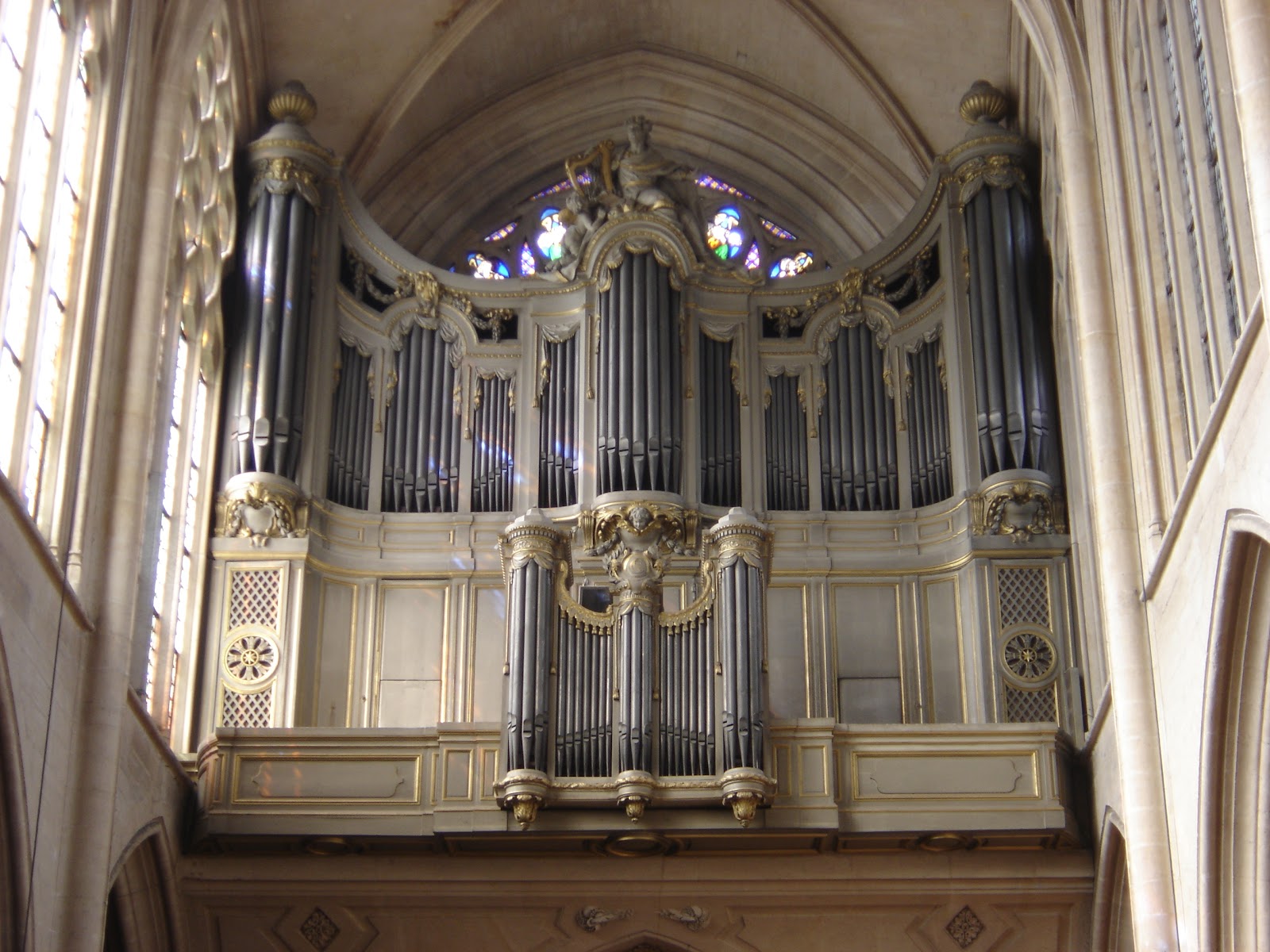
Read how the old Synodical Conference put the Sola Scriptura in practice.  Read about the pipe organ analogy (pg 49, search "pipe" and "organ") and the ridiculousness of saying that a tune is inspired but the notes are not.  Even Andrew Boomhower, the translator, was impressed with this wonderful metaphor. (2024-09-05: the pipe organ analogy also spoken of in Walther's 1868 essay to the Western District, p. 22)

     In the next blog post, I am hopeful to return to Pastor Pasche with Part 19b... [Part 22 here]
- - - - - - - - - - - - - - - -

2016-09-11: see also Pieper's article on Walther's teaching of Inspiraition here; also Manteufel's translation of Walther's lectures of 1885-1886 on Inspiration here.

2016-11-6 [updated 2024-11-06]: the false charge of "docetism" was also made in 1957 by J. Bodensieck, Pres. of Wartburg Seminary (#3), see p. 237 of The Struggle for Lutheran Unity...

2018-02-05: In Walther's book The True Visible Church, Theses XIII-XVIII are on the Inspiration of Scripture, pp. 50-114 (see here); Walther's last Lehre und Wehre Foreword in 1886 also was on Scripture, no English translation... yet. 2019-08-30: see English translation here.

2018-04-23: In F.E. Mayer's 1949 book The Story of Bad Boll – Building Theological Bridges, reporting on the meetings between LC-MS and German theologians after WWII, the Germans firmly denied "verbal inspiration", calling it "docetic". The LC-MS theologians tried to placate the Germans by saying (page 26): [2024-12-07: updated links]
“The doctrine of verbal inspiration is not the basis of our systematic theology and is not the major premise of Christian assurance. … The doctrine of the inspiration of Scripture does not stand in the relationship of a priori, but of a posteriori to our theology. It is not the broad basis upon which the pyramid of dogmatics is built up. It is not the regulative dogma in our system
The above statements were made in the interest of "building theological bridges" across the "unbridgeable chasm", but in reality showed the LC-MS descending into the chasm, a descent that continues today. (see this later blog post for more on Bad Boll.)

Wednesday, March 11, 2015

Martyrs 22j: Diaz murder- & today's LC-MS; 2017 St. Louis parade: Part 1

This continues from the previous Part 22i, the series of posts on the Spanish Lutheran martyr Juan Diaz.  But Diaz lives and the history of his martyrdom provides a picture that fits the teachers in today's LC-MS.  Alfonso Diaz (Juan's papist brother) and his assassin accomplice were shown in Rabus' graphic depicting Juan's martyrdom.  The Roman Pope at the Council of Trent blessed this assassination of the Lutheran martyr.  – Now see the spiritual equivalent in today's LC-MS:
Pope Francis
My "confessional Lutheran" sons!
Bless you!
Prof. Jeffrey Kloha
Provost
Concordia Sem.:


The Bible is a
"plastic text"
Prof. Joel Okamoto – Chair, Systematic Theology, Concordia Sem.:
We recall Sasse once more... “What does the church look like 
that believes in the doctrine of justification of grace through faith?”
Article IV: Justification: 
Undoubtedly [?] sin and forgiveness are essential features
 of the Christian’s life and central concerns for the Christian Church. 
But the topic of “justification” is much broader.... 
no one needs to be taught about justification.
Concordia Journal Winter 2015, pg 46-47
I.e. receiving forgiveness of sins and righteousness before God
out of grace for Christ's sake through faith is MUCH too narrow
for today's LC-MS!


The Evangelical Lutheran Church
The Lutheran Confessions
with a hatchet buried to the hilt into the head (the Lutheran Doctrine of Justification), of the Ev. Lutheran Church by Profs. Kloha and Okamoto.


But I have news for today’s LC-MS, the "What Sasse Says" synod that continually teaches a mixed theology or even directly attacks the Lutheran Church's core teaching of Justification:

The Lutheran Church is not dead!
… neither is the faith of Juan Diaz.

Although Prof. Okamoto says "no one needs to be taught about justification", he is wrong... I do.  And you dear reader, if you be a Christian, will also.  And so since Okamoto will not teach it as the Confessions do (as the chief article), I will continue to teach myself from the Bible (i.e. Kloha's "plastic text") on what God hath said... and also from the Confessions, also from those 3 in my masthead:

Luther, Walther and Pieper.
--------------------------------------------------

A Proposed 500th Anniversary Reformation Parade for St. Louis
I propose that the City of St. Louis have a parade commemorating the 500th anniversary of the Reformation on Reformation Day, October 31, 2017.  Matthew Harrison should invite the Pope for the festivities.  The Grand Marshals should be Profs. Jeffrey Kloha and Joel Okamoto.  Kloha should throw out plastic replicas of Bibles to the crowd, Okamoto would throw out little statues of Hermann Sasse!  And Dr. Robert Kolb would provide "color commentary" for whatever media broadcast would carry the event!

----------------------------------------------
Yet I must thank these LC-MS teachers for one thing – they brought me back to another one of their own.  There have been warnings from within the LC-MS in recent decades, that Kloha and Okamoto are on the wrong path.  A major warning came from Prof. Eugene Klug and I want to publish his testimony in a separate blog post – Part 2.