Search This Blog

Sunday, December 19, 2021

MLPic2: eagle eyes, as a lion, "genuine Luther picture"– Walther (Part 2 of 3)

      This continues from Part 1, a short series on F. W. Wehle's great portrait of Martin Luther. — Walther's overview of the notable features in images of Luther is most instructive — he puts into words what is so distinctive about Luther's physical appearance. Again, from 1882 Der Lutheraner, vol. 38, p. 104 [EN]:
- - - - - - - - - - - - - - - - - - - - - - - - - - - - -  
The most beautiful Luther picture
One cannot get enough of the picture.
[by C. F. W. Walther] (concluded from Part 1)
 
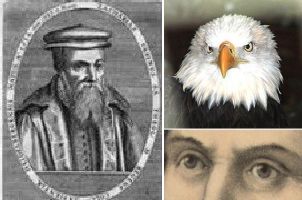
Erasmus Alberus (image: avemariasongs.org); Luther's "eagle eye"
Luther's "eagle eyes"

Thus, for example, Dr. Erasmus Alberus, who as a student saw Luther daily in his lectures for years and also later had much contact with him, described Luther as follows: 

He had a fine, clear, brave face and eagle eyes and was of limbs a beautiful person.” F. S. Keil, who in 1764 published an excellent book on “Luther's Strange Circumstances of Life”, adds: “Of these eagle eyes (Luther's) it is remarkable that they have been passed on to his children, grandchildren and children's children. All accurate pictures show such eyes. Whoever has seen such a portrait will also perceive such eyes in all children of Luther's heritage. And to whom these portraits are known, and sees a Luther child of Luther’s heritage, even if he does not know it, he will say: “that is a Luther face”. Keil also makes the remark that all portraits of Luther, which are found in noble courts, in cabinets and large public libraries, also agree that Luther had a somewhat blunt nose, raised lips and short frizzy hair.

“had a long-haired mane like a lion on [Luther's] forehead”
<<--[Luther's "mane']
The famous physician Dr.
Ratzeberger, Luther's godfather, remarks in his description of Luther's life that he “had a long-haired mane like a lion on his forehead”.  
Valentin Ernst Löscher, (Wikipedia)

The well-known highly learned theologian Valentin Ernst Löscher, who had one of the largest private libraries and collections of portraits of Lutheran theologians, says of Luther: “The blessed man was of healthy and firm constitution, which was not soon weakened even by his almost unbearable work. The stocky stature, the complete (full) face, together with the lively color indicated it.” 

Lucus Cranach the Younger (image: https://gelonchviladegut.com/en/autor/lucas-cranach-el-joven/)
Cranach the Younger, Luther portrait

When in 1746 the second secular celebration of Luther's death was celebrated in many places in Germany, a commemorative publication by the Wittenberg professor Karl Gottlob Hoffmann dealing with this subject was published in Latin, in which he reports, among other things, the following: “On the southern wall of the church, next to Luther's grave, there is a picture of Luther mounted on a wooden panel (see here), painted by Lucas Cranach the Younger, the world-famous painter from Wittenberg, in life-size, exactly in the shape and physique that the great man had in life, as Menz assures us. The face is heroic, the eyes sparkling, the whole face reveals a peculiar bravery of spirit and majesty, which can hardly be described in words and which inspires the highest awe in all onlookers. 

Luther's robe
[Luther’s robe]-->>

Therefore, what Melchior Adam recalled in his biography is confirmed: ‘He was of a lion-like vivacity of eye, so that not all could bear the look of it.’ The habit is the same that the church servants wore in Saxony at that time, namely a black and wrinkled robe hanging down to the ankles.” —


We have taken the liberty of informing our readers of this, partly in order to draw their attention to the fact that God has really already stamped the outward appearance of his great armament Luther as a miracle man, partly because it is therefore foolish to be satisfied with any image of Luther, even if it is a still so miserable distorted image or even if it is a beautiful one, which does not reflect Luther's true impressive figure at all and therefore also creates a completely wrong idea of it.

Therefore, it gives us great pleasure to be able to report to our readers that the Luther picture just published by our dear F. W. Wehle in Milwaukee really has all the characteristics of a genuine Luther picture, which all reliable descriptions and still existing old faithful Luther pictures demand. Mr. Wehle has designed it not only on the basis of years of study, but also with a devotion to his subject, as it can only be found in a Lutheran, who is one out of the liveliest conviction and with all his heart. This painting is by no means about monetary gain. Mr. Wehle did not want the work to praise himself, the master, but to praise Luther, the original. In our opinion, this painting surpasses all its predecessors and contemporaries. This judgment does not give us blind partial love for our painter, but compels us to love Luther, of whom we wish that he be presented to the Lutherans of our time, even in his outward appearance, not like a fine diplomat, or like an emotional theologian, or like a coarse unpolished dull man, but just as he was, as God the Lord created and formed him. 

Foot on indulgence, Finger on Bible, Head of Luther (Wehle portrait)

The picture by Wehle, a lithograph, shows Luther in full stature and in his best years, standing at a desk in the room of a castle [not "reading in a church"], stepping with one foot on a torn indulgence slip, pointing with the index finger of his right hand to a place of the open Bible lying in front of him and looking around him with an expression that expresses his faith resting on God's Word, as on an unshakable rock. One cannot get enough of the picture. The original is a large oil painting, which the painter intends to dedicate to the projected new Concordia Seminary. [An Internet search came up empty on this – who has this painting now?  Did CSSL ever receive the painting??]


The price of a copy is set as low as it was possible, namely to one dollar. May this beautiful picture soon adorn all the houses of our Lutherans! It can be obtained both from our Concordia publishing house and from the painter himself. Don the latter at the address: Mr. F. W Wehle, 107 Wisconsin St., Milwaukee, Wis.      W. [Walther]

- - - - - - - - - - - - - - - - - - - - - - - - - - - - - - - - - - - - - 
      According to 1909 St. Louis history book Historical and Interesting places of Saint Louis, “Among the art pieces in this school is a painting "Martin Luther" by F. W. Wehle, the gift of the artist.” But a search of CSSL websites turned up no evidence that they still have this painting, so at best they don't promote it, at worst they got rid of an Old Missouri treasure. Perhaps CHI possesses it now. — As stated above, this Wehle painting is the frontispiece page in at least two magisterial books of Luther's life, the books of Pastor Herman Fick and Johann Mathesius,  from the Old German Missouri Synod. — In the next Part 3, we find another writing in Der Lutheraner of 1882 on this "genuine Luther picture." Also more on the painter Wehle.

Thursday, December 16, 2021

Letters4: v. 21a, Luther's Letters 1507-1532, in English (Part 4 of 5)

      This continues from Part 3 in a series presenting the St. Louis Edition's Luther's Letters. — Now we present the English translation (by DeepL) of Volume 21a, Luther's letters for the years 1507 to 1532. In this period are the letters associated with the Diet of Augsburg which led to the establishment of the Lutheran Church through the Augsburg Confession.  Many, if not most, of the letters associated with this period are connected with the Diet of Augsburg at which the Confession was presented.  Now let us hear again what C. F. W. Walther had to say about these letters:
As for Luther's letters, let him read especially on the preparation for the Diet of Augsburg (1530), and during that as well, and those dealing with the proceedings of the Diet, indeed all letters relating to church events. No better letters have been written. Such courage of faith, such boldness and assurance of victory is unequaled. You get just the right sense of the events if you read what Luther wrote about it.
Many of the letters associated with this period were published in other volumes of the St. Louis Edition, especially Volume 16, which I hope to publish soon. (keep watching this blog for more volumes to come). However there are many letters from this period that are found in this volume 21a. The following letter, written on the day that the Augsburg Confession was presented, is just one of the letters not published by the American Edition, Old or New Series:
No. 1584.
Fortress Coburg. June 25, 1530.
To Nicolaus Hausmann in Zwickau.
News from the Diet of Augsburg. Luther is busy with the translation of Ezekiel.

      To the man to be highly honored in the Lord, Mr. Nicolaus Hausmann, Bishop of the people at Zwickau, his brother and superior.
      Grace and peace in Christ! I have ordered my family in Wittenberg, my dear man, to send to you in Zwickau all the news they have received from us, from which you will know what is happening in Augsburg at this Imperial Diet. I hope that all this has reached you, for I do not have time to write everything to everyone. Let us only pray diligently, as we have done hitherto, remembering how our fathers were saved. "The hand of the Lord is not shortened" [Isa. 59:1], then the matter is not ours, but His; He will surely hear us.
      I have written to your brother Valentin, and comforted him as much as I could; you will see to it that the letter is given to him. I have leisure here now and am working on the translation of Ezekiel; in the meantime I am also doing some other things.
      The papists indeed raged mightily, but our prince, gifted with an admirable constancy, confessed Christ freely. Likewise also Margrave George. The unbelievable mildness of the Emperor is extraordinarily praised; he seems to have been provided by God with a good angel. You will learn more from Wittenberg. In the meantime, you too pray for me, O man of God; in fine grace be well with you for eternity, Amen. From the desert, on Saturday after John the Baptist's day [25 June] 1530.
Your Mart. Luther.
The following is only a partial excerpt including the first 200 letters (1st 131 pages):  
English: The full DOCX >> HERE << (2 MB!;  Direct); PDF (7 MB); or Internet Archive HERE
German: The full DOCX original file may be downloaded >> HERE <<.

Many weeks were spent on these volumes (21a and 21b) to make not just the Fraktur German, but even the Latin text available. Again, these files are most useful if used in conjunction with the online Luther's Letters Index (blog here). One may cross reference the letters across several other editions and compare these with the DeepL machine translations to see how well the machine translation did, or how badly the previous translations were done.  And as I review again the American Edition that Concordia Publishing House sells (volumes 48, 49, and 50) it does have many helpful comments, along with incorrect and spiritually blind commentary, about the surrounding conditions, people involved, and matters of language and phrases. The best case is that the reader have the American Edition volumes for comparison with the more complete St. Louis Edition. —  More notes on the English translation to follow in the concluding Part 5 where we publish the second part, Volume 21b.

Monday, December 13, 2021

Most beautiful picture of Luther: F. W. Wehle; Greatest Christmas gift (Part 1 of 3)

      A flood of thoughts came to mind when I ran across a short article, in the July 1, 1882 Der Lutheraner, p. 104 [EN] by C. F. W. Walther, with the above title.  The article was in an extremely small font and, after translating the entire article, I believe Walther insisted that the typesetter squeeze a large article into the few remaining column-inches available in that issue of the Der Lutheraner.  
Martin Luther, by F. W. Wehle
Great Christmas gift, up to 22x28 poster
(full size JPG download here)
As I began to translate it, I wondered what picture of Luther was being introduced by Walther.  I wondered “Could it be the image that was used in Pastor Hermann Fick's masterful book entitled Das Lutherbuch?  So a quick Google search of the painter's name and "Luther" turned up the treasure that I would have paid for, but found it for free at the Library of Congress site. Full size JPEG download >> HERE << (8MB, 6941x8569; "No known restrictions on publication".) There is a very pleasant aspect of the Library of Congress free high-resolution image — it is not copyrighted by anyone like Getty Images or some other organization.  It is free to download and print to as large as 22 in. x 28 in. (CPH should be selling these.)  That makes it suitable for about any church setting.  Walther thinks so too. — Before I get to Walther's writing, I would make a suggestion for anyone wanting a gift idea for a Lutheran.  I cannot think of a greater idea than a full size print made from the large JPEG file download above.  At 300 DPI, it will print a poster 22" x 28", the original lithograph size.  Of course it could be printed in a smaller size. For example, a 20" x 30" Lustre digital print at Target Stores is $30.
      Now Walther "hastens" to bring us his exuberant announcement in the 1882 Der Lutheraner, vol. 38, p. 104 [EN]:
- - - - - - - - - - - - - - - - - - - - - - - - - -
 The most beautiful Luther picture
[by C.F.W. Walther]

we have ever seen reached us a few days ago. We therefore hasten to inform our dear readers herewith most dutifully. —

It is true that Luther's face has such peculiar features that probably few faces are so easy to capture as Luther's, so that everyone, after having seen some Luther pictures, at the sight of any one, however botched, immediately notices: This is Luther or this is supposed to be Luther. Consequently, many people are satisfied with any Luther picture; if they only find certain basic features of Luther's face in it, and now underneath it is written: “After Lucas Cranach”, then they think they have an absolutely faithful image of the great man, even though the portrait often contains partly quite alien features, partly lacks just those features that represent the true Luther, as he lived.  

Portrait of martin luther 1543 (Lucas Cranach the Elder, WikiArt)
Classic Cranach portrait

Many also think that it is quite futile to argue about which Luther image is the most accurate. After all, there is no one alive who has seen Luther face to face. Who could therefore say which image of Luther was the most faithful? But one is mistaken. For not only do we still have today pictures of Luther, which were made during his lifetime, among which, as is well known, [Lucas] Cranach's are indisputably the best; for the great painter Cranach was not only Luther's contemporary, but also his co-religionist and intimate friend; we also have exact descriptions of Luther's outward appearance by contemporaries of his, according to which even the best pictures from the time of Luther's life are capable of perfection.

- - - - - - - - - - - -  Continued in Part 2  - - - - - - - - - - - - -
There is much more to come on why this picture became the frontispiece of two major publications from the Old German Missouri Synod.  In the next Part 2

Friday, December 10, 2021

Letters3: Prof. Hoppe's Foreword; Index; comparisons (Part 3 of 5)

Prof. A. F. Hoppe (image: Mezger, Denkstein p 306)
      This continues from Part 2 in a series presenting the St. Louis Edition's Luther's Letters. — The Editor for volumes 21a and 21b was Prof. A. F. (Albert Friedrich) Hoppe who had also edited many other volumes. He began this work in 1886, while Walther was still living, so he would have had at least Walther's approval, if not actually chosen by him. He remained with this task for 25 years, from 1886 to 1911, the year of his passing.
      In the following English translation of Hoppe's Foreword, we can glean what kind of scholarship went into these volumes.  We may then form an opinion on whether modern scholarship's aloof attitude towards the St. Louis Edition is warranted… or not.
Some excerpts from Hoppe's Preface:
— "…we have also followed this example to some extent by including many outside letters."
— "…we have included the letters in chronological order."
— "we are entirely dependent on the editions published in Germany for the reproduction of the letters, since we do not have the sources at our disposal here." [Although Hoppe did not have the source material, his scholarship is extensive. More on that later.]
— "… we have not been concerned solely with enriching Walch's and De Wette's editions, but primarily with correcting both the time indications and the text itself"
— "We have devoted the same effort and care to the German letters as we have to the Latin ones."

Prof. Hoppe's "Foreword" to the first volume of Luther's Letters, Volume 21a:

As mentioned in April this year, I hoped to bring the full digital OCR text of the St. Louis Edition, starting with Luther's Letters, volumes 21a and 21b. This work is necessary because the text of Google Books and HathiTrust is garbled due to the 2-column format, and their OCR "Plain text" does not retain the formatting. In the next Part 4, we begin with Volume 21a. — 
      After the break below, a comparison of a typical letter in 3 different translations: the American Edition (from Latin into English), the St. Louis Edition (from Latin to German to English-by-DeepL), and an abbreviated English translation published in 1913 by Preserved Smith:

Wednesday, December 8, 2021

Letters2- Fuerbringer announces StL vol. 21a & b (Part 2 of 5)

      This continues from Part 1 in a series presenting Luther's Letters. —  In this segment we publish an English translation of portions of Prof. Ludwig Fürbringer's announcements for the St. Louis Edition's Parts 1 and 2 of volume 21 from the years 1903 and 1904.  Of particular interest for me was his listing of sample letters and their subject matter.  From Der Lutheraner, vol. 59 (1903), p. 167-168: 
St. Louis Edition, from Prof. Dau library,  historictrinity.com
St. Louis Edition, from the Dau library,  historictrinity.org
- - - - - - - - - - - - - - - - - - - - - - - - -

[St. Louis Edition, vol. 21a (1903)]

First part: Letters from the years 1507 to 1532. 

Prof. Ludwig Fürbringer

Herewith, the last volume of our great and beautiful Luther edition has been tackled and, for the time being, half of it has been completed. And also this new volume offers a rich, interesting and excellent content in the well-known splendid decoration that our publishing house has bestowed upon it. Certainly, among the twenty-one volumes of Luther's works published so far, there are even more important volumes than this one, which should be purchased and studied especially by Lutheran Christians. …

And now a short word about the content of these letters. How they throw so much light on the life of the great man of God and his friends and co-workers in the work of the Reformation and report on the progress of this work of God. How they show us the Reformer as the highly enlightened, conscientious teacher and pastor to whom one turns from all sides for instruction, counsel and comfort. How he knows how to help the erring on the right path, to give sure and excellent counsel in difficult doubts of conscience, to comfort so powerfully and warmly in distresses and temptations.  

Johannes Brenz, Robert Barnes, Henry VIII

We will pick out a few letters that our eyes come across while leafing through the volume, without having searched in any way for those that are particularly rich in content. Luther sends Spalatin an instruction on how to confess (No. 137); to Martin Seligmann, he answers the question of how a Christian, especially a pastor, should behave in the face of the plague and other plagues of the land (No. 221); in a letter to Paul Speratus, he praises Speratus's sermon and wishes to see it printed, and at the same time speaks out about the Bohemians' doctrine of Holy Communion (No. 494); to Elector John of Saxony, he makes suggestions on how to equip and visit the parishes (No. 933); to Landgrave Philip of Hesse, he advises not to hurry with the publication of the church order (No. 1052); to "all dear Christian people", he writes “a blessed story of Leonhard Kaiser in Bavaria, burned for the sake of the Gospel” (No. 1086); to Nikolaus Hausmann he thanks for the comfort he has received (No. 1143); to Conrad Cordatus he consoles him in the sufferings that the direction of his ministry brings (No. 1436); to Wenceslaus Link he consoles him over the death of his daughter and at the same time gives him information about a difficult passage of Scripture (No. 1565); to Spalatin he shares his opinion about a difficult marriage case (No. 1783); to Johann Brenz he writes about the doctrine of justification (No. 1813); to Robert Barnes in England he gives his opinion about the intended divorce of King Henry VIII of England (No. 1838); to the council of Torgau he asks for a scholarship for a student of theology (No. 1866).

Conrad Porta

But where would we stop, if we were to give even a slight insight into the contents of the letters. Every one of these letters, even though they will soon be four hundred years old, will be read with interest, very many with great benefit and to rich blessing. This is especially true of Luther's theological opinions and concerns, of which the old Lutheran theologian Conrad Porta, in his "Pastorale Lutheri," said more than three hundred years ago: “The man of God Lutherus, out of a strange and wonderful illumination of the Holy Spirit, bases himself before all others who have written anything on this subject, especially on the Holy Scriptures, and thus also shows the pastors how, according to the counsel of Jesus Sirach (9, 22.) they are to judge all their official matters, doings, and non-doings according to God's Word.” And in another place he says: “His (Luther's) counsels and concerns in grave and dangerous cases are glorious and good, and no one can easily improve them.”

Of the detailed, thorough and careful work of the proven editor, Mr. Professor A. F. Hoppe, also this volume again abundantly testifies. May the second half, which will contain Luther's letters from the year 1533 onwards, soon follow; then only the detailed index volumes, which are so valuable and necessary for the use of the entire great work, will be missing. And above all, may God the Lord bestow his rich blessing on all who diligently read and study Luther's words and writings.      L. F.


[Volume 21b (1904)]

Second part: Letters from the years 1533 to 1546. 

Professor A. F. Hoppe

… a new volume has been completed almost every year, and with the present 21st volume, after the 22nd volume was published earlier, the enterprise has indeed been happily completed. The only thing that is still missing are the detailed index volumes, which are, however, so valuable and necessary for the use of the entire great work, and which our faithful Luther editor, Professor A. F. Hoppe, is currently working on. But that all the writings of Luther, the greatest teacher of the Church since the days of the holy apostles, have now been made available to us again in this complete and beautiful edition, is truly a cause to thank God and to diligently study and faithfully use what is presented to us in these writings. We cannot but heartily agree with the words of the preface to the present volume: “With this volume, by the grace of God, the reissue of the complete writings of Luther by Dr. Joh. G. Walch is now completed; praise, glory, and thanks be to God, who has faithfully assisted us in this great work for twenty-four years. May He grant that these glorious writings may also be diligently read, so that through the God-enlightened Luther we may ever better attain the right understanding of the Scriptures given by God, and, like him, grasp and hold them in fervent faith.”

As far as the just finished volume is concerned, already the title says that it contains all letters that Luther wrote or that were addressed to him, in total not less than 1541 numbers. About the letters of Luther we have already spoken in more detail in the description of the first half of this volume ("Lutheraner" 59, p. 167). How interesting these documents are! How important they are for the history of the Reformation! But above all, how much teaching and exhortation, comfort and encouragement they contain! How they give us a glimpse into the daily life, into the tremendous work of this man of God, who is approached from all sides and yet makes his time and strength available to all!

L. F. [Ludwig Fürbringer]

= = = = = = = = = = = = = = = = 

 We will hear more from the editor and translator Prof. Hoppe in the next Part 3.  

Friday, December 3, 2021

Luther's Letters: Brohm in 1862 Der Lutheraner (Part 1 of 5)

      With the success I had on my recent Der Lutheraner project, I decided to embark on another major project that I have longed to do for over 20 years: Luther's Letters. — But before I get into that, I would publish an English translation of a short article on this subject in 1862 from Pastor Theo. Brohm, one of the early Saxon emigrant pastors.  We heard before Walther's glowing remarks on Luther's letters, now we hear from one of his associates who was endeavoring to bring Luther's writings to the people.  This effort was much like that of CPH Publisher Paul McCain's († 2020) effort at bringing a "reader's edition" of Luther's Gospel Sermons without all the extra narrative for scholars. 
      Luther's letters are striking:  his "immense powers", letters "to so many different persons", "so diverse is the content", "seasoned with God's Word", "the most delightful entertainment", Luther's "pastoral theology".  — From Der Lutheraner vol 18, May 28, 1862, p. 166 [EN]: 

- - - - - - - - - - - - - - - - - - - - - - - - - - 

P. Th. Brohm sen. (Denkstein, p. 213)

(Submitted.)

Luther's Letters.

[by Th. Brohm]

Seldom will a man have written so many letters as Dr. Luther. The number of letters found so far and saved from destruction amounts to 2686, of which 2324 have actually appeared in print. Already in the year 1516 Luther complained to his friend, Joh. Lange, that the greatest part of his time was taken up by the business of letter-writing. How much this work must have increased since his name was mentioned far and wide in and outside Germany. Certainly those 2686 letters are only a small minority of all letters written by him.

When one takes into account the work which his actual teaching ministry laid out for him, the preaching, the writing of books, the many journeys which he had to undertake in the service of the Gospel, the numerous visits which he received, one can get an idea of the immense powers with which the man was equipped.

What gives his letters a peculiar interest is that they are addressed to so many different persons. There are letters to the emperor, the pope, cardinals and prelates, letters to kings, princes, dukes, counts and knights, letters to scholars, pastors, lawyers, physicians, artists and craftsmen, letters to communities of whole cities and countries, letters to those who were chased away or imprisoned for the sake of the Gospel, letters to all kinds of the afflicted, the grieved and the miserable, letters to his trusted friends, to his father, mother, brother, his wife and even to his four-year-old son, Hänschen.

As diverse as the persons to whom he wrote are, so diverse is the content of his letters. Some contain concerns and advice about the most important and difficult political issues of his time, others advice in matters of the Gospel and the church, others instruction and consolation in severe distress of conscience, others solve difficult theological questions and doubts, still others are friendly, amicable, even joking content, but always seasoned with God's Word.

All of Luther's letters bear the unmistakable mark of his loyal heart and the Christian modesty of the man on their foreheads; in addition, they are evidence of his loving, sympathetic heart, as well as of his great theological wisdom and prudence, with which he often skilfully unravels the most tangled knots and knows how to hit the nail on the head with his reply. It has been said that Luther's talents can be discerned from his books and his character from his letters. Certainly a very true remark.

Luther's letters indeed provide the Christian reader with the most delightful entertainment, if one has not otherwise allowed one's taste to be spoiled by the wretched reading of newspapers or novels. Here one is transported in spirit to that great time of the Reformation, so rich in gifts and powers, and becomes acquainted with it, as if from one's own experience; one becomes, as it were, a familiar associate of Luther and his most intimate friends. This reading is at the same time a highly instructive activity. From Luther's letters, one could easily compose a theological casuistry or a pastoral theology, as old Conrad Porta actually did to some extent. If one compares the letters and concerns of other learned men, which are often so turgid, prolix and dark, with the light and lively, concise, short and simple letters of Luther, there can be no doubt as to whom the preference is to be given. A lively, fresh spirit wafts through all of them and is suitable to awaken liveliness and freshness in the hearts of the readers.

As the honored readers have seen from No. 17 of the current volume of Der Luthearner [not found], it is the intention to publish a selection from the German letters of Dr. Luther for the current year of the Luther-Association [Luther-Vereins].

When I set about making the selection, I soon found that this was not a very easy thing to do. Often I had to put aside this and that beautiful letter to make room for an even more beautiful one. I am far from thinking that I have always made the right choice. I can only say that I have taken care to select letters which I could assume would be interesting, instructive and comforting to all, especially to unlearned readers who do not have access to Luther's complete works. If it should turn out later that some important letters have been passed over, then it would not be too late to provide a gleanings in a future year.

I have not arranged the letters according to their content, but according to the years, following the Erlangen edition of Luther's works. The 7th volume should contain letters from the year 1530, the 8th volume letters from and after 1530. Since the Erlangen edition has so far provided only the German letters, but the Latin letters are no less important, and often even richer and more instructive, so shall, if the Lord has mercy, later also a selection of the Latin letters be given in German translation.

- - - - - - - - - - - - - - - - - - - - - - 
Forty-one years later, in 1903, the first volume of the St. Louis Edition of Luther's letters would be published in which Prof. A. F. Hoppe fully completed the task of translation, and polishing, of the text (into German) that Theo. Brohm started in 1862.  We will hear Prof. Fuerbringer's announcement of that project in the next Part 2.
- - - - - - - - - - - - - - - - - - - - - - - 
Table of Contents:
Part 1: This post, Theodore Brohm's short essay for introducing Luther's Letters.
Part 2: L. Fuerbringer announces St. Louis Edition's vol. 21a & b
Part 3: Prof. A. F. Hoppe's "Foreword" to volume 21a of Luther's Letters
Part 4: Volume 21a - letters of 1507-1532, in English; sample letter of Luther on day of Augsburg Confession
Part 5: Volume 21b, in English; 

Tuesday, November 30, 2021

A Reformation Sunday bulletin… by them?


<<==This picture emblazoned the full front cover of an Indiana church bulletin used for Reformation Sunday a few weeks ago.  


One might assume that it was a Lutheran Church… 

but it was a conservative Baptist Church, Calvinist Baptist.


What further proof is there needed for the truth of what C. F. W. Walther stated:


"All Reformed sects... were first Lutheran."


Monday, November 29, 2021

Women as church delegates? (Der Lutheraner 1872)

      A recent blog (May 3, 2021) prompted a reader to privately correspond with me to rejoice in the truth of Holy Scripture, and Walther's teaching, on women in the church.  That blog was about women on church councils in 1885. Also an earlier blurb appeared in 1872 by frequent contributor "S.", an associate contributor to Der Lutheraner with Editor Walther.  Were his comments similar to Walther's later one? We find out from Der Lutheraner, vol. 28 (Mar. 1, 1872), p. 86 [EN]: 
- - - - - - - - - - - - - - - - - - - 

Women delegates. — The apostle Paul, by inspiration of the Holy Spirit, expressly said: “Let your women keep silence in the churches: for it is not permitted unto them to speak; … for it is a shame for women to speak in the church.” (1 Cor. 14:34-35); and again, “But I suffer not a woman to teach” (1 Tim. 2:12). In our advanced times, however, our sects understand this better and in this matter, despite the clear words of God, hold it according to their sinful liking. Several denominations have begun to appoint female preachers, and we already read that at the recent Congregational meeting in Andover [Massachusetts], twelve female delegates were present as representatives of their congregations. Will they have represented their congregations only by silence among the congregation”? —       S. [Sihler? Schaller?]

- - - - - - - - - - - - - - - - - -
There they, the Missourians, go again, quoting the clear words of Holy Scripture. — An unbelieving world can point to the LCMS as an example of Lutherans who don't follow the Bible on this, but the same world cannot point to the Old German Missouri Synod.

Wednesday, November 24, 2021

Walther: DL's beginning, Lutheranism—not Romanism, "what is actually the Lutheran Church, its doctrine" (2 or 2)

      This concludes from Part 1 presenting C. F. W. Walther's striking Foreword to volume 14 (1857-1858) of Der Lutheraner. — When I translated this Foreword, I had no idea how much Walther would reveal in it.  For all who would understand the true beginnings of the true Missouri Synod and Walther's flagship publication, this writing should satisfy your interest. From vol. 14 (Aug. 25, 1857), pages 1-2 [EN]: 
- - - - - - - - - - - - - - - - - - - - - - - - - - - 

Foreword of the Editor

to the

Fourteenth Year of Der Lutheraner.

[by C.F.W. Walther]

(concluded from Part 1)

We, the editor of the present paper, were also among the preachers who emigrated from Germany with the Saxons and, after a long time of wandering, obtained with them, through God's gratuitous mercy, that sweet fruit of unspeakably bitter experience, the pure doctrine of our Church, as it soon appears bright as day to him who reads the public confessions of our church and the private writings of its enlightened teachers from its most beautiful days, especially from the time of the Reformation, this time of great divine search for grace, without glasses, without prejudices, with an empty heart thirsting for truth.

 
Der Lutheraner, Volume 1, No. 1

For a number of years we sought to establish ourselves ever more deeply in the truth we had discovered. The treasure we had found and our church, in which we had found this treasure and of which we saw that it alone had it, therefore became more and more precious to us. With deep sadness we saw from the few local papers that we read at that time, partly how wrongly the doctrine of our church was portrayed by its enemies and how insolently it was attacked and blasphemed, partly how almost no one punished these lying distortions and repulsed these shameless attacks, partly how wrong even the ideas of many friends of the Lutheran church were about its actual doctrine, partly how we Saxons were still considered to be a Romanizing sect leading a special doctrine 

This, together with several other Lutheran preachers who had emigrated with us, finally brought to maturity the decision in us to publish a leaflet that would serve our dear church under the open, honest name of Der Lutheraner according to the needs here, as much as God would give grace to do so. The prospects for the existence of such a paper were very, very dim. Our immigrant congregations were still very poor and had to make hardly affordable sacrifices in order to be able to enjoy the benefits of well-ordered and well-supplied Lutheran congregations.  

From them it was hardly to be expected that they alone would be able to secure the existence of the paper, and otherwise we had almost no acquaintance and connection with preachers and congregations. We only dared to send the paper to two of them, W. [Wyneken] and S. [Sihler], who are at present at the head of the Saxon congregations as synodal officials. Our expectations, or at least our pronouncements, went no further than to bring as many sheets into wider circles as were necessary to give an unmistakable public testimony of what is actually the Lutheran Church and what is actually its doctrine.

With deep shame we look back today on a period of thirteen years in which God has done great things for us, not only increasing our readership from year to year, but also giving us the grace to dig deeper and deeper, supported by more and more vigorous and zealous co-workers, and to bring the pure and truthful teaching of our dear church ever brighter to light. To God, who often chooses and dignifies even the most erring and unworthy sinners, if they repent, to teach through them the transgressors his ways, so that sinners turn to Him, be for this alone all honor and praise and glory of His wonderful mercy.

What has occupied us primarily in recent years is something that we least believed in 1844, when we sent out the first sheets of the Lutheraner, would ever become the subject of our struggle with Lutherans: we mean the doctrine of Church and Ministry. We had thought that we would have nothing to do but to publicly cleanse ourselves from the suspicion of the Lutheran Church, as if we were still devoted to the Romanist direction taken earlier. However, it is not we, but God who prescribes our ways, our work and our struggles, and it is our duty to follow, and we do not want to resist. 2


2) There is no doubt in our minds that if God, according to his unfathomable mercy, had not taken care of us and had not forcibly opened our eyes to our Romanizing doctrine and practice, then we would not only have worked here to destroy Christianity, but also have finally been lost forever. Without a doubt Satan had no other purpose than that after our awakening he led us on that horrible wrong path and then led us to America, where we had the best opportunity to preach and carry out our errors unhindered. But, O faithful God, what Satan intended to make evil, God intended to make good. Here we first had to be led by our errors to the abyss of temporal and eternal destruction, and then, saved from it by God's intervention without our doing anything, we can say, as burned children, to bear witness all the more immovably against the same errors that appear elsewhere.


If in the last year we were mainly concerned to present the pure Lutheran doctrine of the Church to our readers and to warn and protect them from the false half-Roman, even entirely Roman doctrine of the Church, which now wants to smuggle itself into our church under the name of good Lutheranism, on the other hand, as we have already indicated, we intend in the new year to occupy ourselves primarily with the pure doctrine of the sacred Office of Ministry [or preaching] and with the rejection of an equally false half-Roman, even entirely Roman doctrine of this, which is now again seeking admittance among the inexperienced Lutherans. May then the gracious God, who desires that all men be helped and come to the knowledge of the truth, abundantly grant us His Holy Spirit for such work, and may also our dear readers diligently call upon the Lord, that He may grant us light, strength, and courage for this purpose. Amen!

= = = = = = = = = = = = = = = = = = = = = = = = = =

      Walther admits the emigration was "devoted to the Romanist direction" in the beginning!  It took God's intervention to turn them away from their error, discover the truth, and fight vigorously against Romanism in matters of Church and Ministry. — This Foreword by Walther shows me again why I could never go back to what the LCMS is today, a clearly Romanizing church body.  Why would today's LCMS go back to that horrible Stephanist error of Romanizing??