Search This Blog

Saturday, March 3, 2018

Fick #2: beginnings in Germany; counsel for parents

      This continues from Part 1 (Table of Contents in Part 1), publishing an English translation of C.F.W. Walther's biography of Pastor C.J. Hermann Fick. —
- - - - - - - - - - - -
      With Walther's stirring introduction of this life story of Fick, we now begin our journey with them, Fick and Walther, in Germany:
- - - - - - - - - - - - - - - - - - - - - - - - - - - - - - - - 
This translation by BackToLuther (BTL), taken from Der Lutheraner, Vol. 42, Nos. 14 (July 15, 1886) to 18 (September 15, 1886). All underlining is emphasis from original. All highlighting by BTL. — This portion from vol. 42, #14, p. 105-106.
- - - - - - - - - - - - - - - - - - - - - - - - - - - - - - - - 
In Memory of Our Unforgettable Fick.
(by C.F.W. Walther; Part 2, cont'd from Part 1)

Our Fick is the son of the once Commissioner of Economics and Lieutenant Otto Fick and his wife, Frau Wilhelmine, born Hillefeld. He was born on February 2, 1822 at Dönhausen in the county Hoya in the former Kingdom of Hanover. Here he also received the first lessons in reading and writing, from an old lady living in his family at that time. Later, in 1828, when his parents moved to Petershagen in the government district of Minden, he visited the same rector’s school. His pious parents seem at that early age to have evoked in the boy the idea that he would once become a pastor. We are informed that, if [Page 105, col. 3] he was asked what he wanted to be during that time, he would always have answered: “Soldier or pastor.”  In any case, the boy particularly wanted to become a soldier because his father was an officer.  But still this, that just then the cavalry was quartered in Petershagen, so that the handsome riders made a deep impression on the awakened boy. However, in all the many letters we have in which the young Fick pours out his heart to his father and mother, later on no word appears from which one could conclude that the desire to become a soldier as a pastor was fixed on him. And later, as we shall see, his choice varied only between missionary or pastor. It was undoubtedly a consequence of the touching tender love of his parents and the deepest veneration of the same, which speaks in all his letters. Each of their wishes was a holy order to him..  Since he saw now that both father and mother had intended him for the direct service in the Kingdom of God, it was and remained a foregone conclusion for him that he had to become either a missionary or a pastor.
Unfortunately many parents, including Christians, follow the principle of leaving the choice of profession entirely to their children. While they may not be opposed to having their sons become pastors, instead of appointing at least one of them for the profession if they see that he has good gifts for doing so, or rather than to awaken and nourish in him the early decision to become a pastor, they see this as a harmful compulsion. In doing so, they neglect the sacred parental obligation to be life-guides to their still inexperienced children; yes, they “sin herein,” [hierin so viel sündigenhere; or “sinning unspeakably” here]  as Luther writes in the preface to the Small Catechism, "need not be said.” [“sinning unspeakably” here]  Like some Christian parents, they would not have had to complain that their gifted son had become a prey to the world if they had dedicated it to the service of the Kingdom of God!  To be sure, an old church teacher says it is a miracle when a pastor is saved; however, we would like to say that it is a miracle when a pastor is lost, since no one has more opportunity to [Page 106, col. 1] hold to the faith just as a pastor, provided that he, like Timothy “nourished up in the words of faith and of good doctrine” (1 Timothy 4:6), has become the servant of an orthodox church.
But let us return to our dear Fick.  In 1832 his parents left Petershagen. As a result, the ten-year-old boy came to Siebenbäumen in Lauenburg near Lübeck to his maternal grandfather, Pastor Hillefeld there. Here he was taken by his uncle August Hillefeld into instruction, a young faithful and gifted man, who was his father's assistant preacher; and here it was also where our Fick came to a conscious living faith. Becoming a missionary here became the ultimate goal of his yearning. “Just think," he said to one of his sisters at the time, "when I'm among the poor black heathen, and they are all sitting around me, and I tell them about the dear LORD JESU, whom they have never heard of, then the great tears roll down their black cheeks.” Most beloved of his little songs, for example to the larks in whose song he enjoyed himself so much, are given to us from this time. When he once read to his sister such a song and she asked him, “how he did that, that he conceived the rhymes," the little poet replied: “I do nothing at all, it is as if someone were reading the verses into my ear, then I must go quickly and write them down.” Far from giving in to childish musings and putting down learning, he was so diligent and made such rapid progress that his teacher was able to begin teaching him Hebrew and English as early as 1834. As the time drew near to be taken to grammar school, he wrote to his parents: “It is now approaching” (in February, 1836) “the time that I will go to Ratzeburg to school, but I still don't like to think about it.  I suppose I have a desire to learn, I also have a pretty good memory, but I cannot think very thoroughly and deeply about a profound thing; but I hope that the dear God will yet give me this gift.”
- - - - - - - - - - -  continued in Part 3  - - - - - - - - - - - -

      This narrative is more than just a biography of Fick, it contains also Walther's spiritual counsel for all Christians.  It contains his “pastoral theology”. Walther's counsel for parents was a stinging one for me.  His counsel, especially for fathers, continues in the next Part 3.

Thursday, March 1, 2018

“Our Unforgettable Fick” #1, Walther's favorite pastor?

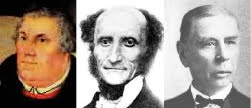
[2019-08-13: updated image of Pastor Fick, included image of younger years]
      When I first published the book on Luther's life from Pastor C.J. Hermann Fick, I knew it was a good book because I had read it and found that Fick, more so than later Missouri Synod writers on Luther, included the key doctrine of Justification, highlighting it especially as Luther used it to sweep away all other issues at the Diet of Regensburg in 1541. I had read practically all other books that had come from Missouri and had wished that A.L. Graebner and W.H.T. Dau had given more weight to this crucial doctrine.  But in my earlier years of a return to my Christian faith, the dear Pastor Fick confirmed that Walther's and Pieper's teaching of a Universal Justification, an Objective Justification, were only teaching exactly what Luther taught – a general forgiveness that is all that the Christian Church distributes today, as it announces the Gospel of free grace, or by the Sacraments of Baptism and Holy Communion. There is no “special forgiveness” beyond this. (For example, see previous blog).   So Hermann Fick moved into my reading room, even if he only wrote in the German language.
      August Suelflow († 1999), in his last major work, Servant of the Word: The Life and Ministry of C. F. W. Walther, gave the following information on the two biographies that Walther wrote (p. 143-144):
“Walther wrote two biographies of fellow pastors during his lifetime. The first was of his brother-in-law J. F. Buenger (1810-1882), titled Kurzer Lebenslauf des weiland ehrwürdigen Pastor Job. Friedr. Bünger, The second was of C. J. H. Fick (1822-1885). In writing these biographies, Walther paid tribute to close friends and co-workers. He portrayed these men—one a pastor and social service worker, the other a pastor and writer—as witnesses of Christ. The biographies were intended to instruct and edify their readers. … Several attempts were made to write about some aspects of the histo­ry of the Missouri Synod during Walther’s lifetime. His own contributions in the biographies of Buenger and Fick point in that direction.”
Regular readers of this blog will notice that the first biography of J. F. Buenger is targeted to be published by me or someone else in the not-to-distant future, especially since it had already been translated into English several decades ago – since 1973. But the other biography has languished untranslated – but no more.
      I am not publishing this biography for modern church historians, for their “research”.  It has not been “peer-reviewed” – Walther and Fick do not need that. I am presenting it as one of the great witnesses of a Christian son, pastor, writer, and defender of the Christian faith – a story to strengthen all Christians in their faith (especially me), so far as they are Christian.  Pastor C.J. Hermann Fick is no ordinary pastor, he is a model for every pastor today, here and now.  Would to God that some talented young Lutheran pastor or theologian would read this account of Hermann Fick and follow in his footsteps, as a truly Lutheran pastor and writer, even a poet. — Now I present the first installment:
- - - - - - - - - - - - - - - - - - - - - - - - - - - - - - - - 
This translation by BackToLuther (BTL), taken from Der Lutheraner, Vol. 42, Nos. 14 (July 15, 1886) to 18 (September 15, 1886). All underlining is emphasis from original. All highlighting by BTL. — This portion from vol. 42, #14, p. 105.
- - - - - - - - - - - - - - - - - - - - - - - - - - - - - - - - 
In Memory of Our Unforgettable Fick.
(by C.F.W. Walther; Part 1)

Pastor Fick
young and old

If we have read an old good book, through which we have been
• awakened from our natural sorrows, or
•  strengthened in faith in the blessed knowledge, or
•  led back to the right way from the dangerous path to which we had fallen, or
•  freed of serious doubts and given certainty, or
•  filled with sweet consolation from sadness and temptation,

then, as a rule, we would like to know something of the man who wrote the book. Then we would like to know
•  when, where and how he lived, what he was,
•  what other books he had written,
•  if his conversion was consistent with his doctrine,
•  how he came to a true living faith,
•  what his life was like that he could write so extensively,
•  and finally whether he had remained faithful unto death, had died in his doctrine, and had gone to peace in the true faith and confession of Jesus Christ, his Savior.
If a book has made a deep impression on our hearts and had great influence on all our Christianity, we are interested in everything that we can learn about the person of the author who has become dear to us. Therefore our godly fathers, after the death of pious writers, so diligently described their lives; and we are now very pleased to receive, through these biographies, clues about men whose works are one of our greatest treasures on earth. Our fathers have with their biographies not only as the blessed authors of good writings placed a memorial to God the Lord, and would show how God wonderfully led them out of free mercy from youth, not only how of lost sinners made them blessed children of God, but also how He had equipped for Himself the efficient and faithful tools of His grace, and had used them to spread His kingdom of grace through their oral preaching in their life, as well as through their writings even after their death. With the description of their lives, they have also given the key to their Spirit-filled writings. [page 105, col. 2]

This is above all the purpose which urges the writer to impart something “to the memory of our unforgettable Fick” to the readers of our Der Lutheraner. To be sure, he was one of our most intimate, sincere, and most faithful friends whom we have ever had on earth, to whom we have much, much to thank. But the purpose of this “remembrance” is not only to discharge a debt of gratitude, but rather to give the reader the image of a man who has left such glorious writings and such precious songs to us and to the whole Church,  and thus to show the root of God's glory.  From these such refreshing fruits have grown.  At the same time our “remembrance” is to  make a small contribution to the future history of the orthodox Evangelical Lutheran Church of America.
We would have gladly published a sketch of his life immediately after the blessed farewell of our friend, but precisely for that part of his life in which he was sought and found by God and made into an instrument of His grace, we lacked exact and certain information. We therefore turned to the relatives of the blessed one in Germany to receive information from them. It is true that we have had to wait a long time as a result of obstacles that have arisen, but at last we have received much richer material for the achievement of our purpose through the kindness of the closest relatives of the deceased, for which we hereby express our sincerest thanks to them.
————————————
- - - - - - - - - - -  continued in Part 2  - - - - - - - - - - - -

Oh!  Walther has made us sit up and take notice!  This Pastor Fick is not just an average writer, but he is of one of the greatest Christian writers of the last 200 years. Walther gave extra effort to tell the full story of Hermann Fick, taking time to gather "exact and certain information" of his early life in Germany before he began writing this biography.  And so we are to get ready, for we, as Christians, are in for a treat ... as we learn of the one of the greatest pastors of the old (German) Missouri Synod,
“whose works are one of our greatest treasures on earth.”
After reading Walther's full biography of Fick, I believe that he was indeed “Walther's favorite pastor”. —  In the next Part 2...
- - - - - - - - - - - - - - - - - - 
      This biography is somewhat lengthy and will extend across many blog posts. In the following series, we will hear Walther speak on the following topics:
Fick in Germany • a father-son relation • close calls with indifferentism • German rationalism • Missionary desireWyneken's call to Americajourney to Americatime with Waltherwritings in Der Lutheraner / Baseley translationsCivil War consolation writingsFree-thinker / atheist Franz Schmidt & newspapers • Humorous satire • Poetry • Monkey Religion/evolution - Darwin & Co. (Negroes descended from monkeys) • Boston congregation (and its stresses)Other pastorates in America • Lutheran MartyrsMartin Luther’s Life • Luther’s chief doctrines (Justification, Antichrist)Papal abominations / Pope is the Antichrist • book –“There Is A God”the "lost" book – Der Heiden Weihnachten or The Gentile Christmas. • book on Luther's Small CatechismLast Hours, Funeral • Fick's monument–his writings
- - - - - - - - - - -  Table of Contents   - - - - - - - - - - - - -
Prologue - Fick's motto for book – Luther's distinguishes the true Antichrist
Part 1 – Walther's introduction to… his favorite pastor, C.J. Hermann Fick (this post)
Part 2 – Beginnings in Germany; counsel for parents
Part 3 – Walther exclaims: such a father! (Fick’s father)
Part 4 – pulled out of lukewarmness by… Luther!
Part 5 – Göttingen- mediating theologians; Gerhardt’s counsel; veiled Rationalism (of LC-MS)
Part 6 – Fick pulled back from brink; Wyneken's call to America; meets Sihler in Ft. Wayne
Part 7 – To St. Louis (w/ Walther); Der Lutheraner articles; poems,  “I Am a Lutheran”
Part 8 – New Melle, Mo. - congregation is free, supreme authority; C.S. Meyer- poor historian
Part 9 – Walther's doctrine of Church flourishes!; Atheist attacks
Part 10 – Atheists, free-thinkers; Lutheran Martyrs; “Missouri Nightingale” sings a parody, laughter!
Part 11 – America, new home; Lutherbuch, Luther–Justification (not Kolb/Arand); Fick forgotten by LC-MS
Part 12 – Collinsville; Abendschule editor; Civil War comfort; Monkey Religion
Part 13 – Boston; against Papacy; No God?; Catechism History
Part 14 – Last Days; Death; Funeral, Trowel, Sword, Staff; Last Poem
Part 15 – Epilogue–Last poem “I Know that My Redeemer Liveth” (Easter 2018); also “I Am a Lutheran”

Sunday, February 25, 2018

Who is the real Antichrist? (Prologue–C.J.H. Fick)

I ran across a statement made by Martin Luther in one of his lectures that drives home the Lutheran doctrine on a certain point rather forcefully.  It was so striking to me, that I tracked down its original form in Latin, which was later translated into German, then finally into English:

Latin:
Omnes haeretici reliqui sunt particulares Antichristi, ille vero est unicus ille et venis Antichristus, qui est contra totum Christum.” (WA 20, p. 730, lines 24-25; Google Translate; Yandex Translate; full paragraph)
German:
“Alle übrigen Ketzer sind nur in gewissen Stücken Ketzer; dieser aber (der Pabst) ist der einzige und wahre Widerchrist, der wider den ganzen Christum ist.” (StL vol. 9, 1475 §13)
English:
“All the rest of the heretics are antichrists in part, but he who is against the whole Christ is the [one and] only true Antichrist.” (Am. Ed., LW 30, p. 287)
Inserted (by Walther) into the German is an explanation of who Luther is speaking about, “der Pabst”, or
the Pope, 
LW vol. 30 p. 287
not just the “papacy as an institution… (excluding) its individual occupants”, (per Robert Kolb, The Christian Faith (1993), p. 292-3). This quote is taken from Luther's “Lectures on the First Epistle of St. John”, particularly 1 John 4:3.  I would invite the reader to discover Luther's basis for his statement in the text preceding it by clicking on the caption at right: ===========>>>>>>>>>
      This quote from Martin Luther was reported by C.F.W. Walther to be the motto for a book written by Pastor C.J. Hermann Fick. And so this blog post is a Prologue to my next series, beginning with the next Part 1


Sunday, February 18, 2018

Ecumenical Lutheranism (#6), CJ & Robert Preus, a mystery

[2018-04-06: addendum on 1964 Robert Preus essay at bottom]
     This concludes from Part 5 (Table of Contents in Part 1), reprinting an English translation, partially from the first issue of Concordia Journal (1975), of Franz Pieper's “Vorwort” (Foreword) to the first issue of Concordia Theological Monthly (1930).

All bold words are Pieper's emphasis. All highlighting by BackToLuther.

Franz Pieper's Foreword to Concordia Theological Monthly, Vol. 1, No. 1
Part 6 (cont'd from Part 5 – from LW 37, 368-372; not included in 1975 Concordia Journal)


For this reason I have a high regard for private confession, for here God’s word and absolution are spoken privately and individually to each believer for the forgiveness of his sins, and as often as he desires it he may have recourse to it for this forgiveness, and also for comfort, counsel, and guidance. Thus it is a precious, useful thing for souls, as long as no one is driven to it with laws and commandments but sinners are left free to make use of it, each according to his own need, when and where he wishes; just as we are free to obtain counsel and comfort, guidance and instruction when and where our need or our inclination moves us. And as long as one is not forced to enumerate all sins but only those which oppress him most grievously, or those which a person will mention in any case, as I have discussed in my Little Book on Prayer.

But the pardons or indulgences which the papal church has and dispenses are a blasphemous deception, not only because it invents and devises a special forgiveness beyond the general forgiveness which in the whole Christian Church is bestowed through the gospel and the sacrament and thus desecrates and nullifies the general forgiveness, but also because it establishes and bases satisfaction for sins upon the works of men and the merits of saints, whereas only Christ can make and has made satisfaction for us.
As for the dead, since Scripture gives us no information on the subject, I regard it as no sin to pray with free devotion in this or some similar fashion: “Dear God, if this soul is in a condition accessible to mercy, be thou gracious to it.” And when this has been done once or twice, let it suffice. For vigils and requiem masses and yearly celebrations of requiems are useless, and are merely the devil’s annual fair.
Nor have we anything in Scripture concerning purgatory. It too was certainly fabricated by goblins. Therefore, I maintain it is not necessary to believe in it; although all things are possible to God, and he could very well allow souls to be tormented after their departure from the body. But he has caused nothing of this to be spoken or written, therefore he does not wish to have it believed, either. I know of a purgatory, however, in another way, but it would not be proper to teach anything about it in the church, nor on the other hand, to deal with it by means of endowments or vigils.
Others before me have attacked the invocation of saints, and this pleases me. I believe, too, that Christ alone should be invoked as our Mediator, a truth which is scriptural and certain. Of the invocation of saints nothing is said in Scripture; therefore it is necessarily uncertain and not to be believed.
If unction were practiced in accordance with the gospel, Mark 6[:13] and James 5[:14], I would let it pass. But to make a sacrament out of it is nonsense. Just as, in place of vigils and masses for the dead, one might well deliver a sermon on death and eternal life, and also pray during the obsequies and meditate upon our own end, as it seems was the practice of the ancients, so it would also be good to visit the sick, pray and admonish, and if anyone wished in addition to anoint him with oil, he should be free to do in the name of God.
Neither is there any need to make sacraments out of marriage and the office of the priesthood. These orders are sufficiently holy in themselves. So, too, penance is nothing else than the practice and the power of baptism. Thus two sacraments remain, baptism and the Lord’s Supper, along with the gospel, in which the Holy Spirit richly offers, bestows, and accomplishes the forgiveness of sins.
As the greatest of all abominations I regard the mass when it is preached or sold as a sacrifice or good work, which is the basis on which all religious foundations and monasteries now stand, but, God willing, they shall soon be overthrown. Although I have been a great, grievous, despicable sinner, and wasted my youth in a thoughtless and damnable manner, yet my greatest sins were that I was so holy a monk, and so horribly angered, tortured, and plagued my dear Lord with so many masses for more than fifteen years. But praise and thanks be to his unspeakable grace in eternity, that he led me out of this abomination, and still continues to sustain and strengthen me daily in the true faith, despite my great ingratitude.
Accordingly, I have advised and still advise people to abandon religious foundations and monasteries and their vows and come forth into the true Christian orders, in order to escape these abominations of the mass and this blasphemous holiness, i.e. “chastity, poverty, and obedience,” by which men imagine they are saved. Excellent as it was in the early days of the Christian Church to maintain the state of virginity, so abominable is it now when it is used to deny the aid and grace of Christ. It is entirely possible to live in a state of virginity, widowhood, and chastity without these blasphemous abominations.

Images, bells, eucharistic vestments, church ornaments, altar lights, and the like I regard as things indifferent. Anyone who wishes may omit them. Images or pictures taken from the Scriptures and from good histories, however, I consider very useful yet indifferent and optional. I have no sympathy with the iconoclasts.
Finally, I believe in the resurrection of all the dead at the Last Day, both the godly and the wicked, that each may receive in his body his reward according to his merits. Thus the godly will live eternally with Christ and the wicked will perish eternally with the devil and his angels. I do not agree with those who teach that the devils also will finally be restored to salvation.
This is my faith, for so all true Christians believe and so the Holy Scriptures teach us. On subjects which I have treated too briefly here, my other writings will testify sufficiently, especially those which have been published during the last four or five years. I pray that all godly hearts will bear me witness of this, and pray for me that I may persevere firmly in this faith to the end of my life. For if in the assault of temptation or the pangs of death I should say something different—which God forbid—let it be disregarded; herewith I declare publicly that it would be incorrect, spoken under the devil’s influence. In this may my Lord and Savior Jesus Christ assist me: blessed be he for ever, Amen.
- - - - - - - - - -   End of essay   - - - - - - - - - - -

      This is my faith also, so the Holy Scriptures teach us.  Ecumenical Lutheranism is nothing more nor less that this.
      Because there are readers of this blog from around the world, some who are native German speakers, I am including a link to the above essay in a side-by-side presentation of both the German original and English translation.
 >>  CTM1-FP Vorwort and Foreword (CJ 1975)  <<
- - - - - - - - - - - - - - - - - -
A Psychological Mystery
      Who was it that suggested that the first issue of the Concordia Journal in 1975 should publish Franz Pieper's great Foreword from 1930 in English?  I wonder that it may have been someone other than translator Pastor Paul Boecler.  I wonder that it was either J.A.O. Preus or Robert Preus.  Why either of them and not others?  Because they came from outside the LC-MS.  Pastor Robert Preus, in 1953, while still a pastor in the “little Norwegian” Evangelical Lutheran Synod, said (A City Set on a Hillp. 180-182):
“Today we find ourselves in … a united, conservative, but also small synod within a much larger conference which, speaking truthfully, is rapidly losing its orthodox character. … Our sister synod of Missouri hands us a document called the “Common Confession,” which is supposed to settle all differences between her and the ALC, but which in reality scarcely mentions these differences, and then she says to us, Please accept this. We have no recourse but to reject the confession as settling nothing, and testify to our dear sister synodGod forbid, repent! . . .  It is not only a matter of our duty, it is a matter of our salvation.…”
It is one of the great psychological mysteries of the 20th Century why both Robert Preus and his brother J.A.O. Preus would leave their “united, conservative” synod to join the LC-MS, a synod they admitted was “rapidly losing its orthodox character”, a synod for which Robert Preus in 1953 would counsel: “God forbid, repent!”.  Nevertheless it appears that he had not completely abandoned his training under S.C. Ylvisaker and Norman A. Madson Sr. and was the major impetus in getting the teaching of Walther and Franz Pieper partially back into Concordia Seminary's program.

= = = = = = = = = = = = = = = = =
2018-04-06: It has come to my attention that an essay with similar subject matter as Pieper's was authored by Robert D. Preus in 1964.  It was published first in the German language Lutherischer Rundblick (ELFK, German title), February-March 1964 issue. It was later translated into English and first published in John Warwick Montgomery's 1967 book (anthology) Crisis in Lutheran Theology, Vol. II. pp. 180 ff. under the title “The Lutheran Church and the Ecumenical Movement” (free borrow at Archive.org).  It is rather informative, especially on the history of the World Council of Churches and "social-gospelism", but even it has some weaknesses.  Overall, I suspect Pieper would still praise it with noted exceptions to its weaknesses.

Saturday, February 17, 2018

Ecumenical Lutheranism (#5): missing part - Luther

     This continues from Part 4 (Table of Contents in Part 1), reprinting the English translation, from the first issue of Concordia Journal (1975), of Franz Pieper's “Vorwort” (Foreword) to the first issue of Concordia Theological Monthly (1930). — This portion, as explained below, begins where the 1975 Concordia Journal left off.  But it is more than just a copy, I have added also Franz Pieper's emphasized words of Luther, words that drive home what “ecumenical Lutheranism” is. I have showcased these in the insets below.

All bold words are Pieper's emphasis. All highlighting by BackToLuther.

Franz Pieper's Foreword to Concordia Theological Monthly, Vol. 1, No. 1
Part 5 (cont'd from Part 4not included in 1975)
[BTL: The following was omitted from the 1975 Concordia Journal translated article, but no notice or reason was given for this omission.  So I, BackToLuther, am publishing it in 2018 as it should have been included in 1975. This was taken from the American Edition, Luther’s Works vol. 37, pp. 363-372 (I am violating the copyright again - “© 1961 by Muhlenberg Press”, although readers would do well to purchase this volume.). Again, this is taken from Part III of Luther's “Confession Concerning Christ's Supper” and quoted by Franz Pieper in full in CTM 1930 with Pieper's emphases added:]


Next, I reject and condemn also as sheer deceptions and errors of the devil all monastic orders, rules, cloisters, religious foundations, and all such things devised and instituted by men beyond and apart from Scripture, bound by vows and obligations, although many great saints have lived in them, and as the elect of God are misled by them even at this time, yet finally by faith in Jesus Christ have been redeemed and have escaped. Because these monastic orders, foundations, and sects have been maintained and perpetuated with the idea that by these ways and works men may seek and win salvation, and escape from sin and death, they are all a notorious, abominable blasphemy and denial of the unique aid and grace of our only Savior and Mediator, Jesus Christ. For “there is no other name given by which we must be saved” than this, which is Jesus Christ [Acts 4:12]. And it is impossible that there should be more saviors, ways, or means to be saved than through the one righteousness which our Savior Jesus Christ is and has bestowed upon us, and has offered to God for us as our one mercy seat, Romans 3:25.
It would be a good thing if monasteries and religious foundations were kept for the purpose of teaching young people God’s Word, the Scriptures, and Christian morals, so that we might train and prepare fine, capable men to become bishops, pastors, and other servants of the church, as well as competent, learned people for civil government, and fine, respectable, learned women capable of keeping house and rearing children in a Christian way. But as a way of seeking salvation, these institutions are all the devil’s doctrine and creed, I Timothy 4:1 ff., etc.
But the holy orders and true religious institutions established by God are these three: the office of priest, the estate of marriage, the civil government. All who are engaged in the clerical office or ministry of the Word are in a holy, proper, good, and God-pleasing order and-estate, such as those who preach, administer sacraments, supervise the common chest, sextons and messengers or servants who serve such persons. These are engaged in works which are altogether holy in God’s sight.
Again, all fathers and mothers who regulate their household wisely and bring up their children to the service of God are engaged in pure holiness, in a holy work and a holy order. Similarly, when children and servants show obedience to their elders and masters, here too is pure holiness, and whoever is thus engaged is a living saint on earth.
Moreover, princes and lords, judges, civil officers, state officials, notaries, male and female servants and all who serve such persons, and further, all their obedient subjects—all are engaged in pure holiness and leading a holy life before God. For these three religious institutions or orders are found in God’s Word and commandment; and whatever is contained in God’s Word must be holy, for God’s Word is holy and sanctifies everything connected with it and involved in it.
Above these three institutions and orders is the common order of Christian love, in which one serves not only the three orders, but also serves every needy person in general with all kinds of benevolent deeds, such as feeding the hungry, giving drink to the thirsty, forgiving enemies, praying for all men on earth, suffering all kinds of evil on earth, etc. Behold, all of these are called good and holy works. However, none of these orders is a means of salvation. There remains only one way above them all, viz. faith in Jesus Christ.
For to be holy and to be saved are two entirely different things. We are saved through Christ alone; but we become holy both through this faith and through these divine foundations and orders. Even the godless may have much about them that is holy without being saved thereby. For God wishes us to perform such works to his praise and glory. And all who are saved in the faith of Christ surely do these works and maintain these orders.
What was said about the estate of marriage, however, should also be applied to widows and unmarried women, for they also belong to the domestic sphere. Now if these orders and divine institutions do not save, what can we say about the effects of the devil’s institutions and monasteries, which have sprung up entirely without God’s Word, and further, rage and contend against the one and only way of faith?


Thirdly, I believe in the Holy Spirit, who with the Father and the Son is one true God and proceeds eternally from the Father and the Son, yet is a distinct person in the one divine essence and nature. By this Holy Spirit, as a living, eternal, divine gift and endowment, all believers are adorned with faith and other spiritual gifts, raised from the dead, freed from sin, and made joyful and confident, free and secure in their conscience. For this is our assurance if we feel this witness of the Spirit in our hearts, that God wishes to be our Father, forgive our sin, and bestow everlasting life on us.
These are the three persons and one God, who has given himself to us all wholly and completely, with all that he is and has. The Father gives himself to us, with heaven and earth and all the creatures, in order that they may serve us and benefit us. But this gift has become obscured and useless through Adam’s fall. Therefore the Son himself subsequently gave himself and bestowed all his works, sufferings, wisdom, and righteousness, and reconciled us to the Father, in order that restored to life and righteousness, we might also know and have the Father and his gifts.
But because this grace would benefit no one if it remained so profoundly hidden and could not come to us, the Holy Spirit comes and gives himself to us also, wholly and completely. He teaches us to understand this deed of Christ which has been manifested to us, helps us receive and preserve it, use it to our advantage and impart it to others, increase and extend it. He does this both inwardly and outwardly—inwardly by means of faith and other spiritual gifts, outwardly through the gospel, baptism, and the sacrament of the altar, through which as through three means or methods he comes to us and inculcates the sufferings of Christ for the benefit of our salvation.


Therefore I maintain and know that just as there is no more than one gospel and one Christ, so also there is no more than one baptism. And that baptism in itself is a divine ordinance, as is his gospel also. And just as the gospel is not false or incorrect for the reason that some use it or teach it falsely, or disbelieve it, so also baptism is not false or incorrect even if some have received or administered it without faith, or otherwise misused it. Accordingly, I altogether reject and condemn the teaching of the Anabaptists and Donatists, and all who rebaptize.
In the same way I also say and confess that in the sacrament of the altar the true body and blood of Christ are orally eaten and drunk in the bread and wine, even if the priests who distribute them or those who receive them do not believe or otherwise misuse the sacrament. It does not rest on man’s belief or unbelief but on the Word and ordinance of God—unless they first change God’s Word and ordinance and misinterpret them, as the enemies of the sacrament do at the present time. They, indeed, have only bread and wine, for they do not also have the words and instituted ordinance of God but have perverted and changed it according to their own imagination.
Next, I believe that there is one holy Christian Church on earth, i.e. the community or number or assembly of all Christians in all the world, the one bride of Christ, and his spiritual body of which he is the only head. The bishops or priests are not her heads or lords or bridegrooms, but servants, friends, and—as the word “bishop” implies—superintendents, guardians, or stewards.
This Christian Church exists not only in the realm of the Roman Church or pope, but in all the world, as the prophets foretold that the gospel of Christ would spread throughout the world, Psalm 2:8, Psalm 19:4. Thus this Christian Church is physically dispersed among pope, Turks, Persians, Tartars, but spiritually gathered in one gospel and faith, under one head, i.e. Jesus Christ. For the papacy is assuredly the true realm of Antichrist, the real anti-Christian tyrant, who sits in the temple of God and rules with human commandments, as Christ in Matthew 24:24 and Paul in II Thessalonians 2:3 f. declare; although the Turk and all heresies, wherever they may be, are also included in this abomination which according to prophecy will stand in the holy place, but are not to be compared to the papacy.
In this Christian Church, wherever it exists, is to be found the forgiveness of sins, i.e a kingdom of grace and of true pardon. For in it are found the gospel, baptism, and the sacrament of the altar, in which the forgiveness of sins is offered, obtained, and received. Moreover, Christ and his Spirit and God are there. Outside this Christian Church there is no salvation or forgiveness of sins, but everlasting death and damnation; even though there may be a magnificent appearance of holiness and many good works, it is all in vain. But this forgiveness of sins is not to be expected only at one time, as in baptism, as the Novatians teach, but frequently, as often as one needs it, till death.

- - - - - - - - - -   concluded in Part 6   - - - - - - - - - - -

      That is Ecumenical Lutheranism, that is Ecumenical Christianity.  Franz Pieper does not just quote Martin Luther verbatim, he rubs our nose in him.  Franz Pieper grabs a hold of Martin Luther like no other teacher in the Lutheran Church since… C.F.W. Walther. Franz Pieper (and Luther) speak for all of Christianity. Too bad this last portion was omitted by the 1975 Concordia Journal. —
      In Part 6, I will include a hyperlink to a presentation of Pieper's essay in both the German and English languages side-by-side.