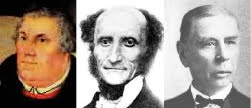
This continues from Part AG1b (Table of Contents in Part AG1a) in a series presenting Walther's essays to the Western District that supported his theme "That Only Through the Doctrine of the Lutheran Church is All Glory Given to God Alone". — Continuing the 1873 Western District essay: In Walther's Thesis III, part 2, the title indicated above could have been expanded to include the words Election of Grace or Predestination. Little did I realize how closely these are tied together. Walther explains at the beginning that he included this topic because the Iowa Synod was accusing Missouri of being Calvinistic. Several modern LCMS theologians have criticized Walther and even Luther on the subject matter covered in this Thesis. Names such as Robert Kolb, Cameron MacKenzie, Roy Suelflow, and even John Wohlrabe and John Brenner (Wisconsin Synod) have slipped in criticisms. These will be covered in more detail in Parts AG7c and AG7d. — From pages 53-63:
Notable Quotes:
53: "For we, following Luther, have proved…that man's free will is not at all active in this [salvation]"
53: "the cause alone is God's eternal mercy and the merit of Jesus Christ. We reject every third cause of salvation that is supposed to lie in man." [Against Synergism.]
54: Those not chosen by God "have not been saved because they have willfully rejected this grace [of God]"
54: "the Iowans say that Luther's book on free will is a completely false book, that it contains pure Calvinism…they say that Luther later revoked this writing"
54: Luther "did not revoke this writing 'That Free Will is Nothing' until his death, but declared it to be his best writing…" [See this blog post]

55: "the cause of sin is the will of the wicked, that is, of the devil and ungodly men"
55-56: "'Why,' said Eve, as it were, 'did you make the serpent?' and Adam wanted to say: 'Why did you give me Eve?' This is part of our nature: we prefer to blame God"
56: "God spoke differently about the vessels of mercy and the vessels of condemnation" [See this blog post]
56: Setting the record straight regarding Luther's On the Bondage of the Will: "it is a gross falsehood when the Iowa Synod says that Luther's writing on free will contains Calvinistic elements" [Some of the above mentioned recent theologians are among those charging Luther on this.]
57: "If they call us Calvinists, they are lying." ["Crypto-Calvinism" was the charge.]
58: "God does not do evil in man; people already do evil without him."
58: " But when God wants to punish in his wrath, he does nothing.…Calvin understood "hardening" to mean a real act of God in the hearts of people, i.e. making them hardened. No, says Luther…"
60: 2 Sam. 24:1 and 1 Chron. 21:1, Calvinist's confusion: "that God was so angry with David because of his unfaithfulness that he decided to allow the devil to give David the power to number the people, which would then result in a great judgment." [I. e. God is not the cause of sin.]
60-61: "Man can be compared to a falling stone.…If God does not work in him, he falls from sin to sin."
61: Calvinists "want to say that God is ultimately to blame; he is such a sovereign being"
61: "It is therefore terrible that the Iowans equate us with the Calvinists."
Regarding this last quote, LC-MS theologians Robert Kolb, Cameron MacKenzie and Roy Suelflow want to charge even Luther with Calvinism in his writing On the Bondage of the Will. Not Walther! Anyone wanting a defense against these LC-MS theologians who want to charge Luther with even a hint of Calvinism will find their heart's desire in this segment. More will detailed on this in Parts AG7c and AG7d. — In the next Part AG1d…

.jpg "Rev. Dr. John Bombaro, St. James Lutheran, Lafayette, IN (2025)")


.png)
.jpg)