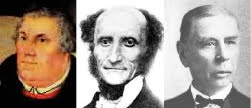
This continues from Part AG7b (Table of Contents in Part AG1a) in a series presenting Walther's essays to the Western District that supported his theme "That Only Through the Doctrine of the Lutheran Church is All Glory Given to God Alone". — Luther's writing on the Bondage of the Will, or in Latin de servo arbitrio is one of his most controversial writings among modern theologians. The Methodist theologian Philip S. Watson, translator of this work for the American Edition of Luther's Works, volume 33, wrote the following in his Introduction, that Luther
"set about refuting him [Erasmus] in a way that was hardly irenic, taking his arguments apart point by point in a book nearly four times the length of the Diatribe. It is in many ways a pity that he adopted this procedure, since with the possible exception of Part VI his argumentation is so shaped by his opponent’s point of view that his own position hardly emerges with the clarity or the balance that would have been desirable."
So our Methodist was understandably not pleased with the way that Luther presented his points. Also, as a Methodist theologian, he takes no note of Luther's irenic explanation of his earlier writing in his well known Genesis Commentary, as the Formula of Concord does, SD 2, 44 On Free Will:
"Even so Dr. Luther wrote of this matter also in his book De Servo Arbitrio, i. e., Of the Captive Will of Man, in opposition to Erasmus, and elucidated and supported this position well and thoroughly, and afterward he repeated and explained it in his glorious exposition of the book of Genesis, especially of Gen. 26. [See StL 2, 174-177; AE 5, 42 ff.]
So how will the Old Missouri Synod treat Luther's controversial writing? Will they also say that Luther's "own position hardly emerges with the clarity or the balance that would have been desirable"? Here is how the 1868 Northern District, pp. 26-27 (emphasis mine), treated this writing and it's corresponding comments in his lectures on Genesis:
"The question whether Luther later taught the doctrine of free will differently than in earlier years, was emphatically denied and noted that it seems so, especially if one compares his book against Erasmus with his interpretation of Genesis. But it only seems that way. Especially in his "de servo arbitrio" (That Free Will Is Nothing [or Bondage of the Will]) Luther speaks with the utmost caution; everything in it is well considered; he himself calls it his best writing. The difference that makes it appear as if Luther later taught differently is that Luther speaks dialectically in the first writing, in such a way and with such words, as it should have been done precisely towards this opponent."
The Good:
- In first place here belongs the 1868 Northern District judgment. As stated above, it follows what is explicitly stated in the Formula of Concord. I am reminded of Walther's writing on Luther's Polemical writings (see here).
Another testimony in the "Good" category would be
.jpg)
- Siegbert Becker (see here): "We will not be able to understand Luther’s thought correctly unless we bear in mind his definition of the knowledge of God and the sharp distinction which he makes between a philosophical, or meta-physical, knowledge of God and the true and proper knowledge of God. Because of his flair for unusual, startling expressions, which is really part of his creativity as a master of language, Luther, more than most writers, must always be read in wide context. By making a judicious selection of isolated statements, it is easy to turn Luther into a follower either of Barth or of Butler. Only a wide acquaintance with Luther’s writings can guard us against both extremes."
I especially liked Becker's characterization of Luther's polemics as a "flair for unusual, startling expressions", hardly a pejorative way of putting it.
.jpg)
- John Brenner here p. 19: "“Because of his sometimes bombastic style, his love of paradoxes, and his gift for making striking statements, Luther must be read carefully.”" [This would have gone into the "Good" category except Brenner's pejorative term "bombastic style". Did he use this term to placate his Jesuit school advisors?]
- John Wohlrabe here. Wohlrabe uses the term "clarified" for the way he says that Luther addressed his earlier De Servo Arbitrio in his Genesis commentary. (Wohlrabe is in a gray area as tempers his negative comment)
- Burnell Eckhardt, here, fn # 82: Contrasts Luther with Calvin, but does not address the all important Genesis commentary as a supposed "correction". Is he avoiding Kolb's error? (see "The Bad" below.)
%20crop.jpg)
- Gottfried Fritschel (Iowa Synod) here, "Iowans"; he started the negative criticisms of Luther/Walther on this! (Walther reports in 1873 Western District, p. 54 "Luther’s book on free will, the Iowans claim, is totally false, containing pure Calvinism, for in it the dear Lord is logically made the agent of damnation"
.jpg)
- Roy Suelflow p. 72 here. and here, and here. ("the committee of Synod (Northern District. 1868, p. 26 f.) which made the report could not state flatly that the De Servo and Genesis were in perfect agreement [!], since it becomes evident to anyone who reads them that this is not the case. [This is against the Formula of Concord!] Therefore the committee modified its report, and stated that they were essentially the same, the only difference being that in De Servo Luther had spoken dialectically, whereas in Genesis he had spoken popularly and instructively.5 Indeed a bit of ingenious sophistry! To admit a difference, but to try to explain it this way!" (Suelflow ridicules old Missouri, and surely Walther, in their proper explanation of the seeming difference.) (p. 69, Suelflow cuts Luther: "No matter how much we admire Luther, there is some truth in this statement: ”We do list him (Wycliff) as a teacher of absolute predestination. And so was Luther. There is no doubt about it,”2 [S. quotes a ULC theologian approvingly!] It is not surprising that Luther and his colleagues held more or less to the teaching of Augustine, since they were trying to combat the current Semi-Pelagianism prevalent at that time")
.jpg)
- Robert Kolb – see here: Dr. Kolb says: "…the reformer’s own 'correction' of his position [in De Servo Arbitrio] in his comments on Genesis 26 some fifteen years later." (Bound Choice, p. 9), Luther "offered codicils to what he had bequeathed to his followers in De servo arbitrio." (p. 26) Luther ''cautioned against possible misinterpretations of De servo arbitrio" (p. 271)
.jpg)
Prof. MacKenzie's "second error" of Walther is so offensive, it deserves it's own separate blog post to document all of the points and the references of the professor's convoluted logic and exaggerations... in the next Part AG7d.

No comments:
Post a Comment
Comments only accepted when directly related to the post.